The World of the Volatility Trader
Most people trade stocks, betting on “up or down”; volatility traders bet on “will it move, and by how much” — direction is just noise in their world. Hundreds of billions of dollars trade on options and volatility derivatives every day: VIX futures, SPX options, variance swaps, dispersion trading — the deepest stretch of financial engineering anywhere. This guide systematizes the volatility world’s core concepts, pricing, the Greeks, the VIX product family, short-vol / long-vol strategies, and the classic traps — language first, strategy after. By the end you should understand “VIX jumps to 30, skew steepened, term inverted” insider talk, and know where each strategy’s money comes from and where the risk hides. Read it alongside the field guide to quant schools for added effect.
Framework — a ten-minute orientation
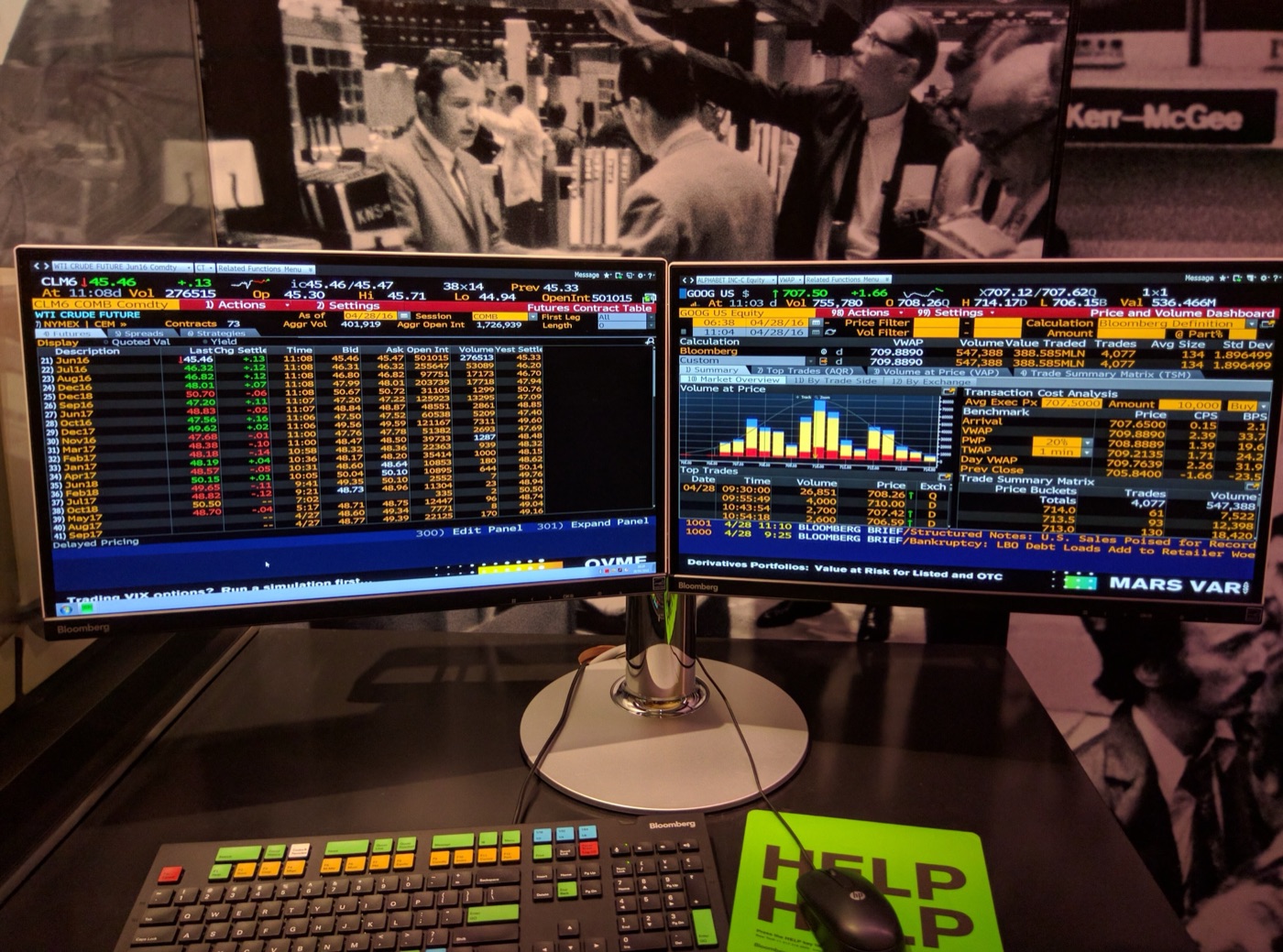
Image: Wikimedia Commons / CC BY-SA 4.0.
“Volatility” (σ) is the magnitude of price variation, typically measured as the annualized standard deviation of N-day log returns. A stock that rallies from $100 to $110, falls back to $95, and lands at $105 has higher volatility than another that climbs smoothly from $100 to $105 — even though both end at the same return.
The core insight of volatility trading is: volatility itself can be independently priced, hedged, and traded — completely independent of price direction. You can be “long vol” betting markets get more turbulent, “short vol” betting they calm down, or “hedge out direction” to make money purely on vol. This is the deepest pool in the derivatives market.
- Market size. US-listed options trade ~45M contracts per day (2024), with notional in the trillions; OTC variance swaps and dispersion add hundreds of billions of open notional. SPX options + VIX derivatives are the two deepest vol markets in the world. CBOE dominates US options; ICE / Eurex dominate Europe; OCC is the unified clearer.
- Who trades. Three main camps: ① market makers (Citadel / Optiver / SIG / Jane Street) — quote two-sided and earn the spread; ② short-vol funds (hedge funds, pensions, retail put-sellers) — long-run carry on the volatility risk premium; ③ long-vol / tail-risk funds (Universa / 36 South) — pay carry to buy insurance and rake it in during crises. Over time more people sell than buy vol → volatility carries a “risk premium.”
- Where the money comes from. Three sources of alpha: risk premium (VRP) — implied vol systematically exceeds realized vol, and sellers collect the “premium”; mispricing — a single point on the surface deviates from fair; forecasting — predicting the direction of IV / skew. Average VRP +3 to +5 vol points · the structural reason short vol pays.
- Direction vs. vol. Buy an SPX call and you’ve bet on direction (Delta), volatility (Vega), and paid time decay (Theta). Pure volatility trading hedges out Delta (delta-hedged), leaving Gamma / Vega / Theta P&L — the key leap from “retail buying calls” to “volatility trading.” See “The Five Greeks.”
- The three core pairs. RV vs. IV (realized vs. implied), skew vs. ATM (OTM vs. at-the-money), near-month vs. far-month (term structure). Volatility traders look at whether these three relationships are at, above, or below their means each day, and whether arbitrage opportunities exist. Read the next six chapters and you’ll naturally see the vol trader’s “three-view chart.”
- Non-linearity is the essence. The biggest difference from stocks is non-linear P&L — selling an ATM put earns 1% for 99% of months and loses 50% for 1%. Linear “risk/reward ratio” analysis is nearly useless; you need Greeks + scenario simulation. “Picking up nickels in front of a steamroller” — the lived experience of selling vol.
Bottom Line · Volatility trading is a market of “selling insurance vs. buying insurance.”
Think of the volatility market as a global financial insurance market: sellers are the insurance companies, collecting premiums in steady state with occasional large payouts; buyers are the policyholders, paying steady premiums to be made whole in disaster. Choosing the right side of this dichotomy matters ten times more than picking the specific strategy.
RV vs. IV — Realized vs. Implied
There are two kinds of volatility — the most important pair in the field, and worth pinning down first: Realized Vol (RV) is what already happened, computable from historical prices; Implied Vol (IV) is what the market expects ahead, backed out of option prices. The first looks in the rear-view mirror, the second through the windshield.
Realized Volatility (RV)
Simplest method: take the past N days of log returns ln(Pₜ / Pₜ₋₁), compute the sample standard deviation, multiply by √252 to annualize. For example:
- SPX long-term RV ≈ 15-18%
- Single names (AAPL / NVDA) ≈ 25-40%
- BTC ≈ 50-80%
- 2008 crisis pushed SPX to 80%+ briefly
The professional version uses estimators like Garman-Klass or Yang-Zhang that incorporate OHLC for more precision. Or use 5-minute high-frequency data to compute realized variance directly.
Implied Volatility (IV)
Given the market price of an option + Black-Scholes + the other parameters (spot, strike, rate, time), invert for σ. IV is not a forecast; it’s a market consensus — the price all traders collectively are willing to pay for this insurance.
The same stock has many IVs at once: every strike-expiry combination has one, which together form the “volatility surface” (see “The Vol Surface”). By default, “IV” usually refers to ATM 30-day IV (at-the-money, nearest expiry).
The average IV across the SPX option chain, weighted appropriately, is the familiar VIX (see “The VIX Complex”).
A key phenomenon: the volatility risk premium
VRP · Volatility Risk Premium — IV runs ~3-5 vol points above RV over the long run.
Over the past 30 years, SPX average RV ≈ 15.5% and average IV (VIX) ≈ 19.5%. That 4-point gap is the volatility risk premium (VRP) — the “premium” paid to vol sellers over time. VRP exists because long vol is a convex asset and buyers willingly overpay; like homeowners’ insurance, you don’t expect it to be actuarially fair.
But VRP isn’t a free lunch — its counterpart is occasional catastrophic losses. On Feb 5, 2018 — “Volmageddon” — XIV (a short-vol ETN) went to zero overnight, wiping out retail short-vol players. This is short vol’s permanent mirror: collecting nickels, then eventually meeting the steamroller.
RV and IV in practice
| Environment | SPX RV (30d) | VIX (IV) | VRP | Implication |
|---|---|---|---|---|
| Normal | 12-15% | 15-20 | +3-5 | Short vol earns steady carry |
| Quiet sideways | 5-8% | 11-14 | +5-7 | VRP is larger, but absolute return is low |
| Early correction | 15-25% | 25-35 | +5-10 | Short vol risk and reward both high |
| Deep panic | 30-50% | 40-80 | -5 to +20 | VRP can briefly go negative → historical long-vol entry |
| 2008 / 2020-3 extremes | 60-80% | 60-85 | -10 to 0 | RV overshoots IV → long vol loses money |
Options Basics — Call · Put · Black-Scholes
Options are the main battleground of volatility trading. You have to understand options before going further. This chapter covers the minimum.
- Call · call option. Buyer has the right (not obligation) to buy at strike K at expiry. Payoff at expiry = max(S - K, 0). Long call: bullish + long vol + pays time decay; short call: bearish / flat vol + collects time decay.
- Put · put option. Buyer has the right to sell at strike K. Payoff = max(K - S, 0). Long put: bearish + long vol; short put: betting it won’t fall + collects carry, often used as “synthetic long stock.”
- ATM / ITM / OTM. The strike’s position relative to spot. ATM ≈ spot, max Vega; OTM is cheap but needs a big move to pay; ITM is “discounted stock,” Delta near 1.
- Premium. The option’s market price. Composed of intrinsic value + time value. OTM options are all time value and decay to zero.
- Expiry. US-listed options expire Fridays; SPX / SPY have 0DTE (same-day), Weekly, Monthly, LEAPS (2+ years). 0DTE now accounts for nearly 50% of SPX options volume (2024).
- European vs. American. European (SPX, indices) can only be exercised at expiry; American (single names, SPY) can be exercised any time. Volatility pricing is much cleaner for European — which is why the professional vol battleground is SPX rather than SPY.
The Black-Scholes formula
The 1973 formula by Fischer Black, Myron Scholes, and Robert Merton, the foundation of the entire derivatives industry:
C = S·N(d₁) − K·e^(−rT)·N(d₂)
d₁ = [ln(S/K) + (r + σ²/2)·T] / (σ·√T)
d₂ = d₁ − σ·√T
Don’t be intimidated. What you need to remember: given S (spot), K (strike), T (time to expiry), r (rate), the option price has only one unknown left — σ (volatility). All the math of volatility trading starts here: give me a market price, and I’ll back out IV.
B-S’s hidden assumptions — it assumes a world that doesn’t exist.
Black-Scholes assumes: ① returns are normal (no, they have fat tails); ② volatility is constant (no, there’s skew); ③ continuous frictionless trading (no, there are fees); ④ constant interest rates (no, there’s a term structure). Each deviation creates an arbitrage — which is exactly the volatility industry’s 30 years of employment runway.
The Five Greeks — The Greeks
“The Greeks” decompose an option’s P&L into sensitivities to each input. Each Greek is a partial derivative of the B-S formula. This is the volatility trader’s daily “risk dashboard.”
| Greek | Meaning | Math | Intuition | Use |
|---|---|---|---|---|
| Δ Delta | sensitivity to spot | ∂C/∂S | spot up $1, option up by how much | direction risk → delta hedging |
| Γ Gamma | rate of change of Delta | ∂²C/∂S² | the “convexity” of P&L when spot accelerates | long vol = long Gamma |
| ν Vega | sensitivity to IV | ∂C/∂σ | IV up 1pt, option up by how much | the core volatility risk |
| Θ Theta | time decay | −∂C/∂T | per day, option loses by how much | short vol = collect Theta |
| ρ Rho | sensitivity to rates | ∂C/∂r | rates up 1%, option up by how much | matters for long-dated options, ignorable for short |
The Gamma-Theta duality
Long vol (Long Vol) — +Gamma · −Theta · +Vega. You’re buying “movement,” afraid of “stillness.” You pay Theta every day; if the underlying moves big, Gamma earns it back.
- Extreme one-way move → big win
- Sideways chop → bleeding out slowly
- IV spike → wins on Vega even with no spot move
Short vol (Short Vol) — −Gamma · +Theta · −Vega. You’re selling “movement,” earning “stillness.” You collect Theta daily, but a big move in the underlying makes Gamma bite you back.
- Sideways / slow bull → steady carry
- Sudden −5% / +5% day → big loss
- IV spike → Vega loss + margin calls
The Delta-Hedged philosophy — true volatility trading hedges Delta out.
Buy an ATM call (Δ=0.5) and simultaneously short 0.5 shares of the underlying → Delta = 0, no longer a directional bet. The remaining P&L comes only from Gamma (rebalancing as the underlying moves) + Vega (IV changes) + Theta (time passes). This is “pure volatility trading.” Pro market makers and vol funds nearly all do this — your “bullish” or “bearish” view shows up in their book only as Delta, instantly netted by their hedges.
The Volatility Surface — The Vol Surface
For the same stock at the same moment, different strikes + different expiries carry different IVs. Plot them across the two-dimensional (strike × expiry) space and you get the volatility surface — the volatility trader’s most important daily chart.
Skew · the smile / skew across strikes
For a single expiry, plotting IV across strikes usually doesn’t yield a flat line; it takes one of these shapes:
- Smile: both wings high, the middle low. Common in FX and commodities.
- Skew / Smirk: the left side (OTM puts) far higher than the right (OTM calls). Almost universal in US equities — the market fears a crash far more than it anticipates a melt-up.
- Reverse Skew: right side higher than left. Common in bottoming tech stocks / crypto / small-cap names — upside explosion is more likely than downside.
The SPX 25-Delta skew (the difference between OTM put IV and OTM call IV) has long-run been ~5-8 vol points and can spike past 15 in crises. This is the direct expression of the “insurance premium”: puts are inherently more expensive than calls.
Term Structure · the curve across expiries
For a single strike (typically ATM), plotting IV across expiries:
- Contango (normal): far-month IV > near-month IV. Usually reflects term premium — more long-run uncertainty. ~70% of the time.
- Backwardation (inverted): near-month IV > far-month IV. Market is panicking about something near term → near-month IV spikes. A crisis signal.
- Hump: an IV bump at a specific expiry (earnings, FOMC) → “event volatility.”
Skew / Term in practice
- Risk Reversal. Buy 25-Delta call + sell 25-Delta put. The steeper the skew, the cheaper the combination (sometimes zero-cost). Hedge funds often use it as a “cheap upside.”
- Calendar Spread. Buy a far-month, sell a near-month at the same strike. When the term is inverted → structurally short the near-month and collect Theta. Common setup around FOMC / earnings.
- Skew Trade. Trade skew itself — long OTM puts + short OTM calls, betting panic intensifies. Or vice versa to sell skew and collect carry.
- Term Trade. When the VIX futures curve is in contango → short VXX to harvest roll yield; when inverted → close out. This is the entire logic of SVXY / XIV.
The VIX Complex — The VIX Complex
The VIX (formally the CBOE Volatility Index) is an index CBOE introduced in 1993 — the 30-day weighted implied volatility of S&P 500 options. Note it isn’t “volatility itself” but “the market’s consensus expectation of SPX volatility over the next 30 days.” The media calls it the “Fear Gauge” — a higher number means the market is more anxious about the next 30 days.
How VIX is computed
Not the IV of any single option, but the weighted average across the entire SPX option chain of OTM calls + OTM puts (a formula similar to variance swap replication). This means VIX incorporates skew — when OTM puts go up, VIX goes up. So “VIX spiking” typically signals left-tail panic, not right-tail euphoria.
Historical VIX levels
| VIX | Environment | Historical examples |
|---|---|---|
| 10-15 | Extreme quiet (rare) | 2017 bull market · H1 2024 |
| 15-20 | Normal | Most of the time |
| 20-25 | Stress / event waiting | Around FOMC · earnings season |
| 25-35 | Correction / early panic | 2018-02 · 2022-06 |
| 35-50 | Systemic panic | 2008-09 pre-Lehman · 2011 US downgrade |
| 50+ | Extreme crisis | 2008-10 · 2020-03 COVID (85) |
The VIX product family
VIX itself is not directly tradable — it’s a mathematical index. What you can trade are its derivatives:
- VIX Futures. Introduced by CFE in 2004. One contract per month (M1, M2, …, M9); M1-M3 are most active. All VIX-related ETFs are built from these.
- VIX Options. Introduced in 2006. Harder to trade than SPX options — the underlying is an index that doesn’t exist, with VIX futures as the actual underlying. The “vol of vol” is measured by VVIX.
- VXX / VIXY. ETN/ETF long the front-month + 2nd month VIX futures. They must fall over the long run — because the VIX futures curve is in contango ~70% of the time, and each roll loses to roll yield. Down 99.99% over a decade.
- UVXY. A 1.5× leveraged version of VXX. Loses even faster. Only fit for short-term tail hedge; hold longer than a week and you lose.
- SVXY · XIV (defunct). Short VIX futures → harvest contango roll yield over time. XIV went to zero on Feb 5, 2018 (VIX +115% in one day), the volatility industry’s most famous disaster. SVXY has since been capped at −0.5×.
- VVIX. “IV of VIX” — the implied vol of VIX options. A high VVIX/VIX ratio → the market has already priced in large moves. Often used to gauge “panic already priced in.”
The most common retail VIX trap — “VIX is at 12, I’ll buy VXX and wait for a spike” — guaranteed to lose.
Because VXX doesn’t track spot VIX, it tracks near-month VIX futures + continuous rolling. Even if VIX is flat, VXX bleeds roll yield every day by selling near-month and buying far-month (in contango, near-month is cheap and far-month is expensive). VXX is down 99.99% cumulatively over the past 10 years (reverse-split N times) — any “buy and hold for the crisis” strategy on VXX is a dead end. To short vol, use SVXY; to buy insurance, buy SPX puts or VIX calls directly.
Short-Vol Strategies — Short Vol Strategies
Short volatility is the hedge fund industry’s largest hidden beta — AQR estimates 30-40% of global hedge fund alpha is structurally short vol in some form. The reason is simple: VRP is positive over time, so selling vol = collecting steady premiums, profitable in most months.
Basic short-vol strategies
- Covered Call. Long 100 shares + short 1 OTM call. Trade upside for carry. The retail-friendliest short vol. ~2-3% annualized excess (JEPI / QYLD are ETF versions). Maximum drawdown is just like the stock minus the carry.
- Cash-Secured Put. Cash on account + short OTM put. Equivalent to “buying stock at a discount” + collecting premium. If it breaks K → assigned (you wanted to buy anyway); if not → keep the premium. A Buffett favorite.
- Iron Condor. Simultaneously short OTM call + short OTM put, with further OTM hedges on each side (capping loss). Wins in chops, loses (with limits) on big moves. A classic range-bound strategy.
- Iron Butterfly. Short ATM straddle + buy a wider strangle hedge. More aggressive than the Iron Condor, betting on near-stillness. Narrow win range, higher carry.
- Short Straddle/Strangle. Sell ATM call + put (straddle) or OTM call + put (strangle) naked. Unhedged means unlimited risk. Pro-only, margin-intensive. The core of the Tastytrade school.
- Calendar / Diagonal. Short near-month + long far-month. Exploits the faster Theta decay of the near month. Cheaper when term structure is inverted.
Systematized short-vol products
| Product | Mechanism | Long-run annualized | Largest risk |
|---|---|---|---|
| JEPI / JEPQ | SPX / Nasdaq covered call ETFs (JPM) | 7-9% | Underperforms in big bulls by 1-2% / drops with SPX in crisis |
| QYLG / XYLD | Global X covered call series | 8-10% | Same as above, slightly higher carry |
| SVXY | −0.5× VIX futures | 15-25% | Same family as XIV which went to zero in Feb 2018 |
| PUTW / WTPI | Systematic SPX put selling | 6-8% | Loses with left-tail moves |
| OTC variance swap sellers | Institutional only | 10-15% | Single trade can lose 8-10× premium in 2008/2020 |
The truth about short vol — every dollar of carry is prepayment for some future disaster.
Long-Term Capital Management (LTCM, 1998), AIG (2008), XIV (2018), Optionsellers.com (2018-11), Allianz Structured Alpha (2020-3)…the funds that have died selling vol share a profile: 10 years of beautiful Sharpe → to zero or −80% in a week. Selling vol isn’t “low-risk, high-return”; it’s “high-frequency small wins + low-frequency huge losses,” averaging out only slightly better than equities. Whether you should sell vol depends not on annualized return but on whether you can survive the worst-case scenario.
Long Vol / Tail Risk — Long Vol / Tail Risk
Long vol is short vol’s mirror: most of the time you bleed (paying carry), but in a crisis you make a fortune overnight. The most famous practitioner is Mark Spitznagel’s Universa Investments (with Nassim Taleb as advisor) — reportedly +4144% in March 2020 alone.
Core idea
Keep a permanent position in deep OTM puts (strike 20-30% below spot). Most of the time these puts are nearly worthless and lose 1-2% per month. But in a 30% market crash, these puts can rally 100-500× — a single hit covers years of carry.
The philosophy: pay 1-3% of capital as “insurance premium” in exchange for 30-50% of tail hedge. A 95% SPX + 5% long-vol blend can have a long-run return above pure SPX, because avoiding the crisis drawdowns lets the survivor compound faster. This is the core argument of Spitznagel’s Safe Haven.
Firms and products
- Universa Investments (Mark Spitznagel) — the most famous US tail-risk fund, ~$16B AUM.
- 36 South Capital Advisors — long vol / global macro tail.
- Capstone Investment Advisors — systematic volatility fund, $10B+.
- Pine River / Saba — credit + tail combinations.
- CBOE-listed funds: VXZ (mid-term VIX), TAIL (Cambria tail ETF).
Retail can buy in too: TAIL ETF (Cambria, 0.59%), or roll SPX 5%-OTM puts directly. But the carry bleed during a sustained bull market is painful.
Long Vol vs. Tail Risk · subtle difference
- Long Vol. Buying “more movement in the next 30 days than now” — doesn’t require a crash. Common instruments: VIX calls, SPX ATM straddles, long variance swaps. Moderate monthly bleed, 5-20× crisis upside.
- Tail Risk. Buying “rare events (>3σ)” — specifically betting on the left tail. Deep OTM puts, smaller monthly bleed but requires a big event to pay. 50-500× crisis upside.
The real pain of long vol — 2009-2019 was purgatory for long-vol traders.
The QE era suppressed volatility persistently; VIX lived at 12-15. Tail-risk funds compounded essentially zero over those ten years, with some down 30%. The carry bleed of long vol is real; without a crisis you slowly bleed out. Universa survived because it serves as an “insurance rider” on its clients’ main book — clients’ main allocation is equities, with a small slice (2-5%) in Universa. Retail holding long vol alone without a main book gets crushed.
Advanced Trades — Pro vol trades
These are the “daily menu” of institutional vol desks — retail rarely touches them, but knowing they exist and how they work helps you make sense of market behavior.
- Variance Swap. OTC contract directly trading “realized variance (RV²) over a period” vs. a fixed strike. Buyer receives RV² − strike²; seller takes the other side. Replicable with OTM puts + calls (the VIX formula). The cleanest tool for institutional long/short vol.
- Vol Swap. Similar to variance swap but trading “realized vol (RV)” rather than variance. More intuitive structurally but harder to price (no perfect replication strategy). Smaller market, mostly OTC.
- Dispersion Trade. Short index vol + long single-name vol. Exploits the structural premium of “index IV pressed below the average of component IVs.” Equivalent to shorting the average pairwise correlation ρ across components. Core strategy of firms like Optiver and SIG.
- Correlation Swap. Directly trades the future average realized correlation of a basket of assets. A “cleaner” version of dispersion. Institutional only.
- Gamma Scalping. Long an option → delta-hedge → as spot moves, the hedge buys low / sells high to harvest Gamma. Pays Theta, harvests Gamma. Essentially “selling IV to the market in real time and buying RV back” — profitable when RV > IV.
- Vol Arb. When two options on the same underlying (different strike / expiry / venue) have IVs deviating from fair → long the cheap, short the expensive. Citadel / SIG / Jane Street market makers execute this millions of times a day.
Dispersion intuition
Why index IV gets pressed — because correlation < 1.
SPX is a weighted average of 500 components. Even if each component has 30% IV, as long as they don’t move in lockstep (correlation ρ < 1), the index IV will be meaningfully below 30% — mathematically σ(index)² ≈ ρ × Σ wᵢ²σᵢ². That’s why SPX IV is often 15-20% while component average IV is 25-35% — the gap is what dispersion traders sell out. Selling SPX vol + buying component vol is equivalent to shorting correlation ρ.
In March 2020 COVID, all stocks moved in lockstep (ρ → 1), SPX vol spiked while single-name vol rose by less → dispersion trades took huge losses. This is the strategy’s deepest left tail.
Common Pitfalls — vol trading pitfalls
- Treating short vol as “low risk, high return.” Sharpe 2.5 + 90% monthly win rate → really a fat-left-tailed catastrophic distribution. Sharpe doesn’t show tail risk; look at Sortino + max drawdown + skewness.
- Long-term holding of VXX. VXX is down 99%+ long-run. It’s not a VIX proxy; it’s VIX futures + continuous roll bleed. See “The VIX Complex.”
- Forgetting pin risk. When the underlying lands very near K at expiry, exercise/non-exercise becomes effectively random. Hedges can be reversed after the close. Pro market makers are very wary.
- Ignoring Vega exposure. “I built an iron condor for sideways” — but if IV spikes, Vega loses even with no spot move. Short-vol traders must understand whether they’re “short Gamma vs. short Vega” — the left tails differ.
- Naked selling on retail platforms. Naked strangles on single names on Robinhood / IBKR use more margin than you’d think; extreme days bring margin call → forced close → permanent loss. Pros use portfolio margin; retail doesn’t.
- Ignoring skew. “OTM puts are cheaper than OTM calls” — wrong. On SPX, 25Δ put IV is 5-8 vol points above 25Δ call IV. Buying OTM calls as “cheap upside” is a gift from skew.
- “Low IV always means sell.” Selling vol at VIX 12 → history says this environment can jump to 30 any moment. Low IV is the expected low RV, usually fair priced, not a free lunch.
- Buying ATM straddles before earnings. Pre-earnings IV is high; post-earnings IV crush (drops 30-50%). Even with a big move in spot, the Vega loss often eats the Gamma profit. To trade earnings, either trade IV crush itself or avoid the structure.
- Ignoring dividends / borrow. Long ITM American calls face early-exercise risk (US options + pre-dividend). A short call assigned early → loss is realized earlier than planned.
- No tail hedge. All short-vol books need 1-3% capital allocated to OTM puts as “fire insurance.” LTCM / XIV failed because they didn’t carry one.
The most dangerous retail belief — “Worst case, I lose my whole stake.”
A vol account doesn’t necessarily stop at zero — naked option selling has unlimited potential loss. In some extremes, the broker force-closes first and pursues a negative balance after. Robinhood user Alex Kearns saw −$730K in his account (actually a display bug) in June 2020 and took his own life. Never sell naked; always buy insurance.
How to start — how to start trading vol
- $10K-$50K retail. Start with covered calls (on already-owned stock) + cash-secured puts (on stock you want to buy). Learn to read IV, the Greeks, and the option chain. Avoid naked selling, avoid 0DTE, avoid VXX. Recommended reading: Sheldon Natenberg, Option Volatility & Pricing, chapters 1-5.
- $50K-$500K intermediate. Try iron condors / calendar spreads and other risk-defined structures. Open portfolio margin at IBKR (requires $110K+). Consider 1-2% in TAIL ETF as a tail hedge. Systematically track IV / RV / skew / term across four dimensions.
- $1M+ professional. Can run SPX / SPY market-making-style strategies and access prop trading firm channels (Tastytrade Pro, Trading Block). Study variance swap replication and the basics of dispersion. Consider Bloomberg Terminal ($24K/year) for OVDV / SKEW screens.
- I want to make a career in vol. Three paths: ① market makers (Optiver / SIG / Jane Street / IMC) — undergrad entry, logic-puzzle interviews; ② sell-side derivatives desks (GS / MS / JPM) — quant finance master’s; ③ buy-side vol funds (Capstone / Universa) — PhD + several years of market making is the more stable path.
- I manage $10M+ capital. Don’t trade it yourself. Allocate 5-10% to a pro vol manager like Capstone / Universa while the main book rolls 5% OTM SPX puts continuously for tail hedge. This is Spitznagel’s repeated “small tail + big main book” framework.
- Must-read books / resources.
- Sheldon Natenberg, Option Volatility & Pricing
- Euan Sinclair, Volatility Trading
- Mark Spitznagel, Safe Haven, The Dao of Capital
- CBOE official VIX white paper
- Tastytrade (free educational videos, though biased toward short vol)
One-line summary · The volatility market is the most “engineering-beautiful” patch of finance.
It turns “risk” into a priceable, hedgeable, tradable product. Understand RV / IV / skew / Greeks and you understand why Buffett says “selling puts is the best entry strategy,” why Taleb says “buying OTM puts is the poor man’s insurance,” why Citadel and SIG are the most profitable private companies in the world. Volatility trading doesn’t require predicting direction — it only requires correctly understanding the probability distribution. That’s its most seductive — and most dangerous — quality.
References — options · volatility · tail hedging
Foundational papers and indices
- Black & Scholes, “The Pricing of Options and Corporate Liabilities” (J. Pol. Econ., 1973) — the founding paper of option pricing. jstor.org
- CBOE Volatility Index (VIX) — official page for the 30-day S&P 500 implied volatility index. cboe.com/vix
Exchanges and institutions
- CBOE — the core US exchange for options / volatility derivatives. cboe.com
- AQR Insights — research on factors / volatility / tail risk. aqr.com
- Universa Investments — Mark Spitznagel’s tail-hedge fund. universa.net
- Optiver — leading global options market maker. optiver.com