Where Ideas Were Born — A European Pilgrimage Map of Works, Thoughts, and Cities
Not going to Europe to find philosophy, but using philosophy to rediscover Europe
Before I left, I laid a stack of classics on my desk: The Republic, Meditations, The Prince, Essais, Discourse on the Method, Ethics, Reveries of the Solitary Walker, Critique of Pure Reason, Phenomenology of Spirit, Capital, Thus Spoke Zarathustra, Being and Time — thirty centimeters thick. Then I unfolded a map of Europe and pinned each book to the actual room, river, mountain where it was born. By the time I was done, the map was creased.
From the olive groves on the northern outskirts of Athens in the 4th century BC to three small huts on a Black Forest summit in 1976, for 2,400 years, again and again, people chose to leave the seat of power and retreat to a small-scale physical space — an olive grove, an army tent, a round tower, a stove-room, a lens-grinding workbench, an island, a path of linden trees, a postbox, a domed reading room, a boulder by a lake, a hilltop wood-burning stove. These spaces have nothing to do with one another, yet they are strung together by the same posture: moving “I” into a corner that won’t be interrupted, so that a single sentence can slowly grow into a book.
This piece arranges these spaces chronologically, with each chapter centered on a representative work or a moment of thought, twelve in total. Each chapter first tells how that book was written in that room — weather, neighbors, post, season, who came, who left — then folds away into an appendix at the end describing “what you can still see today.” Twelve rooms, twelve books, 2,400 years of European thought as a geographic history.
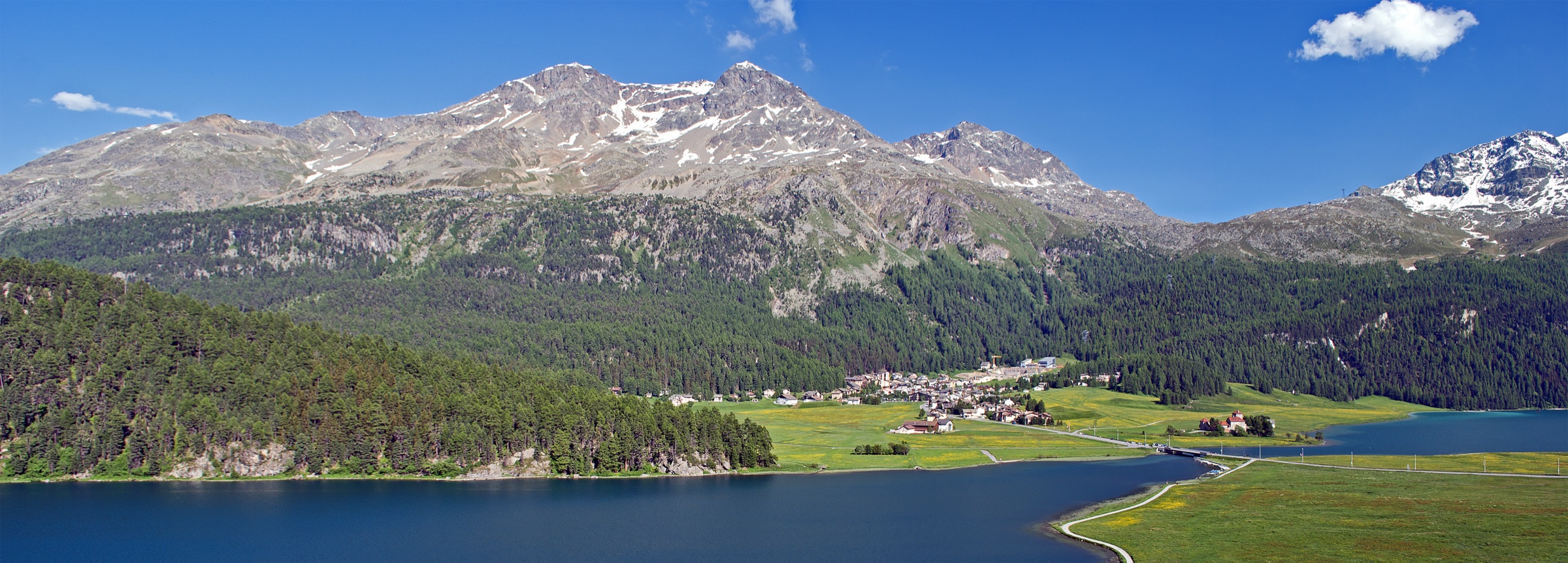
Image: Wikimedia Commons / CC BY-SA 4.0.
Not a travel guide. A geographic history of ideas.
Part I · Classical — The Academy and the Tent
4th century BC to 2nd century AD. Two figures, six hundred years apart: one putting “what is justice” through endless cross-examination in an olive grove north of Athens; one writing to himself in a tent on the Danube, “say to yourself first thing in the morning.” The earliest refuge for thought is shade, is canvas — the kind of slow, near presence the polis cannot provide and the court will not permit.
Plato · The Academy — 387 BC, Athens
Today, you take the No. 5 bus from Omonia Square heading north of the city and get off in an utterly ordinary residential neighborhood — clotheslines, auto repair shops, small shops selling olive oil — but beneath your feet lies the earliest bedrock of Western thought. The park at the Akademia of Plato is nearly empty, a few stray cats, three or five white-haired Greek elders playing chess in the shade. No guide, no ticket booth. This olive grove was once a university. It ran for nine hundred years.
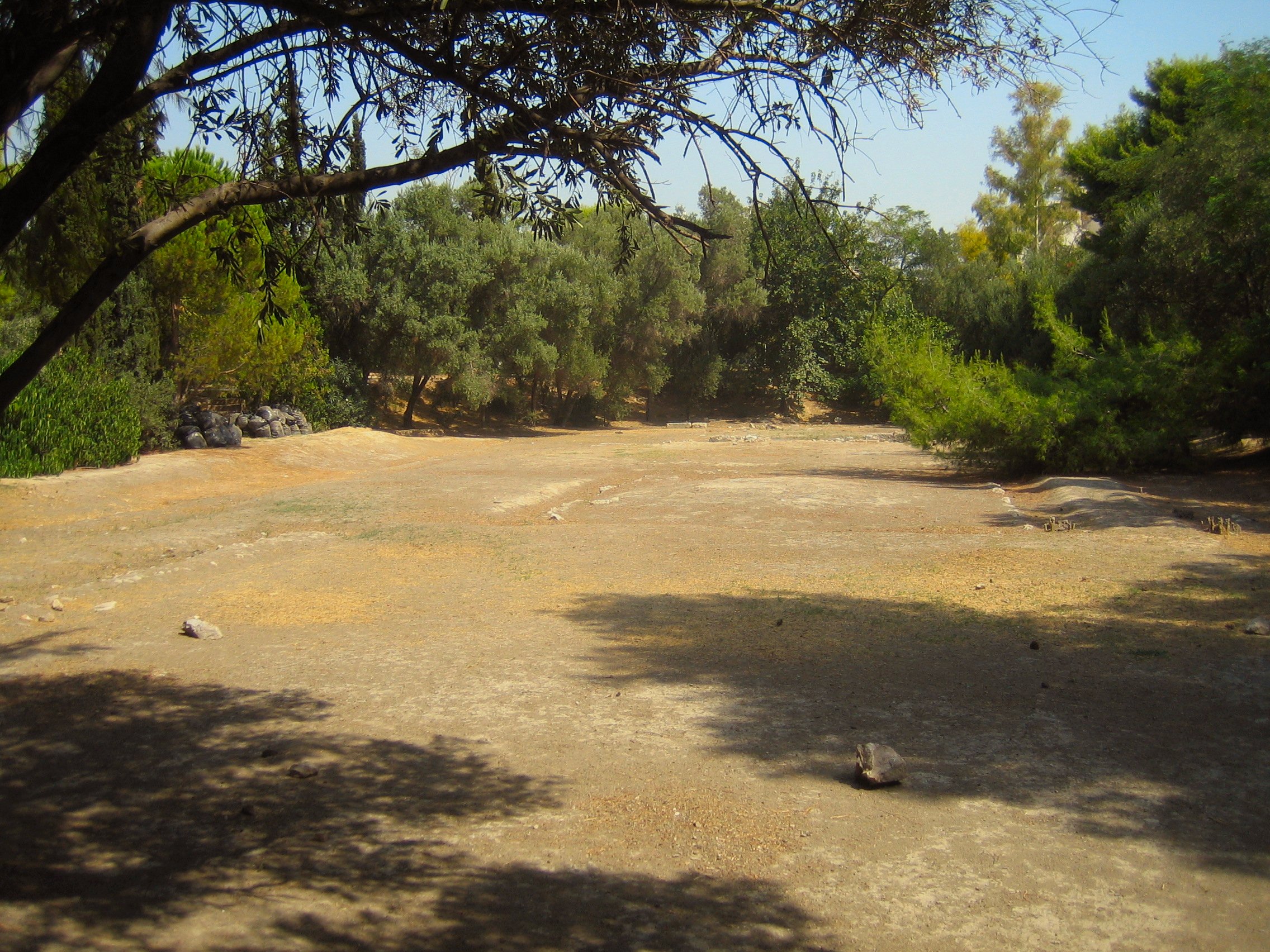
Image: Wikimedia Commons / CC BY-SA 4.0.
Athens in 399 BC — a wound left by one death
To understand the Academy, you have to understand that it begins with a death.
In the spring of 399 BC, Athens had clawed itself out of the catastrophic defeat of the Peloponnesian War only eight years before — walls torn down by Sparta, fleet burned, democracy collapsed and then restored. A defeated city needs a scapegoat. Three citizens — Meletus, Anytus, and Lycon — brought Socrates before the heliaia court on two charges: corrupting the youth, and impiety toward the gods of the polis. Five hundred and one jurors voted. Round one: 280 to 221 for conviction. Round two: 360 votes for the death penalty — fewer dissenting votes than in round one. The Athenians had lost patience with this old man who cross-examined them into corners.
That year Plato was twenty-eight, of aristocratic birth, originally bound for politics — his uncle Critias was one of the Thirty Tyrants, his cousin was Charmides. His family had given him an early skepticism toward democracy, but Socrates’ death turned that skepticism into a lifelong wound. He later wrote in his Seventh Letter: “I saw these men drag the most just man to death… I came at last to understand that no existing polity was rightly governed.” He did not go to see his teacher one last time — in the Phaedo he had the narrator murmur, “Plato, I believe, was ill that day.”
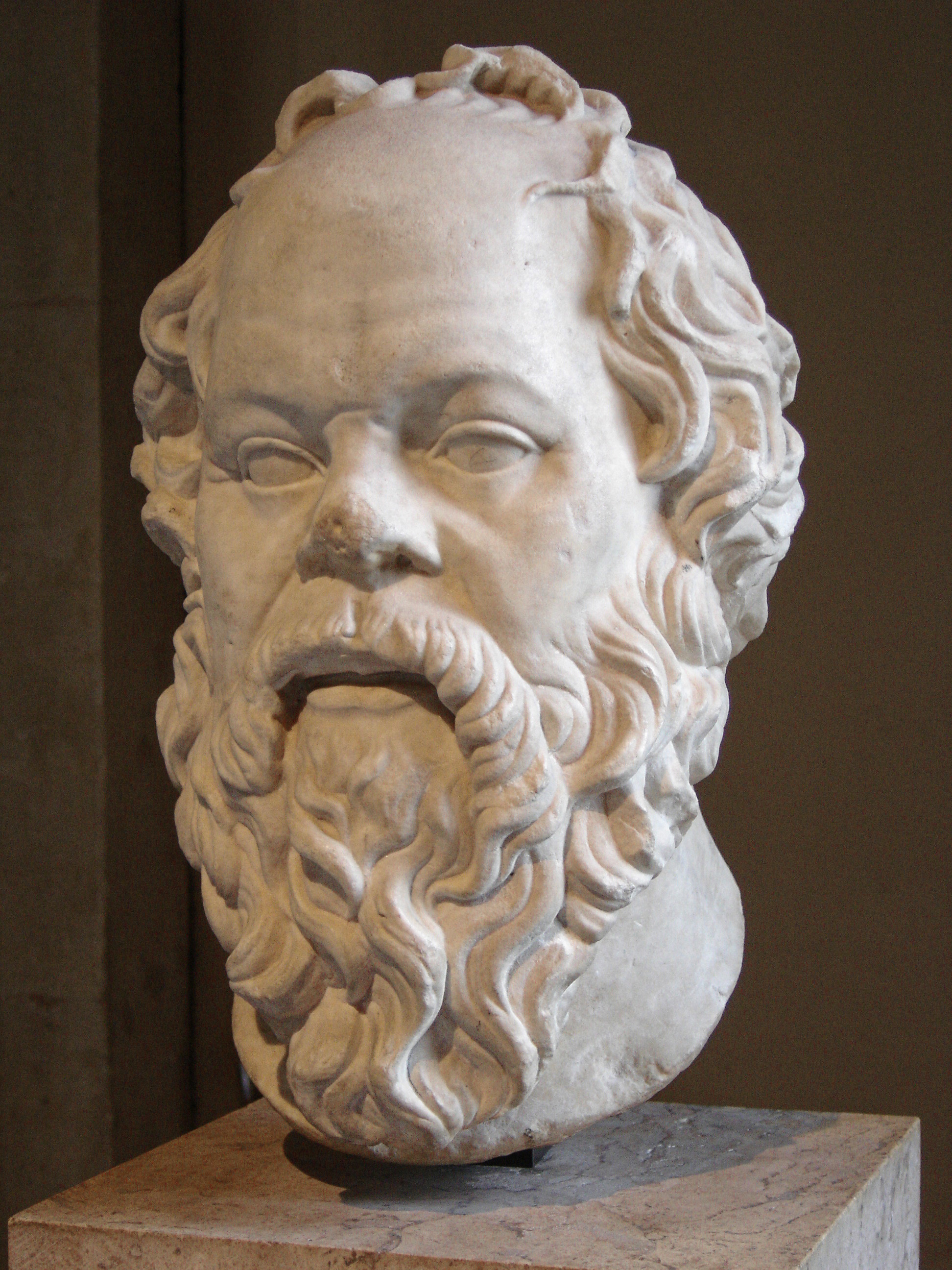
Image: Wikimedia Commons / Public Domain.
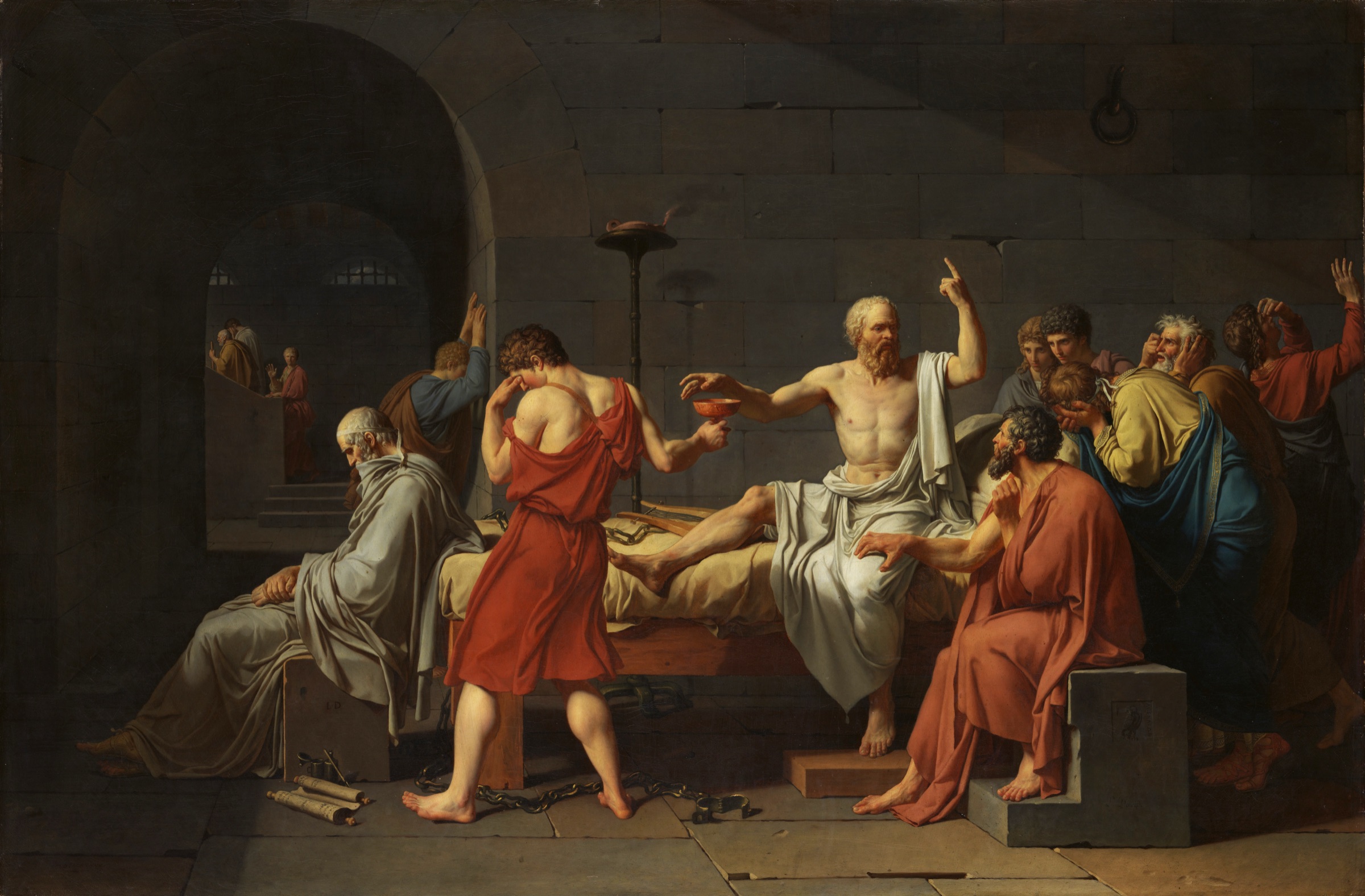
Image: Wikimedia Commons / Public Domain.
In the twelve years that followed, Plato left Athens — Megara, Cyrene, Egypt, and southern Italy and Sicily, where he had long conversations with the Pythagoreans about mathematics. He wrote the Apology, the Crito, the Phaedo — turning his master’s last days into three acts of drama. Writing was his eulogy. By the time he returned to Athens at forty, he had decided he would no longer defend a dead man through dialogues alone — he would found a school, so that Socratic cross-examination could live on inside an institution.
That olive grove — 387 BC
The Academy was not in the city. Plato chose Kolonos Hippios in the northern suburbs — a sacred grove dedicated to the hero Akademos, about a 1.5-kilometer walk from the Dipylon Gate. There were springs, olive trees, an altar to Athena, plus a wall built by Hipparchus in the 6th century BC and a gymnasium — young men already wrestled, ran, and bathed there. Plato bought a small plot next door (reputedly redeemed for him by the wealthy merchant Anniceris — years earlier Plato had been sold into slavery in Sicily by Dionysius, and this Cyrenian raised the ransom). At its center he built a temple of the Muses (Mouseion) as the heart of the teaching grounds.
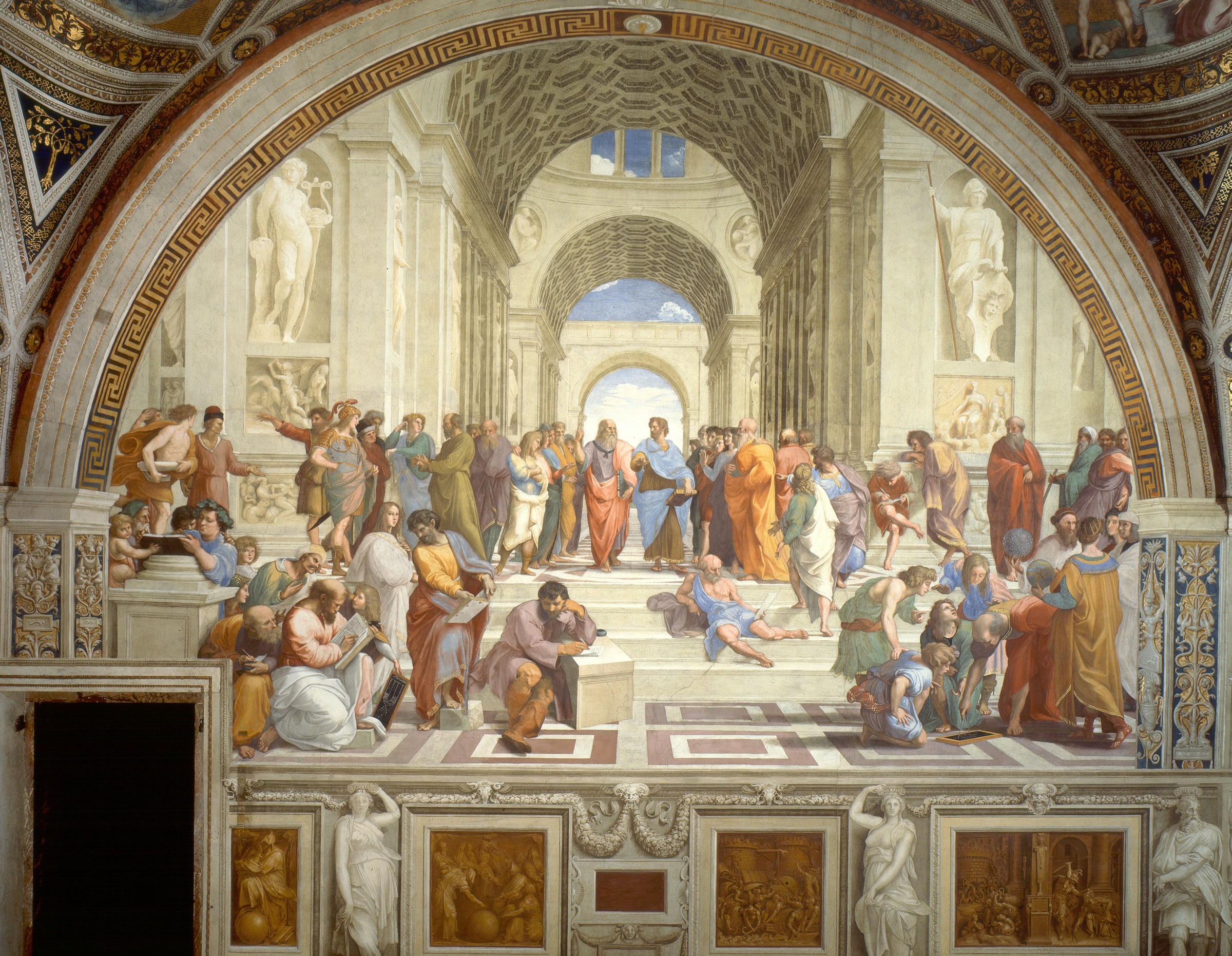
Image: Wikimedia Commons / Public Domain.
The Academy was unlike the sophist schools in the city. The sophists charged by the hour; Plato charged nothing — what he wanted was long-term shared life. Students lived in small houses nearby, ate together, walked together, talked from dawn into the night. Tradition holds that over the door was inscribed Ἀγεωμέτρητος μηδεὶς εἰσίτω — “Let no one ignorant of geometry enter.” This attribution comes from John Philoponus in the 6th century AD; no contemporary source mentions it, and it is most likely a later annotation built on Plato’s mathematical obsession. But the annotation itself reveals something: at the Academy, geometry was not a vocational subject but a preparation for philosophy. Cleanse the eyes of the soul first, then ask what the good is.
What was a day there like? We have no diary, but the stagecraft of the dialogues can reconstruct a little. In the morning the light slants through the olive trees, the master walking ahead, a few students behind, the topic starting from a rumor a citizen had picked up at the agora — “Did you hear what they said at Cephalus’s house yesterday?” — and slowly closing in on the core question: “What, after all, is justice?” (That is the opening register of Republic Book I.) In the afternoon they would return to the Mouseion, geometric figures spread across the table — circles, triangles, cubes — a few young men gesturing with sticks and string while Plato stood beside, nodding or frowning. Aristotle arrived at seventeen, having walked down from Stagira in the north, and stayed in the Academy for a full twenty years — until Plato’s death. He later said he had disagreements with his teacher, but “truth is the dearer friend” (amicus Plato, sed magis amica veritas — a later Latin proverb whose root lies in his ethics).
The Academy was also not merely a “philosophy department.” Diogenes Laertius records that Plato invited the mathematician Theaetetus, the astronomer Eudoxus, and the geometer Archytas (founder of solid geometry) to teach. Eudoxus developed the concentric-spheres astronomical model there — the source of the Ptolemaic system; Theaetetus proved there are only five regular polyhedra — a proof later collected into Book XIII of Euclid’s Elements. The Academy’s core method was “dialectical question-and-answer” — not debate, but two people working together to wash a concept through repeated rinsings, until it either stands or falls of its own accord.
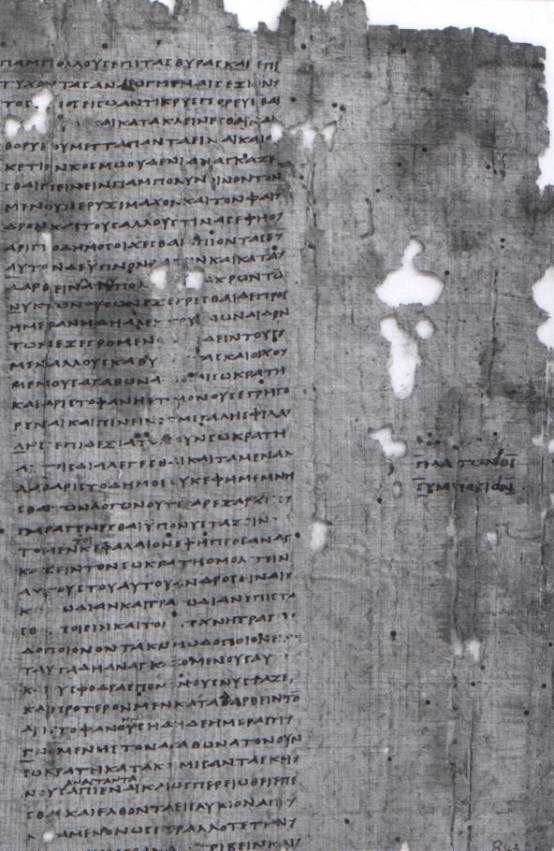
Image: Wikimedia Commons / Public Domain.
Why under the trees
Why did this kind of thing have to happen in an olive grove, far from the agora?
The agora was Athens’s market and square, full of fishmongers, hawkers, and political orators from dawn till dusk. Socrates lived there; Plato set half his master’s dialogues there (Euthyphro at the courthouse door, Crito in prison, the return route from Piraeus in the Republic) — but Plato himself chose an olive grove two kilometers from the agora. This was a deliberate retreat. He had seen, with his own eyes, how a crowd in six months could lift the same man up and then kill him. What he wanted was not public discussion, but an environment that could afford to be slow — an environment where a group of people could sit together for twenty years and study the same question.
The Academy ran for 916 years — from 387 BC to AD 529, when Justinian I ordered all pagan schools closed. There were ups and downs: after Plato’s death, his nephew Speusippus succeeded him, then Xenocrates, Polemo… it passed through the skeptical “Middle Academy” and the Neoplatonist revival. No modern university has lived that long.
Appendix · For those who can get there — route
- Getting there: Athens International Airport (ATH) Metro Line 3 into the city, ~40 minutes. The Akademia of Plato park is in the Akadimia Platonos district; from Omonia Square take bus 051 northwest ~15 minutes, or walk ~25 minutes. No direct metro.
- What’s there to see:
- Akademia of Plato Archaeological Park (Akadimia Platonos, Athens) — open-air site, free entry, no fence, accessible year-round. Foundations of the gymnasium, the Hekademos shrine, and early Hellenistic dwellings were excavated in 1929–1939, 1955–1957, and the 1980s. The Plato Academy Digital Museum in the park (141 Monastiriou St.) is open Tuesday–Sunday 09:00–17:00 (check official website), with digital reconstructions of the site.
- Ancient Agora + Stoa of Attalos Museum — the physical stage of Socratic cross-examination. The Stoa houses the bronze jury-vote tokens (psephoi) from his trial. 08:00–17:00 (extended in summer), combined ticket ~€30 includes the Acropolis.
- The “Prison of Socrates” cave on Filopappou Hill — on the western slope of Filopappou Hill, traditionally identified as where Socrates was held (scholars now think it was more likely a Hellenistic dwelling or storage). Free, always open, no signage.
- Kerameikos Cemetery Museum — the start of the “sacred way” to the Academy. Plato is said to have been buried near the Academy, though the exact site is unknown.
- National Archaeological Museum — Hellenistic-period busts of Plato and Socrates.
- Side trips:
- Delphi — the reason Socrates is Socrates is that the oracle said “no one is wiser than he.” Day-trip bus from Athens, ~3 hours one way.
- Aegina — Plato was born there (some sources say Athens). 40 minutes by ferry from Piraeus.
- Cape Sounion — Temple of Poseidon, a hiking spot for Athenian youth in Plato’s time.
- Best season: April–May or September–October. Athens summers are 35°C+, the site has no shade; the olive grove in spring and autumn feels closest to the “leisurely walk” weather of Plato’s dialogues.
Marcus Aurelius · Meditations — 170s, Danube army camp
A Roman emperor sits in a tent on the north bank of the Danube, the air outside thick with mud, rain, horse breath, and the smell of the dead. He lights an oil lamp and writes a passage to himself in Greek — not Latin. The passage is not meant for anyone else. Eighteen centuries later, these scattered notes became the Meditations. The loneliest book in Western philosophy was written in a trench.
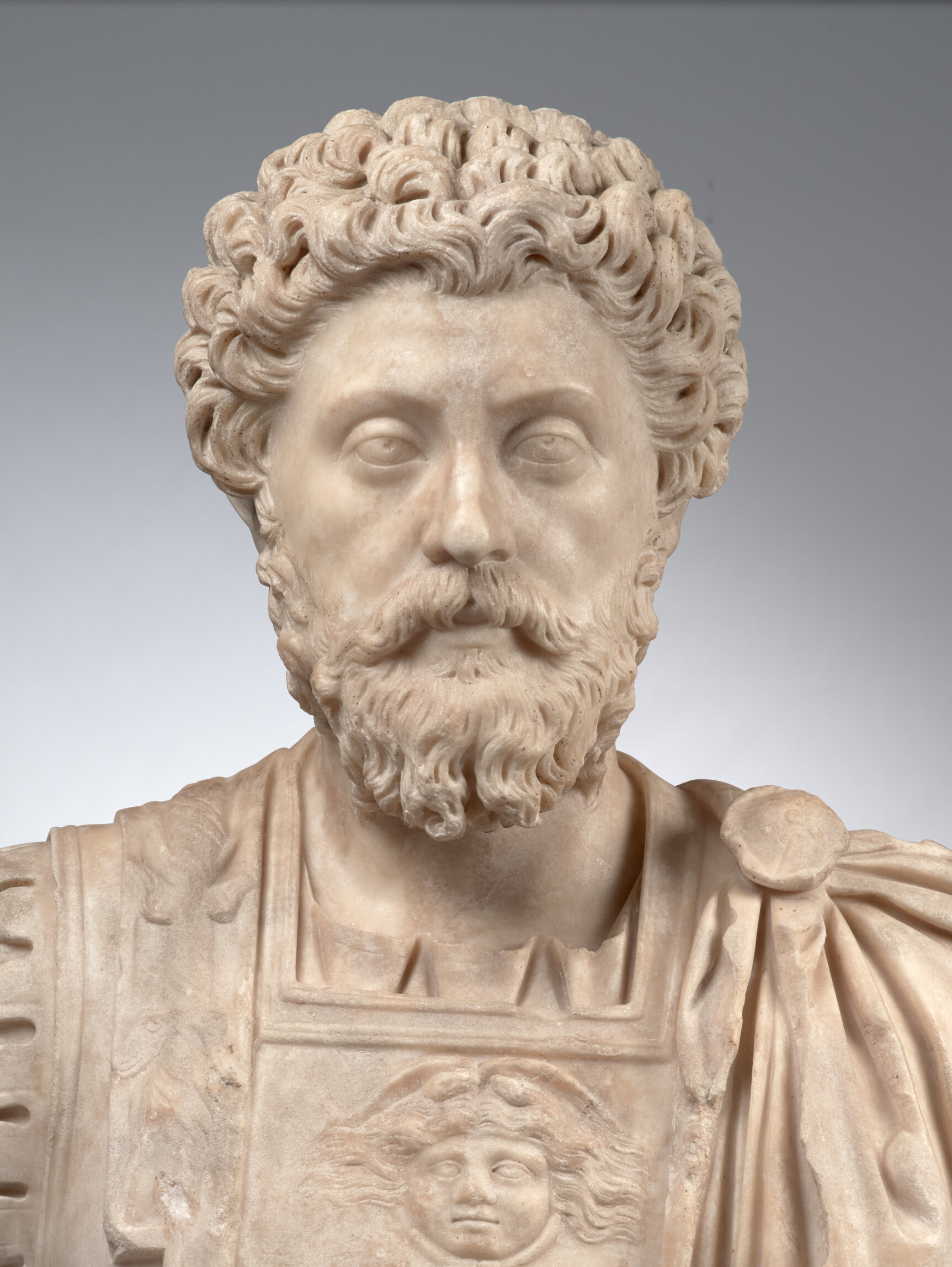
Image: Wikimedia Commons / Public Domain.
The Danube front in AD 170 — the empire’s first rupture
In 166, a coalition of Germanic and Sarmatian tribes called the Marcomanni, Quadi, and Iazyges crossed the Danube and pushed all the way to northern Italy, besieging Aquileia. It was the first time in the nearly two hundred years since Augustus that barbarians had broken into the empire’s heartland. Rome was simultaneously fighting another war — on the eastern front against Parthia — and had just brought back a plague from the East (the “Antonine Plague”) that killed millions. Two-front war, plague, an emptied treasury — that was the situation Aurelius inherited.
In 169, his co-emperor and adoptive brother Lucius Verus died suddenly on the return from the eastern front (most likely of the same plague). From that year on, the entire empire pressed onto Aurelius’s shoulders alone. He never went back to Rome — for ten years, from 170 to 180, he lived mostly in front-line camps: first at Carnuntum (today Petronell-Carnuntum, Austria), then Sirmium (today Sremska Mitrovica, Serbia). He fought wars, signed dispatches, and wrote notes to himself late at night.
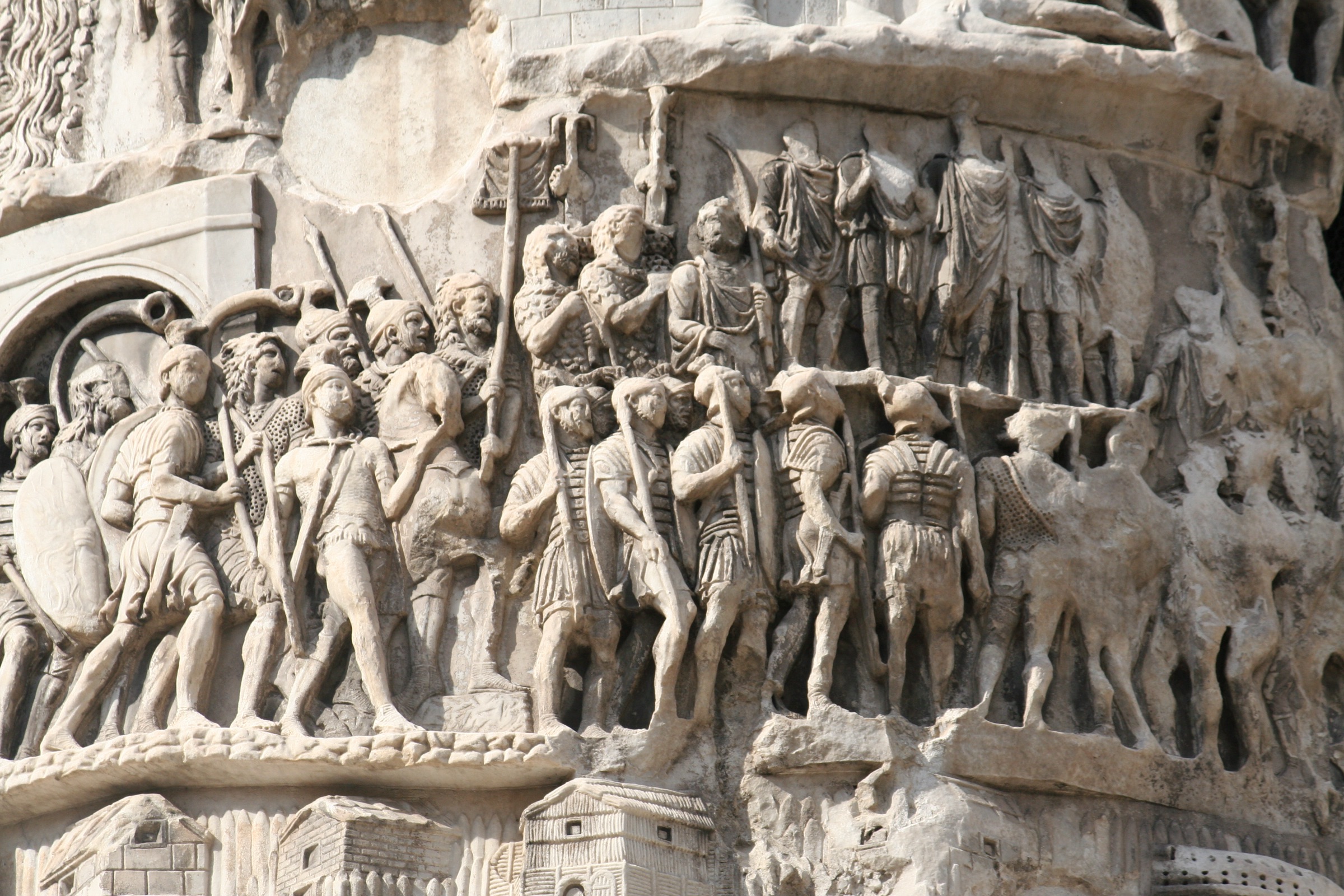
Image: Wikimedia Commons / Public Domain.
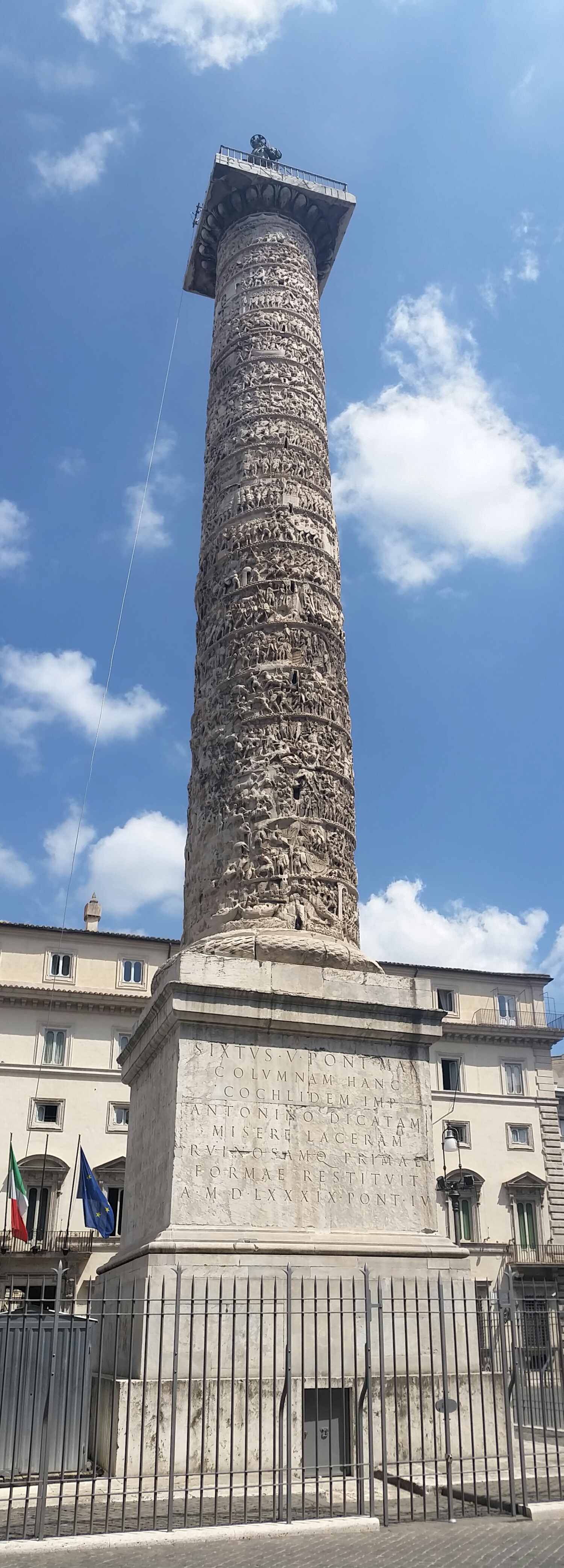
Image: Wikimedia Commons / CC BY-SA 4.0.
That tent — among the Quadi, by the river Granua
The Meditations is in twelve books, with no titles or chapter structure, compiled by later editors. But two manuscript headings survive, and they are almost the hardest evidence we have for the book:
- Book II heading: Τὰ ἐν Κουάδοις πρὸς τῷ Γρανούᾳ (“Written among the Quadi by the Granua”)
- Book III heading: Τὰ ἐν Καρνούντῳ (“Written at Carnuntum”)
The Granua is today’s Hron river in Slovakia, and Carnuntum lies 40 km east of present-day Vienna. Both place names are on the front line of the Danube frontier. This book was written line by line in a tent — between commanding tens of thousands of soldiers, between the sound of hooves and coughing.
The opening of Book II is something nearly everyone who has read the Meditations remembers:
“Begin the morning by saying to yourself: I shall meet today with the meddler, the ungrateful, the arrogant, the deceitful, the envious, the unsocial. They are like this because they cannot tell good from evil. But I — who have seen that the nature of the good is beautiful, and the nature of evil is ugly, and that the nature of the wrongdoer himself is kindred to my own, sharing the same reason, the same divine portion — cannot be harmed by any of them, for no one can impose ugliness on me.” (II.1)
The Greek opening is ἕωθεν προλέγειν ἑαυτῷ — “say to yourself first thing in the morning.” This is an emperor’s psychological pre-warmup at dawn on a battlefield. It is not doctrine, not theology — it is a checklist he writes for his own use. He is writing it down to keep himself from breaking.
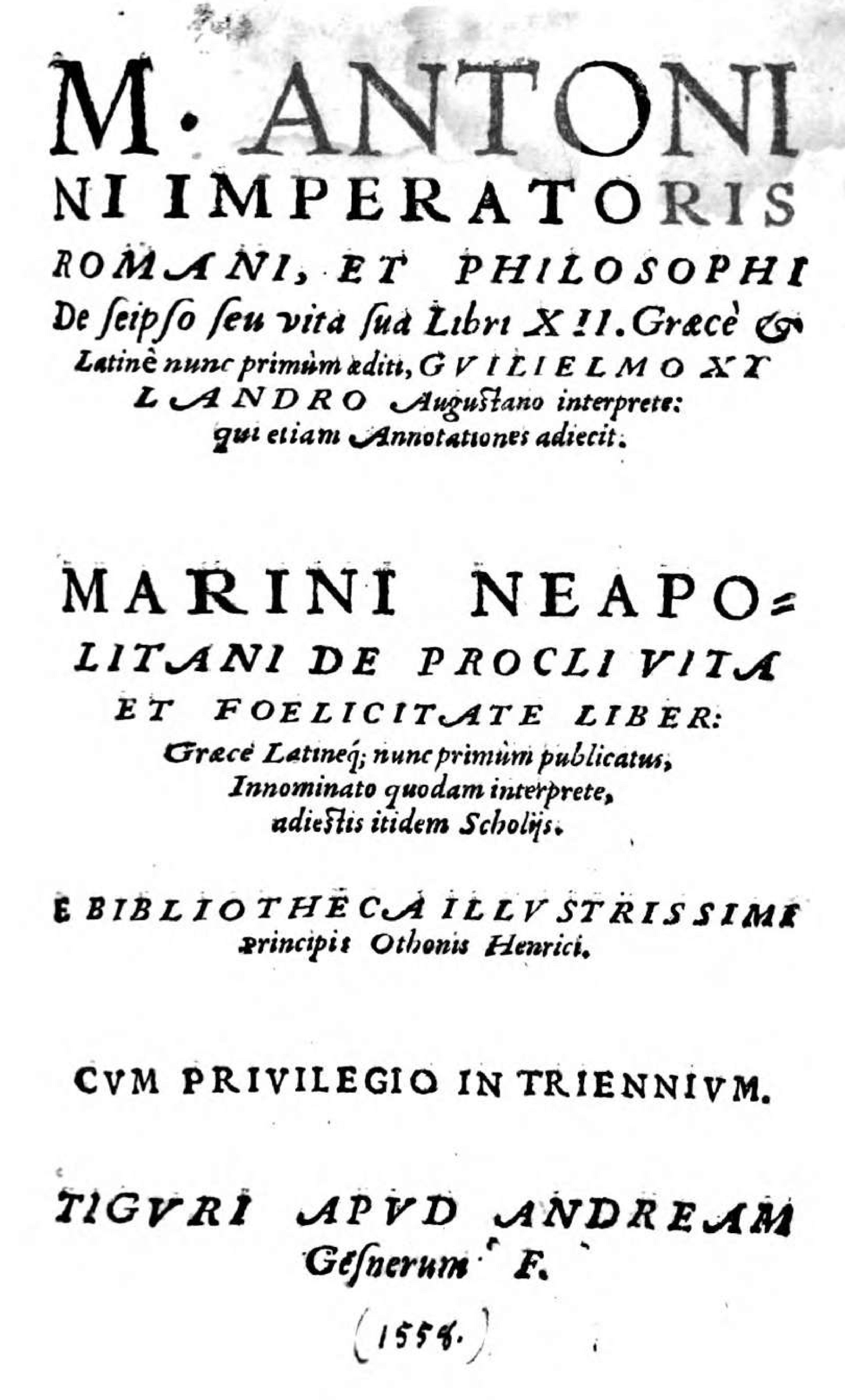
Image: Wikimedia Commons / Public Domain.
Book III, written at Carnuntum, is colder: “Stop wandering. You will not read your notebooks again, nor the sayings and deeds of the ancients of Greece and Rome, nor the extracts you saved for old age. Hurry on, then — if you still care for yourself.” (III.14) He knew his time was short. In 175 his eastern subordinate Avidius Cassius rose in revolt on the rumor of Aurelius’s grave illness; in 180 he himself died in Vindobona (modern Vienna) or Sirmium — the ancient historians disagree, but both places are on the Danube. He did not die in Rome — he died on the front.
The action that recurs most often in the entire book is making himself small. He writes: “Asia, Europe — corners of the universe; the whole sea — a drop in the universe.” (VI.36); “Alexander the Great and his muleteer rot alike.” (VI.24). A man who could order executions and move two hundred thousand troops writes each night before sleep, “I too am only an ant” — this is Stoicism’s deepest move: using the scale of the universe to shrink the purple back to ordinary human size — only that way could he keep from going mad on the front line.
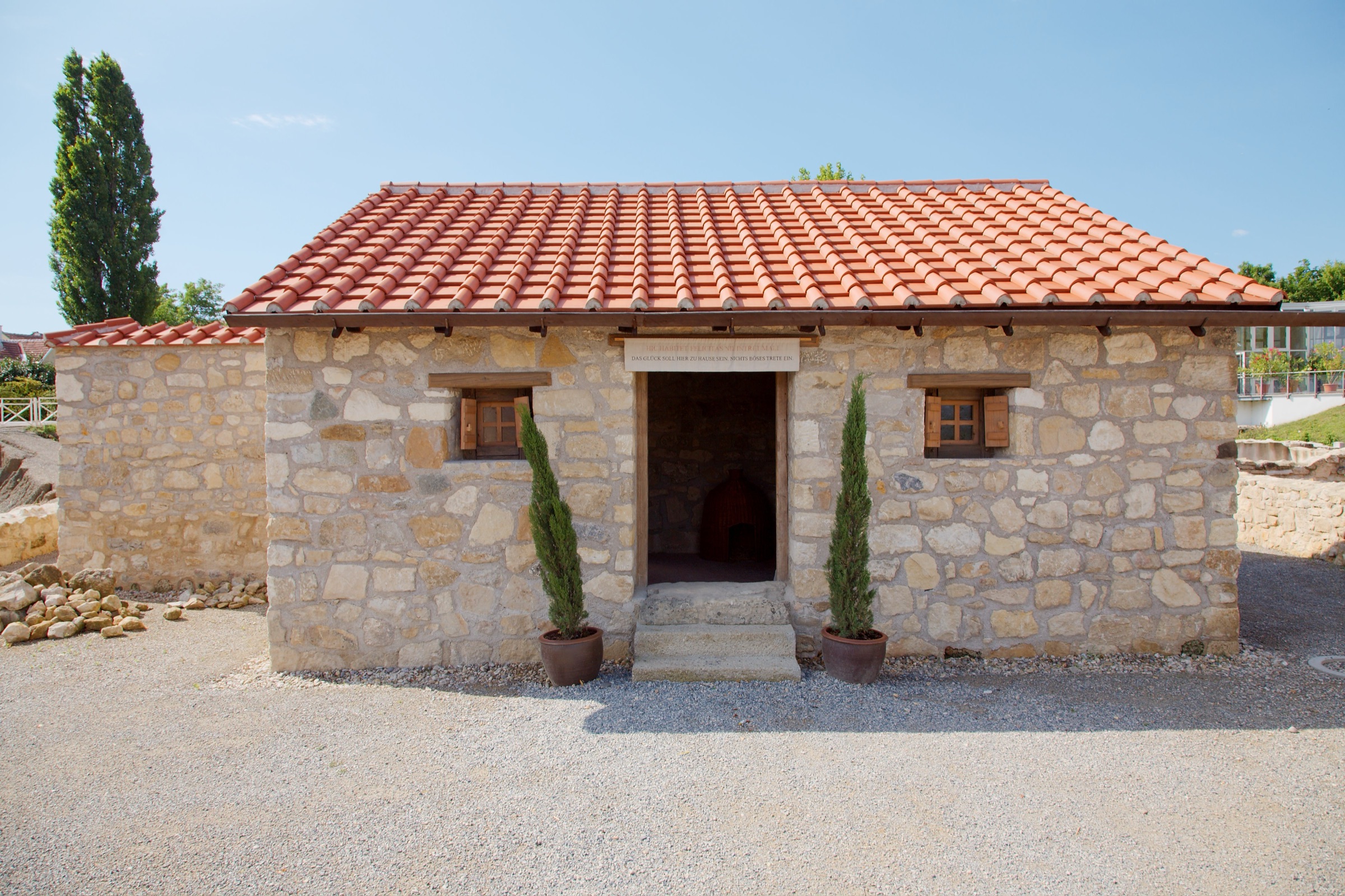
Image: Wikimedia Commons / CC BY-SA 4.0.
Why the frontier — why this place could grow this thought
This book could not have been written in Rome. Rome had the Senate, his wife Faustina, rumor, and a roomful of marble eyes. In Rome he had to perform the emperor. In the tent at Carnuntum no one was watching. The tent held only him, an oil lamp, Greek, and a pen that could be called away to a council of war at any moment. Stoicism had always said one must “live according to nature” — and nature, in this sense, is what kind of person you still are when no one is looking. The Danube gave him that room.
Deeper still: the frontier itself is the Stoic image. Roman law stopped here; north of the river were nameless forests, nameless tribes, winters with deep snow. This is exactly the distinction Epictetus (the slave-philosopher Aurelius reread all his life) made over and over — some things are within you, some are not. Whether the barbarians cross the river, whether the plague returns, whether the Senate turns, whether Avidius Cassius mutinies — none of this is within you. What is within you is only how you speak to yourself this morning. This frontier turned “within me vs. outside me” from an abstract doctrine into a geographic fact he could see the moment he opened his eyes.
Appendix · For those who can get there — route
- Getting there: Vienna Schwechat International Airport is the nearest major airport. From central Vienna, take the S7 suburban train east about 50 minutes to Petronell-Carnuntum station, then 10 minutes on foot to the Römerstadt Carnuntum archaeological park (reconstructed Roman district). Two stops further to Bad Deutsch-Altenburg for the Carnuntum Museum (Museum Carnuntinum) and the large amphitheater.
- What’s there to see:
- Römerstadt Carnuntum (Petronell-Carnuntum) — Roman city dwellings, markets, and baths partly reconstructed in situ from 2011; one of Europe’s rare “walk-into” reconstructions. Open roughly March–November.
- Heidentor (“Heathen’s Gate”) — an isolated 4th-century Roman triumphal arch on the Carnuntum plain, 20 minutes’ walk away.
- Amphitheater Petronell (legionary) + Amphitheater Bad Deutsch-Altenburg (civilian) — both arenas’ foundations are still visible.
- Museum Carnuntinum (Bad Deutsch-Altenburg) — holds extensive 1st–4th century Roman legionary artifacts.
- Vienna Vindobona Museum (Hoher Markt 3) + Michaelerplatz underground Roman ruins — beneath Vienna’s old town are the legionary barracks where Aurelius may have died.
- Rome · Column of Aurelius (Piazza Colonna, free, external view) + Capitoline Museums equestrian statue of Aurelius (original inside, replica on the square) + Castel Sant’Angelo (originally Hadrian’s mausoleum; Antonine family members are buried there).
- Sremska Mitrovica, Serbia (ancient Sirmium) — a late-imperial Tetrarchic capital and possible death-place of Aurelius; today the city center has the Imperial Palace (Carska Palata) ruins park.
- Side trips: Vienna’s Kunsthistorisches Museum classical wing, Devín Castle on the Danube (just outside Bratislava, the entry to Quadi territory), Aquileia (the city the barbarians reached in 166; still preserves complete early-Christian mosaics).
- Best season: May–June or September–October. The Carnuntum park is partly closed November–March; Danube summers bring mosquitoes, winters fog. The “wrapped in a cloak by an oil lamp in a tent” feeling of Book II is most easily recreated in autumn.
Part II · Renaissance — Farmhouse and Tower
1513–1592. A former diplomat driven out by a new regime, and a retired judge who locked himself in a round tower. Neither had university shelter, neither attached themselves to a court; each found a small family estate, dressed up every evening, and began conversing with the ancients. For the first time, writing became the work of exiles.
Machiavelli · The Prince — 1513, Sant’Andrea farmhouse
In the winter of 1513 he was forty-four. The year before he had been signing diplomatic dispatches on the second floor of the Palazzo Vecchio — now he had been driven out of Florence, sitting in a rented small estate fifteen kilometers south of the city, with a strange schedule of his own making: by day, gambling and drinking with hunters, butchers, and millers; in the evening, dressing in formal clothes and going into his study to talk with “the ancients” for four hours. The Prince was written out of that folded life.
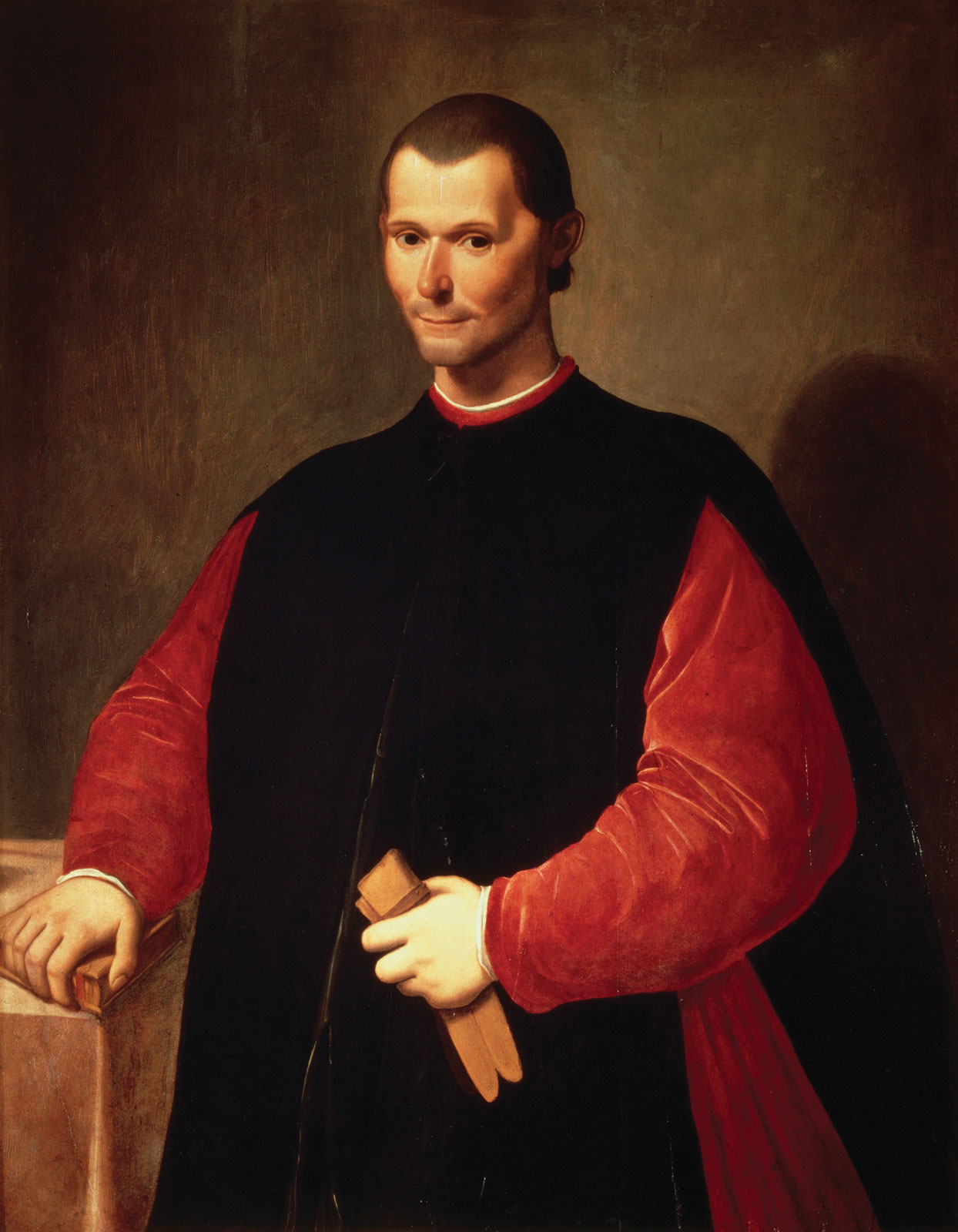
Image: Wikimedia Commons / Public Domain.
Southern outskirts of Florence, 1513
In August 1512, Spanish troops sacked Prato; three days later, after eighteen years of exile, the Medici returned to Florence. The Republic dissolved overnight. Machiavelli had spent fourteen years as “Second Chancellor” — handling military affairs, foreign correspondence, serving as envoy to France and to the papacy, having watched Cesare Borgia conquer Romagna at close range in 1502 — and in the eyes of the new regime, all of this became original sin. In November he was dismissed, fined, and confined to the Florentine countryside for a year.
It got worse in February 1513. A list of names in an anti-Medici conspiracy contained a scrawl of his name — the so-called Boscoli-Capponi affair, in which he was almost certainly not involved. He was imprisoned and given the strappado — hands tied behind the back, hoisted up and dropped suddenly, dislocating the shoulders — six times, without confessing. On 11 March, the new Pope Leo X (the Medici Giovanni) was crowned and issued an amnesty; he was released, and returned with his wounds to the family property at Sant’Andrea in Percussina, the Albergaccio. From then on, year after year, he never returned to any government post.
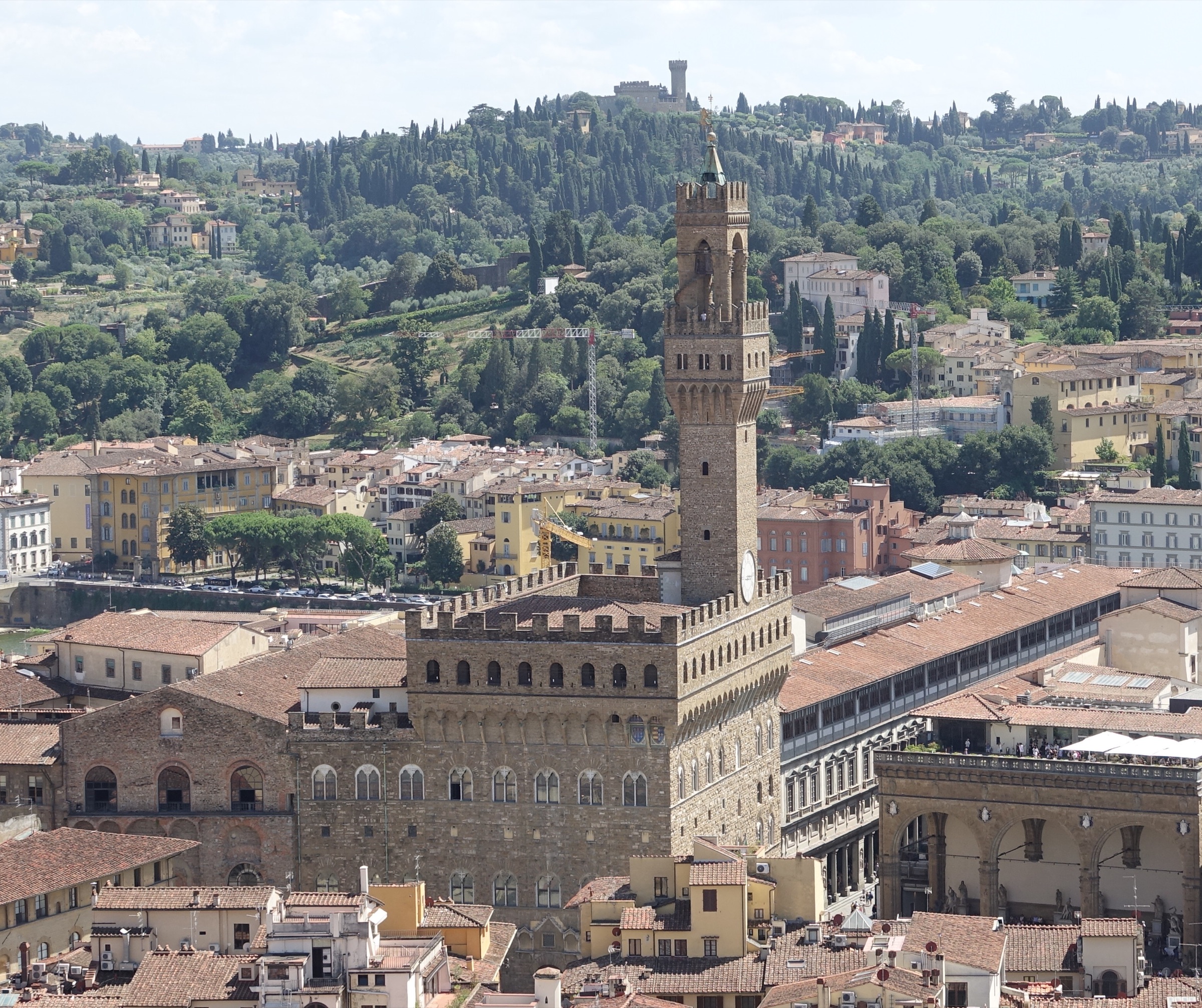
Image: Wikimedia Commons / CC BY-SA.
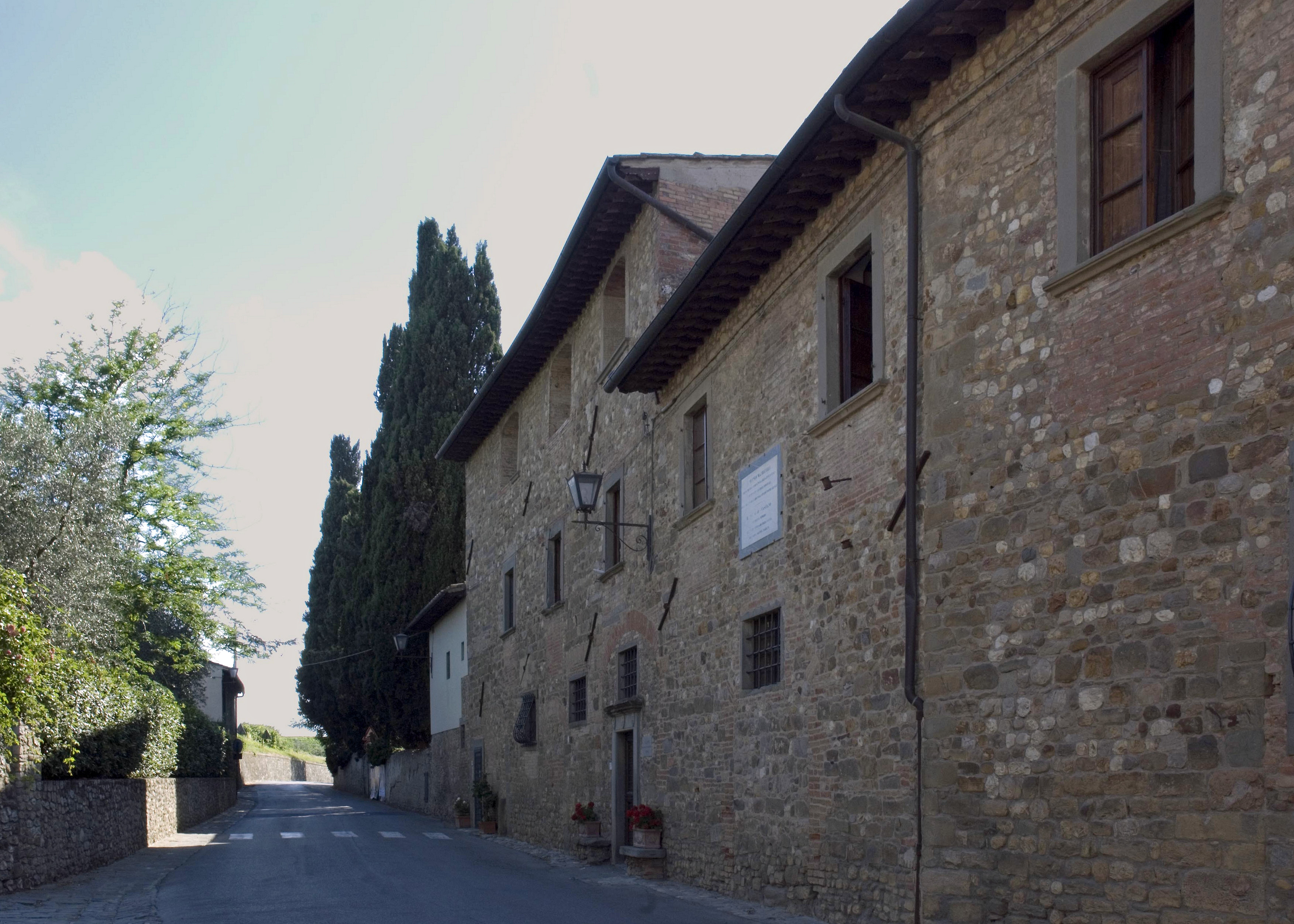
Image: Wikimedia Commons / CC BY-SA.
That small room on the second floor
On 10 December 1513, he wrote a long letter to his friend Francesco Vettori, then ambassador in Rome — the letter became one of the most famous writerly confessions in Western literary history. The first half describes his day: at dawn he goes into the woods to check his bird-snares; comes home to read Dante, Petrarch, Ovid; lunches at a roadside inn, chatting with passersby; in the afternoon goes to the tavern to play cricca and tric-trac with butchers, the miller, and a brick-burner, “arguing over a penny so loudly that the next village hears us — anyone walking by would think we were about to come to blows.”
Then comes the passage that has been quoted for five hundred years —
“Evening comes; I return to my house, I enter my study. At the threshold I take off my muddy, mud-spattered everyday clothes; I put on garments fit for the court of princes; thus properly clothed, I enter the ancient courts of ancient men, who receive me kindly; there I taste the food that alone is mine, that I was born for. I am not ashamed to speak with them, and to ask them why they acted as they did; and they, out of their humanity, answer me. For four hours I feel no weariness, I forget all my troubles, I no longer fear poverty, I am no longer afraid of death — I give myself entirely to them.”
He then tells Vettori he is turning these conversations into a “small treatise” called De Principatibus — “On Principalities.” Most of it was finished within a year. It was originally to be dedicated to Giuliano de’ Medici, but Giuliano died early in 1516, so the dedication shifted to Lorenzo II. He delivered the manuscript in person — the young Lorenzo reportedly was more interested that day in two hunting dogs someone else had brought him. The book did not buy him a position. Machiavelli never returned to the Palazzo Vecchio.
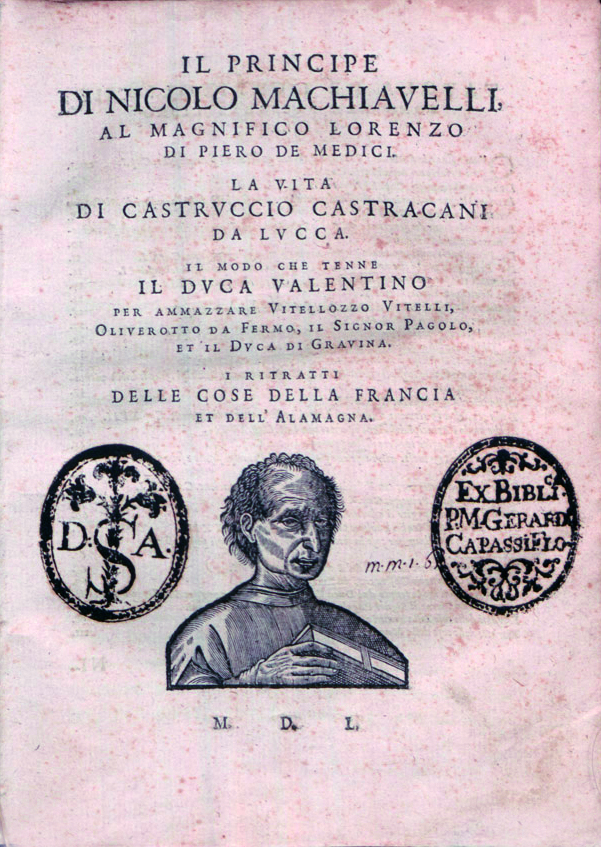
Image: Wikimedia Commons / Public Domain.
The house is still there. From Florence, head southwest along Via Cassia, past Galluzzo and Tavarnuzze; olive groves and not-quite-tidy vineyards on either side; ten more minutes and you arrive at Sant’Andrea in Percussina — a village of only a few dozen houses, silent as the end of the world. The Albergaccio is now an Antinori winery property, with the Albergaccio di Machiavelli restaurant downstairs (same name, red-and-white tablecloths, Tuscan country cooking), and a few small rooms upstairs preserved where he once lived, a replica of the Santi di Tito portrait on the wall. You can book a visit. Out the window you can still see the small wood where he went every morning to check his bird-snares.
Why exile is what wrote it
If he had not been driven out of Florence, The Prince most likely would not exist. In his fourteen years at the Palazzo Vecchio he had already accumulated all the material — he had watched Cesare Borgia ambush four mercenary captains at a single dinner in Sinigaglia, he had lived through Soderini’s hesitations bringing down the Republic, he had written nearly ten thousand official letters — but on the job he neither needed nor was able to write this book. What he needed was that forced extraction from the seat of power: every day, after gambling with butchers, dressing in court clothes to converse with Livy and Tacitus. The door between the daytime mud and the evening “court of ancients” is the origin of The Prince’s cold prose. He was neither still on stage and silenced by deference, nor a pure scholar speaking through parchment — he could see from both sides at once.
The Tuscan farmhouse gave him something else: patience. In 1513 he hoped to trade this “small treatise” for a position. He failed. But he did not put down the pen. Later he wrote the much larger Discorsi on Livy’s first ten books, the play Mandragola, the Florentine Histories. What truly established politics as a discipline that need not first flatter theology or moralism is the quiet of these dozen-plus years at the Albergaccio — a quiet that was, at first, forced on him.
Appendix · For those who can get there — route
- Getting there: Closest airport is Florence Peretola (FLR); Pisa (PSA) + one-hour train to Firenze SMN works too. There is no direct bus from central Florence to Sant’Andrea in Percussina; renting a car along Via Cassia / SR2 south for ~15 km, about 25 minutes, is most reliable; a taxi from SMN station runs ~€30–35 one way. Santa Croce is walkable in the city center, the Palazzo Vecchio is on Piazza della Signoria.
- What’s there to see:
- Albergaccio di Machiavelli (Via Scopeti 64, Sant’Andrea in Percussina) — restaurant downstairs, memorial rooms upstairs; advance email/phone reservation required.
- Santa Croce — a cenotaph carved by Innocenzo Spinazzi in 1787 in the right nave, alongside Galileo, Michelangelo, and Rossini; the actual resting place of his remains is uncertain.
- Palazzo Vecchio — a small room on the second floor labeled “Machiavelli’s office,” part of the museum route.
- Casa di Machiavelli (Via Guicciardini 18, central Florence) — the city house where he was born and where he spent his last years; now marked with a plaque, infrequently open.
- Side trips: Greve in Chianti another 15 minutes south, the heart of Chianti wine country; San Casciano in Val di Pesa, the township to which Sant’Andrea belongs administratively; Certosa del Galluzzo, the hilltop old monastery on the way back to Florence.
- Best season: April–June / September–October. Tuscan summers above 35°C; in December, those “everyday mud-spattered clothes” of his letter are real — Chianti’s small lanes turn to ankle-deep mud after one December rain.
Montaigne · Essais — 1572–1592, the Bordeaux Tower
In 1571, Michel de Montaigne, thirty-eight, sold his seat as judge on the Bordeaux parliament and locked himself in the round tower of his family château. On the ceiling beams of his third-floor library he engraved, sentence by sentence, the maxims of the ancients, and on the paper below them he wrote: «Que sais-je?» (What do I know?) — the first truly modern posture of writing in Europe grew out of this circular room.
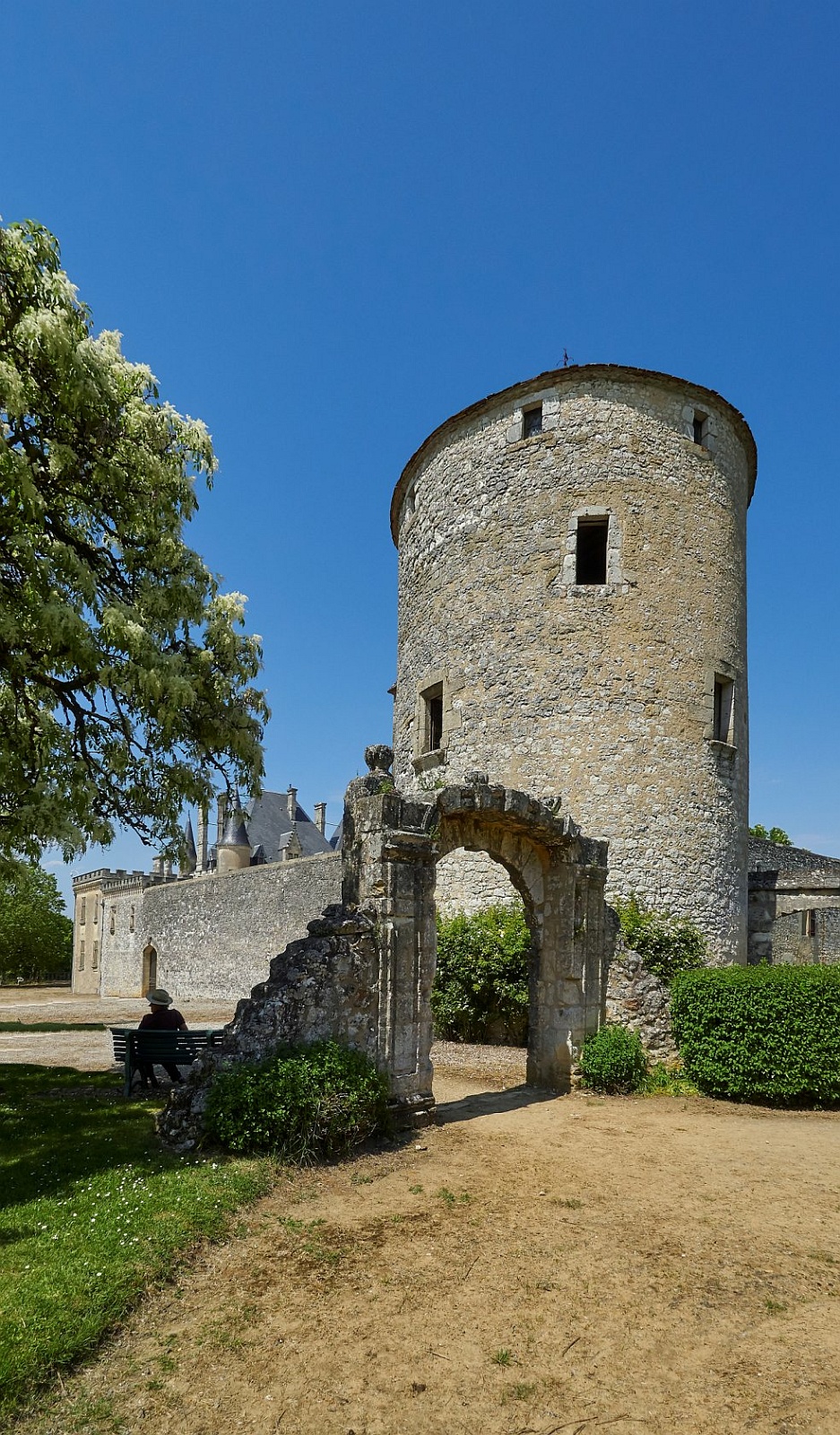
Image: Wikimedia Commons / CC BY-SA.
The 1571 retreat — the situation in which thought was born
Montaigne was not a hermit fleeing to the woods. He was a doctor of law, a parliamentarian, a regular at court, fluent in two classical languages, capable of joking in Latin in letters. The immediate context for his decision to retire was the French Wars of Religion — eight rounds of fighting between Catholics and Huguenots since 1562, the entire southwest in flames. And more specific than the war: in 1563 he lost his closest friend Étienne de La Boétie, the young judge who had written the Discours de la servitude volontaire, dead of plague at thirty-two. Montaigne kept vigil at his bed for the last five days. Later, asked why he loved this friend, he gave an answer as short as a pin:
«Parce que c’était lui, parce que c’était moi.»
(Because it was he, because it was I.)
He could say no more. That inability to say more would later become the undertone of the Essais — a distrust of every grand explanation.
28 February 1571 was his 38th birthday. He had inscribed a Latin inscription on the wall of the second-floor bedchamber of the tower, dedicating himself “to a restful and free repose in the lap of the Muses.” From that day on he held no public office — at least so he thought. Ten years later, King Henri III appointed him mayor of Bordeaux without consultation; he served two terms with reluctant courtesy, and in 1585 during the great plague he was on circuit outside the city and simply did not return, drawing no small criticism. Once the term ended he was back in the tower. The tower was the true geometric center of his life.
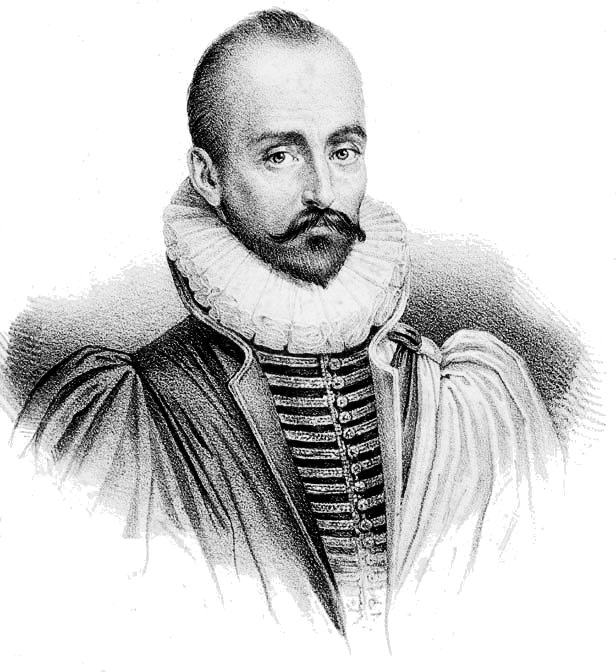
Image: Wikimedia Commons / Public Domain.
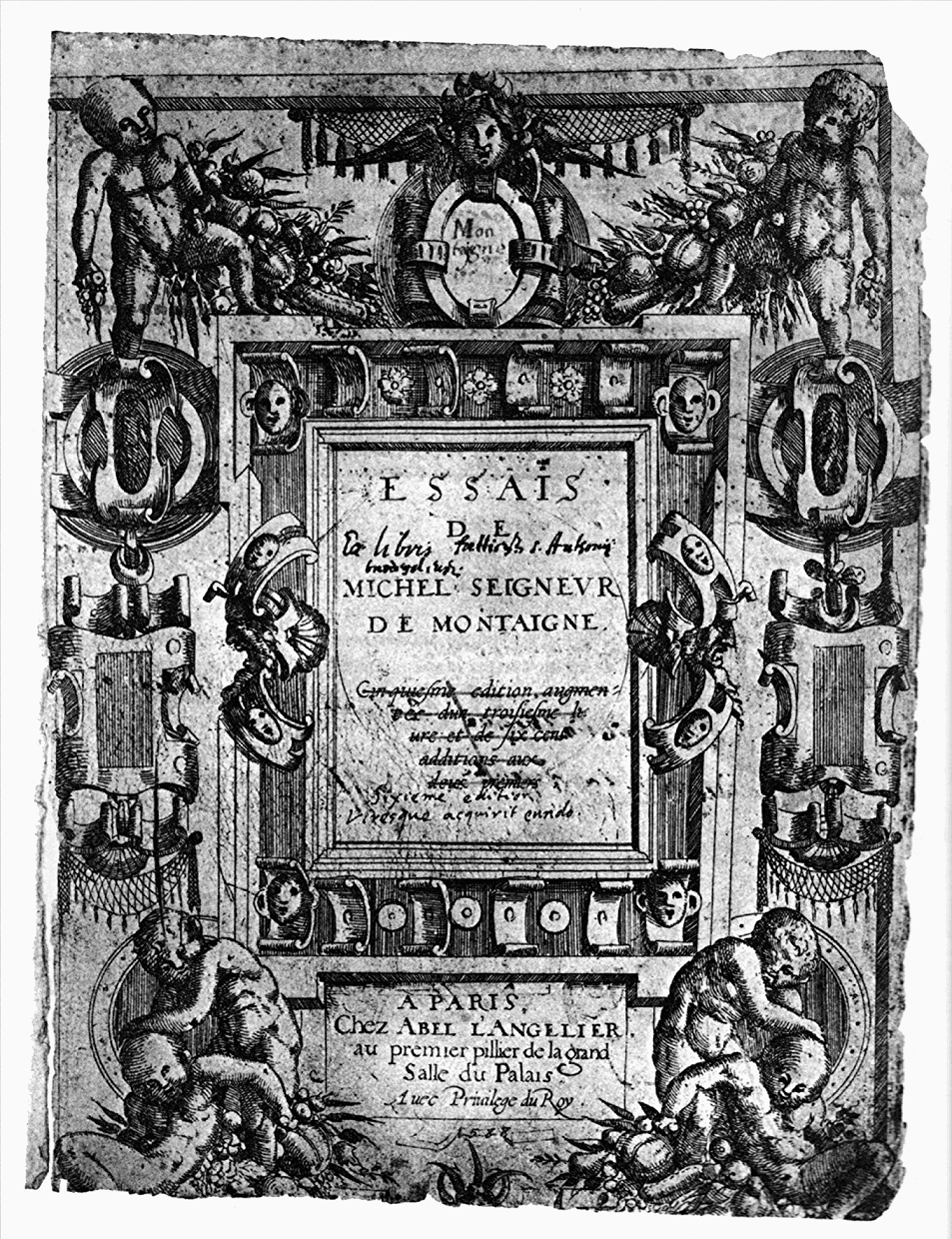
Image: Wikimedia Commons / Public Domain.
The three floors of the round tower — a vertical staircase of faith, body, and thought
The tower is circular; from outside it looks like a gray stone column rising out of the vineyard. Inside it is cut into three floors, connected by a spiral stone staircase narrow enough for only one person to pass. Climbing from bottom to top is exactly a vertical staircase from faith to body to thought.
The first floor is a chapel (chapelle). Not large, with Latin and Greek inscriptions still on the walls. Under the dome is a small trou de communication — a sound-passage that runs diagonally up through the ceiling into the second floor — so that when Montaigne lay ill in bed, the priest’s Mass downstairs could rise through the hole and he could hear it without leaving his bed. A not-very-pious man’s compromise designed for himself.
The second floor is the bedchamber (chambre). A curtained large bed, a fireplace. On the wall is that 1571 Latin inscription. This floor leaves faith below and thought above, the self in the middle — the floor of the body.
The third floor is the library (librairie). The moment you step in you forget to breathe — a circular room, with five arc-shaped bookshelves around the walls. At his height, Montaigne had about a thousand volumes. The windows are small, opening south toward the vineyards. What you cannot escape, when you look up, is the ceiling: fifty-seven beams, each (in most cases) inscribed on both faces with a maxim — entirely in Greek or Latin.
Montaigne chose them himself. From Sextus Empiricus’s Outlines of Pyrrhonism (a skeptic handbook only reprinted in Europe in 1562), from Lucretius’s De Rerum Natura, from Ecclesiastes, from Pyrrho, Heraclitus, Pindar, Sophocles, Terence. For example, this one in Greek, from Sextus:
Ἐπέχω (epechō)
“I suspend judgment.”
And one in Latin from Ecclesiastes:
«Cur quaeris altius extolli, cum sis homo?»
(Since you are only a man, why ask to be raised higher?)
Look up, and that is what is up there. To write in such a room for twenty years — those sentences “What do I know?”, “Man is a being in flux,” “Truth always wavers between two poles” — were almost dripped down from the beams.
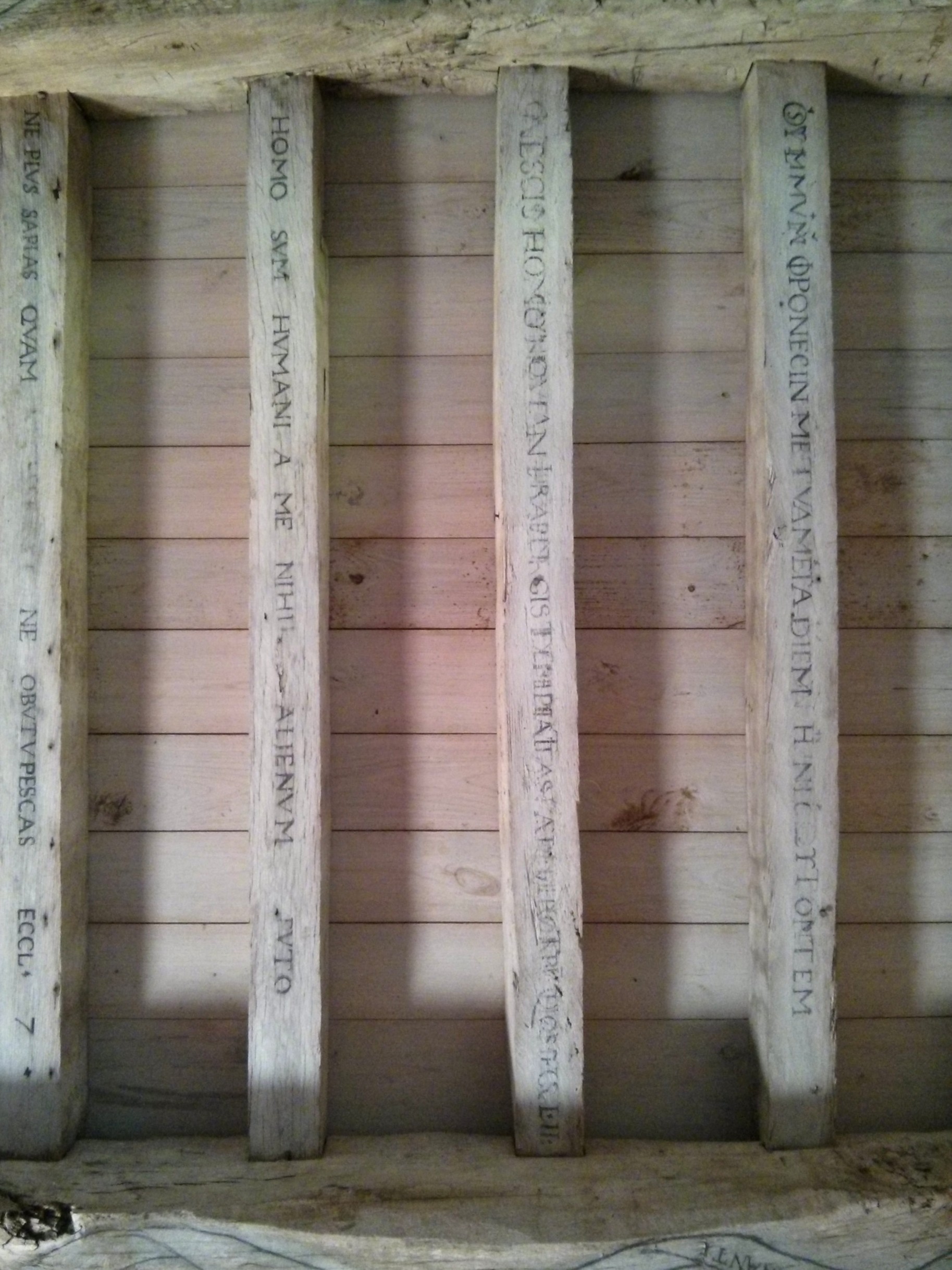
Image: Wikimedia Commons / CC BY-SA.
It was in this room that he gave a new kind of writing a verbal name — essayer, “to try,” “to weigh.” He was not writing a traité, not systematically proving anything; in each essay he picked up an idea, turned it over, found he couldn’t hold to it, and honestly wrote down “What do I know?” In 1576 he even minted a medal to carry with him — a balance scale and the inscription Que sais-je? — three words, no verb, no tense. This was the first time in Europe that someone made not-knowing into an accomplishment.
Why this place could grow this thought
The geometry of the tower decided the geometry of the thought. A round room has no front, no lectern, no rows of students — only one man and a circle of books. And the Greek and Latin on the beams are two dozen dead voices he willingly invited under his ceiling: they disagree with one another, and Montaigne never takes a side. The ancients stand side by side as their own contradictions, and Montaigne writes himself down as his own contradictions. What the round tower teaches him is: thought need not solidify. What solidifies is stone.
Outside the tower is vineyard, the Dordogne plowed repeatedly by religious war through the 1580s. A judge weighs “I” and “man” again and again in a tower, writes no treatise but loose notes, because he believes the only honest way of writing about “man” is to admit that man is always changing — “Je ne peins pas l’être, je peins le passage” (I do not paint being, I paint passage). That judgment held in the Bordeaux tower because each time Montaigne climbed the narrow stone staircase, he was himself in passage.
Appendix · For those who can get there — route
- Getting there · From Bordeaux Saint-Jean station, drive east 50 km on D936 to Castillon-la-Bataille, then turn onto D17, ~50 minutes to the village of Saint-Michel-de-Montaigne. No direct public transport; a taxi from Castillon station is ~15 minutes.
- What’s there to see · The round tower (La Tour de Montaigne) is open seasonally, with required visite guidée booking (guided tours, ~45 minutes). All three floors are intact — the chapel on the ground floor, the bedchamber on the second, and the library with beam inscriptions on the third are all in original position. The main château, rebuilt after the 1885 fire, is a 19th-century building, currently a private residence, not open; you can only view it from outside.
- Side trips · In Bordeaux — the Bordeaux Bibliothèque municipale (Mériadeck branch) holds the Exemplaire de Bordeaux (the 1588 Essais with Montaigne’s own margin notes); the old university chapel near Église Saint-Antoine houses Montaigne’s original sarcophagus (relocated multiple times; now at the Musée d’Aquitaine); the Hôtel de Ville (Bordeaux town hall) was where he served as mayor 1581–85. Saint-Émilion wine village is 15 km east of the tower and can be combined.
- Best season · May–June or September–October. The vineyards are at their best then; in summer the tower is stuffy and guided tours often fully booked.
Part III · The 17th Century — The Stove-Room, the Lens-Grinder
1619–1677. The Thirty Years’ War burns through the heart of Europe; Protestants and Catholics slaughter one another. Two men — one making three dreams beside a tiled stove in a Bavarian army camp, the other grinding the glass that will eventually kill him by a Dutch canal — set up the two pillars of modernity with doubt and geometry: mind is cut into a separate substance from body; God is renamed Nature.
Descartes · Three Dreams and a Stove-Room — 1619–1650, Ulm / Egmond / Stockholm
Descartes’s life is a very long-stretched map: from three dreams beside the Danube at 23, to dying at 54 in a 5 AM philosophy lesson in the Stockholm winter. In between were the Thirty Years’ War, 24 addresses in the Netherlands, and a skull that ultimately parted from its body. For the argument details (Cogito, mind-body dualism, analytic geometry) see Thought Relay; this piece walks through the specific rooms where those arguments were written.
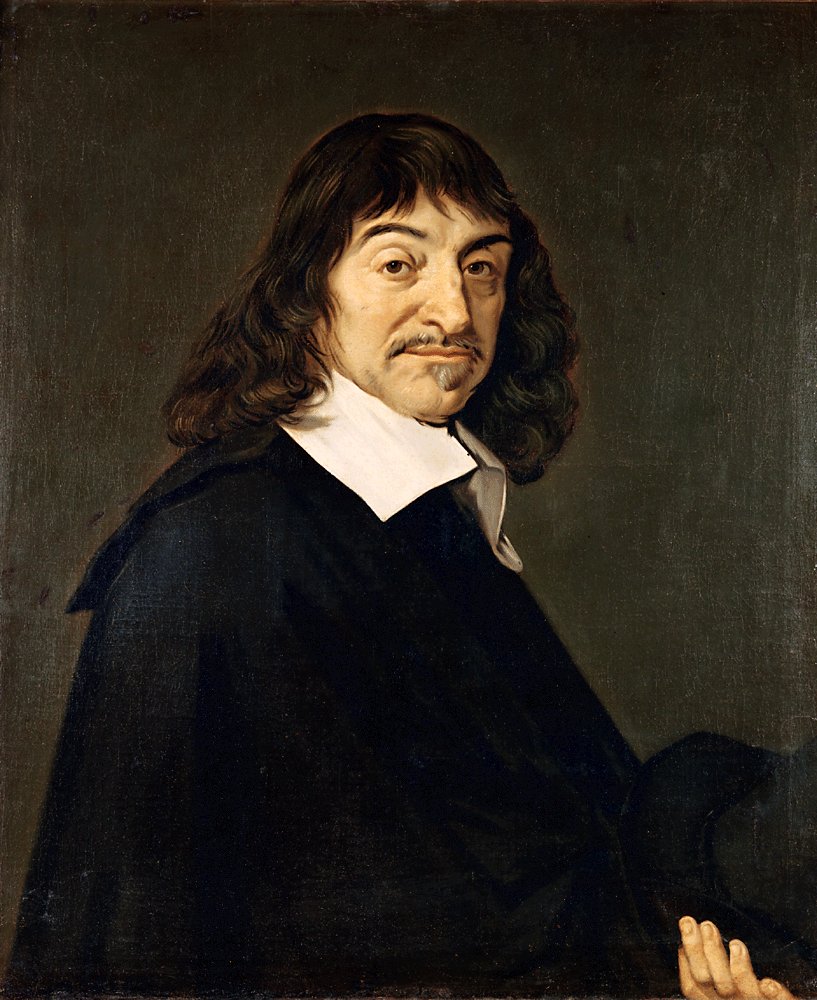
Image: Wikimedia Commons / Public Domain.
What happened that year — the stove-room of 1619
After the 1618 Defenestration of Prague, the Thirty Years’ War broke out. Nominally a religious war between Protestants and Catholics, it became a free-for-all involving every German principality inside the Holy Roman Empire plus Sweden, France, and Spain; it lasted thirty years, and about one-third of the population of the German lands died from war, famine, and plague — Europe’s deepest wound before the two World Wars.
Descartes was 23 at the time, freshly out of the Jesuit school at La Flèche and holding a law degree from Poitiers, but he chose to join the army of Duke Maximilian of Bavaria as a volunteer. He was not short of money (his father was a councilor in the Brittany parliament; he lived on his inheritance for life), and joining the army was to “read the great book of the world,” as he later put it in Part 2 of the Discourse on the Method. In the summer of 1619 the duke’s force marched up the Danube, attended Ferdinand II’s coronation in Frankfurt in September, and then moved into winter quarters near Ulm.
November 10, 1619, the eve of St. Martin’s Day.
That moment · three rooms, three countries
Ulm, 1619
The cold had pressed down. Descartes shut himself in a poêle — the kind of small room in German-speaking regions warmed slowly from dawn to deep night by a tiled stove on one wall, without the open flame of a fireplace, only the constant, womb-like warmth. He writes in the Discourse: “I spent the whole day shut up alone in a stove-heated room, where I had complete leisure to converse with my own thoughts.”
That night he had three dreams. First dream: a whirlwind from the right lifted him up and blew him toward a church courtyard; he tried to turn to greet a passerby but was held in place by the wind. Second dream: a clap of thunder; sparks filled the room. Third dream: a dictionary and a book of poetry appeared on the table; the poetry was open at Ausonius — “Quod vitae sectabor iter?” (Which path of life shall I take?) — and a stranger handed him a poem beginning “Est et Non” (Yes and No). Within the dream he was already interpreting it: the whirlwind was the evil spirit, the thunder was the spirit of truth descending, the book of poems was the union of philosophy and wisdom.
When he woke he made a vow — henceforth to unite all the sciences under a single method, and to make pilgrimage to Loreto. That night holds a near-mythic place in the history of philosophy: modern philosophy did not begin with a treatise but with three dreams a 23-year-old soldier had in a small German town.
Egmond, 1640s
From 1628 Descartes moved to the Dutch Republic. The reason was practical: it was the most free, most commercial, and least interested in your beliefs Protestant country in Europe at the time — Galileo was being tried in Rome in 1633 while the printing presses in Amsterdam went on working as usual. He lived in the Netherlands for twenty years, using 24 different addresses — Leiden, Amsterdam, Deventer, Franeker, Endegeest — moving for reasons ranging from dodging visitors to dodging theological controversies.
The longest stretch was at Egmond aan den Hoef and Egmond-Binnen — two small villages tucked behind the North Sea dunes, half a day’s walk from Alkmaar. From 1643 to 1649 he was mostly here: not getting up before eleven, going into the garden to look at tulips, writing in the afternoon, drinking and debating in the evening with the Benedictines of Egmond-Binnen monastery. The Meditations (Latin 1641, French translation 1642) and the Principles of Philosophy (1644) were finished in country houses in this region. Later he told his friend Chanut: among these low-lying dunes, the sound of one’s own thought was easier to hear than in any Paris salon.
Stockholm, 1650
In September 1649, Queen Christina of Sweden dispatched a warship to bring him to Stockholm. She was 22, read Latin, Greek, and Spanish, kept Plato and Seneca in her private library, and wanted a private philosophy lesson three times a week at 5 AM in the court library. A southern Frenchman accustomed to the warm Egmond bedclothes and the eleven o’clock sun was transplanted into a 59°N February wind.
In late January 1650 he caught pneumonia on the way to the palace; on the morning of February 11 he died at Christina’s residence at 54. To Chanut, the French ambassador at his side, he said in his last days: “Ça mon âme, il faut partir” — Now then, my soul, it is time to depart.
The story of his burial does not end there. First buried in Stockholm at the Adolf Fredriks Kyrka (a cemetery reserved for non-Lutherans); in 1666 the French ambassador to Sweden brought his remains back to Paris and placed them in Saint-Étienne-du-Mont; then later moved into the chapel of Saint-Germain-des-Prés — but his skull was pocketed during the reburial by a Swedish officer of the guard, passed through hands in Sweden, was collected by a phrenologist, and only sent back to Paris by Berzelius in 1821; it is now in the Musée de l’Homme. The man who cut mind and body cleanly apart could not even keep his bones together.
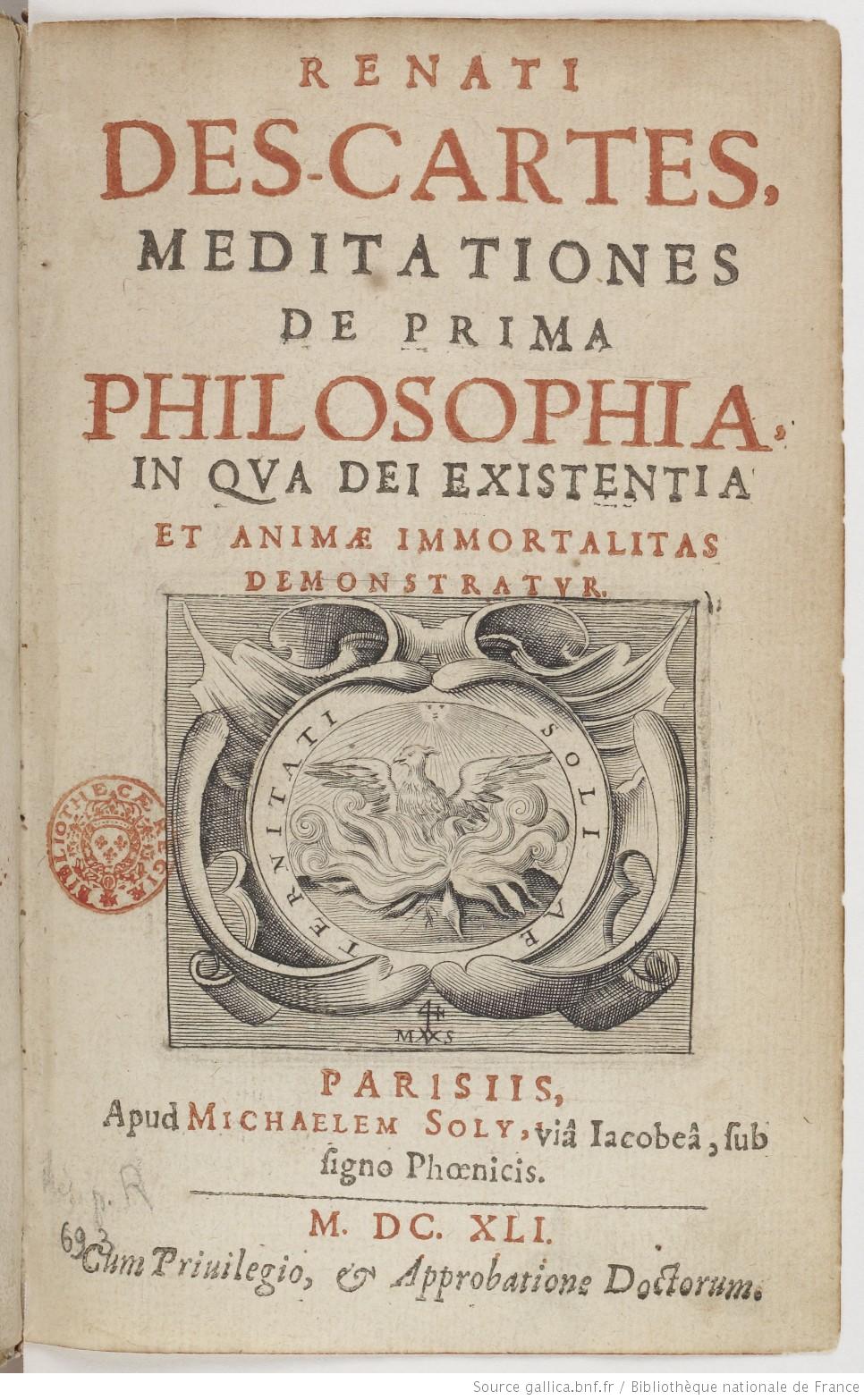
Image: Wikimedia Commons / Public Domain.
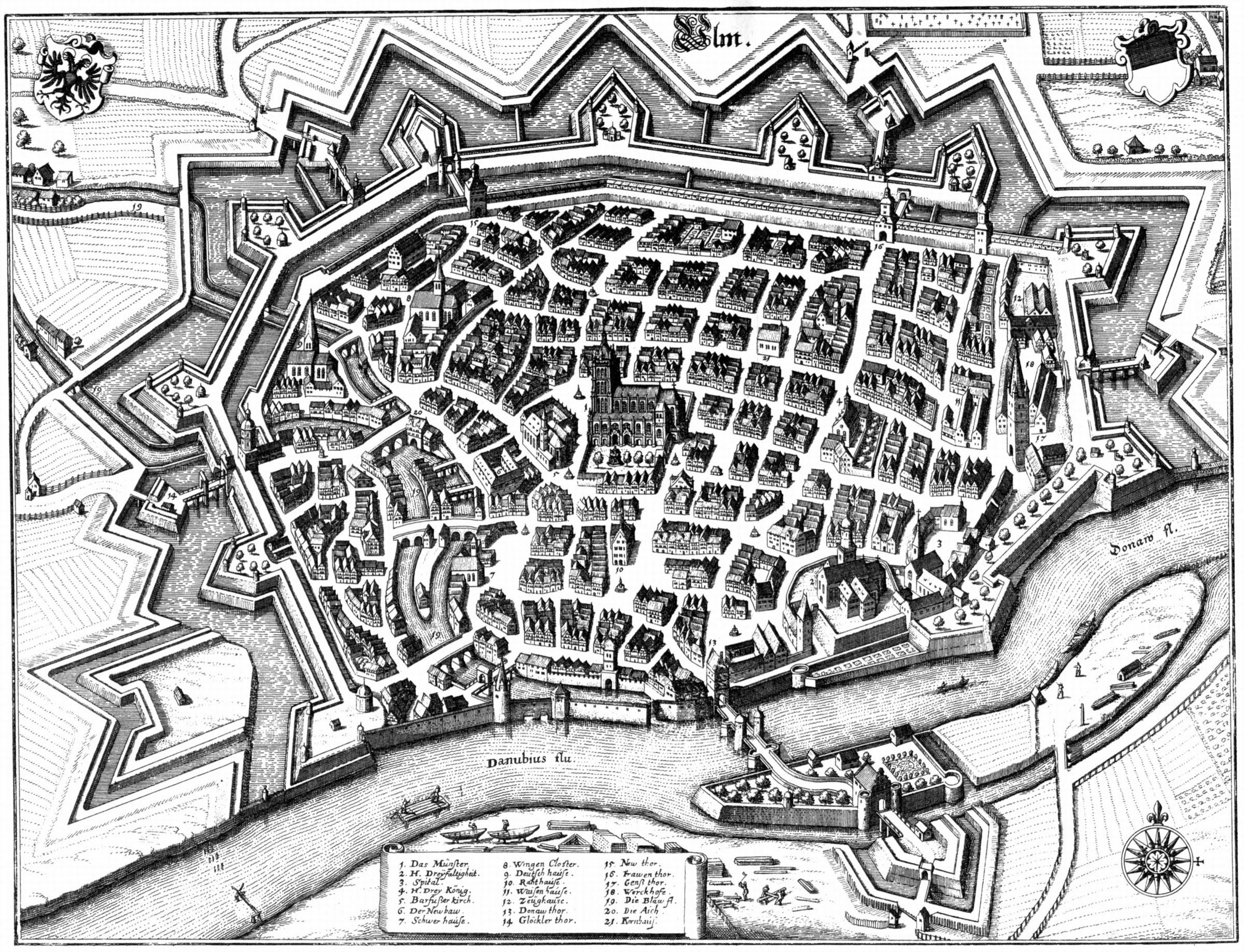
Image: Wikimedia Commons / Public Domain.
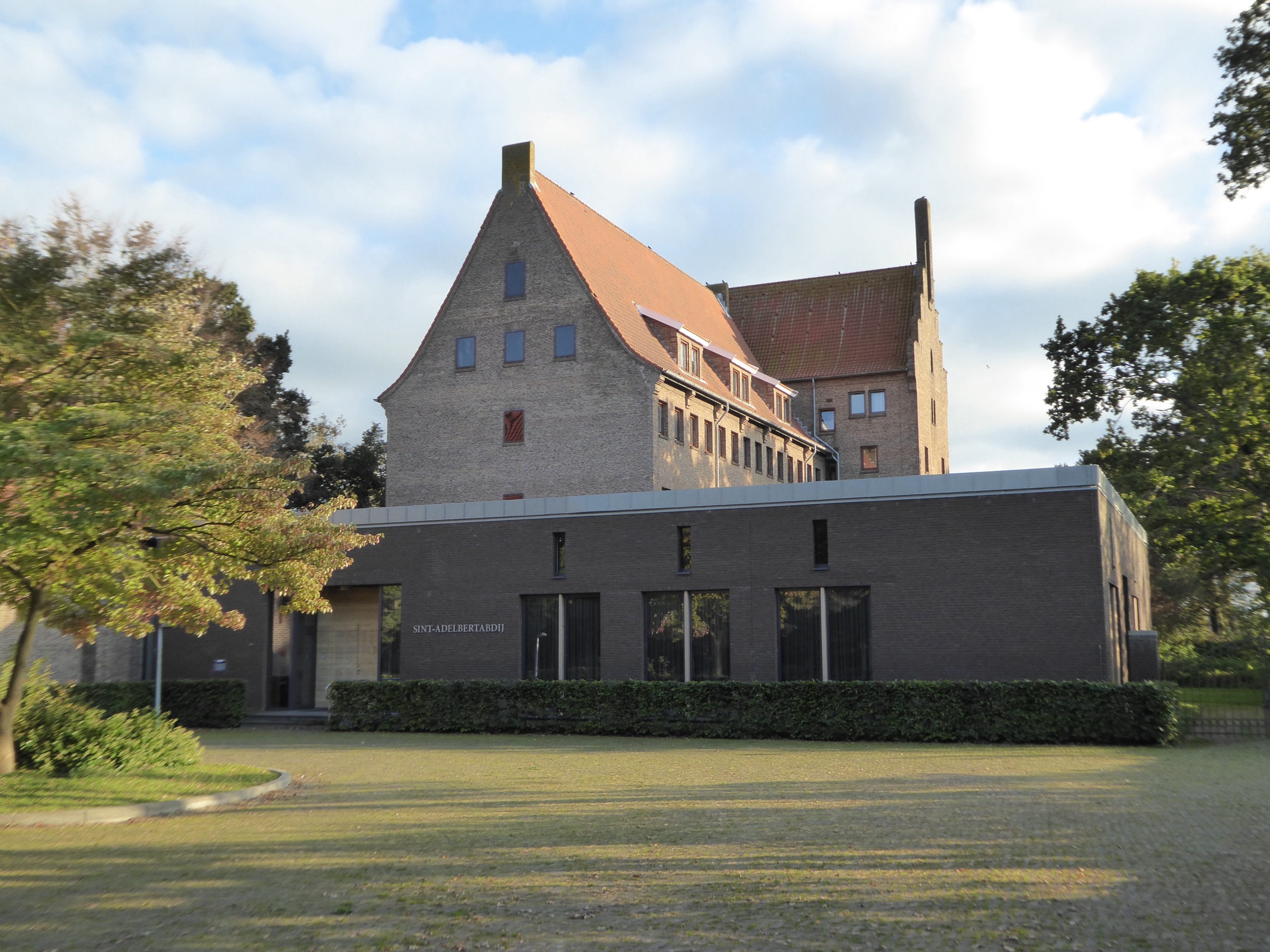
Image: Wikimedia Commons / CC BY-SA.
Why this place could grow this thought
Put the three rooms side by side: the tiled stove at Ulm is “alone,” the country at Egmond is “far from authority,” the library at Stockholm is “thought colliding with body.” Descartes’s method required a particular physical condition — warm, quiet, undisturbed, yet not entirely cut off from Europe’s letter networks. The Dutch Republic in the 17th century was the only place in Europe that met all four: print freedom, developed postal service, Calvinist theologians who argued but did not burn people. He could look at tulips in Egmond and correspond simultaneously with Mersenne in Paris, Heereboord in Leiden, and Princess Elisabeth of Bohemia.
And the 5 AM philosophy lesson that killed him was the greatest irony of his own system: the man who cut mind cleanly out of extended matter died because a specific body could not bear a northern winter.
Appendix · For those who can get there — route
- Ulm (Baden-Württemberg, Germany) — ICE from Munich or Stuttgart, ~1.5 hours. In the old town there is a Descartes-Denkmal (Descartes monument, around Keltergasse) marking the conjectured site of the three dreams; the specific stove-room is long gone. Companion: Ulm Minster (the world’s tallest church spire, 161.5 m), the old fishermen’s quarter along the Danube.
- Egmond aan den Hoef + Egmond-Binnen (North Holland) — train from Amsterdam Centraal to Alkmaar, ~35 minutes; bus 165, ~20 minutes. The two villages adjoin each other and are walkable across the dunes; key points are the Egmond Castle ruins (Slotruïne) and the Sint-Adelbertabdij at Egmond-Binnen (still operating). The North Sea beach is 2 km west, a two-hour walk is what Descartes did daily.
- Stockholm Adolf Fredriks Kyrka — 10 minutes’ walk from Stockholm Centralstation, on Sveavägen. On the church’s north exterior wall is the 1810 Descartes monument inscribed “Cartesius — here was once his temporary grave.”
- Paris Saint-Germain-des-Prés — 6th arrondissement, Place Saint-Germain-des-Prés. The second small chapel on the south side of the church holds Descartes’s cenotaph, inscribed in Latin. The skull is held separately at the Musée de l’Homme (16th arr., Trocadéro), ticketed entry, on permanent display in the “Who is Man” exhibition.
Spinoza · Ethics — 1660s–1677, Rijnsburg / The Hague
One afternoon in July 1656, the Portuguese-Jewish synagogue on the Houtgracht in Amsterdam read out a writ of curse. The cursed was a 24-year-old man named Baruch de Spinoza. From that day on he was no longer a member of any community. Twenty-one years later he died in a small second-floor room in The Hague, leaving behind an Ethics written in the manner of Euclid — and a lens-grinding workbench.
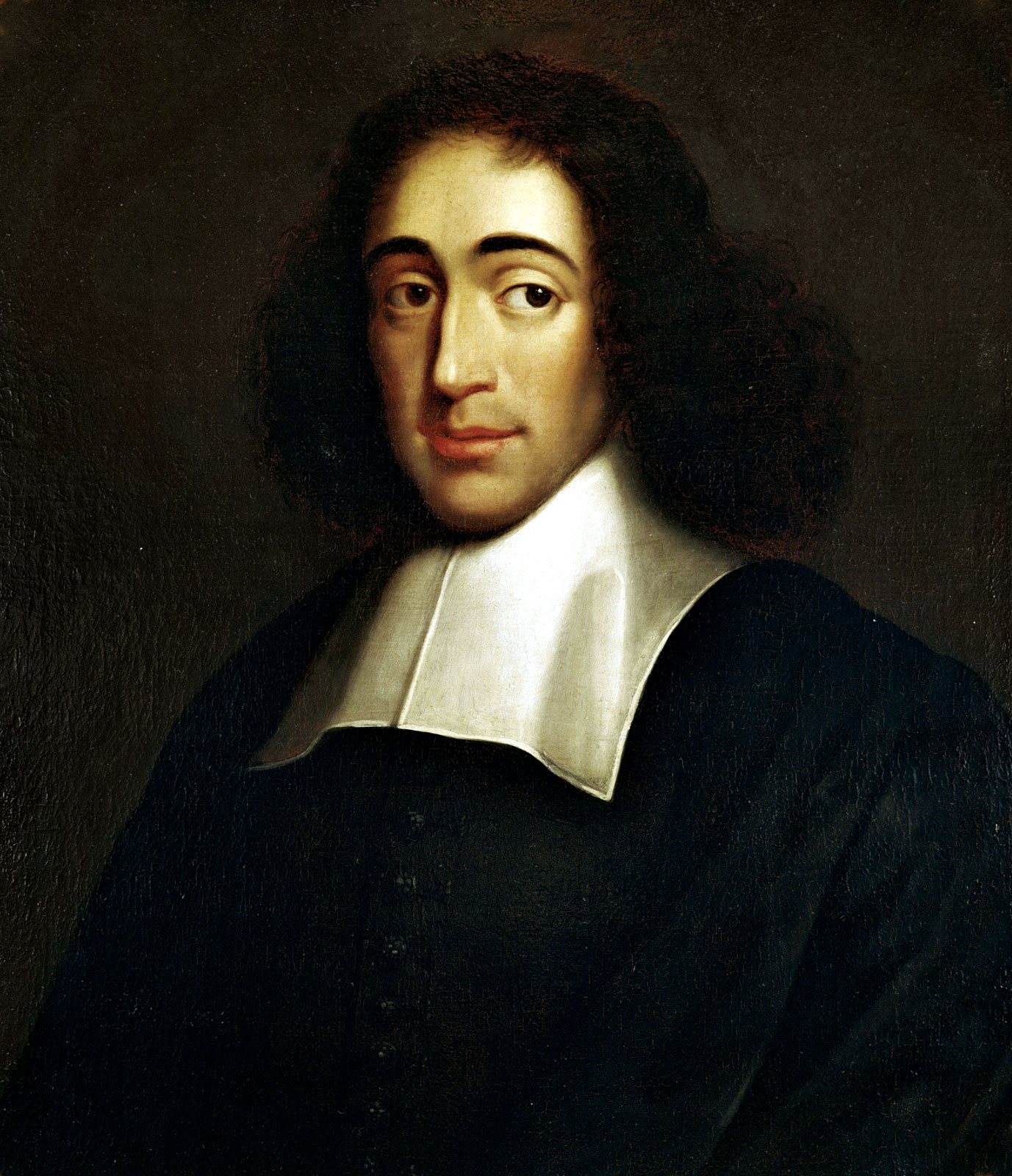
Image: Wikimedia Commons / Public Domain.
The 1656 herem
The text of the writ still survives. Written in Hebrew and Portuguese, its wording is the most violent of all surviving Sephardic herem writs:
“By the decree of the angels, by the curse of Joshua upon Jericho and Elisha upon the children, we curse, banish, anathematize him… Cursed be he by day and cursed by night; cursed when he lies down and cursed when he rises up; cursed when he goes out and cursed when he comes in.”
After the reading, the elder extinguished the candles. The writ closed by demanding that no Jew should speak or write to him, read anything he wrote, share a roof with him, or come within four cubits of him. The cause was not stated, but rumor was already circulating — this young man had been saying privately that God was not a personal creator, that the soul was not immortal, that Moses did not write the Pentateuch.
Spinoza was the son of a successful merchant. His father was a Sephardic Jew who had fled Portugal to Amsterdam and ran an import-export business; he himself had attended the community’s Jewish school, learned Talmud and Hebrew, and was regarded as a promising student. After his father died in 1654 he inherited the business, but his interests had long moved toward Latin, Descartes, and the “free-thinkers” being watched by the Dutch authorities. After the herem he changed his name from the Hebrew Baruch (“the blessed one”) to the Latin Benedictus — the same literal meaning, but blessed in another way. The year he was driven from the community, he almost sighed with relief.
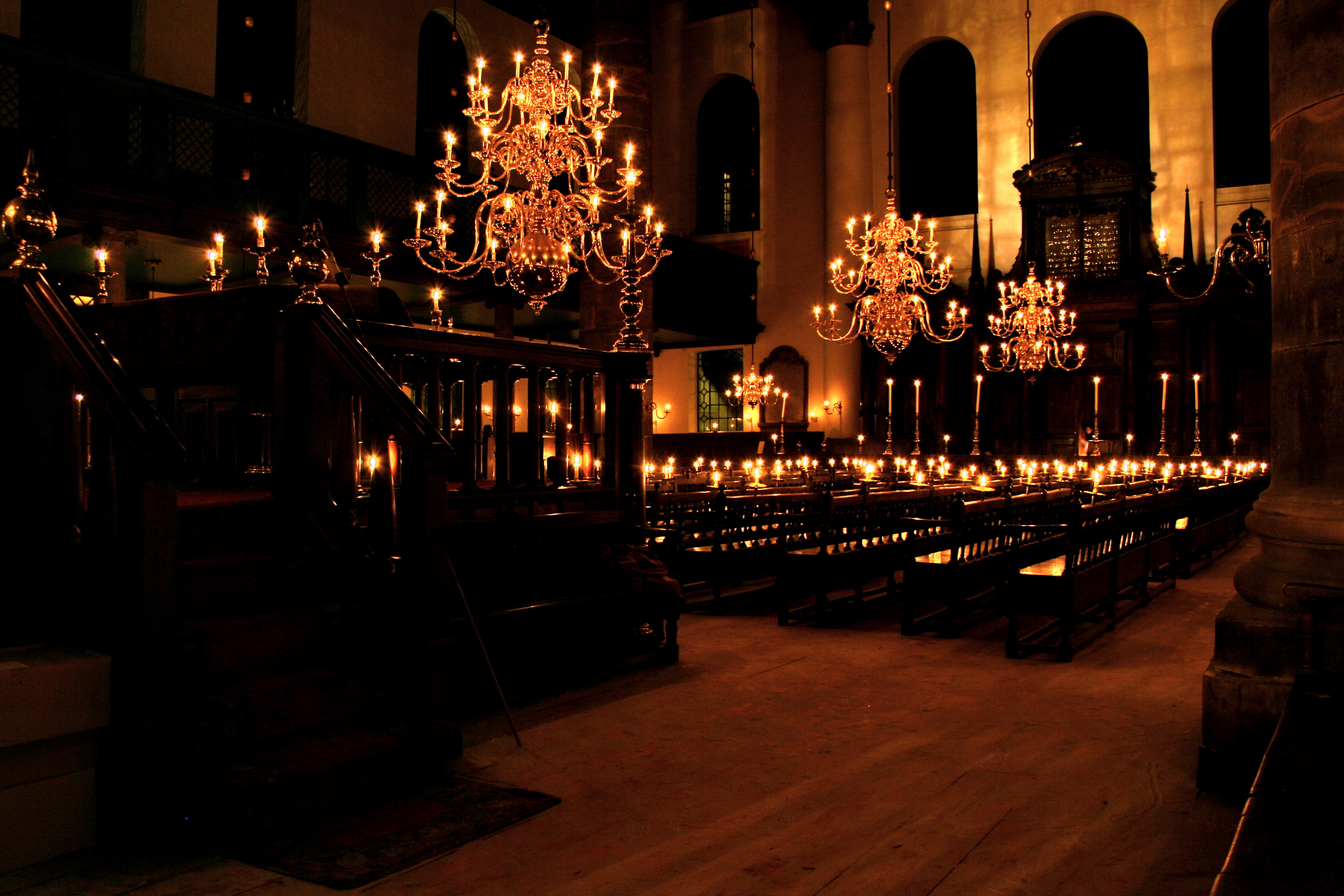
Image: Wikimedia Commons / CC BY-SA.
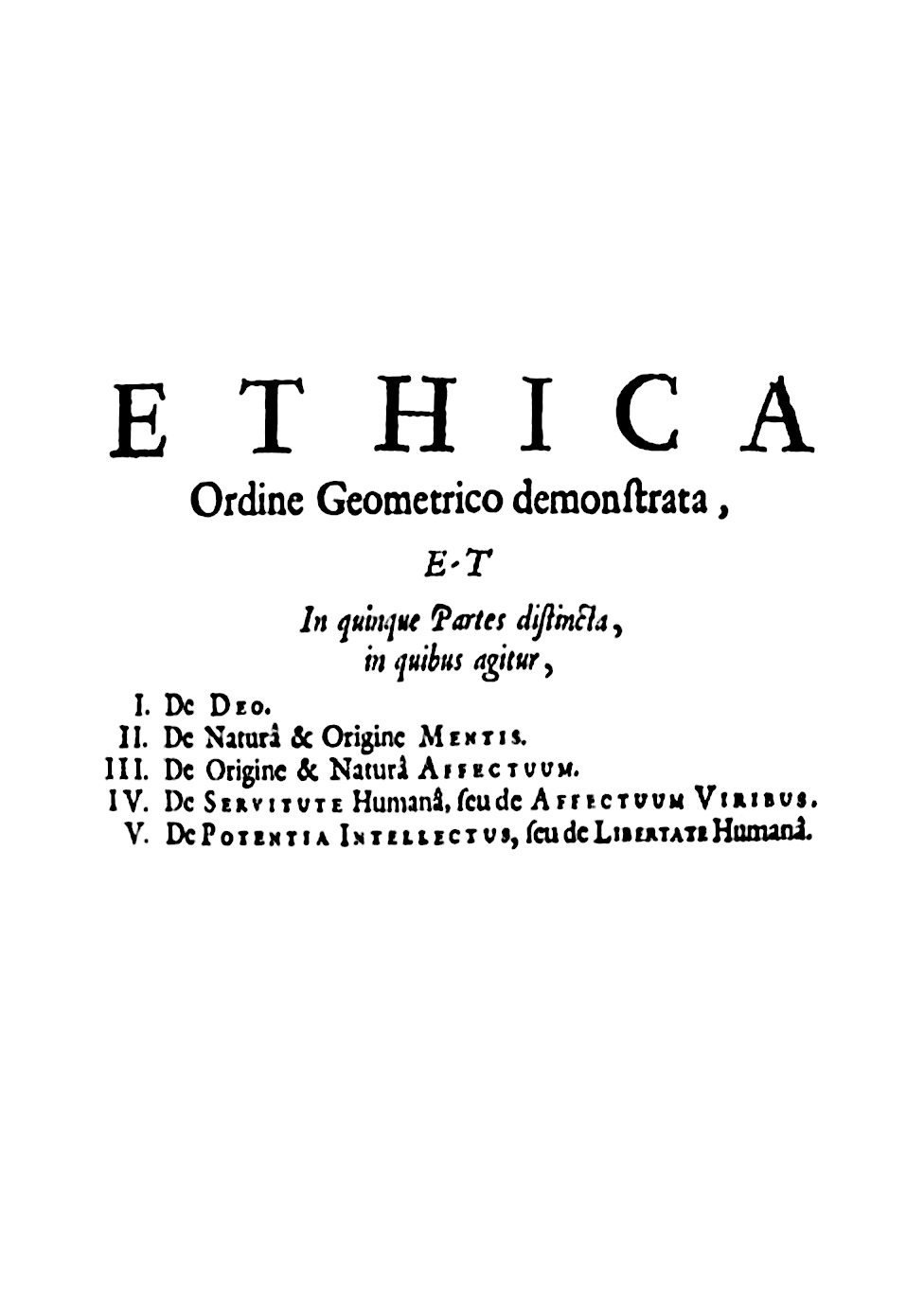
Image: Wikimedia Commons / Public Domain.
That small second-floor lens-grinding room
After the excommunication he had to make a living. He chose an unusual craft: lens grinding. The Low Countries in the 17th century were in the middle of an optical revolution — Huygens was making telescopes, Leeuwenhoek microscopes, Descartes had discussed hyperbolic lens surfaces in his Dioptrics — and anyone capable of grinding precision convex lenses was a sought-after collaborator in scientific circles. Spinoza did not want to depend on any patron again; lens-grinding was the way he kept his independence. The cost was his lungs: glass dust fine enough to pass through any handkerchief.
Around 1660 he moved to Rijnsburg — a small village about seven kilometers northwest of Leiden, half a day’s walk along the canal. This was a stronghold of the Collegiants (a Protestant heterodox group that opposed clergy and held free Bible-reading meetings), one of the few places in the Netherlands where a young man excommunicated by the Jews and unwilling to convert could read in peace. He took rooms on the second floor of a small house on Katwijkerlaan and began grinding lenses while writing the Treatise on the Improvement of the Intellect and the earliest drafts of the Ethics. This small house is still on its original site and was purchased by the Spinoza Foundation in 1899 and restored as Spinozahuis Rijnsburg — the ground floor is a 17th-century kitchen, the second floor a reconstructed study and lens-grinding workbench, with a shelf along one wall holding replicas of the 161 books listed in his estate inventory.
In 1663 he moved to Voorburg, on the outskirts of The Hague. Here he anonymously published the Theological-Political Treatise (Tractatus Theologico-Politicus, 1670) — reading the Bible as a historical document and arguing that the state should guarantee freedom of thought. Within a year it was banned by every Dutch provincial assembly, but the text had already spread through Europe. In 1670 he moved again, this time into The Hague itself, to the second floor of Paviljoensgracht 72–74, the house of a painter Hendrik van der Spyck. The van der Spyck family preserved nearly every daily detail of him: he stayed upstairs most of the time, smoked a pipe, listened to the children downstairs; occasionally he came down to chat with the landlord, always gentle in manner; he never went to church but would advise the landlady “to keep faithfully to what you believe.”
It was in that second-floor room that the Ethics was rewritten and rewritten. Its form is one of the strangest things in the history of philosophy — he wrote an entire book on God, mind, the emotions, and freedom in the manner of Euclidean geometry: definitions, axioms, propositions, demonstrations, scholia, corollaries. Book One begins with 8 definitions and 7 axioms, deriving 36 propositions. At its core is the equation he inscribed in his own hand:
Deus, sive Natura — “God, or Nature.”
This is not renaming God as Nature; it is saying there is one and only one infinite substance, and “God” and “Nature” are two interchangeable names for that same substance. Hence the proposition I.14:
“Except God, no substance can be or be conceived.” (IP14)
And at the scholium to I.29, he compresses the whole metaphysics into a single password-like phrase:
“By ‘Nature’ I here mean two things: Natura naturans (‘the begetting nature’) and Natura naturata (‘the begotten nature’).” (IP29s)
Geometric steps cold to the point of austerity, applied to the warmest subjects — love, envy, fear, freedom. That tension is Spinoza’s alone: using the most inhuman form to write the things most about being human.
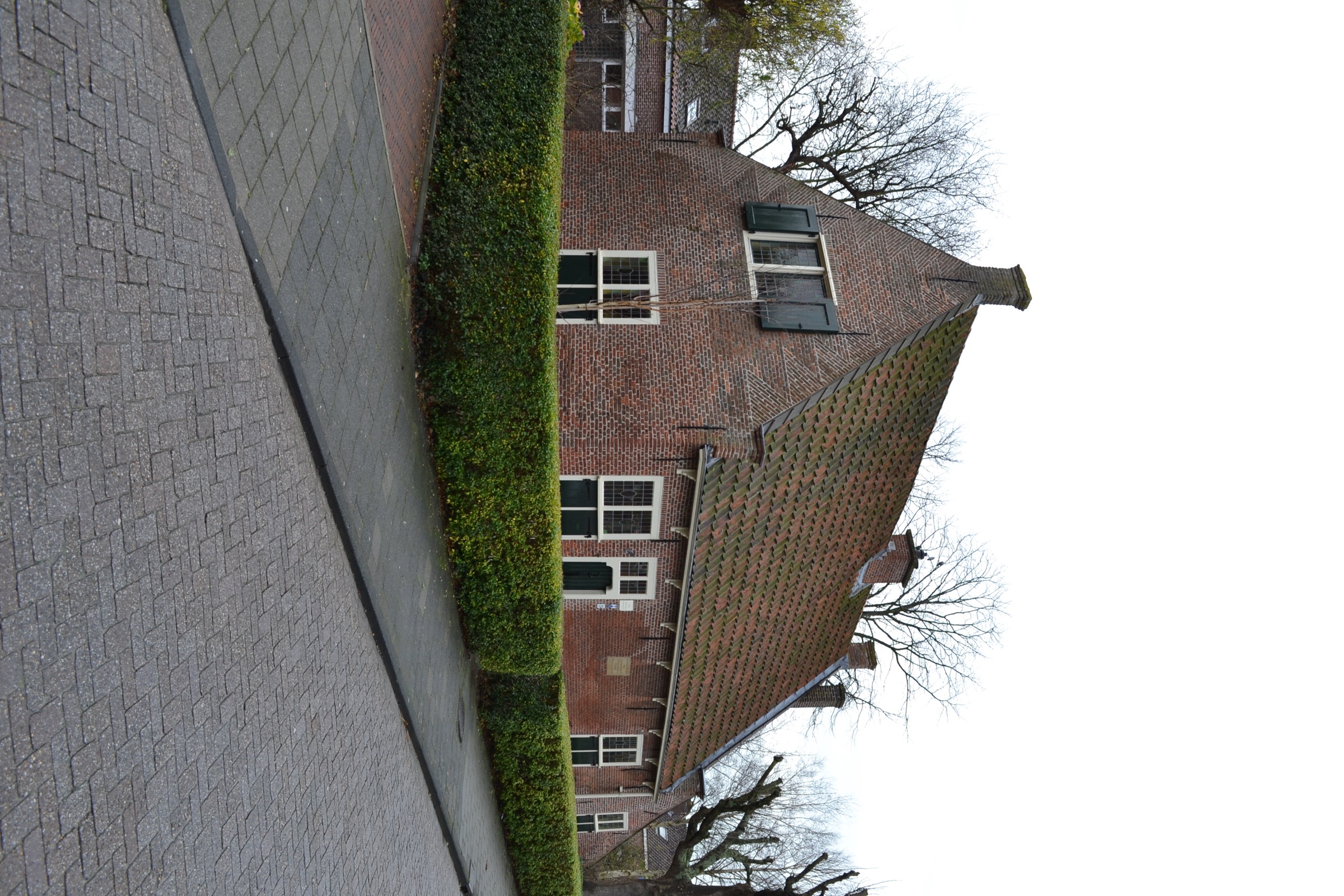
Image: Wikimedia Commons / CC BY-SA.
On 21 February 1677, he died on the second floor at Paviljoensgracht, of lung disease, at 44. The van der Spyck household took stock of his effects: one bed, one table, a few chairs, a lens-grinding workbench, 161 books, a finished but unpublished manuscript. Within months, friends including Jarig Jelles and Lodewijk Meyer issued that manuscript anonymously under the name Opera Posthuma (1677) — containing the Ethics, the Political Treatise, the Treatise on the Improvement of the Intellect, and his letters. The next year the Dutch provincial assemblies banned it again. He was buried at the Nieuwe Kerk in The Hague, but 17th-century burial plots there were repeatedly leveled and reburied; the bones are long lost. In 1956, on the 300th anniversary of his death, a memorial stone was placed at the original burial location, inscribed with a single Hebrew word — Amcha: “your people.” Three hundred years after the excommunication, he was reclaimed, in some sense, by a community.
Why the Low Countries
There is a reason Spinoza belongs in the Netherlands. The Dutch Republic of the 17th century was the only place in Europe a man like him could survive — a fragile union of seven provinces, with Amsterdam’s Jewish community, Collegiant heterodox meetings, the Protestant theologians of Leiden University, press freedom (always at the edge), and an enormous international correspondence network. Any single one of these conditions would have been insufficient — but seven of them together were just enough.
And a geometric-method ethics needs exactly this kind of damp, flat, free, and mutually surveilled environment. The canals of Rijnsburg are always gray; the second-floor windows are always misted; the lens-grinding dust sinks into the gaps in the floorboards. A man writing a book about “God, or Nature” in such an environment can only fight back against the noise of the outside world with the coldest possible form — definitions, axioms, propositions, demonstrations are a self-protective grammar. The Low Countries cannot grow a passionate poet-philosopher, but they can protect a Jewish lens-grinder long enough to finish a book that will not compromise with its age.
Appendix · For those who can get there — route
- Spinozahuis Rijnsburg: Katwijkerlaan 27, Rijnsburg. Bus 385/386 from Leiden Centraal Station, ~15 minutes; ~5 minutes on foot from the stop. Generally open Tuesday to Saturday afternoons — check spinozahuis.nl. The museum has a reconstructed study, lens-grinding workbench, and the 161-volume book inventory.
- Spinozahuis Den Haag: Paviljoensgracht 72–74, The Hague. ~12 minutes on foot from The Hague Centraal, along the small canal Stille Veerkade. A bronze bust at the entrance; a few small rooms on the second floor were his last residence.
- Nieuwe Kerk Den Haag: Spui 175, The Hague. ~10 minutes on foot. The 1956 memorial in the side courtyard is inscribed Amcha.
- Esnoga / Portuguese Synagogue: Mr. Visserplein 3, Amsterdam. Next to Waterlooplein metro. Completed 1675, successor to the old synagogue where the 1656 herem was pronounced. The community has never lifted the curse.
Part IV · The Enlightenment — The Island and One City for a Life
1765–1804. A man wanted by two countries spends the two happiest months of his life in the middle of a lake; a man who never left his city in his life writes the “Copernican Revolution.” Both needed boundaries at a strong scale — a lakeshore, a path of linden trees — to filter the outside world into a bearable speed.
Rousseau · Reveries of the Solitary Walker · Fifth Walk — 1765, Île Saint-Pierre, Lake Bienne
In the autumn of 1765, a man banished by half of Europe rowed a small boat into the middle of Lake Bienne. Oars across his knees, he did nothing, thought nothing, only “felt that he existed.” Thirteen years later in Paris he wrote the Fifth Walk of the Reveries of the Solitary Walker — those two months were the happiest time of his life.
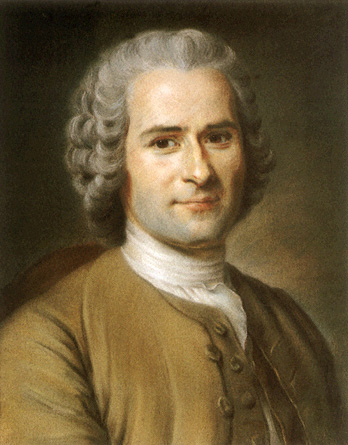
Image: Wikimedia Commons / Public Domain.
Exile in 1765
1762 was the watershed. That year he published The Social Contract in the Netherlands, and simultaneously released Émile in Amsterdam and Paris. The latter recounts how a child is raised by nature — its “Profession of Faith of the Savoyard Vicar” chapter proposes a “natural religion” that depends neither on the church nor on revelation. On 9 June, the Parisian Parlement ordered the books burned and an arrest warrant issued; a few days later, the Little Council of Geneva followed, sentencing Émile and The Social Contract together. A man born in a Protestant republic and taken in by a Catholic kingdom was now driven out by both.
He first fled to Môtiers, a small village in the Neuchâtel canton under the King of Prussia’s protection — three years there, in a not-very-warm Voltairean shelter. But the village pastor, after reading his open letter to the Archbishop of Paris, began to call him out from the pulpit as a heretic. On the night of 6 September 1765, villagers surrounded his house and threw stones — the “Lapidation de Môtiers.” One stone nearly reached the bedroom. He and his housekeeper Thérèse packed up his books and plant specimens and left in the night.
Six days later, the 53-year-old Rousseau arrived at a tiny island in the middle of Lake Bienne, the Île Saint-Pierre. The island had only one large house, half belonging to a tax steward for the Bern authorities, half empty — he was allowed to stay.
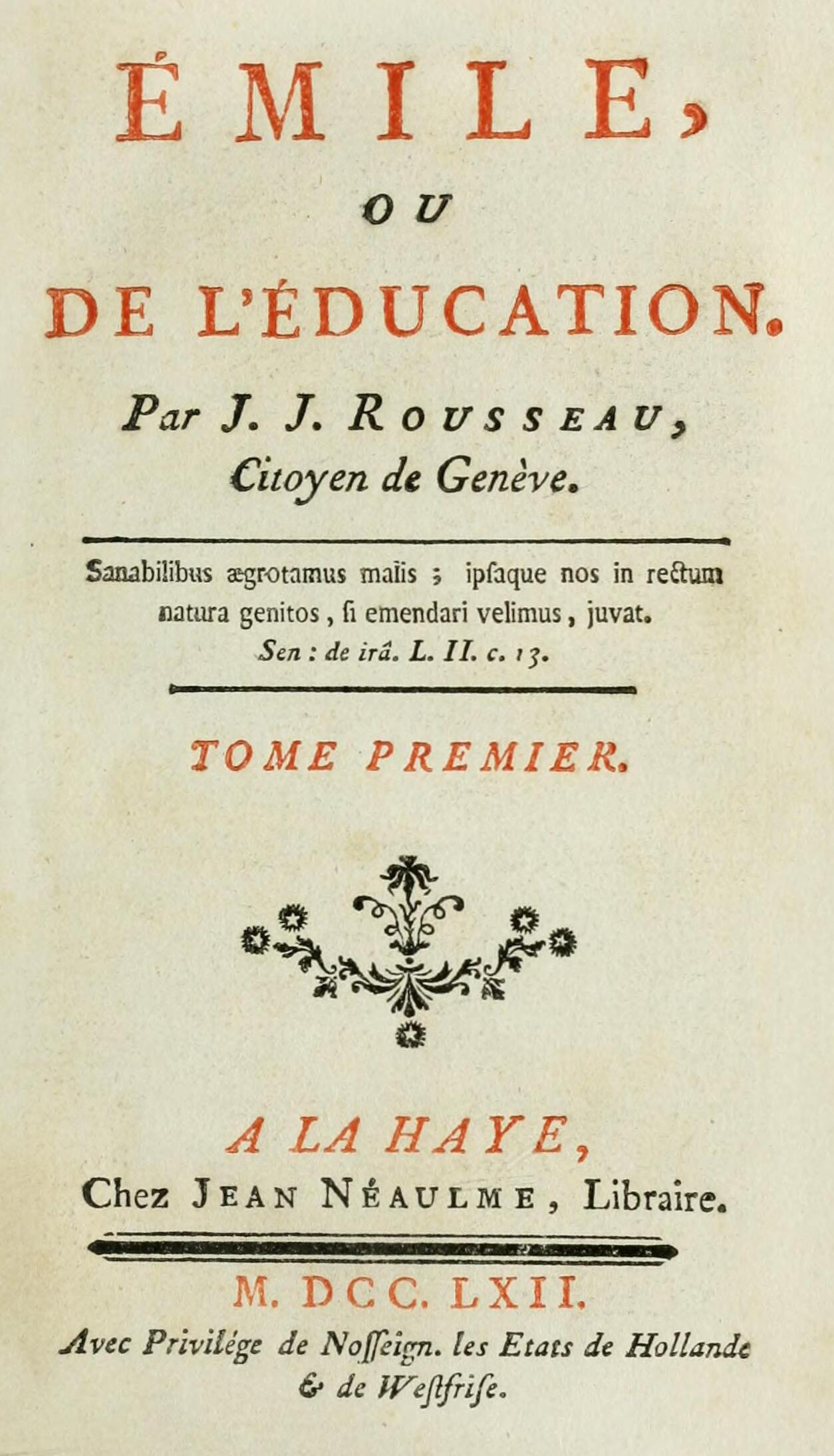
Image: Wikimedia Commons / Public Domain.
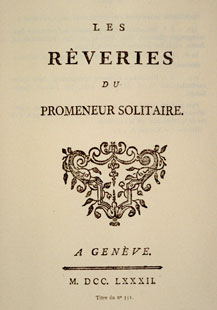
Image: Wikimedia Commons / Public Domain.
Those two months on the lake
The island is less than a kilometer long, with a vineyard running from the southern slope down to the water. Each morning he carried Linnaeus’s classifications and walked once around the island, picking leaves and pressing them in his Bible — he was compiling a Flora of the Île Saint-Pierre which he never finished. Afternoons were more radical: he would tow a small boat into the middle of the lake, pull in the oars, and let it drift on the wind, lying on his back at the bottom of the boat.
In the Fifth Walk he writes —
“When evening fell, I came down from the island and sat on the sand where the water lapped the shore. The waves and the sound of the water on my ears and my eyes took the place of the inner motions reverie had driven away, and let me, without needing to think, enjoy with pleasure the feeling of my own existence. From time to time arose brief and feeble reflections on the instability of things in this world; the surface of the water erased them at once.”
And —
“There the flux of time was nothing to me; the present persisted without leaving any trace of succession, with no feeling of lack or enjoyment, no pleasure or pain, no desire or fear — only the feeling of our existence, which by itself could fill the soul.”
This is rare in the history of philosophy — it is not arguing what, it is recording the present. Sixteen years before Kant in Königsberg hung the “transcendental self” before all experience as a fulcrum, Rousseau had already, on the lake, pulled this fulcrum out and thrown it into the water — what remained was a sense of being without past or future, no longer asking. Later, Bergson’s durée, Heidegger’s being-in-the-world, even the Buddhist pratyaksha — all can see their own reflection in this passage.
But that “present” was fragile. Two months later, on 16 October, the Bernese Senate issued an expulsion order — on the grounds that he was not a Bernese citizen and the island could not host him long-term. He wrote asking to remain “even as a prisoner”; refused. On 25 October he left the island, never to return.
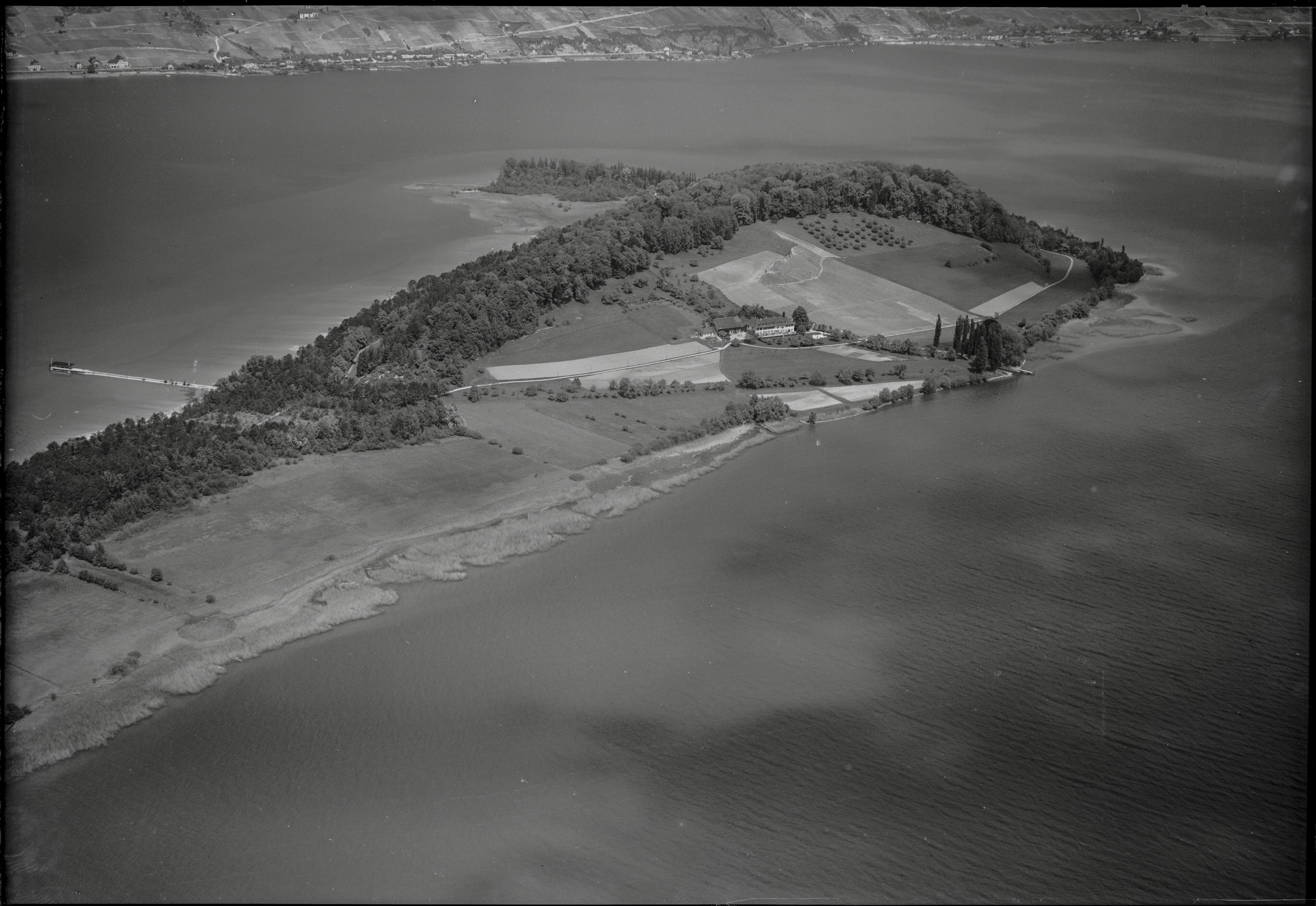
Image: Wikimedia Commons / CC BY-SA.
Why an island
Not every village can grow the Fifth Walk. All his life Rousseau wanted “to be alone” — but what he needed was not monastic isolation, but bounded, small-scale nature surrounded by water. The island was only a kilometer long, walkable in half a day; the water filtered every visitor down to the speed of a small boat. His enemies were 50 kilometers away in Bern, but to reach him they had to mobilize a boat and a sealed order — that delay gave him a near-childhood sense of safety.
A deeper layer: in the Confessions and the Reveries he says repeatedly that being among people instantly hijacks him into performance, into self-explanation, into “what I am in other eyes” — and that hijacked state is exactly the problem The Social Contract tried to solve, applied to a single person. The Île Saint-Pierre is his own “state of nature” experiment: take away the mirror of society, and see what is left of “I” that no longer needs to explain itself to anyone. What was left was the “merely feeling existence” of the Fifth Walk.
Later, in May 1778, at the invitation of the Marquis de Girardin, he moved to the Ermenonville estate 50 km northeast of Paris — also a place with an island in a lake, modeled on an English landscape garden. On the morning of 2 July, returning from a walk, he collapsed suddenly and died within hours, 66 years old. Girardin buried him on the small island of poplars in the park, the “Île des Peupliers” — a deliberate copy of the Île Saint-Pierre. For sixteen years that island of poplars was Europe’s most popular pilgrimage site; Marie Antoinette, Franklin, and Napoleon all visited. On 11 October 1794, the revolutionary government moved his remains to the Pantheon in Paris, his coffin placed across the aisle from Voltaire — two men who detested each other in life made into neighbors by the Revolution.
Appendix · For those who can get there — route
- Getting there · From Zurich or Basel, IC direct to Biel/Bienne (~1.5 h), then a regional train to La Neuveville or Erlach, then on foot/by boat to the island. In summer the BSG boats depart from Biel harbor, ~1 hour to the island. In winter the boats stop; walking in from Erlach along the southern dike (~45 minutes through vineyards) is the closest way to feel that “this was once an island.”
- What’s on the island · Maison Saint-Pierre (the manor Rousseau stayed in) — the “Chambre Rousseau” on the second floor is restored to its 1765 appearance, including his small writing desk; the ground floor is a hotel-restaurant where you can stay the night. The 4-km loop trail still runs through vineyard + deciduous woodland; autumn light is closest to that in the Reveries.
- Extension · Ermenonville Île des Peupliers · Train from Paris Gare du Nord to Senlis (~50 minutes), bus to Ermenonville; in the Parc Jean-Jacques Rousseau, the Île des Peupliers still preserves the 18th-century cenotaph (the remains have been moved, the tomb remains). Hubert Robert’s 1770s paintings of the place remain a textbook image of the English landscape garden.
- Endpoint · Paris Pantheon · 5th arr., Latin Quarter, Place du Panthéon. The crypt has Rousseau on the east side; directly facing him to the west is Voltaire, the two coffins looking at each other across the aisle. Open daily 10:00–18:30, ticket about €13.
Kant · One City for One Life — 1724–1804, Königsberg
Can a person spend an entire life in one city and rework all of European philosophy in it? Königsberg’s answer is: yes. For eighty years Kant did not leave East Prussia, traveling no further than Pillau, a coastal town 200 versts away. But it was from this Baltic city that the three Critiques — the “Copernican Revolution” — walked out. Two centuries later, the city he lived in was leveled by war, renamed, and changed flags — only his grave still stands at the north wall of the cathedral.
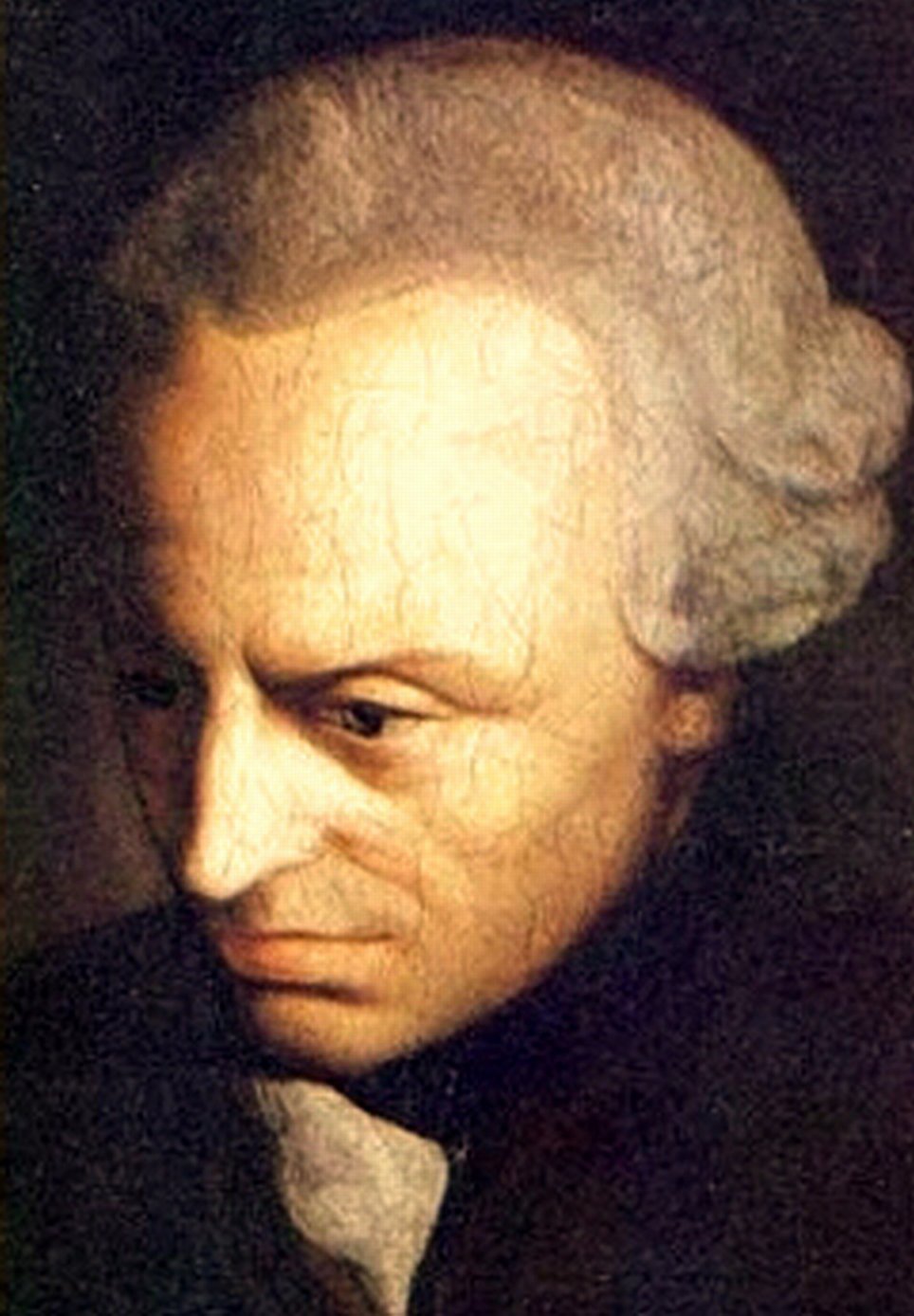
Image: Wikimedia Commons / Public Domain.
1724–1804 · one city for one life
Kant was born on 22 April 1724 in the family of a harness-maker on the outskirts of Königsberg. His father was a craftsman; his mother came from a Pietist (Pietismus) family — the early-18th-century Prussian Protestant strain that emphasized inner self-examination, individual conscience, and the unimportance of external ritual. That background flows entirely into the Critique of Practical Reason: the posture of treating “moral law” as an inner command rather than as an external authority is a posture Pietism gave him from childhood.
In 1740 he entered the University of Königsberg. His father died in 1746; he worked nine years as a private tutor to earn money, returned to the university in 1755 to take his doctorate and Privatdozent status, living on student lecture fees for a full fifteen years. Not until 1770 was he promoted to full professor — the chair of Logic and Metaphysics (Logik und Metaphysik) — that year he was forty-six.
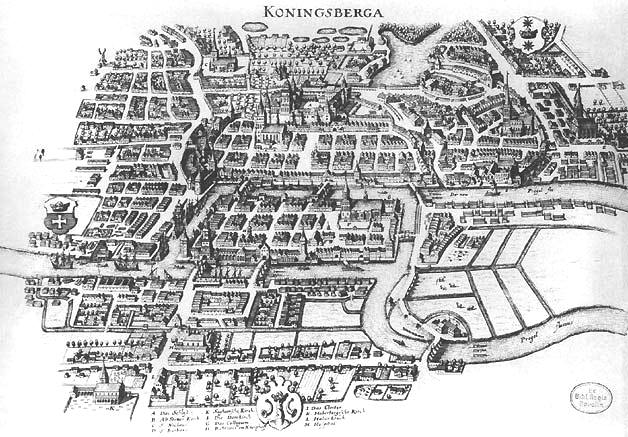
Image: Wikimedia Commons / Public Domain.
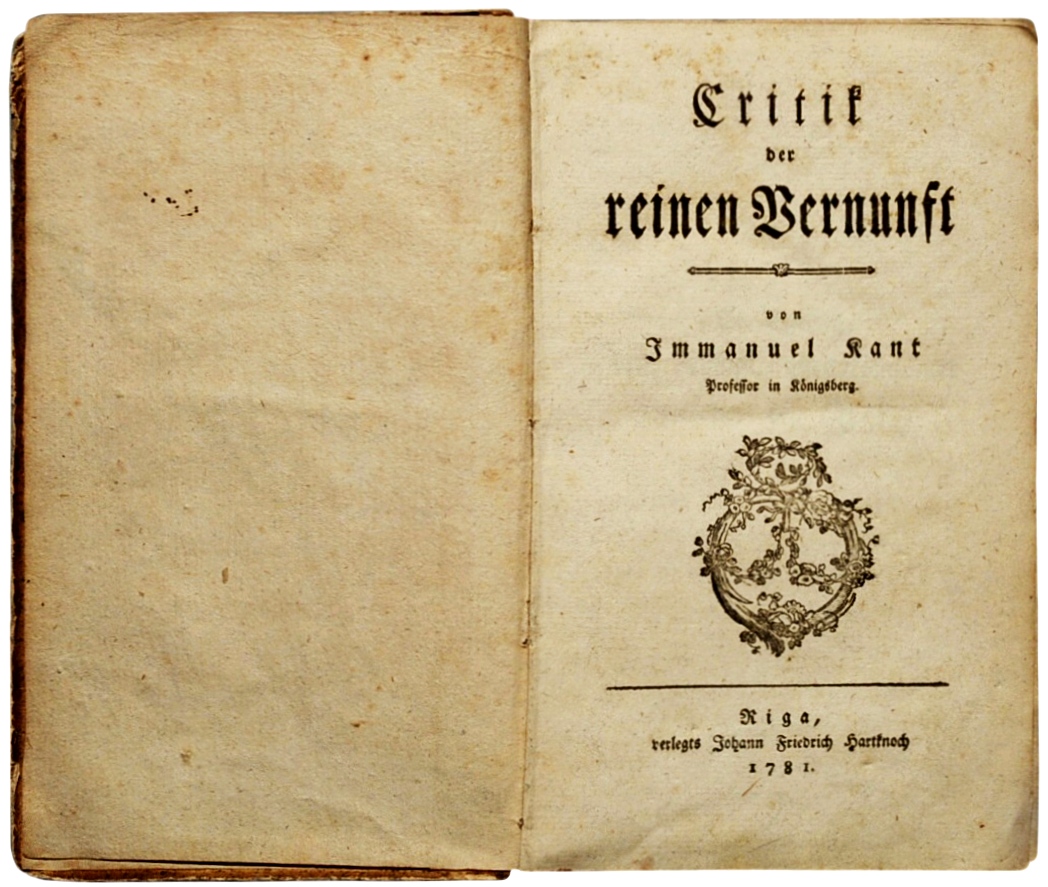
Image: Wikimedia Commons / Public Domain.
There is a less-told episode in between. From 1758 to 1762, during the Seven Years’ War, Russian forces occupied East Prussia and Königsberg became Russian territory for four whole years. For those four years Kant’s legal status was subject of Empress Elizabeth — he even wrote her a letter applying for the chair of logic at the university (unsuccessfully). The city was not much damaged; Russian officers attended his lectures. He almost never mentions this experience in his later writings, but you can faintly hear something behind the solemn closing of the Critique of Practical Reason on “the starry heavens and the moral law”: a man in his thirties suddenly discovers that even the ground beneath him can change masters overnight, and that the starry sky above and the law within do not.
That linden path, that cathedral
Once full professor, Kant turned his life into a precise mechanical clock. Up at five every morning, a cup of weak tea, a pipe of tobacco, writing until 9 AM when he lectured. At midday, a few friends for a long lunch — his only social interaction of the day; the conversation never permitted philosophy, only weather, politics, new books, and gossip. At 3:30 in the afternoon, he set out for his walk, on the path later called the Philosophenweg — the linden-shaded “Philosopher’s Path” — with his servant Lampe carrying an umbrella behind, rain or shine, because that was Kant’s rule.
According to Heine’s anecdote: housewives in Königsberg set their clocks by the time Kant passed their windows. The story is largely literary embellishment, but its plausibility lies in the fact that a small city that treats Kant as a neighbor would indeed do so.
The Kant before forty was not like this. As a young man Kant had danced, played billiards, and written pamphlets on earthquakes and the origin of the universe. At thirty-one he published Universal Natural History and Theory of the Heavens (1755), explaining the origin of the solar system in purely mechanical terms — later named the Kant-Laplace nebular hypothesis. But after his 1770 elevation he suddenly entered a decade of silence — publishing almost nothing, only preparing lectures, discussing, and self-examining alone.
A decade later, 1781, he delivered the Critique of Pure Reason — 856 pages of German Gothic type. 1788 was the Critique of Practical Reason, 1790 the Critique of Judgment. The intervals between the three Critiques shortened, even as the world outside was turned upside down — when news of the 1789 French Revolution reached Königsberg, this lifelong punctual walker is said to have for once broken his walking schedule to hurry off to read the arriving newspapers.
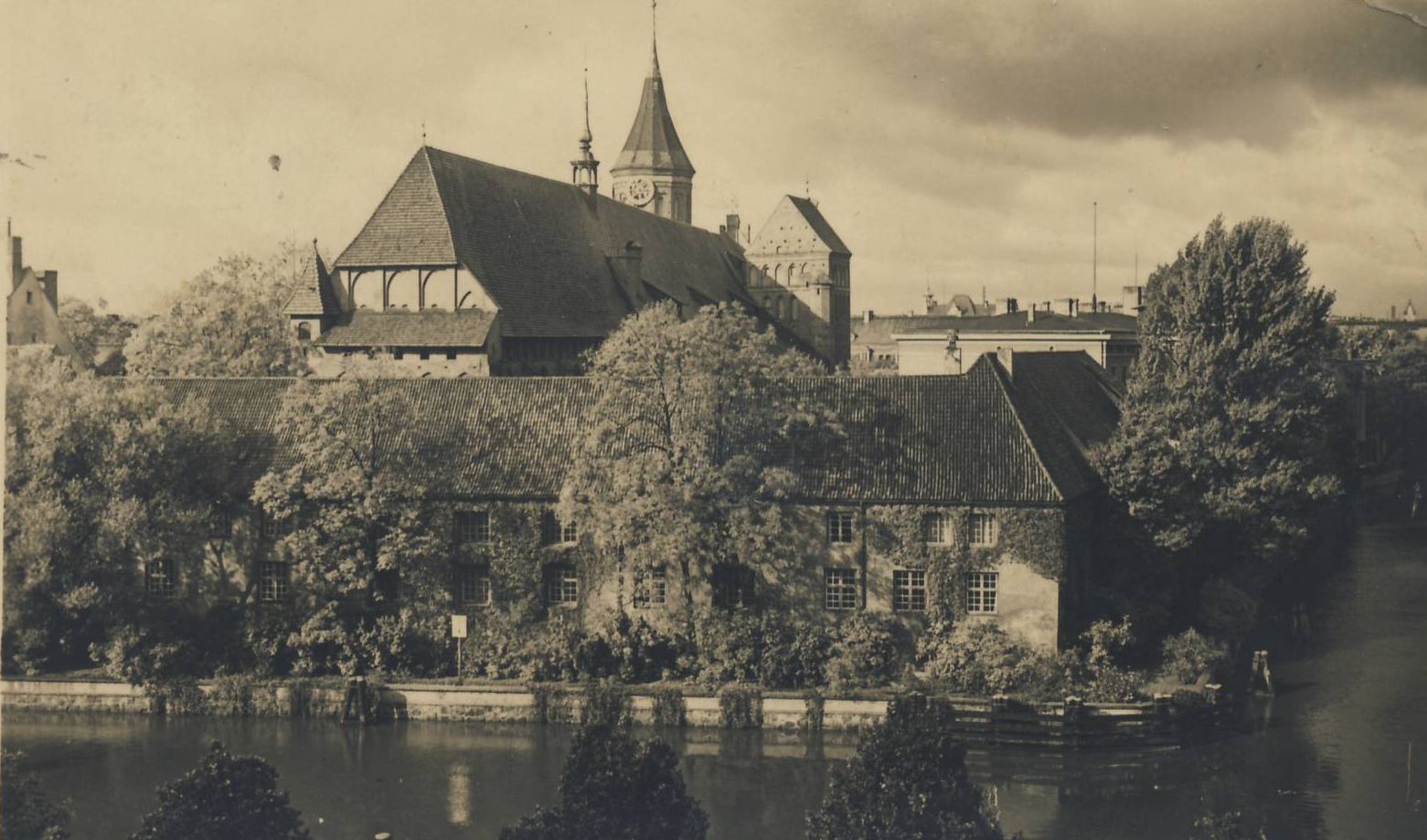
Image: Wikimedia Commons / Public Domain.
On 12 February 1804, Kant died at his home in Königsberg, saying to his servant just before death, “Es ist gut” — “It is enough.” Buried at the north wall of the cathedral. One hundred and twenty years later, in 1924, for the bicentennial of his birth, Königsberg built an open colonnade tomb at the original grave site, called the Stoa Kantiana.
And the opening of the conclusion of the Critique of Practical Reason is inscribed in that colonnade:
Der bestirnte Himmel über mir, und das moralische Gesetz in mir.
“The starry heavens above me, and the moral law within me.”
Kant goes on: there are two things, the more often I think of them, the greater and the deeper they fill my mind with admiration and awe. One is outside, infinitely large; one is inside, infinitely deep. And what connects the two is the being who can both know the starry heavens and give itself law.
Why the border, why Prussia
Why Königsberg? Why not Paris, Edinburgh, Göttingen?
This city in the 18th century occupied a strange position — at the easternmost end of the German-speaking world, abutting Poland, Lithuania, and Russia, the port hub of Prussia, the easternmost lighthouse of the European Enlightenment. It wasn’t large (about 60,000 in Kant’s time), but as a trading port it received English, Dutch, Russian, Jewish, and Polish merchants — Kant never traveled, but the world came to him. He read Hume, Rousseau (Rousseau’s portrait was the only ornament in his study), Newton, Leibniz — all the raw material arrived along this shipping lane.
And Pietism gave him a unique core: God is not outside, He questions you from within. Run that temperament through Kantianism, and you get the “transcendental self” — not some particular self, but any position that can ask “what can I know.” That position can be in Königsberg, or in any reader of his books two centuries later.
In August 1944 the British bombed Königsberg, and in April 1945 the Red Army stormed it; the old city was almost entirely leveled. In 1946 the city was renamed by the Soviet Union to Kaliningrad (after Soviet leader Mikhail Kalinin), and the Potsdam Agreement gave it to the USSR. The German-speaking inhabitants were expelled, and the city’s language, street names, and population were exchanged in their entirety. In the midst of all this, Kant’s grave miraculously survived — reportedly under Soviet officers’ protection, because Kant “was also a critic of German idealism, and was quoted by Lenin.” In 1992–1996, Germany and Russia jointly funded the restoration of the bombed-out cathedral.
Today in Kaliningrad you cannot see the physical shell of the Königsberg Kant lived in — except his grave and a few stone walls of the cathedral. It is almost the only place in the city you can sense the pre-German period. A city he lived in has been erased, but this erasable grave still tells you: he walked here, every afternoon at three-thirty.
Appendix · For those who can get there — route
- Getting there · Kaliningrad is a Russian exclave, surrounded by Poland and Lithuania. Entry requires a Russian visa — there used to be a Kaliningrad-specific e-visa policy (72-hour visa-free / e-visa), but policy has fluctuated since 2022; current status should be verified with the Russian consulate or visa services before traveling. Flying from Russia proper is most convenient (Moscow / St. Petersburg 1.5–2 hours direct); overland through Belarus-Lithuania or Poland is complicated for Schengen-visa travelers right now.
- What to see · Königsberg Cathedral (Кафедральный собор) is at the city center on Kneiphof island (Russian: Остров Канта, “Kant Island”), restored 1992–1996; the second floor is now the Kant Museum, holding his death mask, the first edition of the Critique of Pure Reason, and several artifacts. The Stoa Kantiana (Kant’s tomb) is on the north exterior wall of the cathedral, open-colonnade, viewable any time — you can stand at the tomb without entering the cathedral.
- When · May to September is most comfortable, the Baltic wind not cold. Winters are very cold with extremely short days. 22 April (Kant’s birthday) and 12 February (death day) usually have local academic commemorations.
- Companion · The Philosophenweg in the war was destroyed, but the city government has restored a green walking strip near the original “Philosopher’s Path,” with Kant quotations on signs. The city also has a Kant statue, originally by Christian Daniel Rauch (1864), destroyed in WWII, recast in 2005 with German funding, standing in front of the former Albertina University (now Russia’s Baltic Federal University).
Part V · The 19th Century — Postbox, Dome, High Mountains
1806–1889. A Privatdozent without a regular post at 35 puts his manuscript into the post the night before Napoleon enters town; an exile clocks in at the round reading room of the British Museum from 9 to 7 every day; a former professor forced into the Alps by migraines arrives at the eternal return beside a lakeside boulder. For the first time, thought unfolds at the scale of “World Spirit” — and at the same time collapses at the scale of a “mountain hut.”
Hegel · Phenomenology of Spirit — October 1806, Jena
On the evening of 13 October 1806, the campfires of the French army were already visible on the hills west of Jena. A 35-year-old Privatdozent, still without a regular post, bound the last pages of the Phenomenology of Spirit and sealed them into an envelope — addressed to Niethammer, his publisher in Bamberg. The next day, Prussia was annihilated outside the city, and his lodgings were looted by French troops; he ran out with what was left of the manuscript in his arms. The book he had put into the postbox would define 19th-century philosophy.
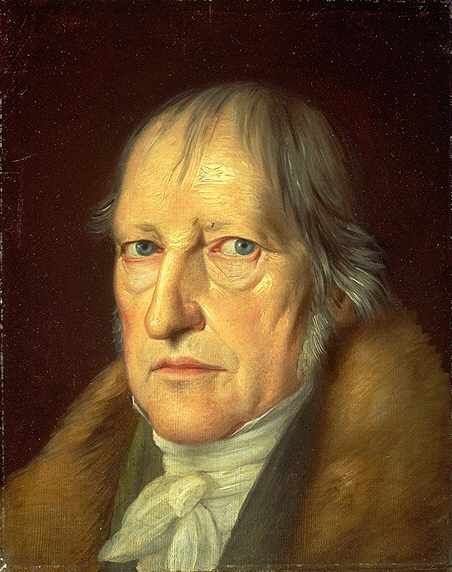
Image: Wikimedia Commons / Public Domain.
Jena in 1806
To understand why Hegel posted that book that night, pull the lens back. From the 1790s to 1806, the University of Jena was the epicenter of philosophy in the German-speaking world: Fichte arrived in 1794 to give his Wissenschaftslehre, was expelled in 1799 over the “atheism dispute”; Schelling took over in 1798 and stayed until 1803; Hölderlin came through, the Schlegel brothers, Novalis, and Tieck gathered around Caroline in early Romantic salons; Goethe was at his post 30 km away in Weimar, overseeing the university’s affairs, personally recruiting and dispatching names. A Thuringian town of only a few thousand people became, because of one school and one Weimar duchy, the engine where German idealism took the baton from Kant and pushed it forward.
Hegel was the latecomer to this epicenter. He arrived in Jena from Frankfurt only in 1801, landing as a Privatdozent — a fee-paying lecturer without salary, living on student lecture fees. He co-edited the Critical Journal of Philosophy with Schelling, finding his own voice behind his five-years-younger friend who was already famous. In 1805 he was finally promoted to Außerordentlicher Professor, extraordinary professor — good title, almost no salary. At 35, paper after paper, still no regular post. From that year he began turning the material on “consciousness’s experience of itself” he had been giving in lectures into a thick book.
By the summer of 1806 the manuscript was largely shaped; the original plan was an ordinary academic book with the Bamberg publisher Joseph Anton Goebhardt. The contract was signed in haste: Hegel needed money, the publisher pushed for delivery, and the deadline was October. He chased that date all summer; by autumn, he was chasing not only the deadline — but Napoleon.
Image: Wikimedia Commons / Public Domain.
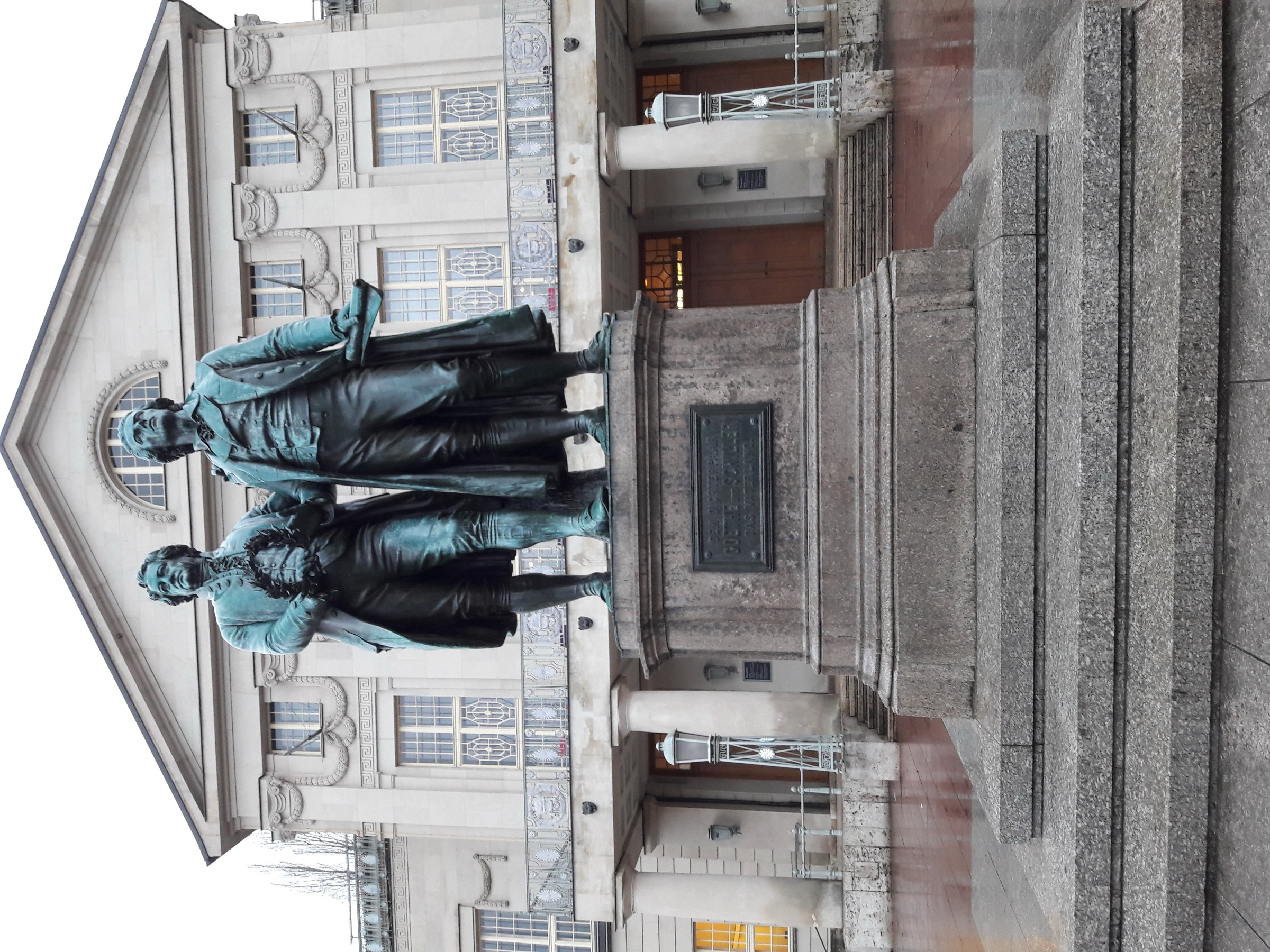
Image: Wikimedia Commons / CC BY-SA.
That postbox and that battle
In October 1806 the fires of the Fourth Coalition reached Thuringia. On the afternoon of October 13, Napoleon’s advance guard reached the outskirts of Jena. People in town began moving valuables into cellars, those who could moved north, the rest boarded up windows. That day Hegel saw from his window the figure that would travel through Europe. He wrote a sentence in his letter to Niethammer of October 13 that has been quoted in every Hegel biography:
„Den Kaiser — diese Weltseele — sah ich durch die Stadt zum Recognoscieren hinausreiten.”
“I saw the Emperor — this World Soul — ride out of the city for reconnaissance.”
The sequence has to be precise: when he sat down to write this letter, the last sections of the Phenomenology were largely bound and ready to go off in batches to the publisher in Bamberg; when Napoleon entered the city, Hegel was not at the bindery but at the window, watching the man who turned over the old Europe ride down his own street. The two events were squeezed into the same two days — and the metaphor he later used all his life, of Weltgeist (World Spirit) manifesting in history through an individual, was not abstract rhetoric. He had seen it once with his own eyes.
October 14: the Battle of Jena-Auerstedt. Napoleon on the heights outside Jena, Marshal Davout on the plain of Auerstedt 20 km north, in a single day shattered Frederick the Great’s old Prussian army. Hegel’s lodgings — by several biographies’ accounts in an old building around the Markt in the city, the precise address now hard to verify — were looted by French troops. He hurriedly left with what was left of the manuscript, sleeping at a friend’s, then sending the rest of the book to Bamberg in two batches. In his letter of October 18 he complained to Niethammer about lost luggage and lost dignity, but still handed in the last pages.
The Phenomenology was printed at Bamberg and Würzburg in the spring of 1807. The phrase on the title-page preface — “the true is the whole” (das Wahre ist das Ganze) — became one of the most quoted sentences in all of German idealism. By the time the book appeared, its author no longer had a job in Jena. The university was half-paralyzed; Niethammer arranged for him to become the editor of the Bamberger Zeitung in Bamberg (1807–08), then headmaster of the Gymnasium in Nuremberg for eight years (1808–16), professor at Heidelberg from 1816, then called to Berlin in 1818. He died in Berlin of cholera on 14 November 1831 and, by his own request, was buried in the Dorotheenstadt cemetery next to Fichte — the man expelled from Jena in 1799 became, thirty-two years later, his long-term neighbor.
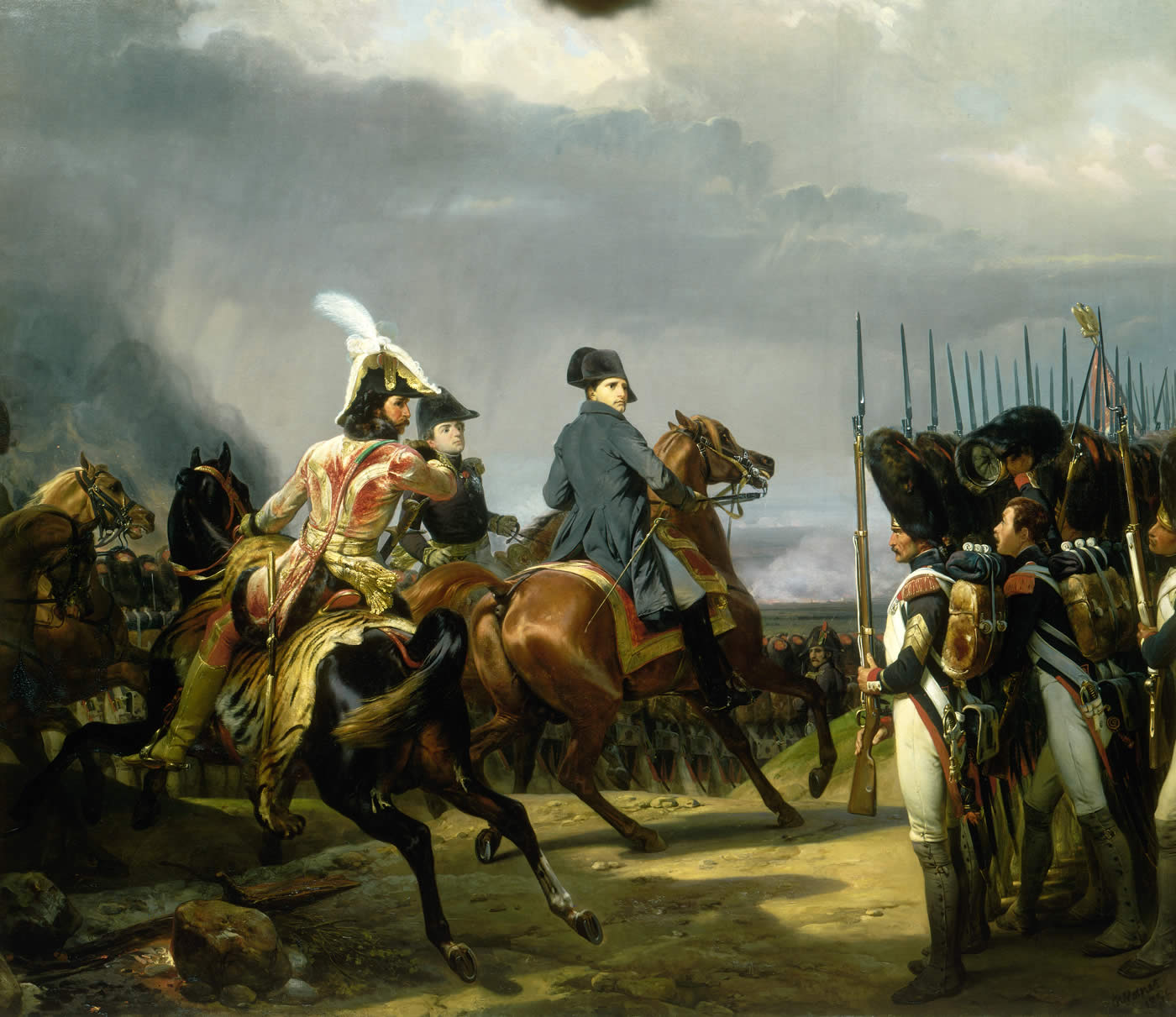
Image: Wikimedia Commons / Public Domain.
Why Jena
Put that night back on the map of Europe and three things stack on the same point. First, Jena as scholarship: German philosophy after Kant had pushed the Fichte–Schelling line — “how does the subject push the world out of itself” — to a critical edge, and Hegel entered town at the hottest end of that line. What he had to do was to close that line and then turn it inside out — to let “Spirit” walk its whole detour from sense-certainty to absolute knowledge. That summarizing work had to take place in a town where Fichte’s echo could still be heard and Schelling was next door.
Second, Jena as politics: the 1806 defeat smashed the old shell of the Holy Roman Empire (Franz II abdicated in August the same year); Prussia began its reforms, southern German states entered the Napoleonic system. A new world was replacing an old one — what Hegel saw out his window was not a particular general, but the replacement itself. His later philosophy of history is built on a basic experience: thought does not first form a concept and then look for history; history moves first, and thought catches up to articulate it. On the night of 13 October 1806 he held both ends for the first time.
Appendix · For those who can get there — route
- Getting there: ICE from Berlin Hbf or Frankfurt(M) Hbf to Jena Paradies, roughly 2 hours / 2.5 hours; from Leipzig Hbf a regional train about 1 hour direct. The town is small, everything walkable.
- In Jena: From Jena Paradies, 10 minutes on foot to the Markt, the old market square. The Romantikerhaus nearby (the Schlegel brothers’ salon, now a museum) is worth a sit. Hegel’s specific address is not uniformly recorded; biographies tend to say generically “in the city, around the Markt.” If you must have a single point, half an hour through the old lanes around Johannisstraße / Unterm Markt off the Markt is the scale of the 1806 Jena still detectable today. Opening hours per official website.
- 30 km side trip: 15-minute regional train from Jena to Weimar, then Goethe-Wohnhaus (Frauenplan 1) + Schiller-Wohnhaus (Schillerstraße 12) + the Goethe-Schiller double statue in front of the national theater. Half a day. This was the route Hegel rode back and forth on in those Jena years.
- The grave: Berlin Dorotheenstädtischer Friedhof (Chausseestraße 126, 5 minutes out of U-Bahn Oranienburger Tor). Hegel is buried next to Fichte; Brecht and Heiner Müller are also in this cemetery. Autumn is the best time — leaves falling on the headstones.
Marx · Capital — 1849–1883, London
The London fog followed him from August 1849 to March 1883. A German Jew expelled from Prussia, France, and Belgium in turn finally sat down in the library at the heart of the empire and wrote, on the books of the British Empire, a book that would tear down that empire. This itself is the greatest irony of the 19th century.
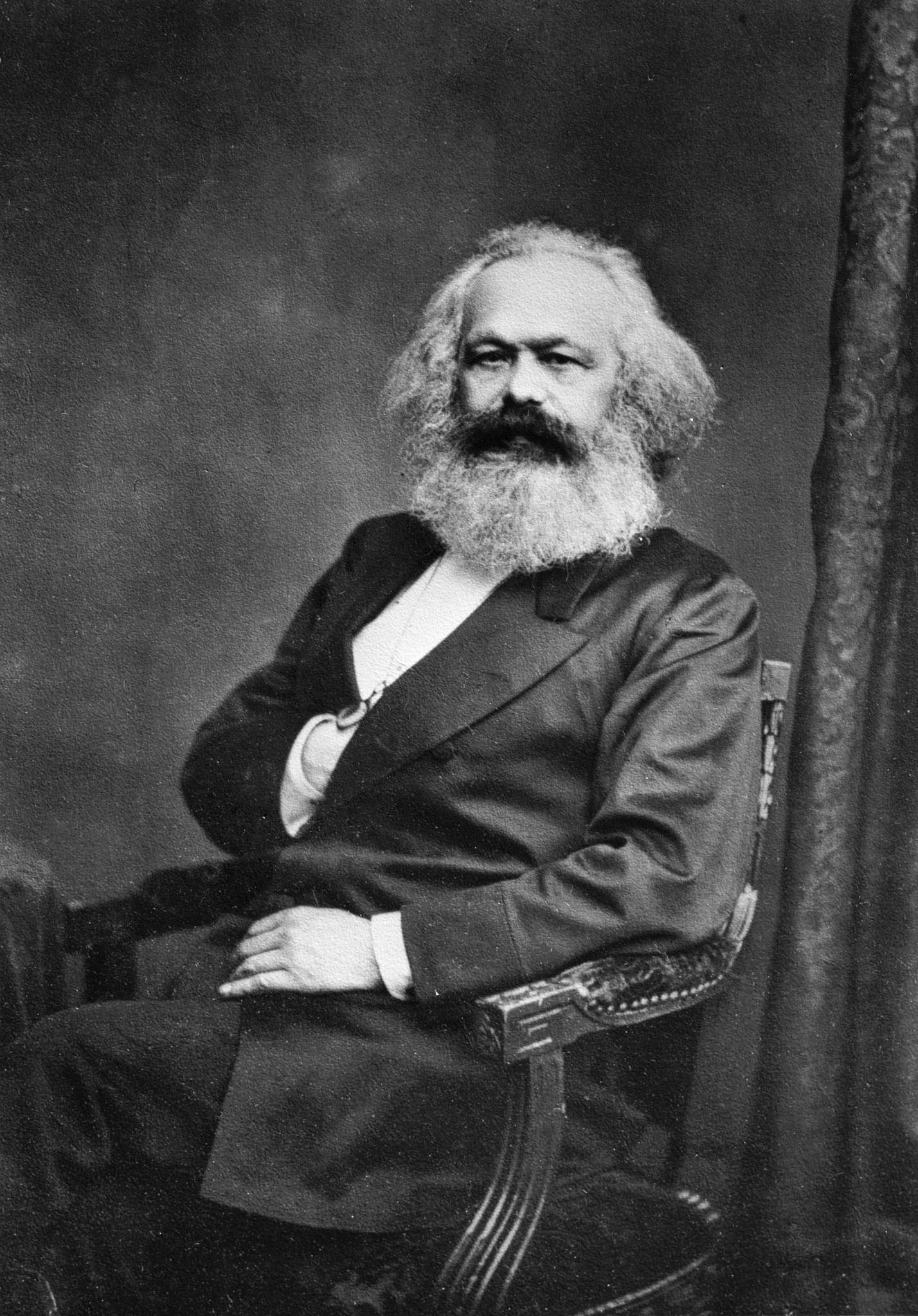
Image: Wikimedia Commons / Public Domain.
What happened that year — arriving in London, 1849
Born 1818 in Trier in Prussia’s Rhineland, his father Heinrich Marx was a lawyer who in 1817 converted to Lutheranism to circumvent the law barring Jews from practice; Marx himself was baptized at one. He studied law and then philosophy at Bonn and Berlin, his doctoral dissertation on Democritus and Epicurus. After the Rheinische Zeitung was banned in 1843, he went to Paris and met Engels; expelled by France in 1845, he went to Brussels; in 1848 he and Engels finished the Communist Manifesto there (drafted in Brussels, printed in London); after the February Revolution he was expelled by Belgium, returned to Cologne to run the Neue Rheinische Zeitung, was prosecuted by Prussia, the paper closed. On 24 August 1849, he set foot on the dock at Dover with only a few francs in his pocket, thinking it would be a stay of a few months — he stayed thirty-four years, until his death.
The first year was the hardest. The family was evicted from 4 Anderson Street in Chelsea, their belongings impounded on the street; in 1850 they moved to 64 Dean Street in Soho, in 1851 to 28 Dean Street — top floor two rooms, family of seven plus housekeeper Helene “Lenchen” Demuth, damp, no coal, creditors knocking downstairs. Three children died in those rooms: Heinrich Guido, born 1850, died winter 1850; Franziska, born 1851, died of bronchitis 1852, the coffin paid for by a neighbor’s loan; his most beloved son Edgar — nicknamed “Musch” — died in his father’s arms in spring 1855, aged eight. Marx wrote to Engels afterward: “I have lived through many unhappy events, but only now do I know what real unhappiness is.”
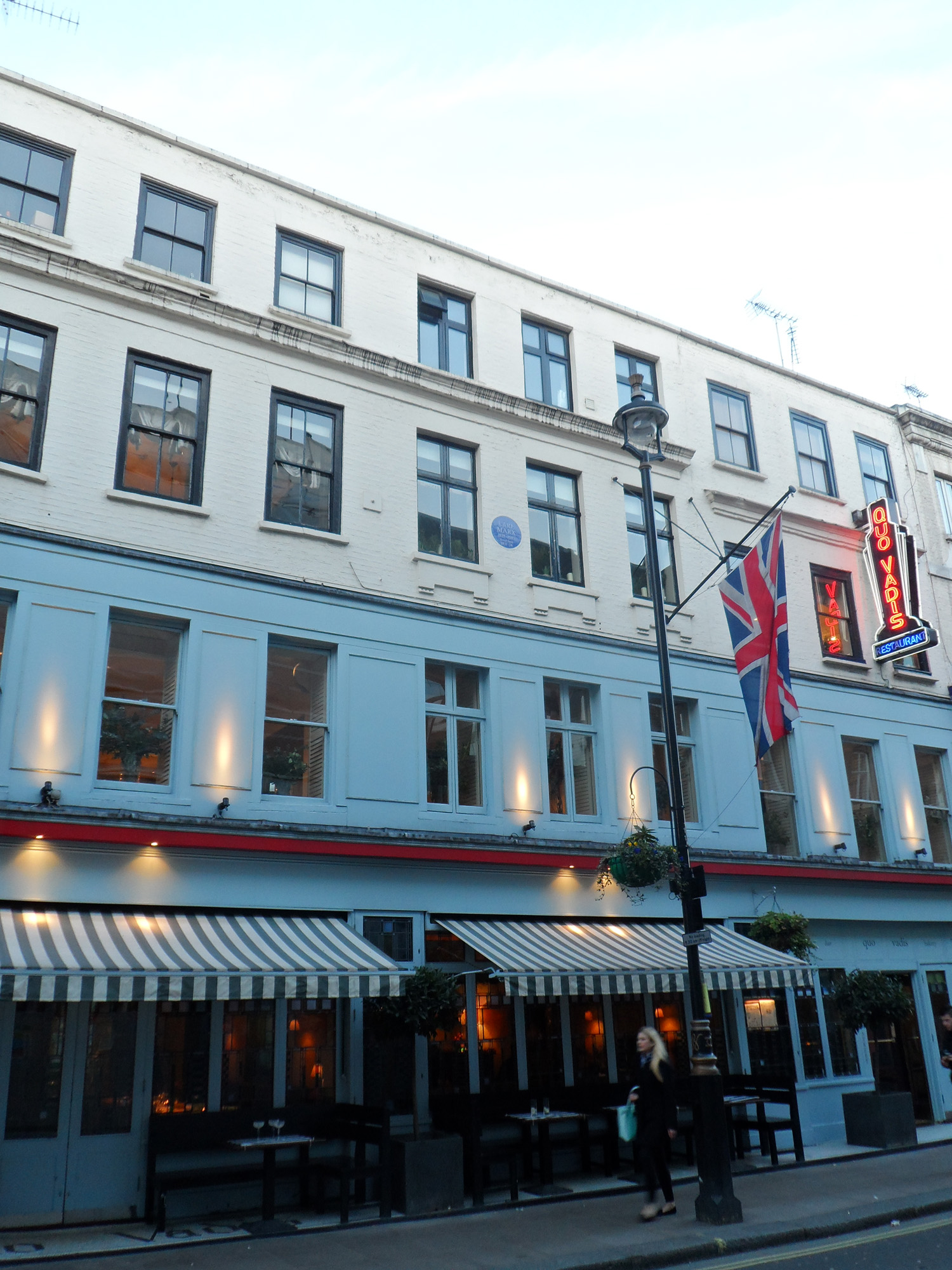
Image: Wikimedia Commons / CC BY-SA.
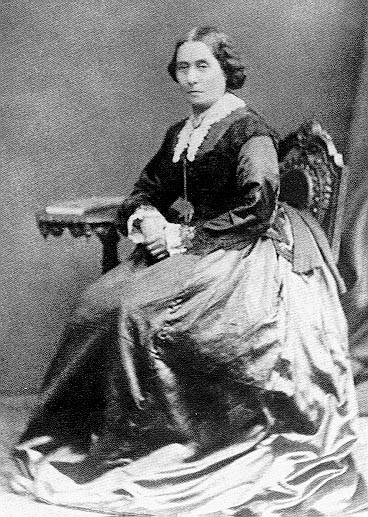
Image: Wikimedia Commons / Public Domain.
The same seat under the dome
In June 1850 Marx received his British Museum reading-room ticket; from that year on, almost every day he was there when the doors opened at 9 and stayed until they closed at 7, going back to Dean Street midday for a hot meal then returning. The Round Reading Room was only completed in 1857 by Sydney Smirke — blue-and-gold dome, 140-foot radius, cast-iron stacks, leather-topped desks radiating outward; before that he had used the old reading room, only moving under that famous dome (now photographed by tourists) after 1857.
“Marx’s seat” is legend. Docents will still point at G7, L13, or P-7 — the version varies, the museum has no official record, and Marxist Internet Archive notes this is folk lore. What is certain is that he was indeed there for years — from 1850 right until his body gave out in the early 1880s — pulling volume after volume of Blue Books (British parliamentary factory reports), Malthus, Ricardo, Adam Smith, the English Factory Acts, the history of British colonial India, statistical yearbooks of the machine industry.
The capitalist appropriation, which is based on the appropriation of the products of social labor, is thus the radical contradiction of the developed law of commodity production.
The sentence in Chapter Twenty-Four of Volume One of Capital — “the so-called primitive accumulation” — was written and rewritten in that chair under the dome. The detail that fascinates: this book, which would tear down capitalism, was written from the ready-made data of capitalism’s most mature machine (the British Empire’s Office of Statistics, parliamentary Blue Books, East India Company archives). Marx did not go to the factories. He sat in London’s most luxurious reading room and, through reports the empire published about itself, reconstructed the empire’s viscera.
In 1856 Engels took over the family share of the Manchester mill; from then on he sent monthly checks. The Marx family moved out of Soho, north to Grafton Terrace near Kentish Town, then to 9 Maitland Park Road. Life eased a little, but his body was breaking — liver disease, boils, insomnia, a nearly blind right eye. On 14 September 1867 Volume One of Capital was published in Hamburg by Otto Meissner, 800 pages, 1,000 copies first run, slow to sell. He wrote to Engels: “I hope the bourgeoisie remembers my carbuncles for the rest of their lives.” Twenty-five years of work compressed into that book.
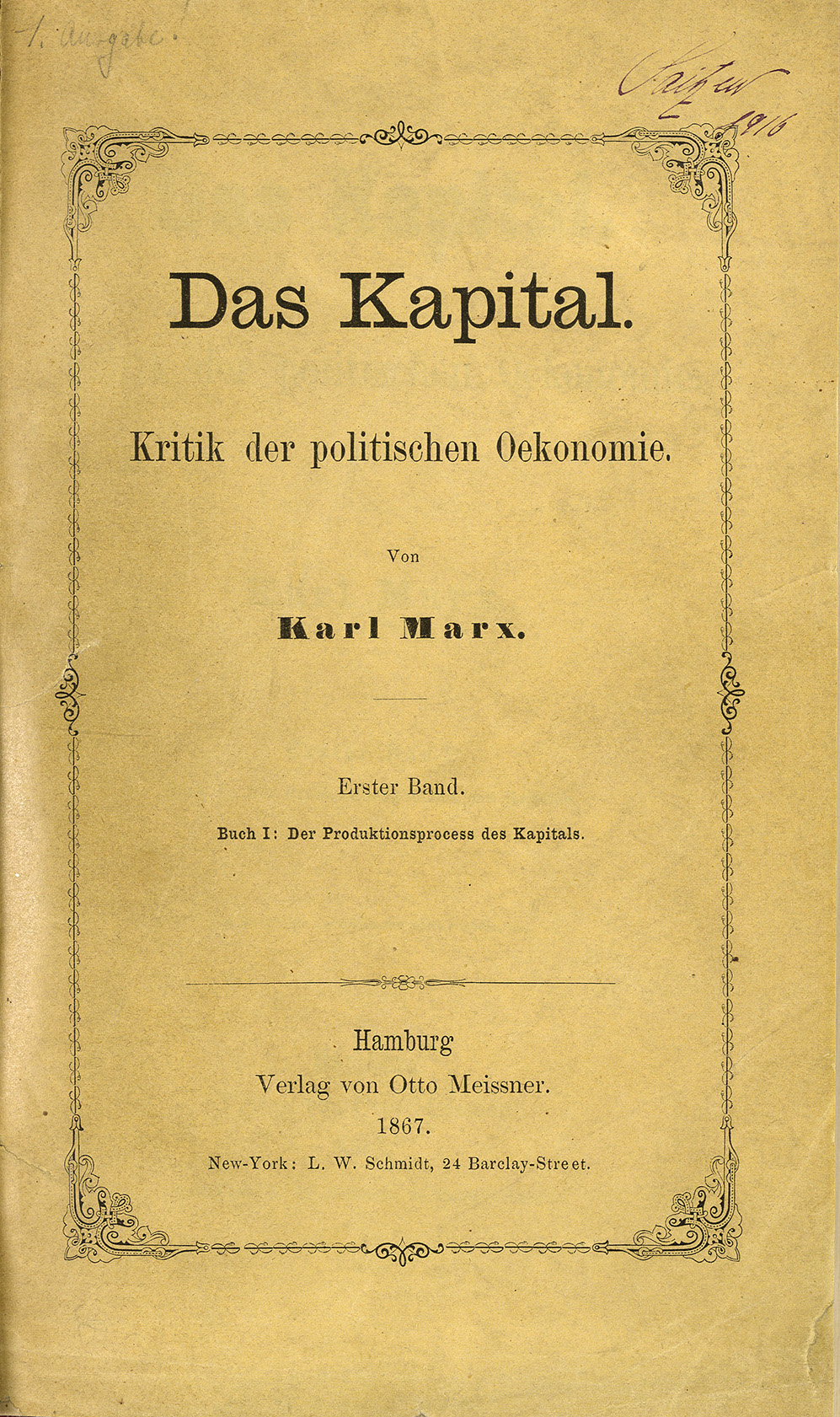
Image: Wikimedia Commons / Public Domain.
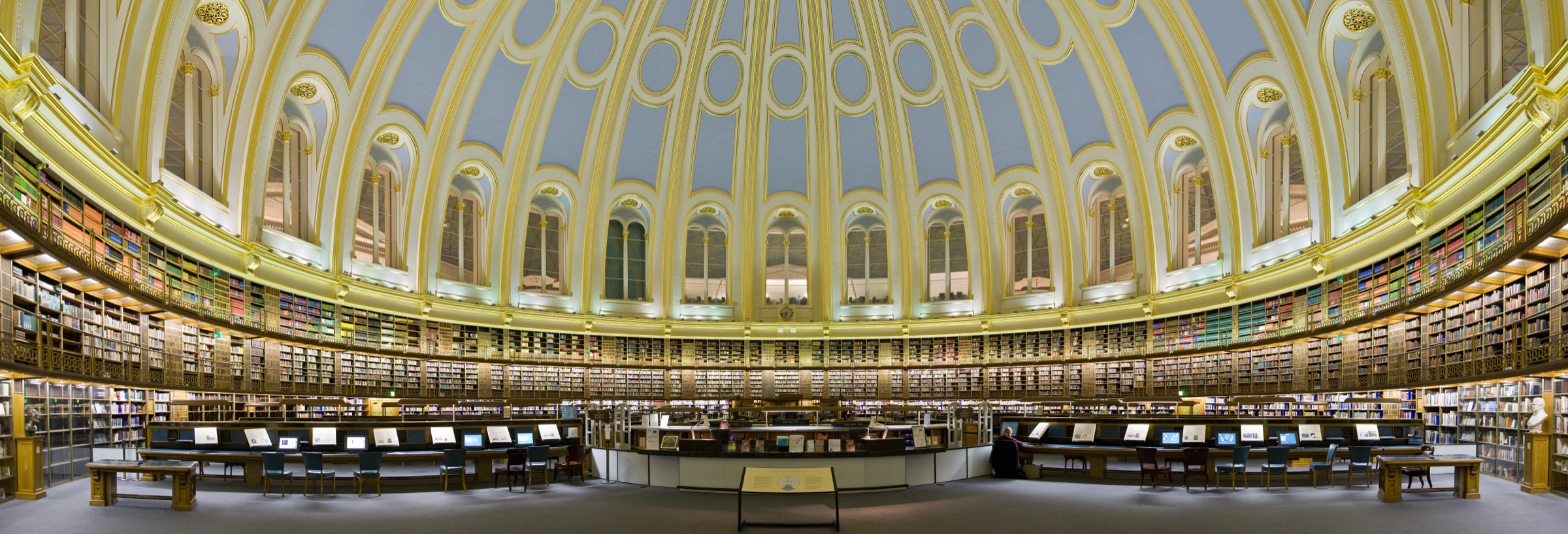
Image: Wikimedia Commons / CC BY-SA.
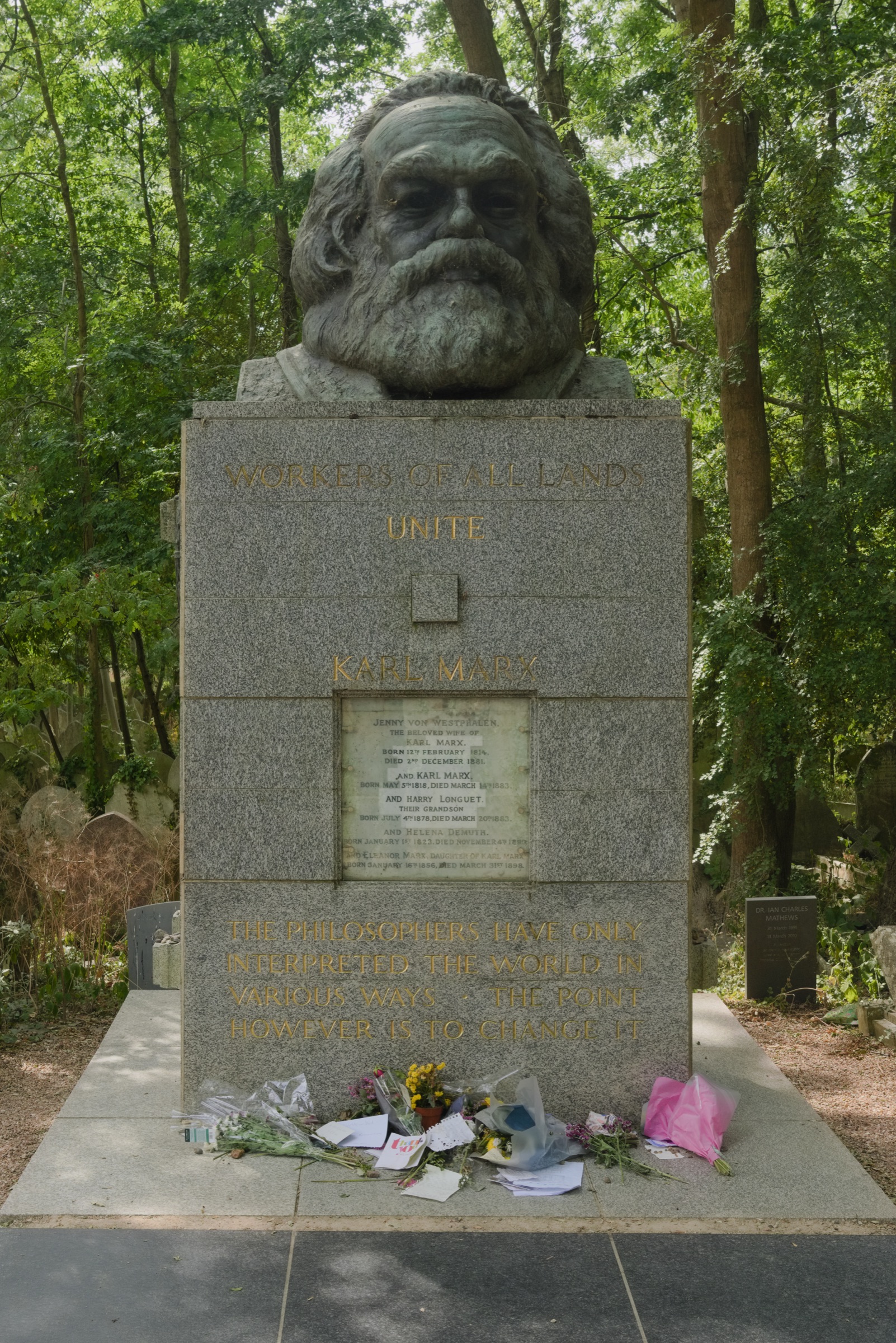
Image: Wikimedia Commons / CC BY-SA.
In 1881 Jenny died of liver cancer. Marx scarcely wrote a letter for a year. On the afternoon of 14 March 1883, 2:45 PM, Engels pushed open the door at 9 Maitland Park Road as usual — Marx was in his armchair, having just stopped breathing, a Russian statistical yearbook open on the table beside him. Three days later he was buried at Highgate Cemetery East; the funeral had eleven mourners; Engels read the eulogy: “A man who worked all his life for humanity’s liberation.”
Why London
Asking why London produced Capital is less useful than asking: was there a second city in the world of the 1850s where it could have been written? No. Manchester had factories without a library, Paris had a library but a revolution every few years driving people out, Berlin was the capital of Prussia and could not house him. Only London simultaneously had the three nearly impossible coexisting things: the world’s most complete site of industrial capitalism (within a mile, from the Thames docks to the East End sweatshops), the world’s most detailed government public statistics (the parliamentary Blue Books, from the 1830s, mandating factory owners disclose child-labor mortality), and a city culture most indifferent to political exiles (the police never knocked on his door).
The empire’s openness became the workbench of the empire’s gravedigger. In his later years at Maitland Park Road, a London map hung in his study, and it is said he pointed at the south bank of the Thames and said: “Everything is here, waiting to be read out.” That line has no reliable source, but it sounds like him. The entire city was his laboratory, and the Round Reading Room was his microscope.
Appendix · For those who can get there — route
- British Museum Round Reading Room (Bloomsbury, Great Russell Street) — free entry to the museum, but the Round Reading Room has been essentially closed to the public since the 2000s — it served as the “Reading Room” exhibition space 2000–2007, fully closed since 2013 and currently not open to visitors (check britishmuseum.org for occasional open days before traveling). Next-best: look up at the dome’s exterior from the Great Court, then visit the “Enlightenment Gallery” for the 19th-century London knowledge-collection style. If you want to actually sit in a 19th-century London reading room, the British Library (St Pancras) Humanities 1 reading room is closest — show ID for a free reader’s pass.
- Soho, 28 Dean Street — the ground floor is the Quo Vadis restaurant (opened 1926; the building was not a restaurant when Marx lived there), and on the second-floor exterior wall is an English Heritage Blue Plaque: “Karl Marx 1818–1883 lived here 1851–1856.” The flat itself is not open to the public. 5 minutes’ walk from Tottenham Court Road station. Best at dusk — Soho is office space by day, with the restaurants lit up after dark the street recovers some of that period dampness.
- Highgate Cemetery East · Marx’s grave — north London, Swain’s Lane, 12 minutes’ walk from Highgate Tube (Northern Line). East Cemetery requires a ticket, adult ticket about £10 (check highgatecemetery.org for current pricing, which changes). The grave is to the right off the main path, moved in 1956 with British Communist Party funding from the original modest site to the current monumental position; bronze bust by Laurence Bradshaw. People often leave small stones at the grave; the lower half of the base inscribes the eleventh of the Theses on Feuerbach: “The philosophers have only interpreted the world in various ways; the point, however, is to change it.” Open hours roughly 10:00–17:00 (shorter in winter).
- Bonuses:
- Trier · Brückenstraße 10 (Marx House Museum, run by the Friedrich-Ebert-Stiftung). In May 2018, for Marx’s 200th birthday, China donated a 5.5-meter bronze statue of Marx (sculptor Wu Weishan), now standing on Trier’s old town Simeonstiftsplatz — a 19th-century German exile, his bronze statue sent back by 21st-century China, placed on the square of his birthplace.
- Manchester · Chetham’s Library (the UK’s oldest public library). When Engels was writing The Condition of the Working Class in England in 1845, he and Marx had a square table by the window here; the librarian still points it out.
Nietzsche · Eternal Return — 1881–1889, Upper Engadine and Turin
On 6 August 1881, by Lake Silvaplana in the Upper Engadine at 1,800 meters, beside a pyramidal boulder, a thought struck Nietzsche: eternal return. The boulder was later pointed out to tourists as the Pyramidenstein bei Surlej. Eight years later, that thought did not save him — on 3 January 1889, in Carlo Alberto Square in Turin, he embraced an old horse being beaten by its driver and wept; from then on he never wrote a word. This chapter traces his path from the summer mountains to the winter colonnade. For the relay of ideas (Descartes → Hume → Nietzsche) see Thought Relay.
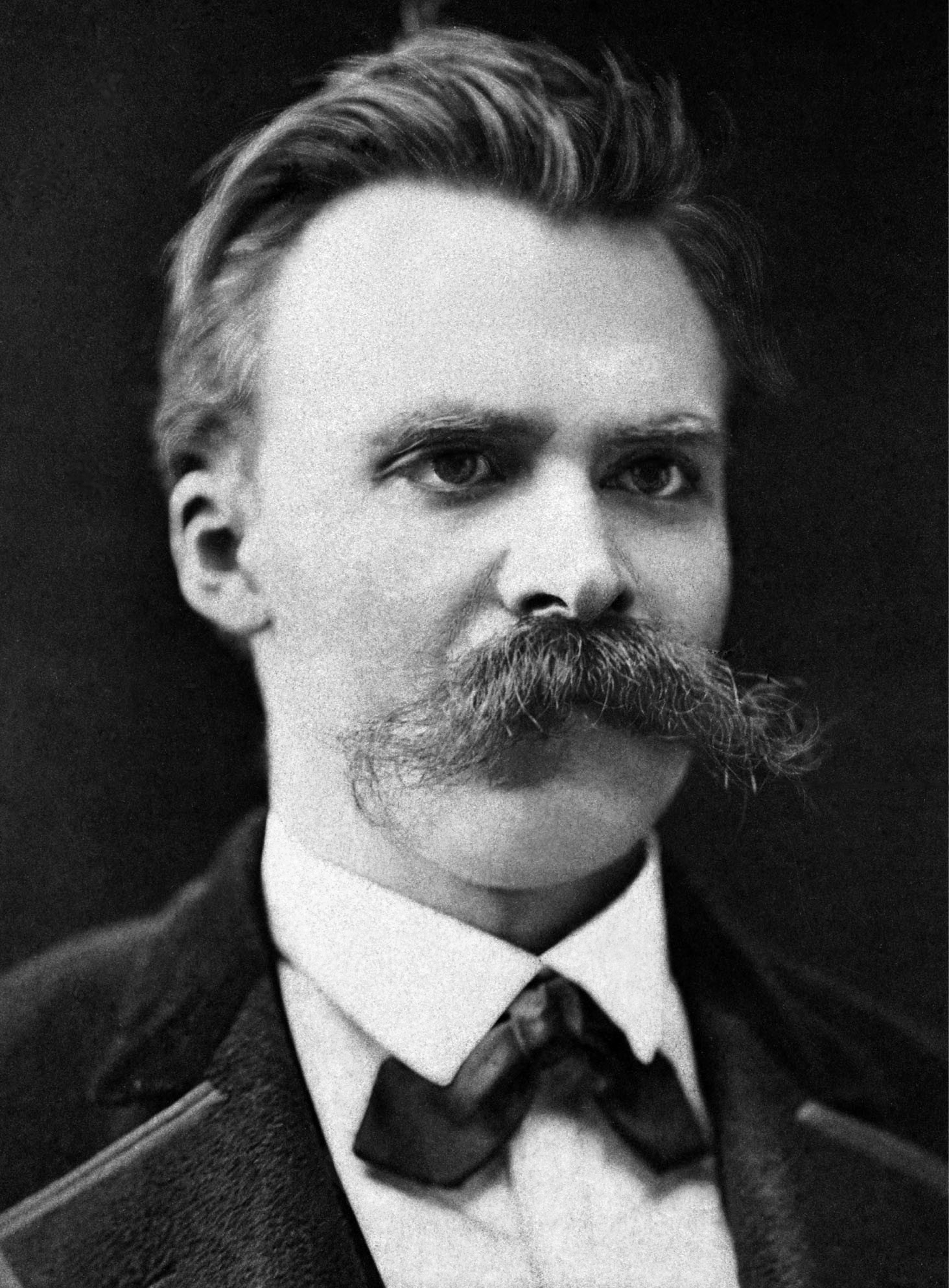
Image: Wikimedia Commons / Public Domain.
What happened that year — the Engadine of 1881
In 1879, at thirty-five, Nietzsche retired from the University of Basel. He had been its youngest classics professor since age twenty-four, but ten years of migraines, optic neuritis, and stomach illness had broken him; he resigned “for health reasons,” drawing a meager retirement pension of under 3,000 Swiss francs and never holding another fixed post. He became a season-following migrant: in summer to the heights of the Alps to flee heat, in winter to the Mediterranean coast to flee cold. He walked this route for ten years — summer Sils-Maria, winter Genoa, Nice, finally Turin.
On 4 July 1881 he first arrived in Sils-Maria, taking a small room on the second floor of the village grocer Durisch’s house for one franc a month. Outside the window was Lake Silvaplana; further west, the Maloja Pass; the room small enough for only a bed, a writing desk, and a washbasin. From then to 1888, almost every summer he came back to that same room — seven summers, producing the first three parts of Thus Spoke Zarathustra, Beyond Good and Evil, On the Genealogy of Morality. The room is now the Nietzsche-Haus Sils Maria, open to the public since 1960.
In early August that year he walked five to eight hours a day alone along the lake. On 6 August, on the east shore of Lake Silvaplana, near the village of Surlej, by a pyramidal boulder, he suddenly stopped. “That day I was walking along the woods by Lake Silvaplana; near a great pyramidal boulder not far from Surlej, I stopped. There the thought came to me.” he reconstructs in Ecce Homo. This was the first time eternal return entered his mind: would you be willing to live this life — every second, including all the shame — over an infinity of times?
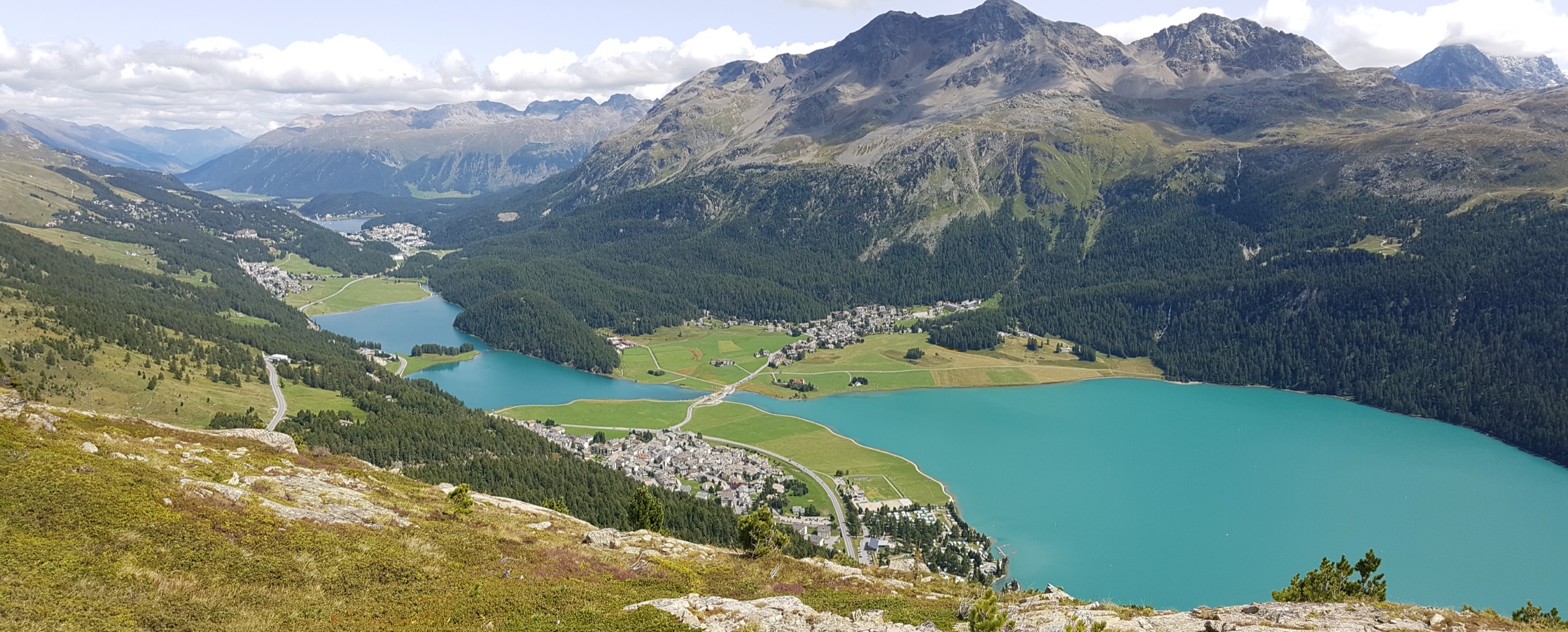
Image: Wikimedia Commons / CC BY-SA.
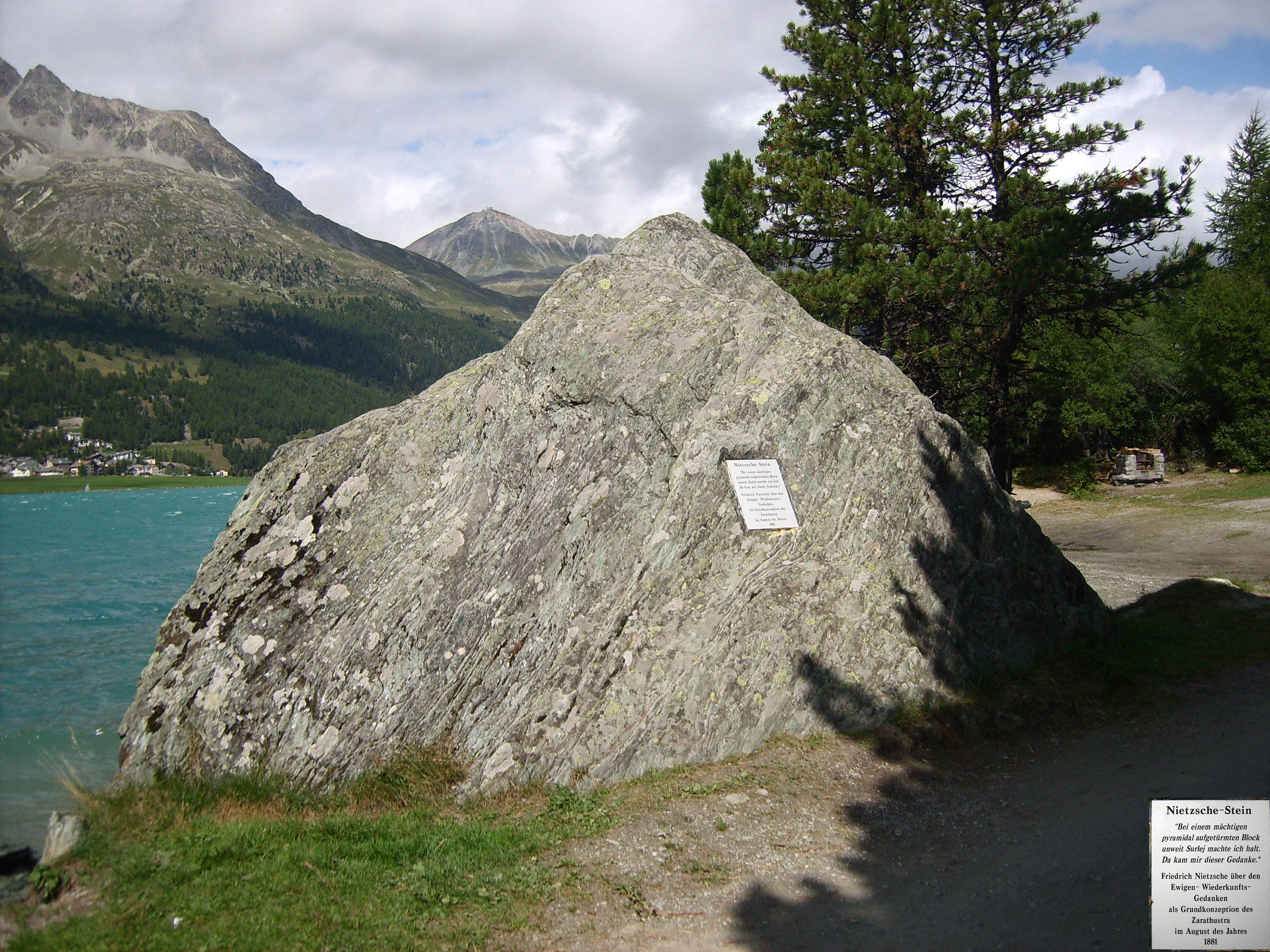
Image: Wikimedia Commons / CC BY-SA.
The moment · the Surlej boulder, and the horse in Turin
1881 · “The heaviest weight” at Sils-Maria
Eternal return is not a thesis about cosmological physics — though he did try in notebooks to ground it in energy conservation — it is first an ethical experiment. Section 341 of the Gay Science (1882) is titled “The heaviest weight”: a demon creeps into your loneliest night and says, “This life you are living now and have lived, you will have to live again, and innumerable times more; nothing new will come into it, all the pain, the joy, the thought, the sigh… will return upon you in the same order and sequence — even this spider, even this moonlight, even this moment and myself.” Will you cast yourself down and curse him, or answer: “I have never heard anything more divine”?
This is the most extreme test of whether one truly loves one’s own life. To say “yes” to eternal return means saying “again” to every second of it — including the worst. In Thus Spoke Zarathustra (1883–85) he pushed the thought to its peak, letting Zarathustra announce on the mountaintop:
“Say to all time: come back again!”
Writing that book he was nearly delirious. The first part was finished in three weeks, the second in ten days. “My whole body trembled during that period,” he said.
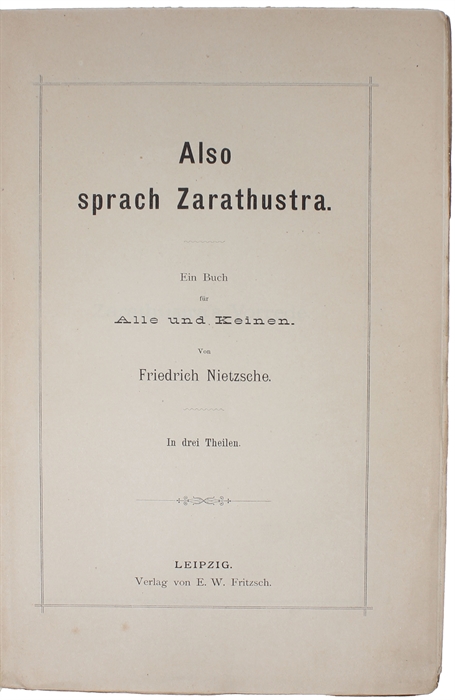
Image: Wikimedia Commons / Public Domain.
1889 · the horse of Turin
In April 1888, Nietzsche came to Turin for the first time. From Nice he went north, across the Genoa plain, to the old Savoyard capital. “There is an aristocratic quiet here,” he wrote, “the colonnades, the wide streets, the evening lamps, the Po — all of it puts me in better spirits.” He stayed in a second-floor room at Via Carlo Alberto 6, just off the square, in the house of the news-vendor Davide Fino, walking each day along Via Po to the river, listening to street bands, eating slow meals in cafés.
That autumn and winter he wrote feverishly — Twilight of the Idols in three weeks, The Antichrist in two, Nietzsche contra Wagner in a few days, and the autobiographical Ecce Homo in one stroke. All of these were within 1888, almost all in that small Turin apartment. The text grew brighter, the rhythm faster, the aggression sharper — he himself later wrote in the autobiography: I philosophize with a hammer.
On the morning of 3 January 1889, Carlo Alberto Square. A cab stood there, the cabman whipping an old horse. Nietzsche ran across the street, embraced the horse’s neck and wept, and collapsed on the cobblestones. Davide Fino carried him home. Over the next few days he wrote to Cosima Wagner, to Burckhardt, to Brandes, signing himself “Dionysos” or “The Crucified.” In early January his friend Franz Overbeck rushed from Basel, picked him up like a child, and put him on a train to the asylum in Basel. The diagnosis: progressive paralysis (some say late-stage syphilis, others a meningioma, never settled).
His mother Franziska took him from Basel to her house in Naumburg — the small house at Weingarten 18 where he had lived as a child — and cared for him for seven years. After her death in 1897, his sister Elisabeth moved the paralyzed and silenced Nietzsche to the Villa Silberblick in Weimar, founded the Nietzsche-Archiv, and ran it herself. On 25 August 1900 he died there, aged 55. He was buried in his birthplace Röcken (Saxony-Anhalt, near Lützen), beside the village church, next to his father — the Lutheran pastor who had died when he was four.
Why this place could grow this thought
The mountain where Nietzsche wrote Zarathustra is at 1,800 meters; the city where he collapsed is at 240. One is thin air, cold lake water, a sun setting only at nine in summer; the other is the fog of the Po plain, evenings under colonnades, hot coffee. He is the man who sees from above — the field of view from the Upper Engadine pressed down all the noise of European civilization and let him hear the bass note under two thousand years of moral language. But he is also the man who collapsed from below — the horse and its driver in Turin were a failed attempt to walk back among people; a high-mountain prophet on the city cobblestones embracing a suffering animal — in that moment he had turned back into the “last man” his own work had tried to overcome.
That is why the two extremes of this chapter cannot be separated. The Surlej boulder gave him the superman’s “once more!”; the Turin horse took away his ability to say it. Eternal return is the answer; the horse is the question — and the question outlived the answer by eleven years.
Appendix · For those who can get there — route
- Sils-Maria · Nietzsche-Haus (Graubünden, Switzerland, 1,800 m). From Zurich Hbf take the RhB red rack train via Chur → Samedan → St. Moritz, ~3.5 hours; transfer to Postauto yellow bus line 4 to Sils Maria Posta, ~25 minutes. The Nietzsche-Haus is at Via da Marias 67 in the village, open mid-May to mid-October, closed Mondays off-season. Ticket about 10 CHF. Inside you can see his second-floor room, with the writing desk and washbasin still in their original places.
- Pyramidenstein bei Surlej · the stone of eternal return. From Sils-Maria follow the Seeuferweg east-shore path of Lake Silvaplana north ~4–5 km to the village of Surlej, then continue 10 minutes along the shore. August is the right time, the month Nietzsche walked that path. Bring shoes good for five hours, a flask of water, and a copy of Gay Science §341.
- Turin · Carlo Alberto Square + Via Carlo Alberto 6. From Torino Porta Nuova station 15 minutes on foot to the square. At the south side of the square, the entrance to Via Carlo Alberto 6 has a commemorative plaque noting Nietzsche’s residence September 1888–January 1889. From there walk along Via Po to the river — the path he walked every day, about 1.2 km under the colonnades.
- Röcken · birthplace and burial place. A small village in Saxony-Anhalt, ~40 minutes by car from Leipzig; public transport requires changing to a local bus at Lützen. The birth house (Geburtshaus Nietzsche) is now a museum; the grave is in the adjacent Lutheran cemetery, three headstones in a row: father, mother, Nietzsche. Naumburg-Haus (Weingarten 18) and Weimar Nietzsche-Archiv (Humboldtstraße 36) are both open to the public, three sites strung together as a complete 1844–1900 biographical line.
Part VI · The 20th Century — A Hilltop Hut
1922–1976. Philosophy retreats into a hilltop hut without running water, without electricity. The university lectern below caught fire once (1933), the political stain was never washed out, but writing in that hut went on. The 20th century’s last posture: return to the ready-to-hand of tools and daily life — chop wood, draw water, watch snow fall on the roof.
Heidegger · Being and Time — 1922–1976, Todtnauberg
In the Black Forest, winter dusk falls at four. On the summit, in a three-room wooden hut, pine wood crackles in the iron stove, smoke from the chimney is torn into a thread by the wind. Heidegger loved that sound — halfway through Being and Time he would stand up from his desk, go outside to knock snow from his boots, and look toward the bell tower of St. Blasien down below. He always said that thought grew out of here, not from the Freiburg Lehrstuhl, not from the Marburg lectern, but from this hilltop hut without running water, drawing water from a well, lighting fires with split wood.
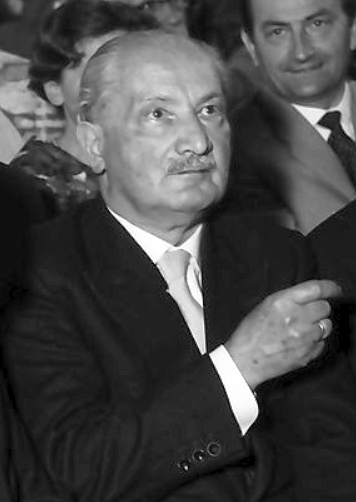
Image: Wikimedia Commons / Landesarchiv Baden-Württemberg · CC BY 3.0.
1922 on the summit — a hut built by his wife
In 1922 he was still Husserl’s assistant in Freiburg, thirty-three, with a meager salary and Being and Time not yet titled. His wife Elfride Petri did one thing — she took money from her parents, hired the village carpenters, and built a small wooden hut at about 1,100 m on the slopes of Todtnauberg. Three rooms: one bedroom, one living room, one writing room; plus a well, a wood stove, no running water, no electricity (electricity didn’t reach the hut until after WWII). Behind the hut were spruces; in front you could see the smoke of the village rising and, further off, the Alps on the Swiss side.
He called this place die Hütte — not “villa,” not “study,” just “hut.” From 1922 until a few months before his death in 1976 he went up almost every summer and winter for weeks at a time. The second half of Being and Time, Wegmarken, The Origin of the Work of Art, Contributions to Philosophy — most of the manuscripts were written at that pine table. In 1934 he wrote a short piece Warum bleiben wir in der Provinz? (“Why do we stay in the provinces?”) refusing the Berlin chair: the farmers down below greeted him “without needing a word, a knock on the pipe was enough.”
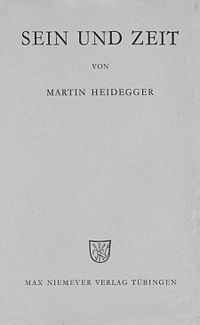
Image: Wikimedia Commons / Public Domain.
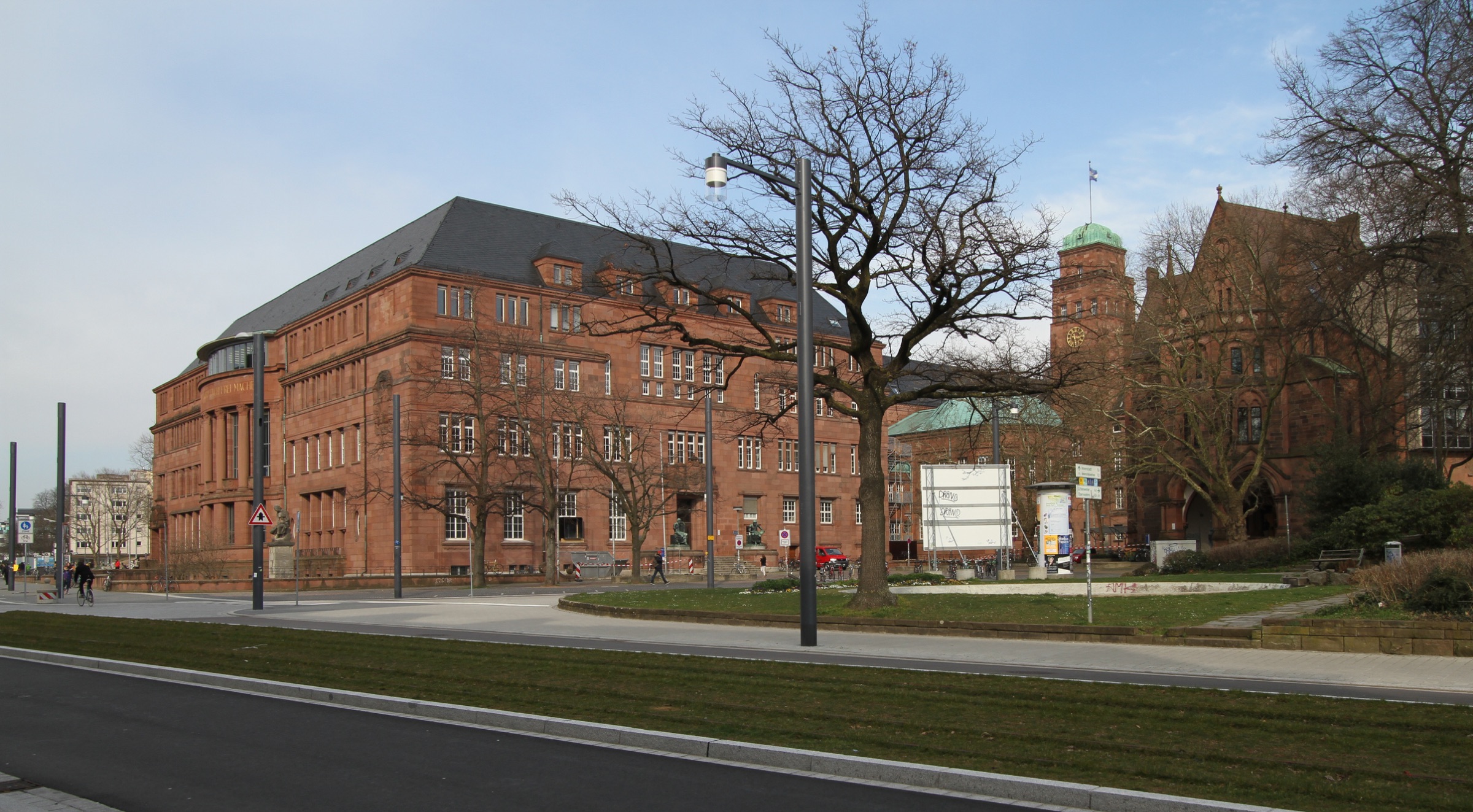
Image: Wikimedia Commons / CC BY-SA 4.0.
The three-room hut — visits of 1933 and 1967
But the hut held more than thought. It held the two hardest-to-explain episodes of Heidegger’s life.
The first is 1933. On 21 April he was elected rector of Freiburg; on 1 May he joined the NSDAP. On 27 May he delivered the inaugural lecture in the university hall, Die Selbstbehauptung der deutschen Universität (The Self-Assertion of the German University), weaving “labor service,” “military service,” and “knowledge service” — three forms of Dienst — into a call for the destiny of Germany. In April 1934 he resigned the rectorship. After the French occupation in 1945, the denazification committee banned him from teaching for five years (1946–51). Husserl had already died in 1938 in the isolation of being stripped of his chair — and from the sixth edition of Sein und Zeit in 1941, the dedication line to Husserl was removed. Heidegger said publicly only once that this was “a mistake,” and said no more. In 1947 he wrote to Jean Beaufret the Letter on Humanism, re-launching his writing; the letter’s line
“Language is the house of Being. Man dwells in the house of language.”
— became one of the most-quoted lines in postwar Continental philosophy. But for the part where he himself had collapsed that house, he left no line.
The second is 25 July 1967. The poet Paul Celan — Holocaust survivor, Jew, his mother killed in a Ukrainian camp — came to Todtnauberg specifically to visit Heidegger. Heidegger asked him to sign the visitors’ book (Gästebuch) in the hut, then took him to look at the wooden wheel on the well behind the hut. They walked along a small path and talked of something nobody now knows for sure. After Celan left, he wrote the short poem Todtnauberg:
“On the well-log / a star / a hope, today, / for a thinking man’s / coming / word in the heart.”
The word never came. Heidegger never publicly repented for the Nazi era. Celan drowned himself in the Seine in 1970. This hut holds both the purity in which Being and Time was written and the silence in the visitors’ book that never said it — standing outside the hut at a distance you might feel it too small to hold this, but it does.
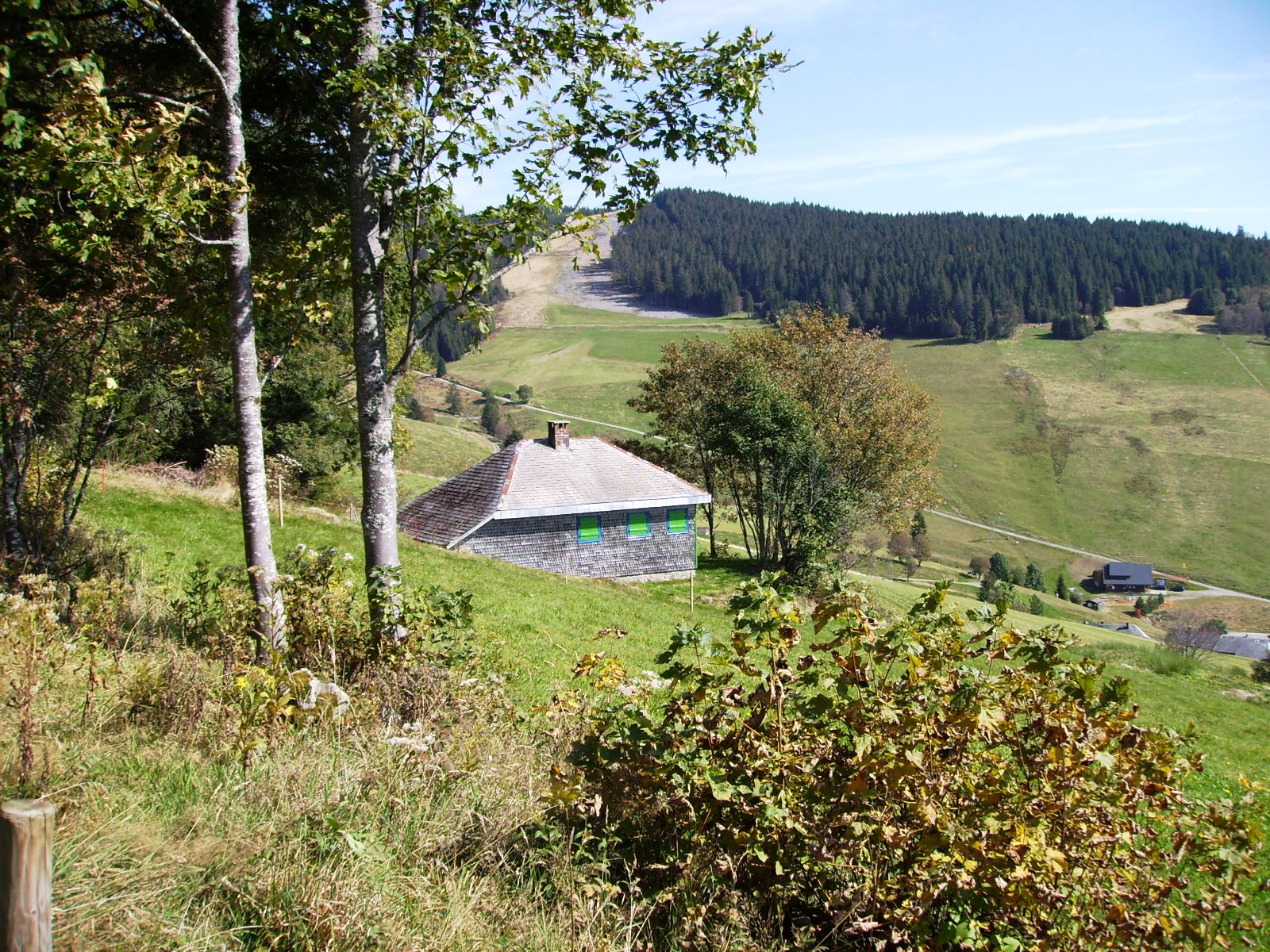
Image: Wikimedia Commons / CC BY-SA 4.0.
Why the Black Forest — fog, well, and “being-in-the-world”
Take the hut out of the landscape and would Being and Time still be written? Probably, but a different book. The core concept In-der-Welt-sein (being-in-the-world) — that man is not first an isolated “I” who then encounters the world, but is from the start thrown into a network woven of tools, habits, neighbors, and weather — its easiest footnote is the Black Forest itself. A farmer does not first reason in his head about the “essence” of the iron stove; when he is cold, he splits wood. The well does not first have to be defined as a container of H₂O; before it freezes you draw water. Heidegger writes the “ready-to-hand of the surrounding world” (Zuhandenheit) into philosophy because he was doing these things with his own hands every summer and winter on the hilltop.
Freiburg down below is another extreme. The lectern at Albert-Ludwigs, Husserl’s phenomenology seminar, the Marburg years entangled with Hannah Arendt, the correspondence with Jaspers, the Davos duel with Ernst Cassirer after returning to Freiburg — these are philosophy’s social stages. He needed them, but he never wrote in them. He wrote on the mountain. Meßkirch is another — birthplace, burial place, the plainest Catholic country childhood. Three points form an axis 100 km long: village (Meßkirch) — academy (Freiburg) — seclusion (Todtnauberg). He moved between these three points all his life, finally returning to the first.
Appendix · For those who can get there — route
Four points, ranked by accessibility. The Hütte is private property, still held by the Heidegger family, absolutely not open to the public — any guide that describes it as a “museum” is wrong; you can only view it from a distance.
- Freiburg university main building (Kollegiengebäude I, Platz der Universität 3) — easiest to reach, ~10 minutes’ walk from Freiburg Hauptbahnhof. The 1911 neo-Baroque facade is inscribed “Die Wahrheit wird euch frei machen” (“the truth will set you free”). Heidegger was assistant 1916–23, full professor 1928–45, and gave his rectorship inaugural address in the Aula next to the main building in 1933. There is no Heidegger plaque on the campus — that fact itself is worth pausing over.
- Todtnauberg village + Heidegger-Rundweg (Schwarzwald). From Freiburg station take SBG bus 7300 to Notschrei, then a local bus to Todtnauberg, total ~1.5–2 hours; or drive B31 → B317 → L126, ~50 km. The village tourist office has the “Heidegger-Rundweg” hiking map — a ~6 km circular route from the Stübenwasen cable car base, passing the slope-side viewpoint of the Hütte (a wooden sign on the trail reads “Heideggers Hütte – Privatbesitz, Zutritt verboten” — “private property, no entry”). You can only photograph from outside; do not climb the fence, do not knock. Best season June–September (part of the trail is closed in winter snow).
- Meßkirch Heidegger grave (Friedhof Meßkirch, St. Martin parish cemetery) — from Freiburg take a train via Donaueschingen, change at Meßkirch, ~2.5 hours; ~130 km by car. The grave is in the family section on the south side of the cemetery; the headstone is marked with a star, not a cross (his request). The Meßkirch old town also has a Martin-Heidegger-Museum in a building beside the town hall where he lived as a child (open Tue–Sun 14:00–17:00, check stadt-messkirch.de), with his desk, pipe, and a scale model of the Hütte’s interior. This is the only place you can legally see the inside of the Hütte.
- Bonus · St. Martin church + the sacristan’s room — Heidegger’s father was the sacristan (Mesner) of St. Martin’s; Heidegger grew up beneath the tower. Vom Geheimnis des Glockenturms (The Secret of the Bell Tower, 1954) is his most tender essay. The church is open during the day; the small sacristan’s room at the foot of the tower is still there, with a plaque at the door.
Three Routes — Stitching the Twelve Rooms Together
Twelve sites scattered across the map of Europe, from 38°N at Athens to 55°N at Königsberg, from Bordeaux on the Atlantic to Carnuntum in the middle Danube. One trip cannot do them all. But they can be stitched into three intersecting routes — by era, by geography, by transport feasibility — each doable in 10–14 days.
Route A · Classical-Mediterranean loop (about 12–14 days, 4 chapters)
Athens → Rome → Vienna + Carnuntum → Turin → Florence + Sant’Andrea
Covers Ch1 Plato, Ch2 Aurelius, Ch11 Nietzsche’s collapse, Ch3 Machiavelli.
- Athens 3 days — Akademia park + Agora + Filopappou Hill, with half a day for the National Archaeological Museum.
- Rome 2 days — Piazza Colonna Aurelius Column + Capitoline equestrian + Castel Sant’Angelo.
- Vienna 2 days + Carnuntum 1 day — Petronell Archaeological Park + Bad Deutsch-Altenburg Museum + Vindobona under Vienna’s old town.
- Turin 1 day — Carlo Alberto Square + walk along Via Po to the river + Via Carlo Alberto 6 plaque.
- Florence + Sant’Andrea in Percussina 2 days — Santa Croce, Palazzo Vecchio, Albergaccio farmhouse (book the upper floor in advance).
Best season: April–May or September–October. The Mediterranean is reliable from May to October.
Route B · Western Europe-Low Countries-France line (about 10–12 days, 5 chapters)
Bordeaux → Paris → Lake Bienne → Amsterdam → Rijnsburg + The Hague → Egmond → London
Covers Ch4 Montaigne, Ch7 Rousseau, Ch6 Spinoza, Ch5 Descartes (seclusion and remains), Ch10 Marx.
- Bordeaux + Saint-Michel-de-Montaigne 2 days — three floors of the round tower (seasonal guided tour) + Bordeaux Bibliothèque municipale to see the Exemplaire de Bordeaux.
- Paris 2 days — Pantheon (Rousseau + Voltaire + Hugo) + Saint-Germain-des-Prés Descartes cenotaph + Musée de l’Homme for the Descartes skull.
- Lake Bienne 1–2 days — Île Saint-Pierre + Maison Rousseau, you can stay a night.
- Amsterdam + Rijnsburg + The Hague 2 days — Esnoga Portuguese Synagogue + Spinozahuis Rijnsburg + The Hague Paviljoensgracht + Nieuwe Kerk memorial.
- Egmond aan den Hoef + Egmond-Binnen 1 day — abbey + Descartes’s walking route through the North Sea dunes.
- London 2 days — looking up at the dome in the British Museum Great Court + a British Library reading room session + Soho Dean Street 28 blue plaque + Highgate Cemetery East Marx’s grave.
Best season: May–June or September. Damp-cold months feel rough in London and the Low Countries.
Route C · German-speaking high-mountain-hut line (about 12–14 days, 4–5 chapters)
Trier → Jena + Weimar → Sils-Maria (Upper Engadine) → Black Forest Todtnauberg + Freiburg + Meßkirch (→ Kaliningrad, if visa permits)
Covers Ch10 Marx birthplace (side trip), Ch9 Hegel, Ch11 Nietzsche Sils-Maria, Ch12 Heidegger, Ch8 Kant (if visa permits).
- Trier 1 day — Brückenstraße 10 Marx House + Simeonstiftsplatz China-donated bronze + Roman Porta Nigra.
- Jena + Weimar 2 days — Markt old town + Romantikerhaus + Goethe-Wohnhaus + Schiller-Wohnhaus 30 km away.
- Sils-Maria 3 days — Nietzsche-Haus + Surlej boulder (the Seeuferweg is a must) + St. Moritz lake light + Maloja Pass.
- Freiburg + Todtnauberg + Meßkirch 3 days — university main building + Heidegger-Rundweg (Hütte from a distance) + Martin-Heidegger-Museum + the star on the headstone.
- Kaliningrad 2 days (optional) — Stoa Kantiana + restored cathedral + the few remaining threads of Königsberg. Verify entry policy with the Russian consulate / third-party visa services before traveling — conditions have been volatile since 2022.
Best season: June–September. The Upper Engadine and the Black Forest are blocked by snow in winter.
Afterword · This Piece Walks Slow
After finishing these 12 chapters I reread my own — and I noticed something they share: none of these places are at the seat of power.
The Academy at Athens lies two kilometers outside the city in an olive grove; Aurelius is in a tent on the Danube; Machiavelli in a small farm on Florence’s southern outskirts; Montaigne in a round tower 50 km east of Bordeaux; Descartes moved 24 times in the Dutch Republic; Spinoza in a small village northwest of Leiden; Rousseau on an island in the middle of a Bern lake; Kant at the easternmost Prussian port; Hegel in a small apartment the night Napoleon entered town; Marx in the round reading room at the edge of London; Nietzsche on the second floor of an Alpine grocer’s at 1,800 m; Heidegger in a wooden hut at 1,100 m on a Black Forest summit.
Thought has never been written from the seat of power — it has been written from the corners power cannot reach. That line has not been broken for 2,400 years. From the olive grove to the hilltop hut, each time thought has had to start again, it has had to find first a small-scale space that can afford to be slow, in which “thinking a sentence through” becomes possible.