Hong Kong Through Its Films and Songs — A Pilgrimage Map of Works, People, and Culture
Not going to Hong Kong to look for movies, but using movies to know Hong Kong again
Before I went to Hong Kong, I laid out a dozen DVDs and a stack of old records on the table. Chungking Express, In the Mood for Love, A Better Tomorrow, PTU, Infernal Affairs, McDull… they made a pile about thirty centimeters thick. I realized that what I was going to wasn’t “Hong Kong” — it was the other city these reels of film and audio tracks had repeatedly painted over the past three decades, layered on top of the real Hong Kong, more real than the real thing.
Then I actually arrived. The first night off the plane I went to Chungking Mansions, stood in front of the same elevator Faye Wong walked past in 1994, and discovered that the neon halo in those photos was actually a mixture of humidity and sweat. The next day at the Mandarin Oriental’s afternoon-tea lounge, an older gentleman at the next table was humming “The Wind Continues to Blow” under his breath. It wasn’t a hallucination. This city remembers itself.
This piece reshuffles that pile of film and vinyl. No longer by map or by location — instead, by work, person, culture. Locations have been pushed to the addendums, as a checklist for those who can actually walk there; the main text is about why this film, this song, this person became embedded in the muscle of Hong Kong. Across eleven chapters you’ll meet three Hong Kongs: one written by movies (six films), one written by people (three names), and one written by cultural symbols (two landmarks). Layered together, they form an internal map of this city from 1986 to 2025.
This isn’t a guide. It’s a listening map.
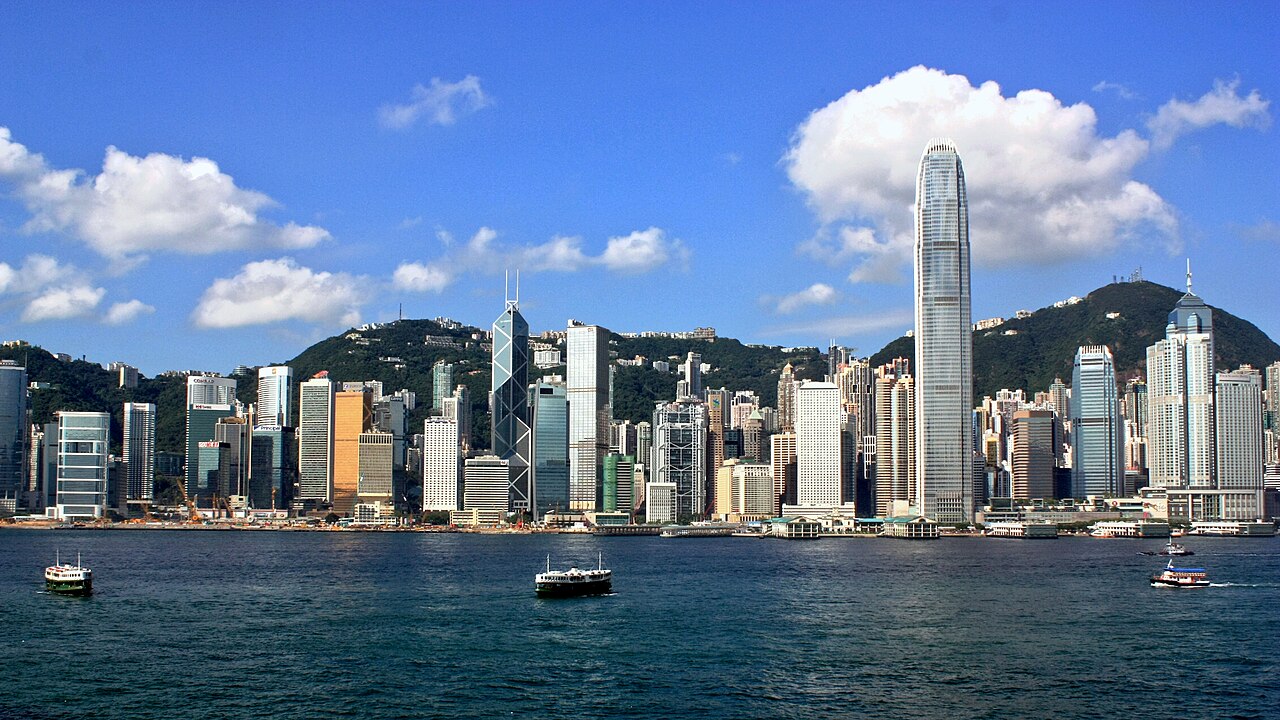
Image: Wikimedia Commons / CC BY-SA 4.0.
Part I · Works — Hong Kong Through Six Films
Start with the works. Hong Kong cinema has never been a contest about screenplays — it’s a contest about how the camera sees the city. Each of the six films below has rewritten the Hong Kong you thought you knew.
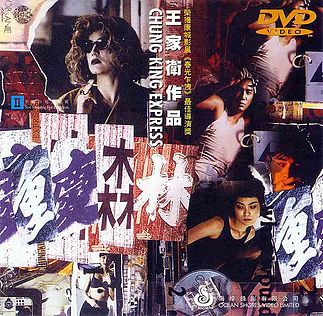
Chungking Express (1994) — Wong Kar-wai’s End of the Century
In the summer of 1994, Wong Kar-wai shot a seemingly casual film in sixty days that redefined what the word “urban” meant in Chinese-language cinema.
That year he had just finished the fifth cut of Ashes of Time and was nearly cut to pieces himself. During the editing break, he wanted to shoot something smaller and lighter as a palate cleanser, and Chungking Express was the result. From Days of Being Wild (1990) to Ashes of Time (1994), Wong had been filming drifting people — people refusing to be nailed in place and unable to find their next station. Chungking Express moved that drift from the 1960s and the western deserts back to 1994 Tsim Sha Tsui and Central. The time ruler changed to “May 1st pineapple-can expiry date” and the convenience-store closing hour, but the core didn’t change: all the characters are living on some kind of countdown.
That countdown had a source. After the 1984 Sino-British Joint Declaration, Hong Kongers began counting days in a particular way — how many days left until 1997. End-of-century anxiety seeped into nearly every serious Hong Kong film of the early ’90s. Beneath the light surface of Chungking Express, this is what’s hiding: a premonition that “we could lose the present at any moment.”
Still: Wikipedia / fair use (non-commercial).
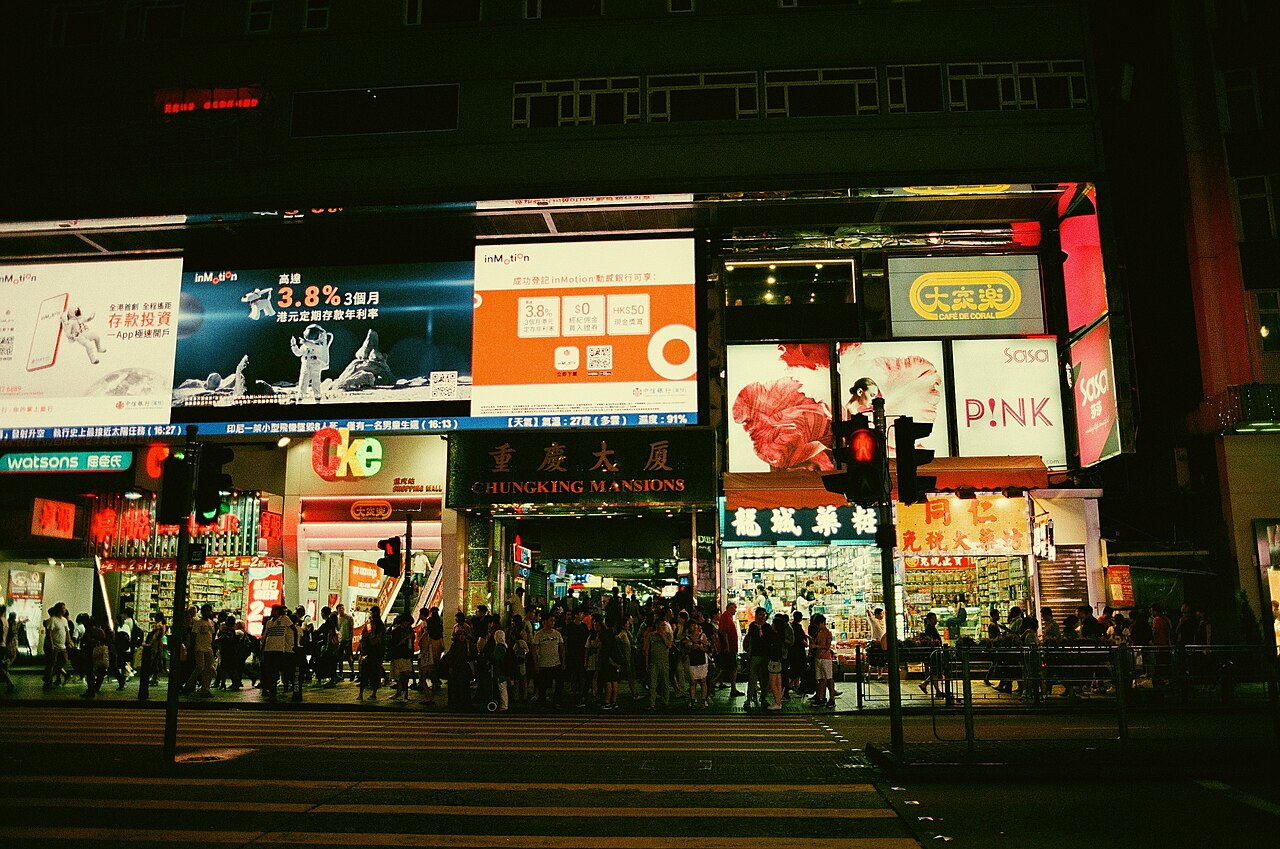
Image: Wikimedia Commons / CC BY-SA 4.0.
The film is made of two stories that barely intersect. The first is set inside Chungking Mansions: Cop No. 223 (Takeshi Kaneshiro), heartbroken, buys a can of pineapple expiring on May 1st every day, and in the crowd along Nathan Road bumps into a drug dealer in a blonde wig, trench coat, and sunglasses (Brigitte Lin) — she’s busy chasing down a shipment of heroin a South Asian middleman has run off with. The second moves to Mid-Levels in Central: Cop No. 663 (Tony Leung Chiu-wai), dumped by his flight-attendant girlfriend, frequents the snack bar “Midnight Express” and orders a chef’s salad. Behind the counter, Faye (Faye Wong) steals his keys and sneaks into his apartment every day to clean, change the goldfish, and stuff toys into his cabinets.
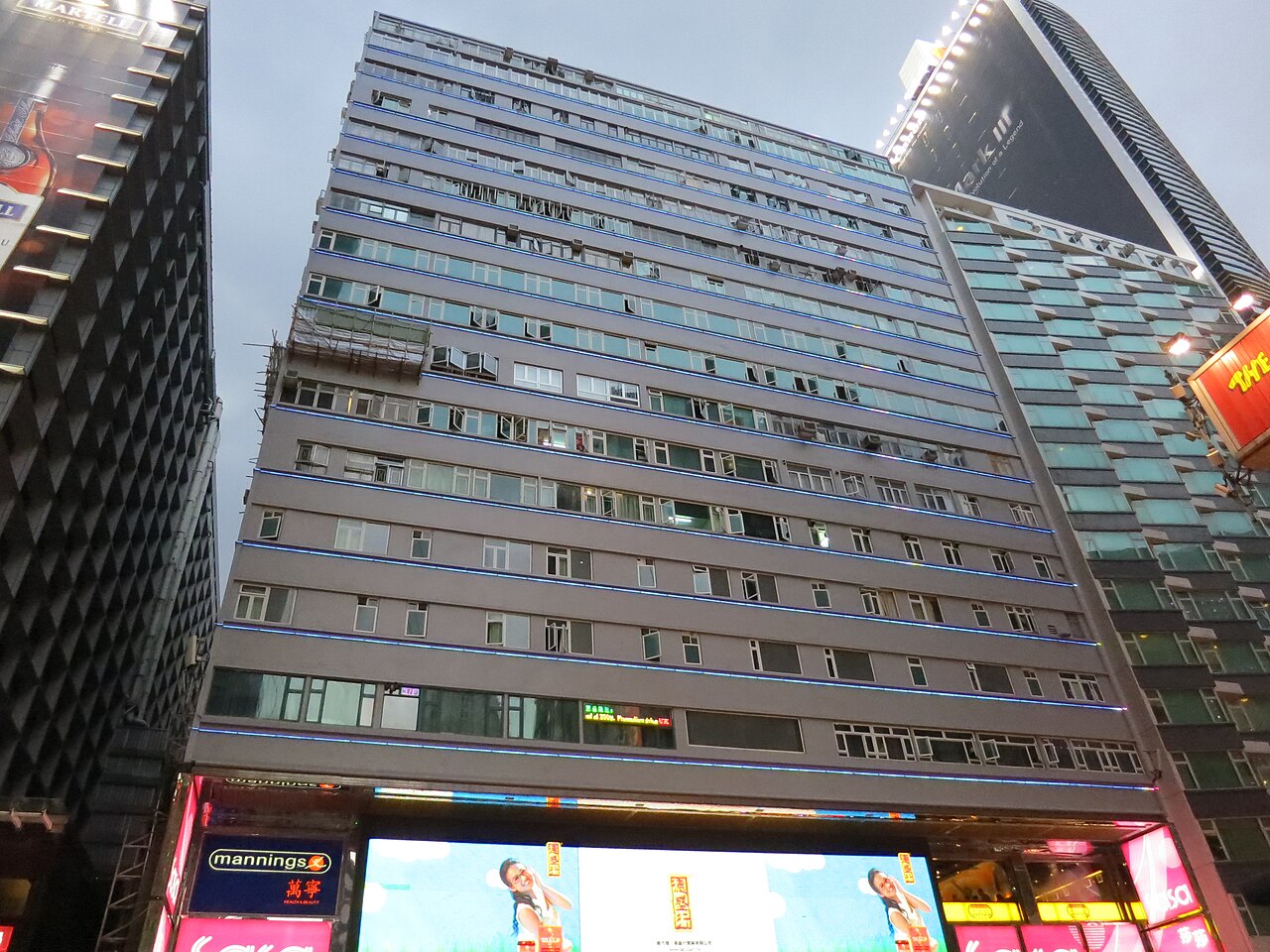
Image: Wikimedia Commons / CC BY-SA 4.0.
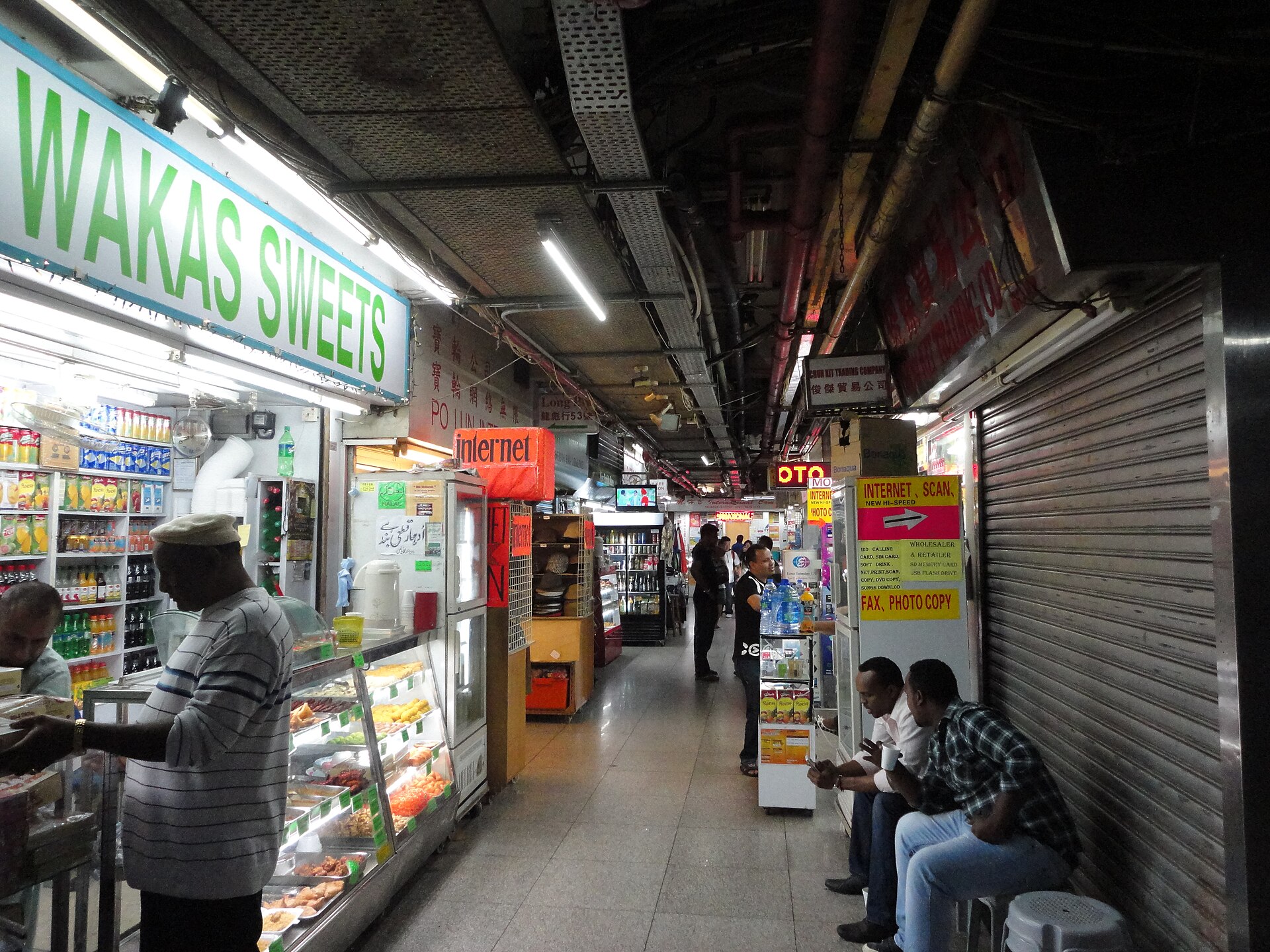
Image: Wikimedia Commons / CC BY-SA 4.0.
What holds up the air in both halves is the cinematography of Christopher Doyle (杜可风). In the narrow alleys of Chungking Mansions he shoots almost entirely handheld, slowing the shutter way down, and then using step-printing to turn Takeshi Kaneshiro’s chase after Brigitte Lin into a kind of viscous, neon-smeared blur — the people move, the background flows, like Tsim Sha Tsui as you remember it from a drunk night. In the second half the camera suddenly calms; a wide lens sweeps through Tony Leung’s leaky apartment while Faye Wong dances around the living room with a boombox. She’s covering The Cranberries’ “Dreams” (the Cantonese version, “Meng Zhong Ren”), and the lifeline of the whole film is The Mamas & the Papas’ 1965 “California Dreaming” — a song that had a very specific meaning in 1990s Hong Kong: California was one of the top emigration destinations for Hong Kongers at the time, and “All the leaves are brown” wasn’t about a season — it was about an entire generation’s ambiguous craving for leaving.
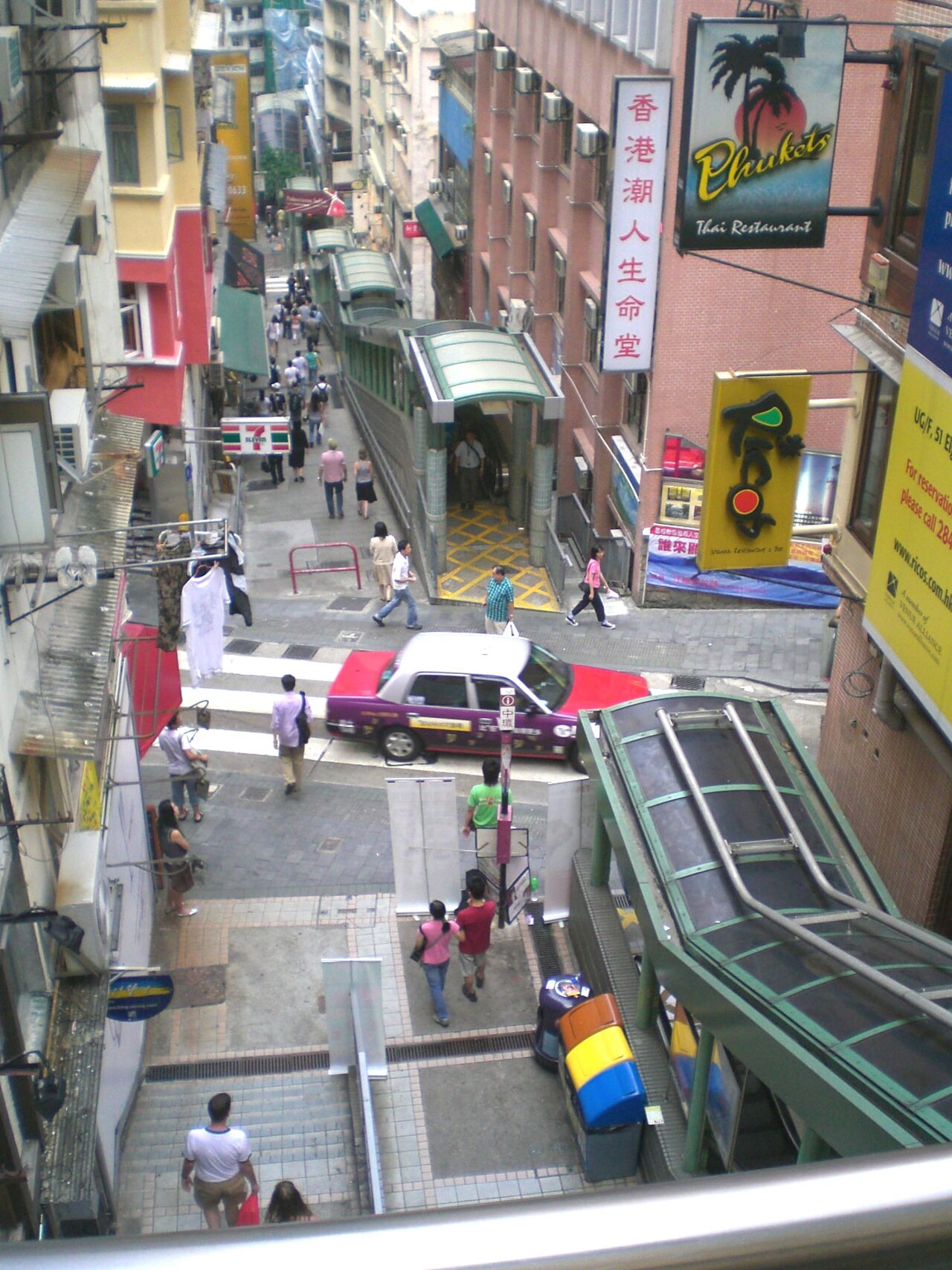
Image: Wikimedia Commons / CC BY-SA 4.0.
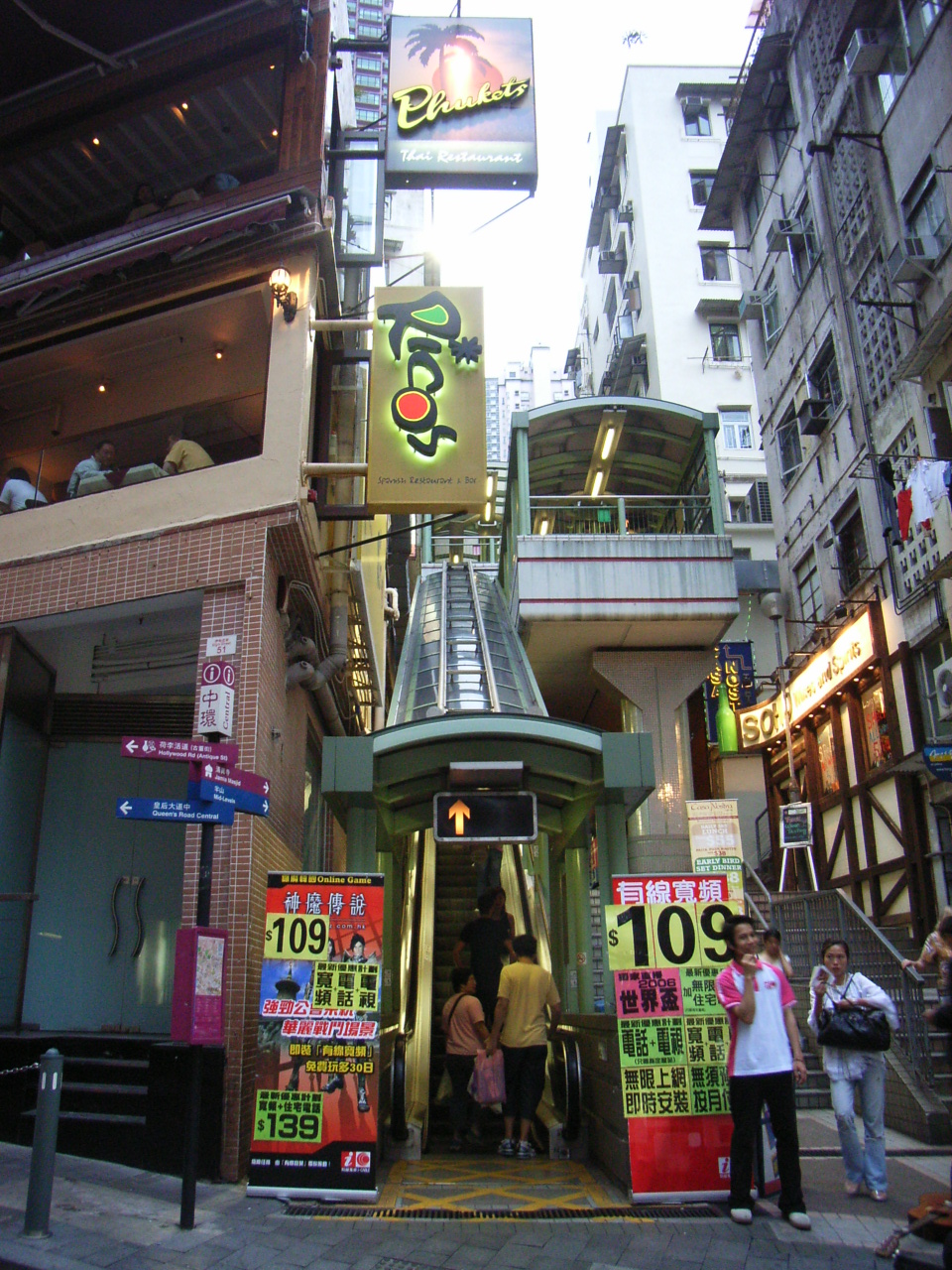
Image: Wikimedia Commons / CC BY-SA 4.0.
Faye Wong was this film’s biggest discovery. She was already a pop star but had never properly acted in a movie; Wong Kar-wai essentially let her play herself, and the result is one of the most natural lead-actress performances in Chinese-language cinema of the 1990s. The film earned about HK$7.7 million locally — no blockbuster — but in European and North American arthouse circuits it set off a real wave. Quentin Tarantino saw it and bought the US distribution rights, releasing it nationwide in 1996 through his Rolling Thunder Pictures. From that moment Wong Kar-wai stepped out of the Chinese-language circuit and was written into world cinema history under the page marked end-of-century auteur.
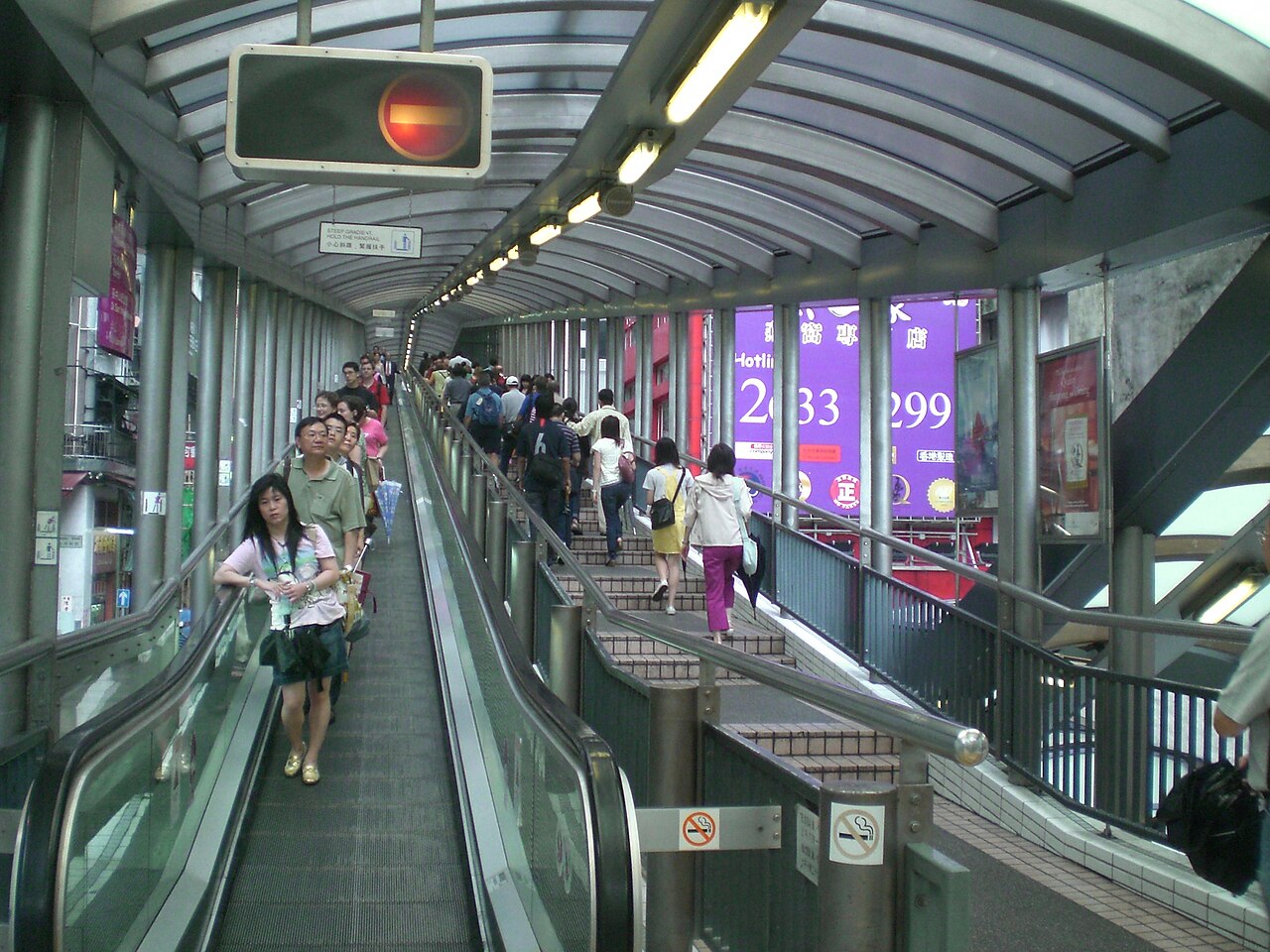
Image: Wikimedia Commons / CC BY-SA 4.0.
For an on-the-ground pilgrimage, three spots line up. Chungking Mansions is in Tsim Sha Tsui at 36–44 Nathan Road, built in 1961, 17 stories with about 770 units, housing people from over a hundred nationalities. Walk out Exit E of Tsim Sha Tsui MTR Station and look up. The ground floor is still phone shops, currency exchanges, and South Asian restaurants. Best to come after 8 PM — neon all the way up. Set up under the pedestrian overpass on the opposite side of Nathan Road, shoot upward to frame the entire building, and you’ll get that viscous quality from the film. The Central–Mid-Levels Escalator was completed in 1993, runs about 800 meters, and is the world’s longest covered outdoor escalator. Operating hours: 6:00–10:00 AM downward, 10:20 AM–midnight upward — Tony Leung’s apartment window faces the section between Cochrane Street and Shelley Street. Best to come up after 2 PM, when the light softens. Two blocks further is Lan Kwai Fong, the night-time entrance Faye imagines on her way to California; empty by day, alive at night.
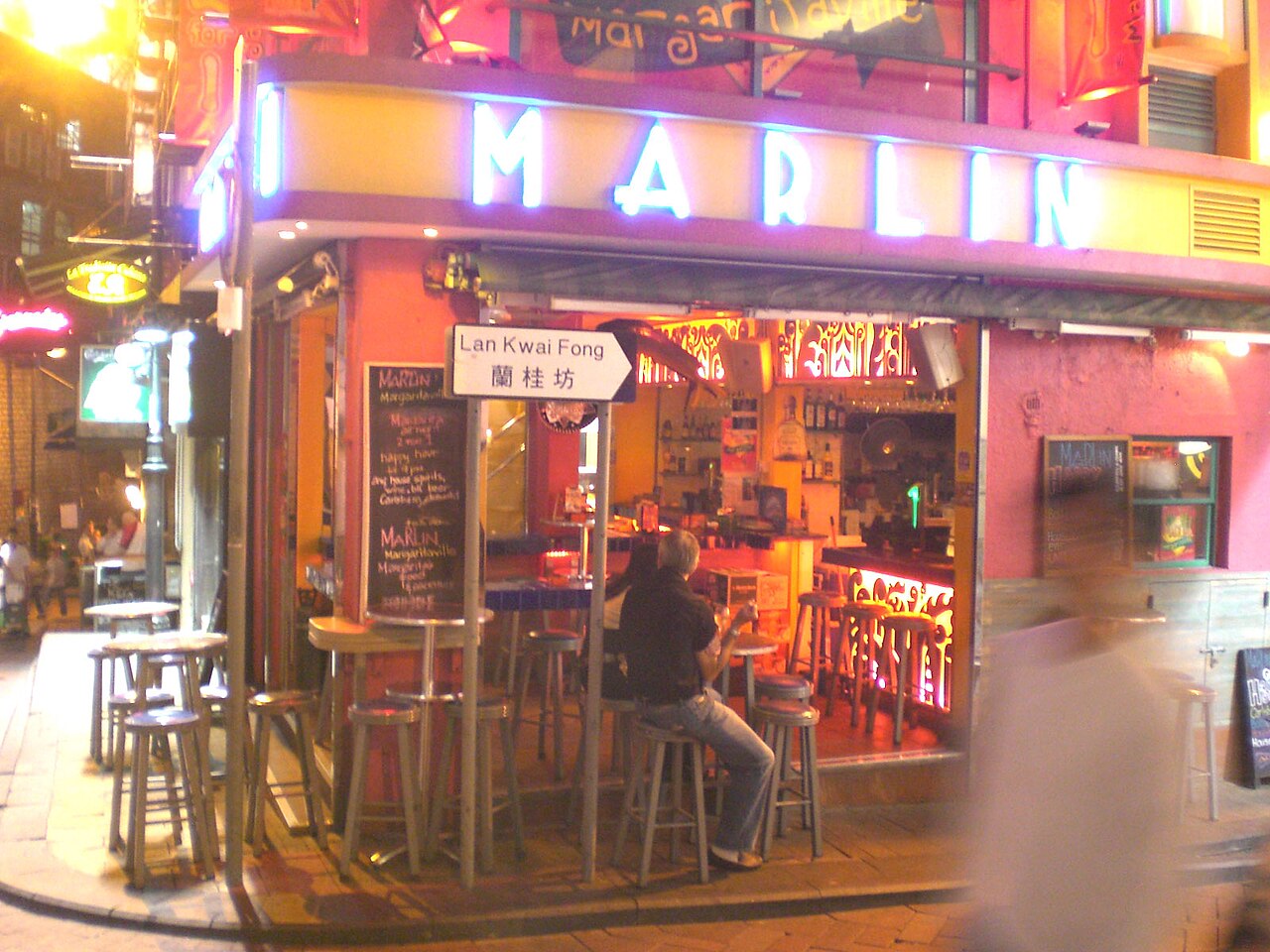
Image: Wikimedia Commons / CC BY-SA 4.0.
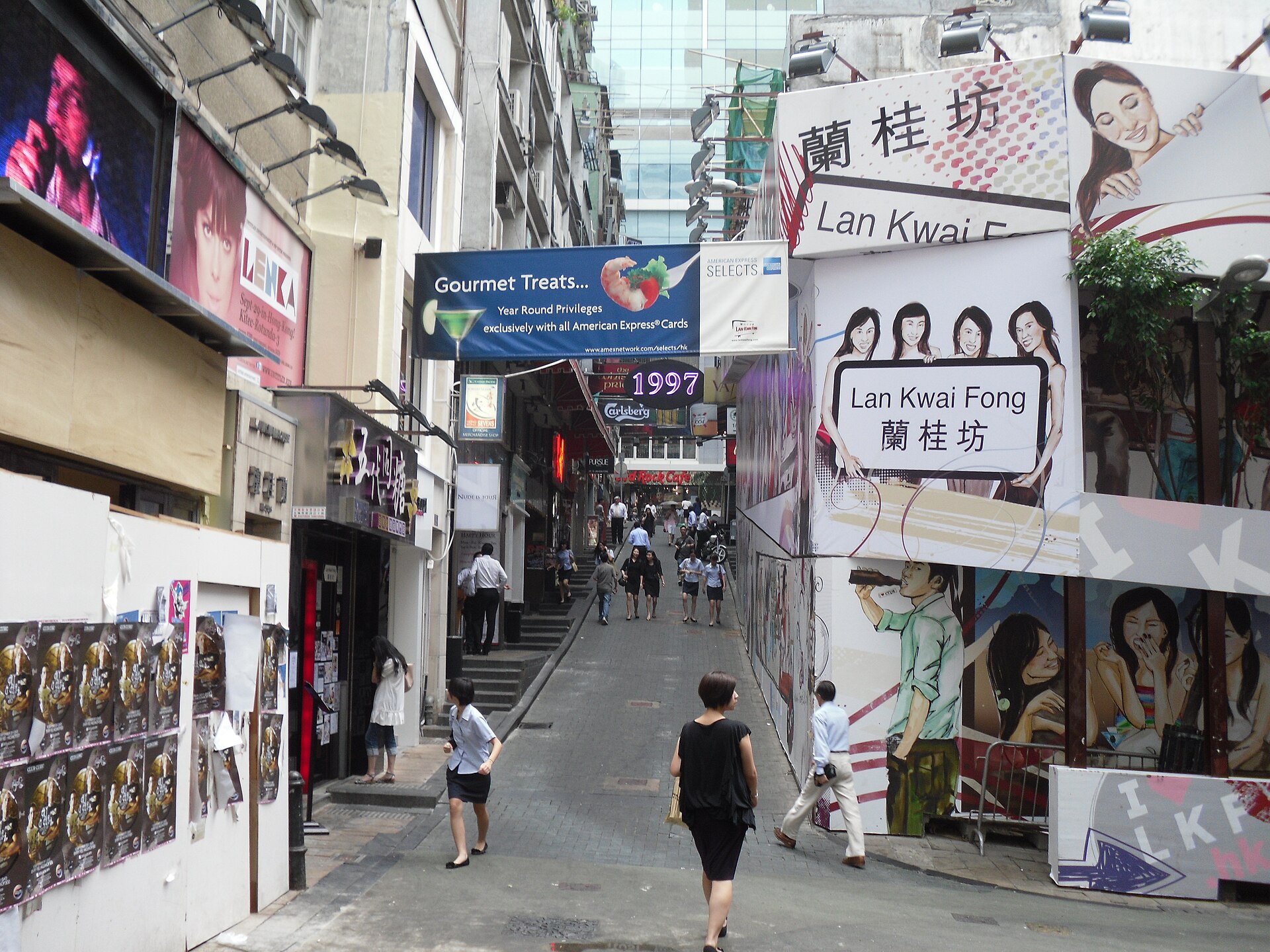
Image: Wikimedia Commons / CC BY-SA 4.0.
Close Chungking Express and rewind thirty years — what Wong Kar-wai was really filming his whole life was a 1960s Hong Kong you can never return to. That Hong Kong only exists in his celluloid: damp, slow, always one minute too late.
In the Mood for Love + Days of Being Wild + 2046 — Wong Kar-wai’s 1960s Trilogy
Wong Kar-wai didn’t film 1960s Hong Kong. He filmed what was left of it after memory had rubbed it down for decades. That Hong Kong only exists in his celluloid — humid, slow, always a minute behind.
Three works: from box-office disaster to Cannes Best Actor
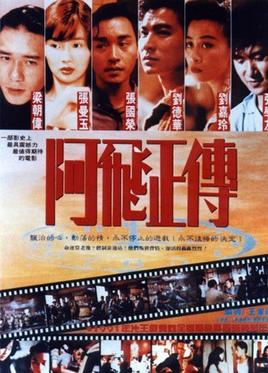
Days of Being Wild (1990) is the starting point. Starring Leslie Cheung, Maggie Cheung, Carina Lau, Jacky Cheung, Andy Lau, and Tony Leung Chiu-wai (in the final 1-minute-plus cameo), it swept the 10th Hong Kong Film Awards in 1991 for Best Picture, Best Director, and Best Actor — but flopped at the box office. Audiences had waited months for the all-star lineup and got an apple-eating, mambo-dancing Yuddy muttering about “a bird with no legs.” The investors had originally planned a two-part film; the sequel was shelved.
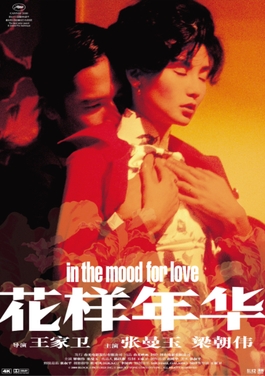
Ten years later, In the Mood for Love (2000) won Tony Leung Best Actor at the 53rd Cannes (the first Chinese actor ever); Christopher Doyle, Mark Lee Ping-bing, and William Chang shared the Technical Grand Prize. It had originally been just one segment of a 2000 project called Summer in Beijing; the more they shot, the longer it grew, until it became a film of its own.
2046 (2004) took a full 5 years to shoot. Takuya Kimura, Zhang Ziyi, Gong Li, Carina Lau, and Faye Wong all appeared. At the 2004 Cannes premiere the print was still being rush-printed on the plane; Wong Kar-wai finished editing only hours before the screening.
Still: Jet Tone Films / Wikipedia · fair use (non-commercial).
Still: Jet Tone Films / Wikipedia · fair use (non-commercial).
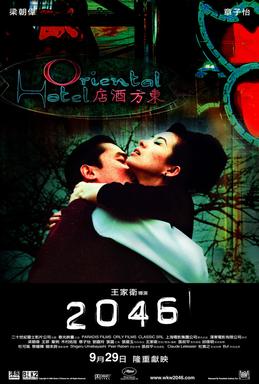
Still: Jet Tone Films / Wikipedia · fair use (non-commercial).
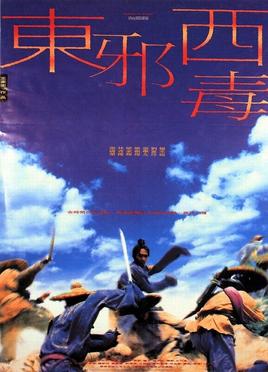
Still: Jet Tone Films / Wikipedia · fair use (non-commercial).
The characters move through the three films like blood vessels:
- Yuddy (Leslie Cheung) in Days of Being Wild searches for his Shanghainese émigré birth mother (Rebecca Pan), who lives in Mid-Levels
- Chow Mo-wan (Tony Leung) appears for just over a minute at the end of Days of Being Wild — combing his hair in the mirror, lighting a cigarette, fixing his cuff links — and becomes the absolute lead in In the Mood for Love and 2046
- Su Li-zhen has two versions: in Days of Being Wild she’s a ticket-booth clerk played by Maggie Cheung; in In the Mood for Love she’s a newspaper secretary, same name, possibly not the same person — Wong Kar-wai never explains
Cheongsams, lenses, no script
Maggie Cheung wore 23 cheongsams in In the Mood for Love, all custom-made by William Chang. The same woman wearing different cheongsams across the same stretch of time is how Wong Kar-wai handles time: the scene hasn’t changed, the dress has, so the audience knows time has passed. It’s editing without dialogue.
William Chang’s art direction runs through all three films: the greenish lamp in Yuddy’s home, the patterned wallpaper in Su Li-zhen’s apartment, the neon room numbers of 2046 — every color temperature was hand-tuned. Christopher Doyle’s handheld wide lens, hugging the wall in narrow corridors, makes you feel like you’re peeping from the next room through a crack in the door. In In the Mood for Love the scene of Su Li-zhen walking up and down the stairs to buy noodles has no dialogue at all — only Nat King Cole’s “Quizás, Quizás, Quizás” and rain.
Wong Kar-wai’s working method is famously scriptless: actors arrive on set and are handed a slip of paper with the day’s lines, sometimes just a few sentences. Leslie Cheung’s mirror-combing scene in Days of Being Wild in 1990 is said to have been shot 47 times. He later said it was his most satisfying scene as an actor — and the line Yuddy keeps repeating
“I am the one minute before 3 PM on April 16, 1960. Because of you, I’ll remember this one minute.”
was replayed by fans over and over on the day Leslie Cheung fell to his death in 2003. Between the Yuddy he played and the man himself, there was a mirror that was never taken down.
Wong Kar-wai has openly acknowledged the influence of Yasujirō Ozu — the family rituals shot from fixed cameras, the restrained negative space, the inch of distance between people that never closes. But he traded Ozu’s tatami for rented partition rooms: Shanghainese-auntie mahjong tables, Zhou Xuan on the gramophone, rice cookers in the attic — these are not all of 1960s Hong Kong but a slice of life from the wave of post-1949 migrants who came south from Shanghai and settled in North Point and Causeway Bay. Chow Mo-wan writes wuxia novels; Su Li-zhen listens to Yueju opera — that’s Shanghai, not Hong Kong.
Locations: have a bowl of wonton noodles, have an afternoon tea
- Goldfinch Restaurant (13-15 Lan Fong Road, Causeway Bay) — the real-life shooting location for many scenes in 2046 and Days of Being Wild: red booths, gas lamps, Swiss-sauce chicken wings. Closed for the first time in 2015, reopened in 2016, moved again in 2018; the new place hangs a “Hong Kong Affection” sign and continues the old decor. It’s one of Wong Kar-wai’s private-reservation restaurants
- Mandarin Oriental Hotel (5 Connaught Road Central, opened 1963) — afternoon tea 14:00–17:00 at the Clipper Lounge on the second floor; the glass windows look out onto the Central skyline pressed against Victoria Harbour. Leslie Cheung fell from the 24th floor of this hotel on April 1, 2003
- The Peninsula Hotel (Salisbury Road, Tsim Sha Tsui, opened 1928) — the lobby afternoon tea does not take reservations; you have to queue in person, and the wait after 2 PM is usually 30–60 minutes. A string quartet plays on the second-floor mezzanine. The hotel corridor Zhang Ziyi walks in 2046 was scaled to this one
- Queen’s Café — a nostalgic spot Wong Kar-wai often mentions, originally in Central, closed in October 1994 and later relocated to Hysan Avenue in Causeway Bay. The borscht and baked pork-chop rice are still on the menu, but it’s no longer the same Queen
- Ladder Street, Sheung Wan — the original staircase shot for In the Mood for Love was in Central and has since been redeveloped; fans use Ladder Street as a substitute pilgrimage spot. Stone steps, granite low walls, orange streetlamps in the evening — the soundtrack starts playing on its own
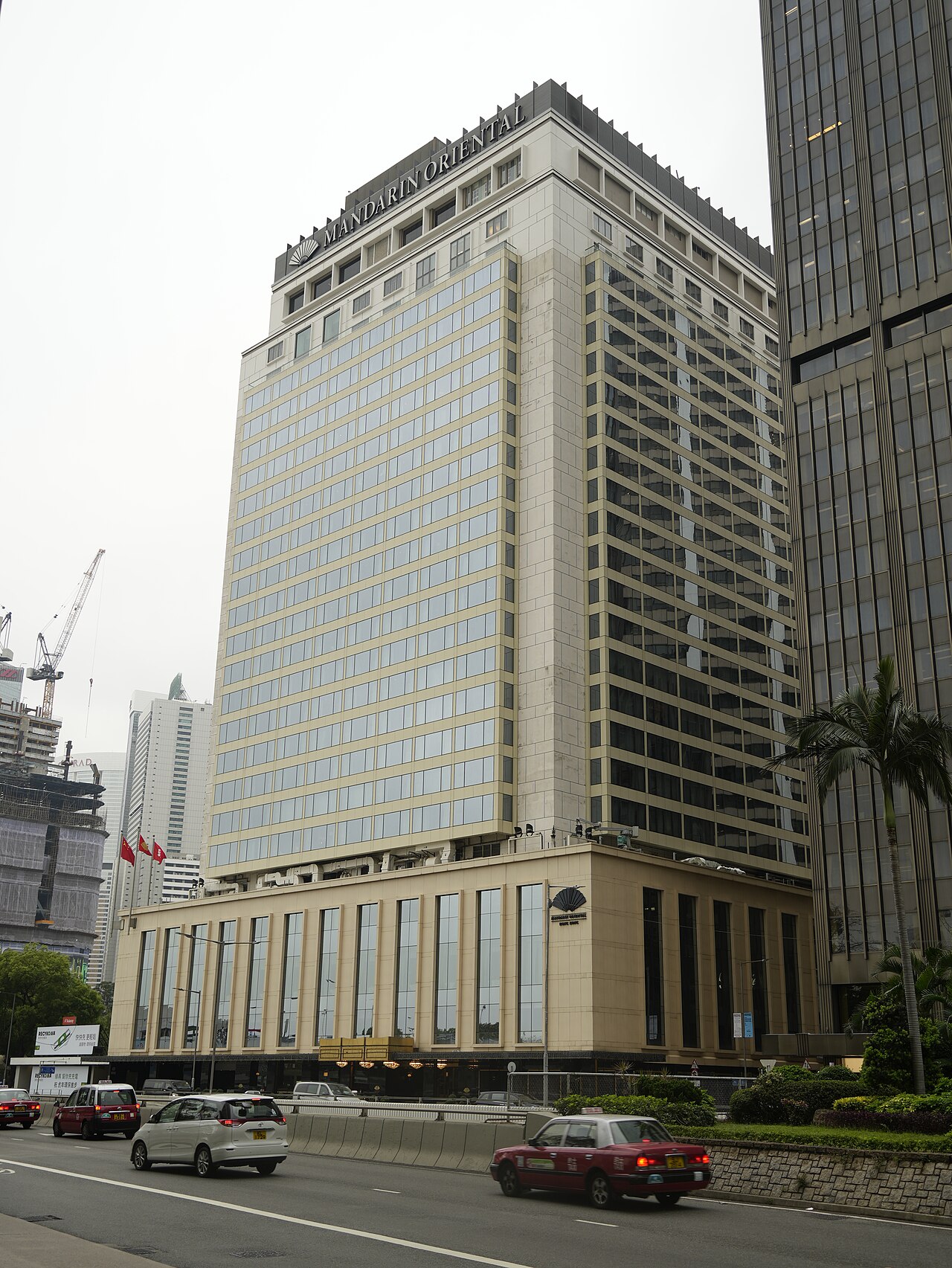
Image: Wikimedia Commons / CC BY-SA 4.0.
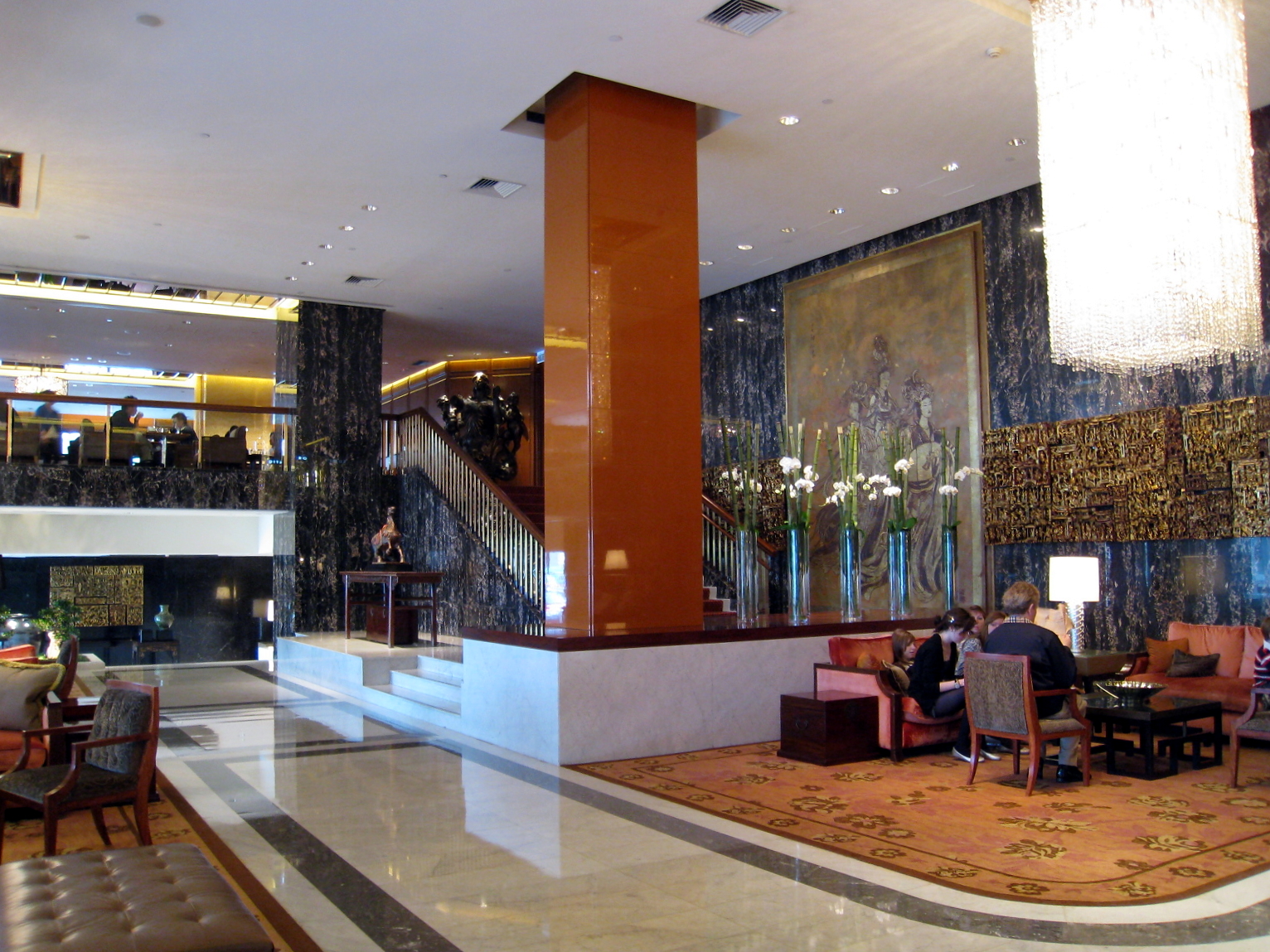
Image: Wikimedia Commons / CC BY-SA 4.0.
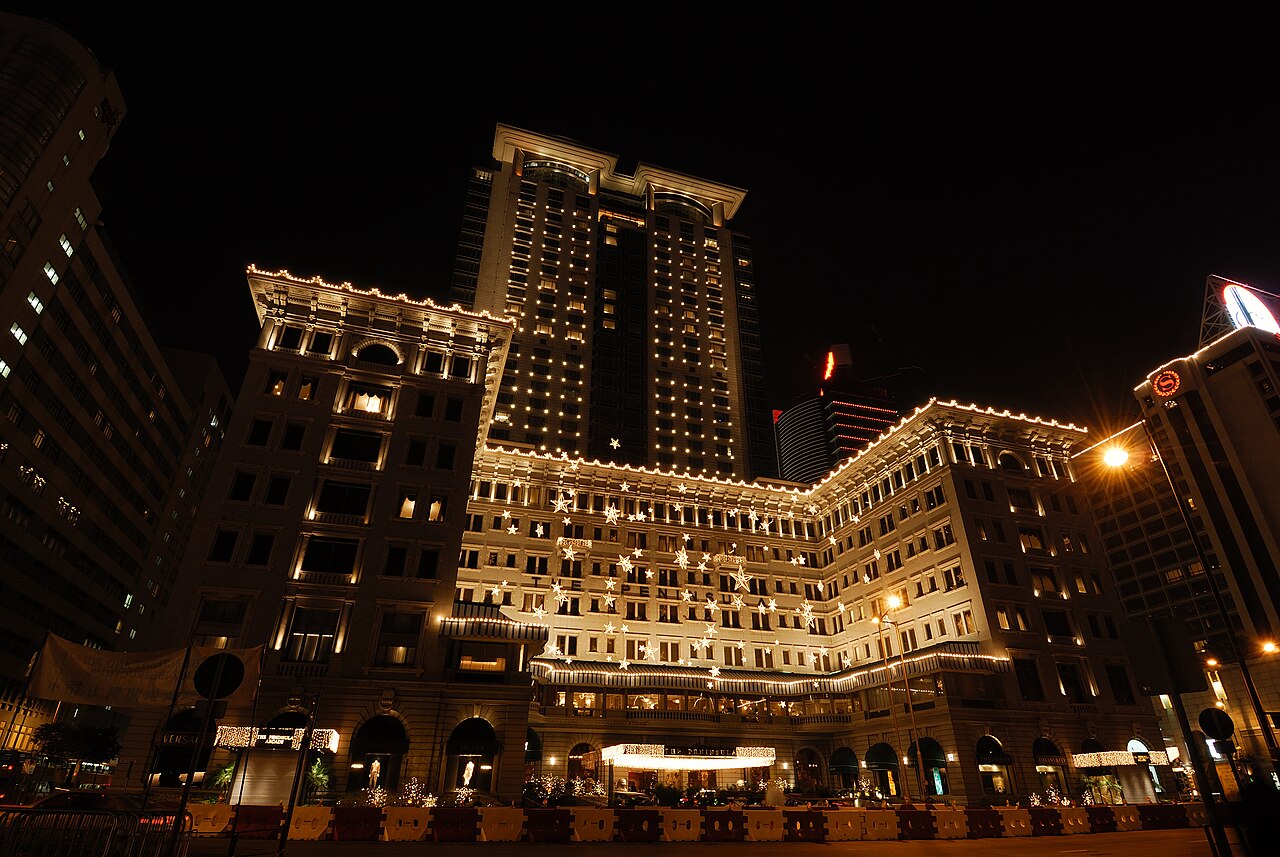
Image: Wikimedia Commons / CC BY-SA 4.0.
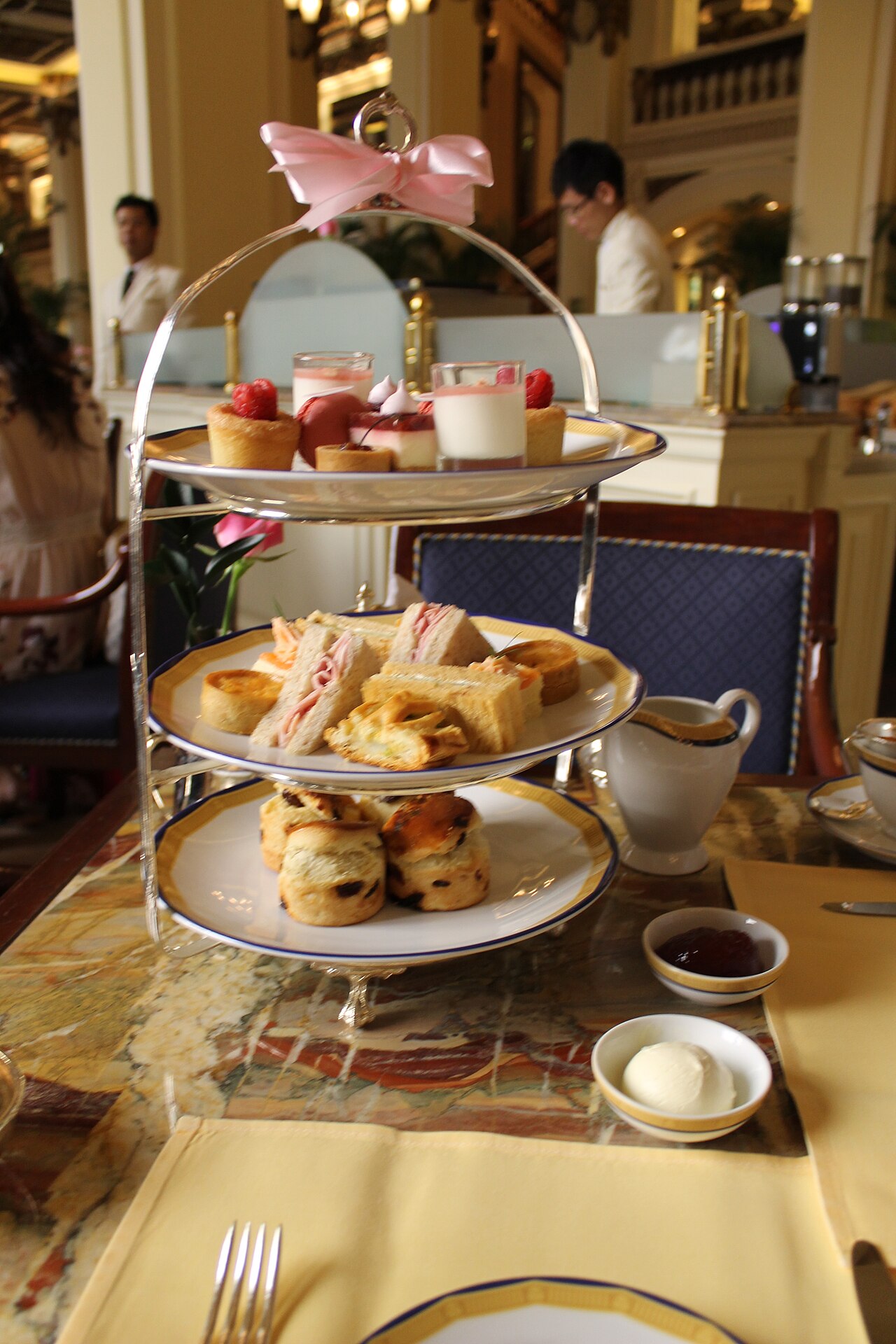
Image: Wikimedia Commons / CC BY-SA 4.0.
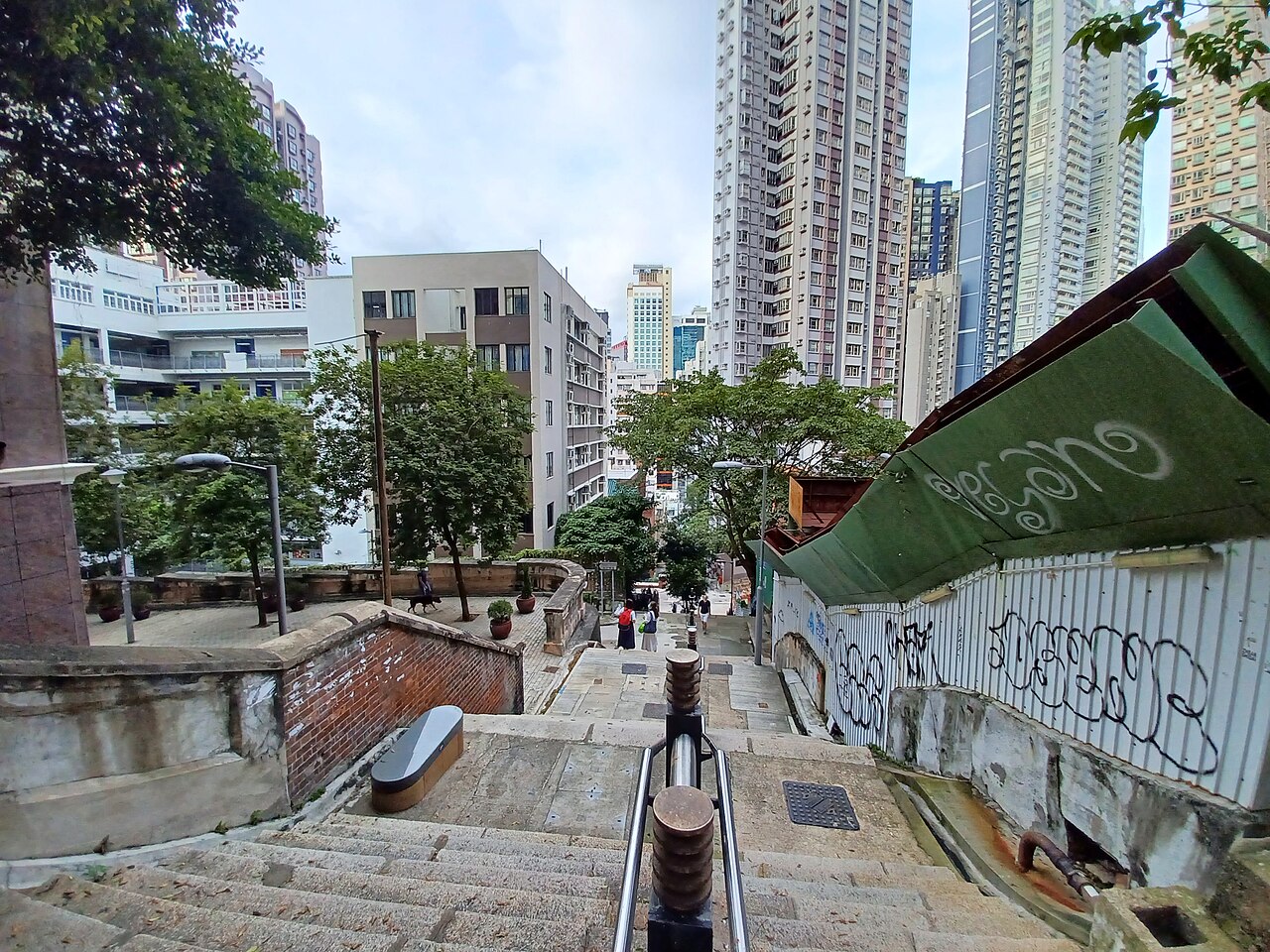
Image: Wikimedia Commons / CC BY-SA 4.0.
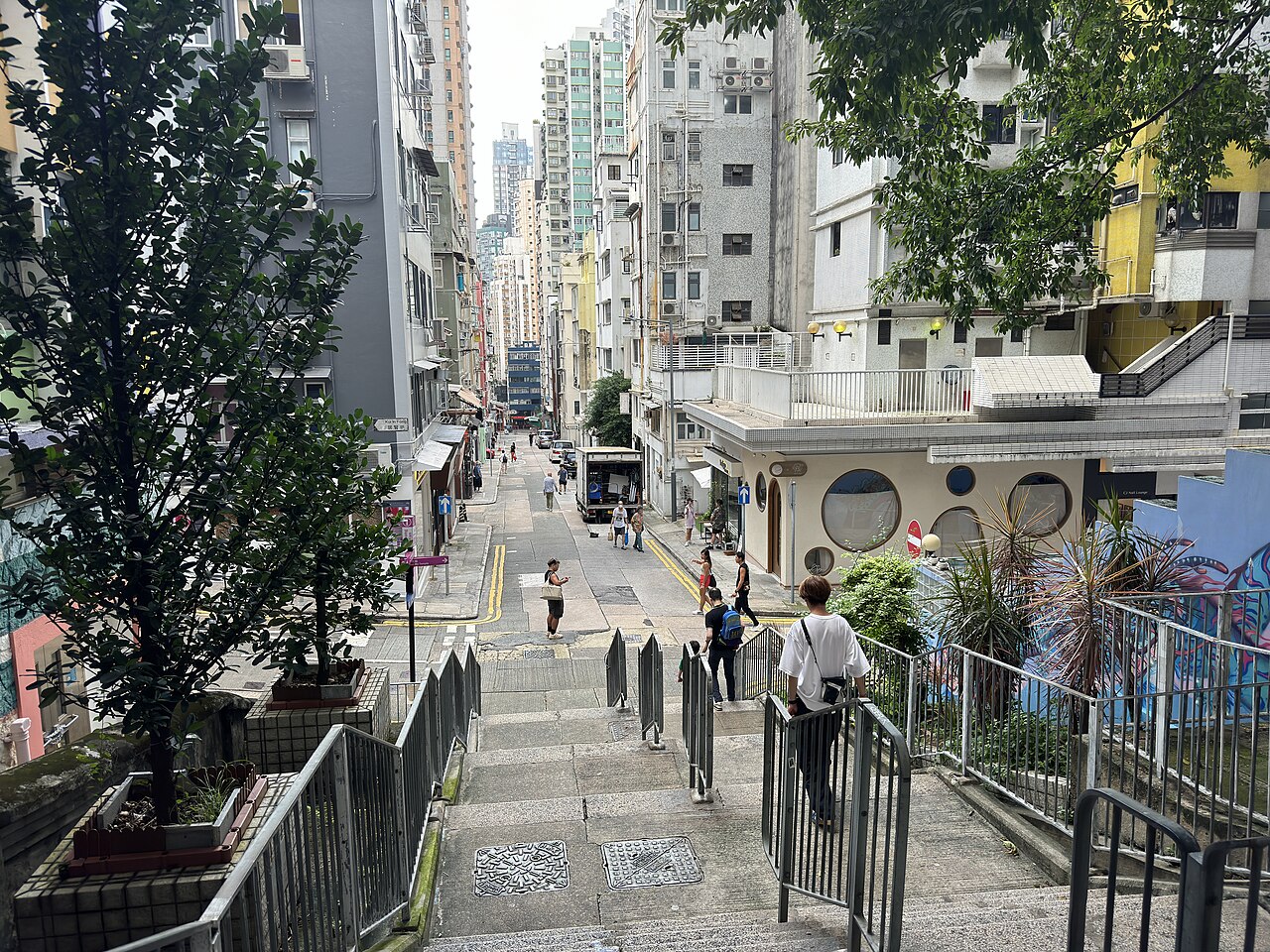
Image: Wikimedia Commons / CC BY-SA 4.0.
Walk the line from Causeway Bay to Sheung Wan and you’ll notice the 1960s aren’t on the streets — they’re in the seams. The seams of signboards, the edges of staircases, the cracked leather of booth seats.
Wong Kar-wai’s 1960s is Hong Kong told in a Shanghainese accent. Next chapter: the 1980s — the Hong Kong that spoke with guns and tears, John Woo and Stanley Kwan, A Better Tomorrow’s Tsim Sha Tsui East and Rouge’s Shek Tong Tsui.
A Better Tomorrow + Rouge — 1980s Hong Kong’s Twin Pistols and Burning Candle
1986 Hong Kong had two kinds of death: one bloomed in slow motion under the gun barrel of a Central restaurant, the other closed quietly amid the opium smoke of Shek Tong Tsui. Released within months of each other, A Better Tomorrow and Rouge pressed this city’s restlessness and afterglow into two negatives lying side by side.
Two films: the yang and yin of the same generation
A Better Tomorrow (1986) was John Woo’s comeback throw after a slump in comedy, and also the resurrection of Chow Yun-fat — until then derided in the industry as “box-office poison,” with over a dozen consecutive flops. The film, made on a budget of only HK34.65 million** in Hong Kong, and went on to rewrite Taiwan’s box-office history with over NT$100 million. In a single stroke it nailed Chow Yun-fat, Leslie Cheung, and Ti Lung into the Chinese film history pantheon. John Woo’s “violent ballet” didn’t come out of nowhere — its skeleton came from his mentor Chang Cheh’s entrails-bursting brotherhood epics, its rhythm borrowed from the multi-angle slow-motion in Sam Peckinpah’s The Wild Bunch, and the jump cuts and emotional inversions in the editing echo his beloved French New Wave (especially Jean-Pierre Melville’s Le Samouraï).
Rouge (1987) goes the opposite way. The source novel by Lilian Lee (1984) was reshaped by Stanley Kwan from a curiosity ghost story into a thoroughly female-perspective film — the camera lingers on Fleur lighting a cigarette, drawing her eyebrows, waiting, while the men are pushed to the edges of the frame. Anita Mui as Fleur, Leslie Cheung as the Twelfth Master — this was their second official collaboration after Behind the Yellow Line (1984); Anita Mui won Best Actress at the 7th Hong Kong Film Awards in 1988 for this role, and the same year took Best Actress at the Golden Horse.
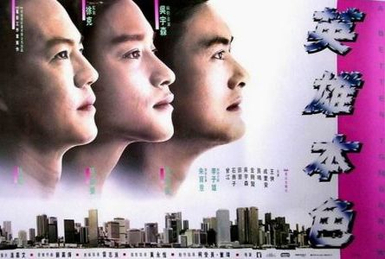
Still: Cinema City / Wikipedia · fair use (non-commercial).
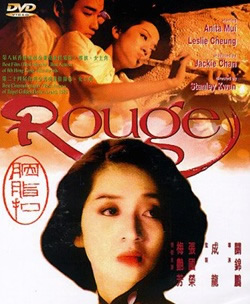
Still: Golden Harvest / Wikipedia · fair use (non-commercial).
Mark Gor and Fleur: two postures of “waiting”
Chow Yun-fat’s Mark Gor — Ray-Ban Wayfarers, beige trench coat, a matchstick clenched in his teeth — sold out at every wholesale stall in Tsim Sha Tsui that year, with teenagers across Asia scrambling to copy him. The scene most often replayed is the one outside The Peninsula in Central: he plants guns under the dinner table one by one, then rolls up two hundred-dollar US bills to light a cigarette, announcing in the most flamboyant possible way: “I use money for matches.” Three years later he emerges from prison in a wheelchair and says to Sung Tse-ho: “I waited three years just to wait for a chance to prove I’m not a failure” — a line that has been quoted more often than any political speech in Cantonese cinema, and that more precisely than any other speech engraved the inner state of 1980s Hong Kongers.
Rouge’s most-quoted line sits at the opposite pole. “Like dreamlike phantom moon / like coming, like leaving flower” — these two lines from the title song, written by James Wong (Wong Jim) for the film and sung by Anita Mui herself, were written in a single night. Wong later said: “Those ten characters were Fleur’s whole life.” Fleur and the Twelfth Master agree to commit double suicide by opium in 1932 Shek Tong Tsui — she dies, he doesn’t. Fifty years later she returns from the underworld to 1987 Hong Kong to look for him, places a missing-person ad in a Yau Ma Tei newspaper, and finally finds him in a film-set warehouse: over seventy, broken, hunched. This is the cruelest cut in the whole film — the one who waits hasn’t aged; the one who was waited for has lived into a ruin.
Read together, the two films are writing about the same anxiety. The 1984 Sino-British Joint Declaration was signed, the countdown to 1997 began; A Better Tomorrow’s English title is ironic — no one in the film actually gets a better tomorrow; while Rouge’s 50-year displacement (1932 → 1987) is precisely a séance for pre-colonial Hong Kong, performed at the end of the colonial period. One drowns death-anxiety in gunfire, the other pickles it in opium smoke. Underneath, both are late-1980s Hong Kongers asking the same question: does tomorrow still belong to me?
Locations: from the Tsim Sha Tsui waterfront to the tong lau of Shek Tong Tsui
Start with Tsim Sha Tsui. Ocean Terminal opened in 1966 as Asia’s first shopping mall and the “ship’s prow” jutting from the Kowloon Peninsula into Victoria Harbour — the night-time pier where Mark Gor walks shoulder-to-shoulder with Ho Gor was shot here. Today’s Avenue of Stars only opened in 2004, so the celebrity handprints embedded in the pavement didn’t exist when the film was made; the Victoria Harbour you see standing here is not the version 1986 audiences saw. Best time: dusk 17:30–19:30 — in blue hour the Central skyline lights up exactly as Ocean Terminal’s tip splits the sunset in half.
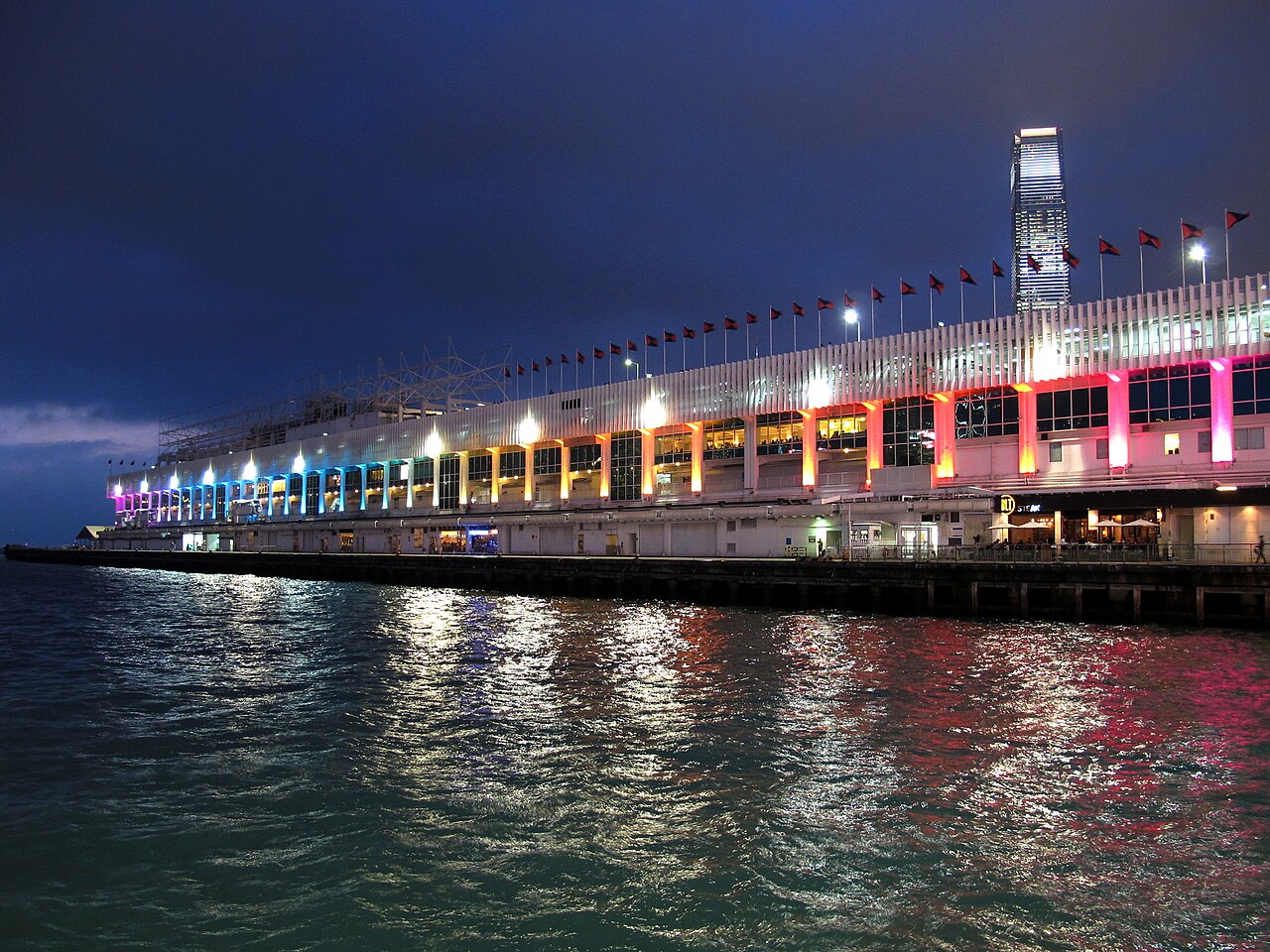
Image: Wikimedia Commons / CC BY-SA 4.0.
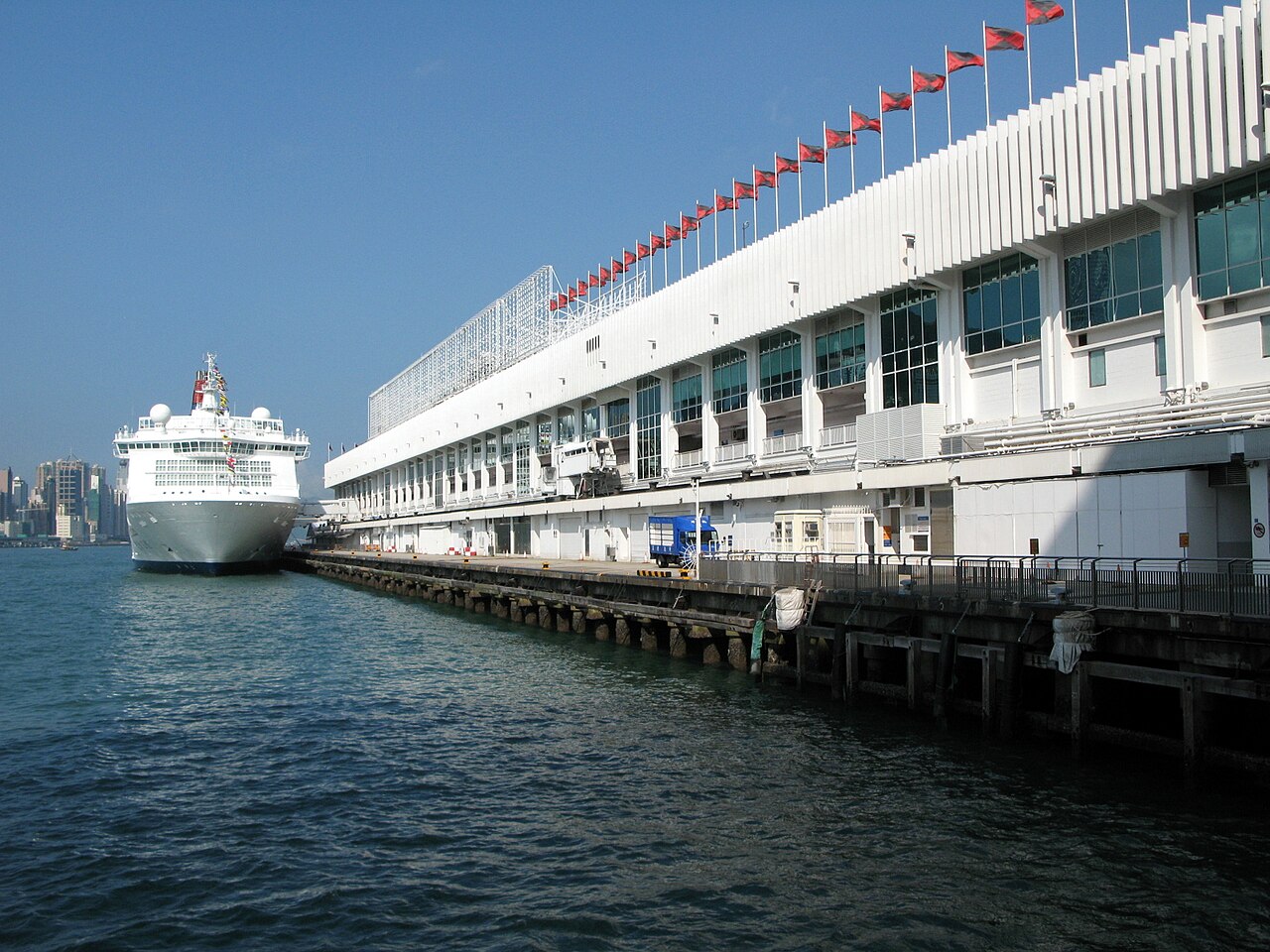
Image: Wikimedia Commons / CC BY-SA 4.0.
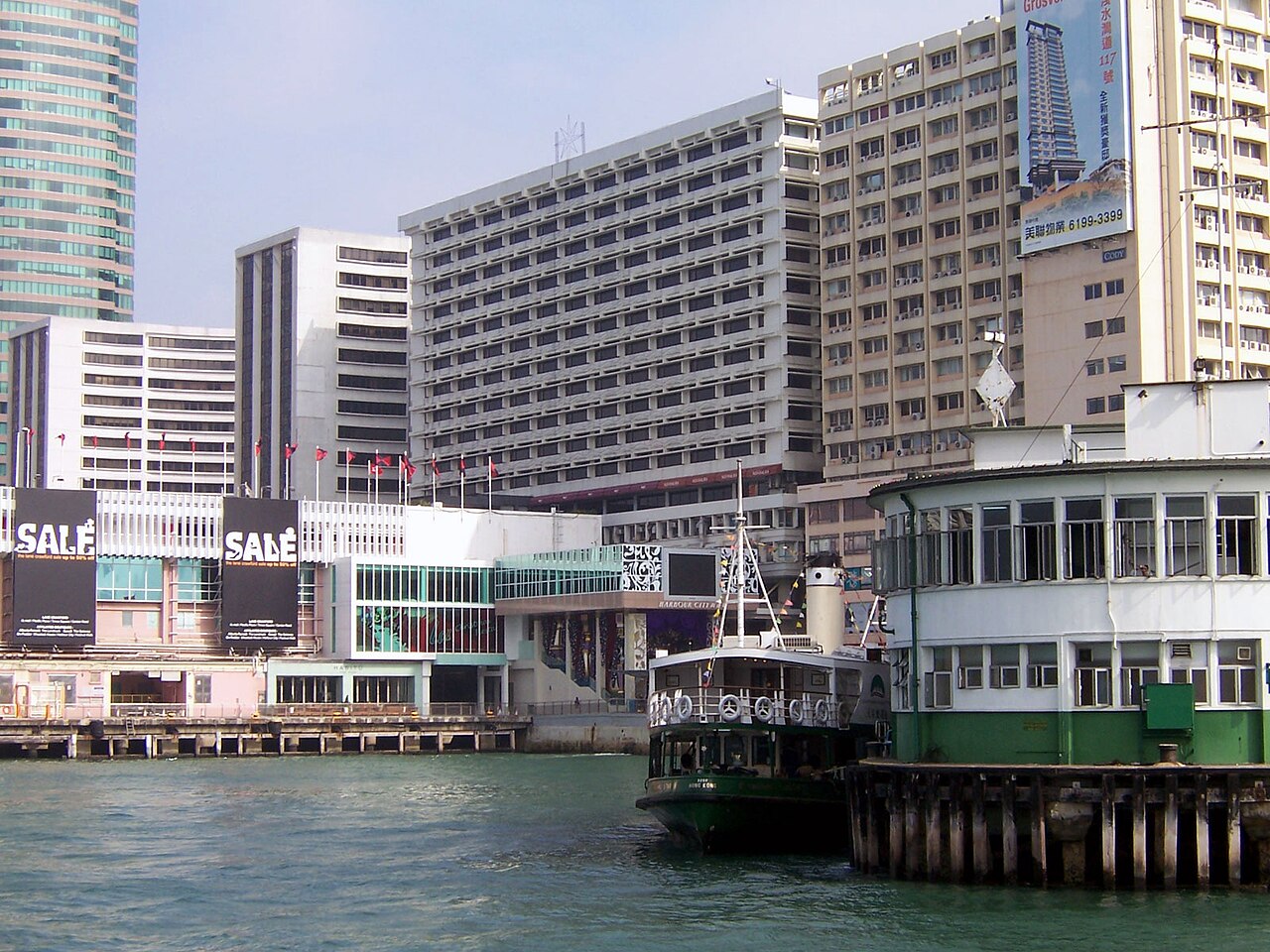
Image: Wikimedia Commons / CC BY-SA 4.0.
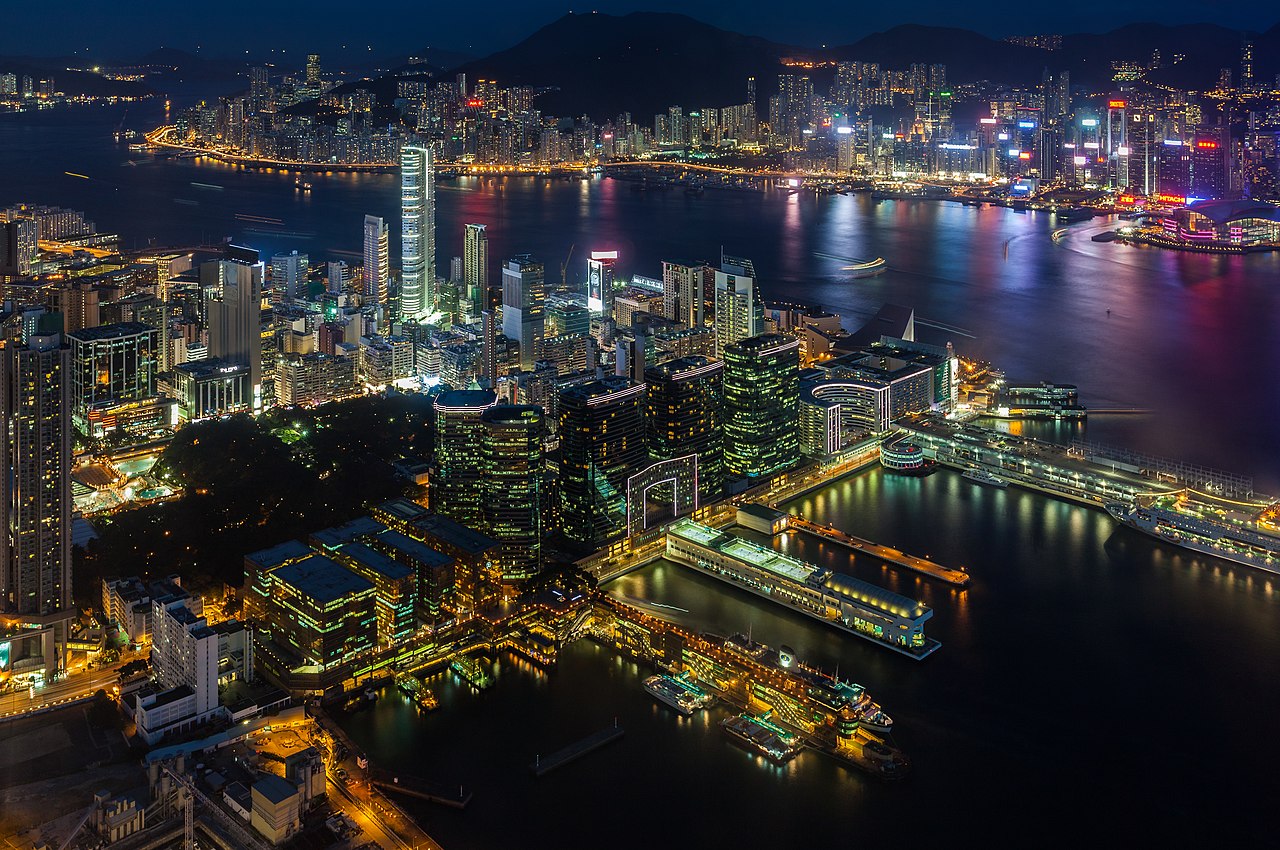
Image: Wikimedia Commons / CC BY-SA 4.0.
Then take the MTR Island Line west, get off at HKU Station Exit A2, and walk about 8 minutes down Hill Road into Shek Tong Tsui. From 1900 to 1935 this was south China’s biggest red-light district — brothels, restaurants, and opium dens packed shoulder to shoulder. The Kam Ling Restaurant in the film was modeled on a real establishment of that era; after the Hong Kong government banned prostitution in 1935, the district faded away, and no traces of the original Kam Ling remain. But along Hill Road, Queen’s Road West, and Des Voeux Road West a handful of 1930s tong lau (Cantonese verandah-style shophouses) still stand, and the Hong Kong Tramways (ding-ding) still rattle through. Walk Hill Road toward Kennedy Town in the evening and you’ll understand why Stanley Kwan placed Fleur here — what she returns to isn’t just her 1932 love, it’s an entire street erased by bulldozers.
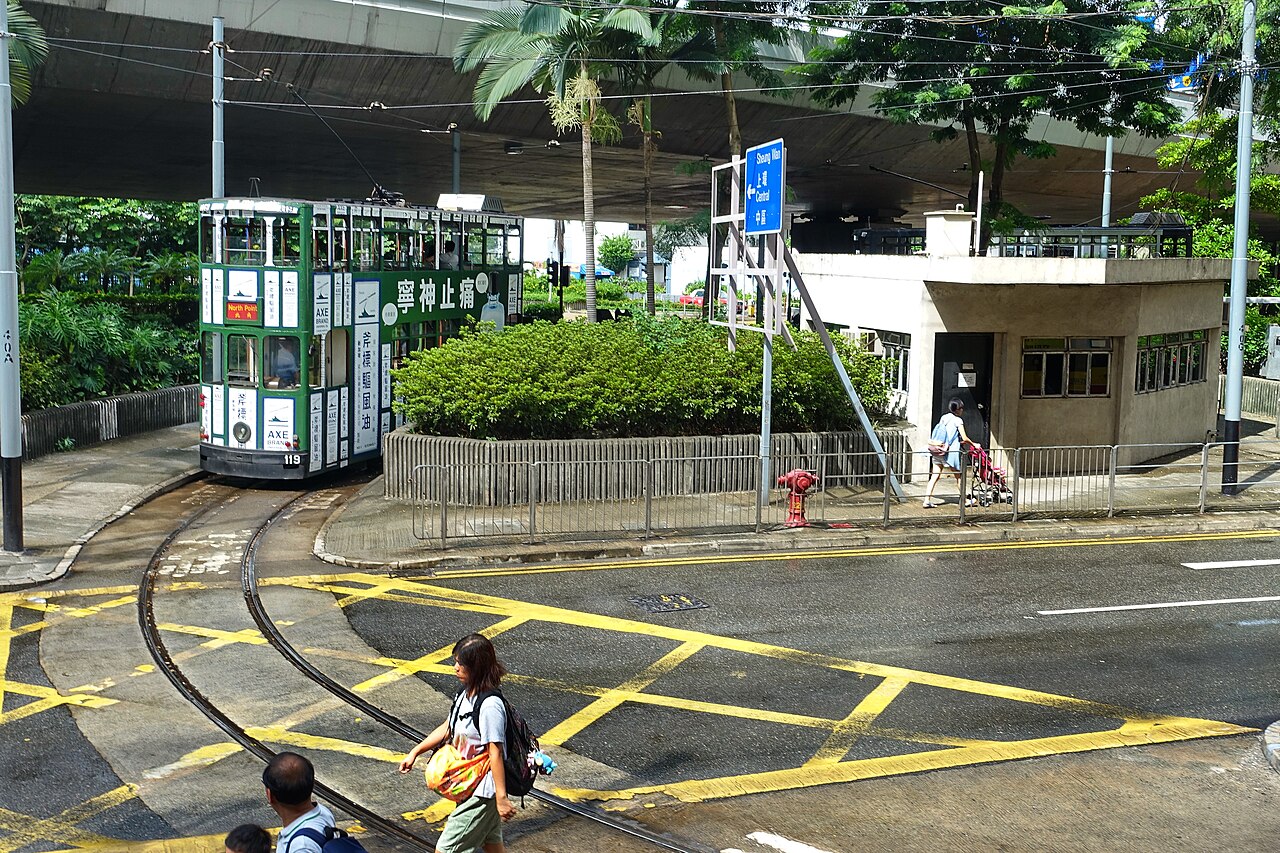
Image: Wikimedia Commons / CC BY-SA 4.0.
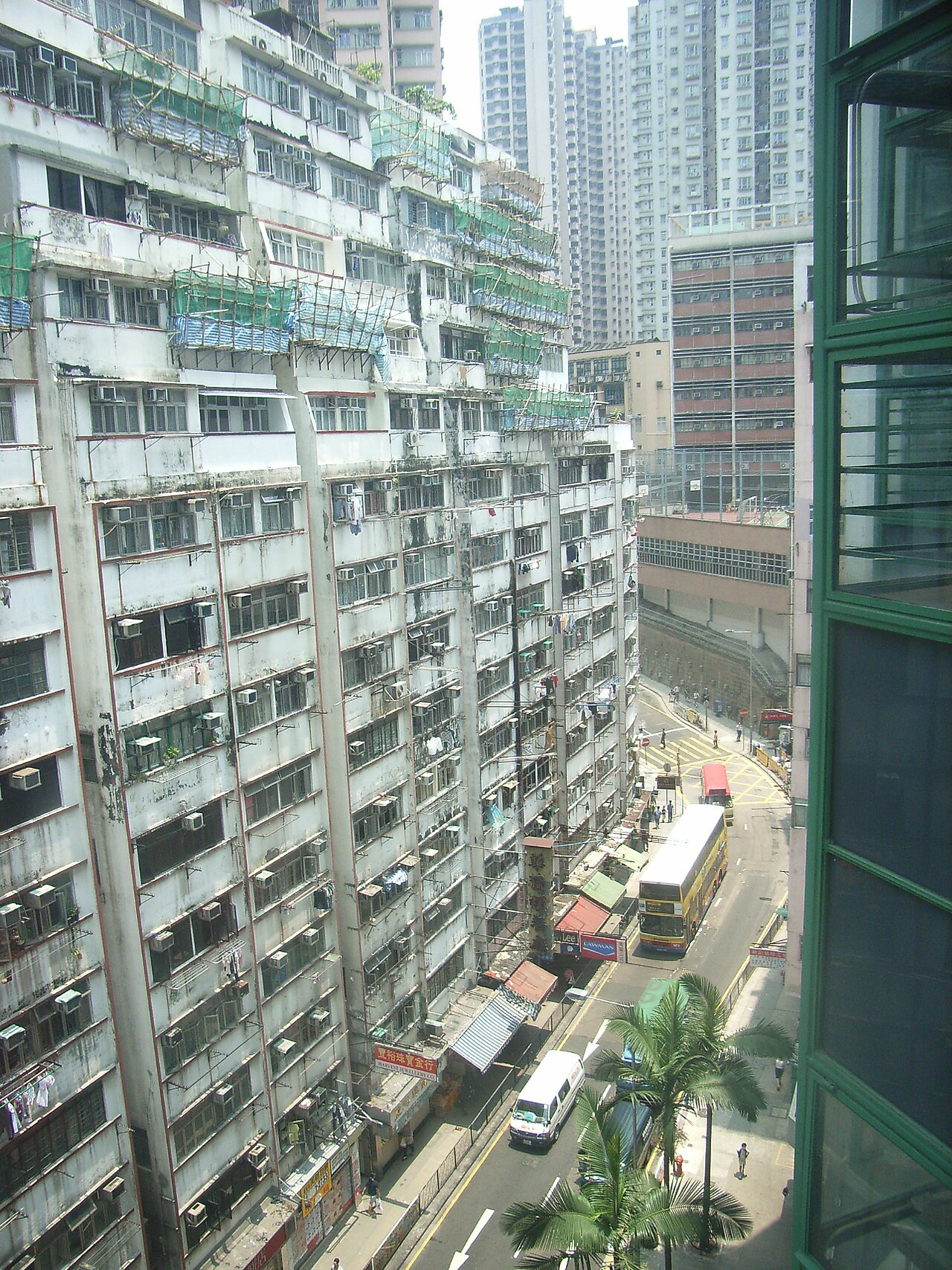
Image: Wikimedia Commons / CC BY-SA 4.0.
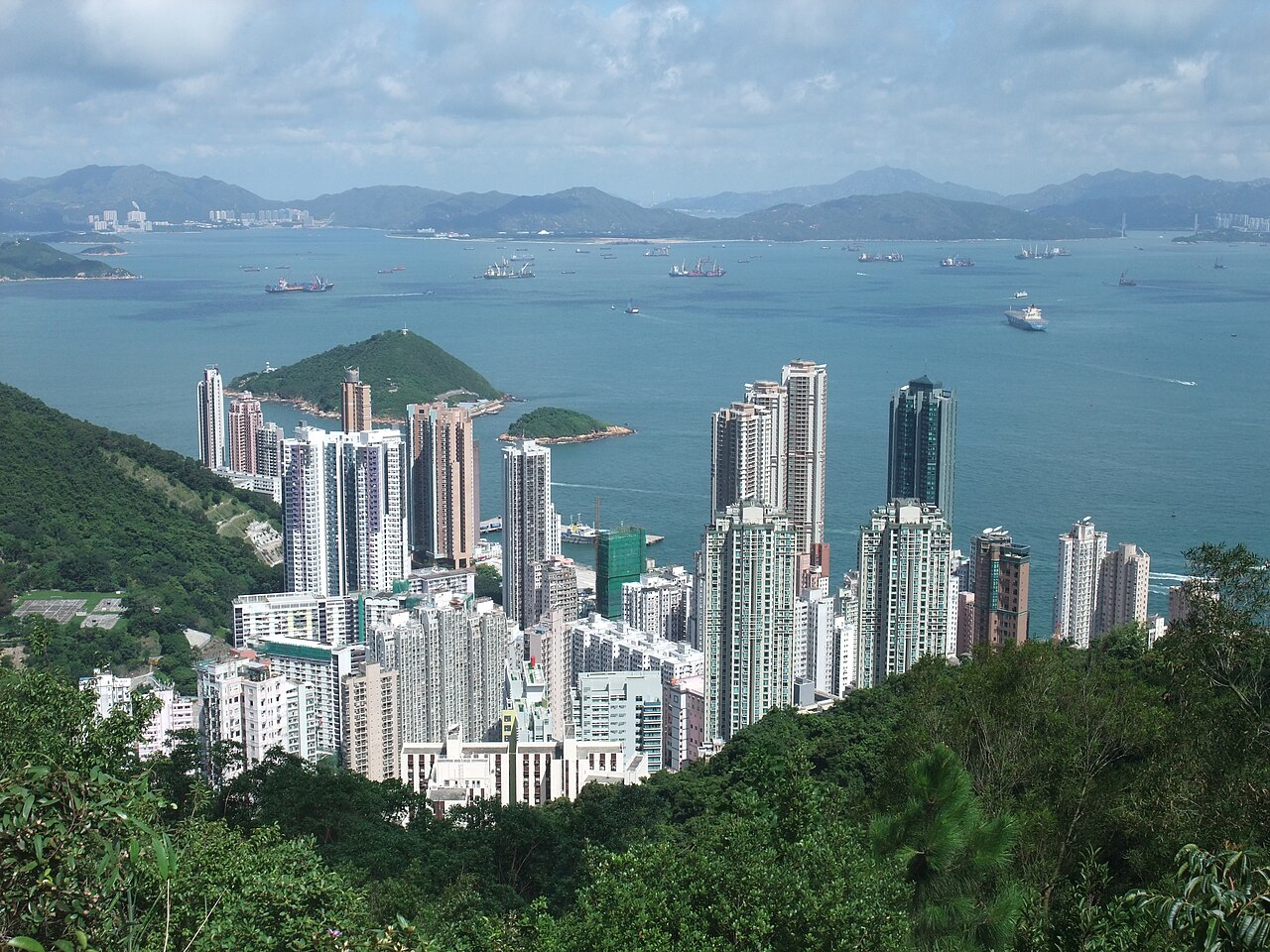
Image: Wikimedia Commons / CC BY-SA 4.0.
Putting down the twin pistols and the dying candle, the next stop leaves the harbor and the opium den behind and burrows into the cracks between Kowloon Walled City and Chungking Mansions — to see how Stephen Chow simmered the small-time underdog into a different kind of myth.
The God of Cookery + King of Comedy — Stephen Chow’s Working-Class Myths
The protagonists in Stephen Chow’s films are always losers: a God of Cookery toppled from the altar, an extra who can’t even pass for a “dead extra.” But they never really give in. The stance of still shouting “try harder, fight on” at the most absurd moment — that’s the deepest profile 1990s Hong Kong left to the world.
From Kowloon Walled City to the top of the Hong Kong box office
Stephen Chow was born in 1962 to a Shanghainese émigré family. At seven he moved with his mother to Kowloon, and his childhood was spent on the edge of Kowloon Walled City — the anarchic forest of steel and concrete that would later appear, again and again, in the backgrounds of his films. He took the TVB Actor Training Class entrance exam twice and was admitted to the evening class in 1982, the same year as Tony Leung Chiu-wai. After graduating he was assigned to the children’s program “430 Space Shuttle” as a host, spending six full years playing kids’ MC, alongside one-off drama episodes like Wind Sword. Then in 1990, All for the Winner, his pairing with Ng Man-tat, set a Hong Kong box-office record at HK$41.32 million, and the “Year of Stephen Chow” began.
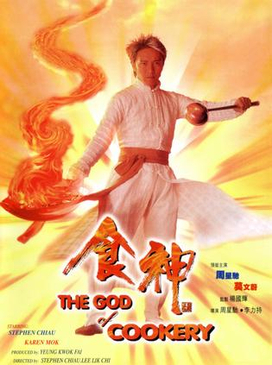
- The God of Cookery (1996): one of his early self-directed films, co-directed with Lee Lik-chi; HK$40.86 million locally, the year’s #3
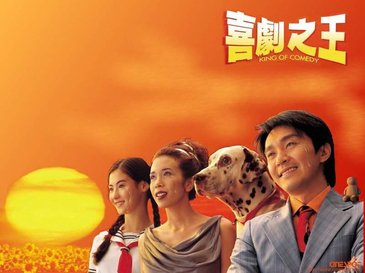
- King of Comedy (1999): again co-directed with Lee Lik-chi, a semi-autobiographical look back at his TVB extra days; HK$29.84 million locally, the year’s #1; also the screen debut of Cecilia Cheung
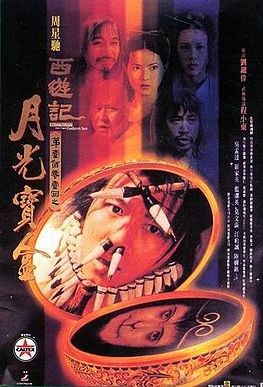
- A Chinese Odyssey (1995): co-directed with Jeffrey Lau as a two-part film, a box-office flop at release; later, on Mainland college campuses, it was deified through VCDs as the bible of 1990s-born youth
After those three, Stephen Chow essentially stopped acting in other directors’ films (with a few cameos), pivoting entirely from “comedy star” to “auteur director.”
Still: Star Overseas / Wikipedia · fair use (non-commercial).
Still: Star Overseas / Wikipedia · fair use (non-commercial).
The “Sorrowful Rice” and “An Actor’s Self-Cultivation”
The core of The God of Cookery is a bowl of rice. Stephen Chow falls from the Michelin altar, meets the scar-faced Sister Turkey (Karen Mok) in Temple Street, and together they invent the “exploding pissing beef balls” that take all of Hong Kong by storm. In the end, he wins back the judges with a single “Sorrowful Rice” — a slice of char siu, a soft-yolk fried egg, a sprinkle of scallions, over white rice — and Susanna Kwan, playing the judge, weeps. The beauty of the dish is its anti-climax: the so-called god-tier cuisine is really just a heartbroken man remembering his mother’s cooking. The line Sister Turkey says to him — “I don’t know why, but you seem to me more human than Turkey” — is one of the few in a Stephen Chow film that lands almost without a punchline.
King of Comedy is even more personal. Wan Tin-sau lives in a shack in Sai Kung, always carrying a copy of Stanislavski’s “An Actor’s Self-Cultivation,” running from set to set begging for any extra role. He says to Piu-piu (Cecilia Cheung), “Let me support you,” and to a nameless background actor, “The truth is, I am an actor.” The whole film plays like a late love letter from Stephen Chow to the years no one saw him in the 1980s. The line “God never gives up on any extra” comes from someone who’s actually eaten that bitterness.
So-called mo lei tau (nonsense humor) was never about meaninglessness. It’s the extreme form of Cantonese wit:
- Improvised reaction: Cantonese’s nine tones and six contours are naturally suited to homophones, displacements, self-interruption
- Loser philosophy: the protagonist is always humble, always smacked down, but always stands up again the second after being smacked down
- Postcolonial-anxiety counterstrike: a dialect that the official languages (Mandarin, English) never recognized but that seven million people use daily — establishing its dignity in the least serious way
This is why mo lei tau is essentially untranslatable. You can render the lines into any language, but the rhythm of “philosophy hidden in toilet humor” can only run in Cantonese. It’s also why Stephen Chow, though contemporaneous with Wong Kar-wai, Tsui Hark, and Jeffrey Lau as part of the new wave of Hong Kong cinema, took the opposite road: Wong Kar-wai films the nostalgia of intellectuals; Stephen Chow films the dignity of street-market vendors.
Still: Caixing Films / Wikipedia · fair use (non-commercial).
Pilgrimage points: Temple Street + Sai Kung
Temple Street (Yau Ma Tei)
- Range: from Jordan Road to Kansu Street, roughly 600 meters north-to-south — the street where Stephen Chow’s character sets up his beef-ball stall in The God of Cookery
- Transit: MTR Yau Ma Tei Station Exit C (north end) or Jordan Station Exit A (south end), 3 minutes on foot
- Best time: 18:00–22:00, all stalls open, noisy and packed; after midnight only the dai pai dong remain
- Suggested order: south end, Hing Kee Claypot Rice (closest in spirit to Sorrowful Rice); middle, Mido Café (opened 1950, also a Wong Kar-wai shooting location); north end, Yau Ma Tei Tin Hau Temple, after which Temple Street is named
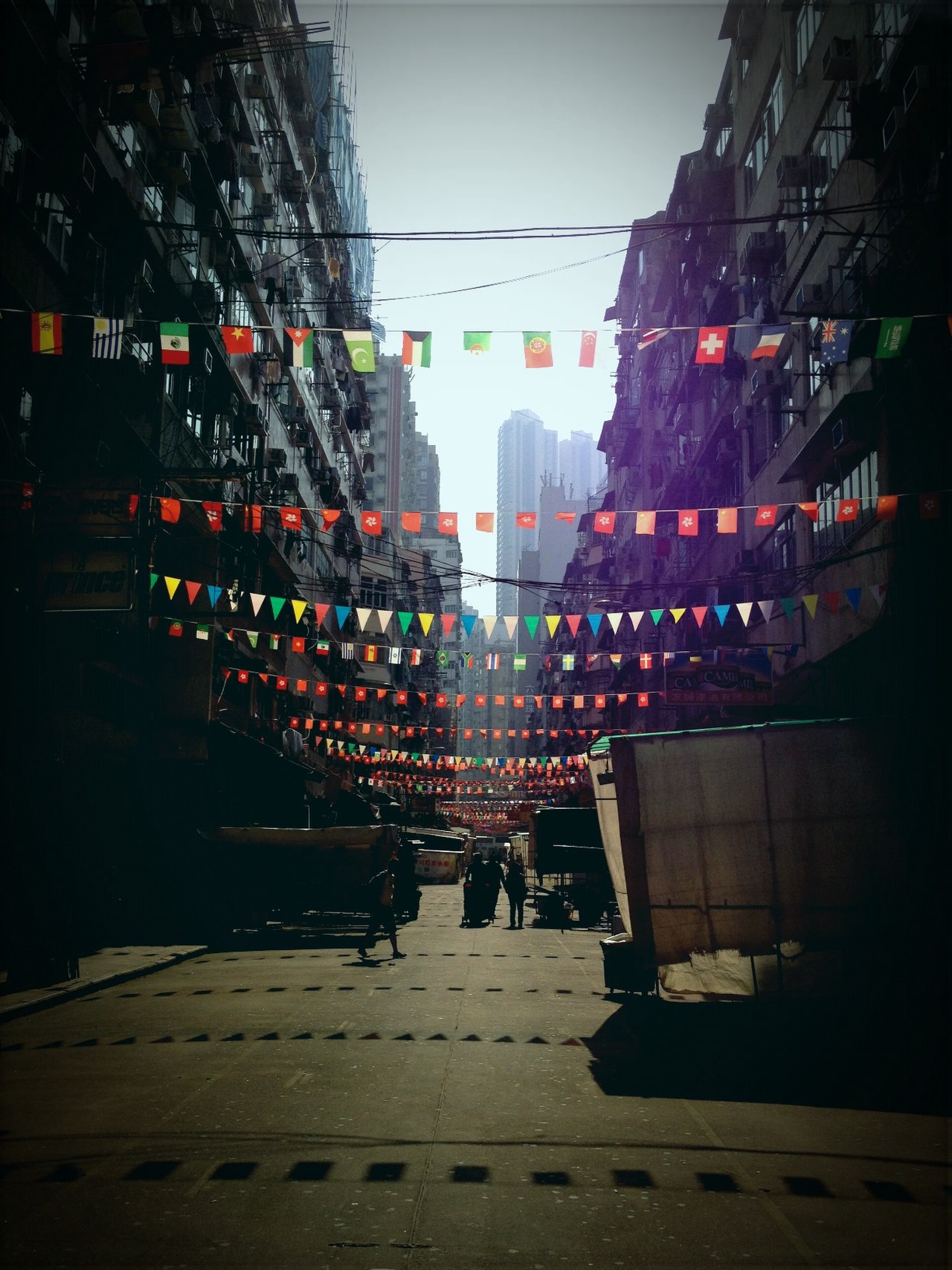
Image: Wikimedia Commons / CC BY-SA 4.0.
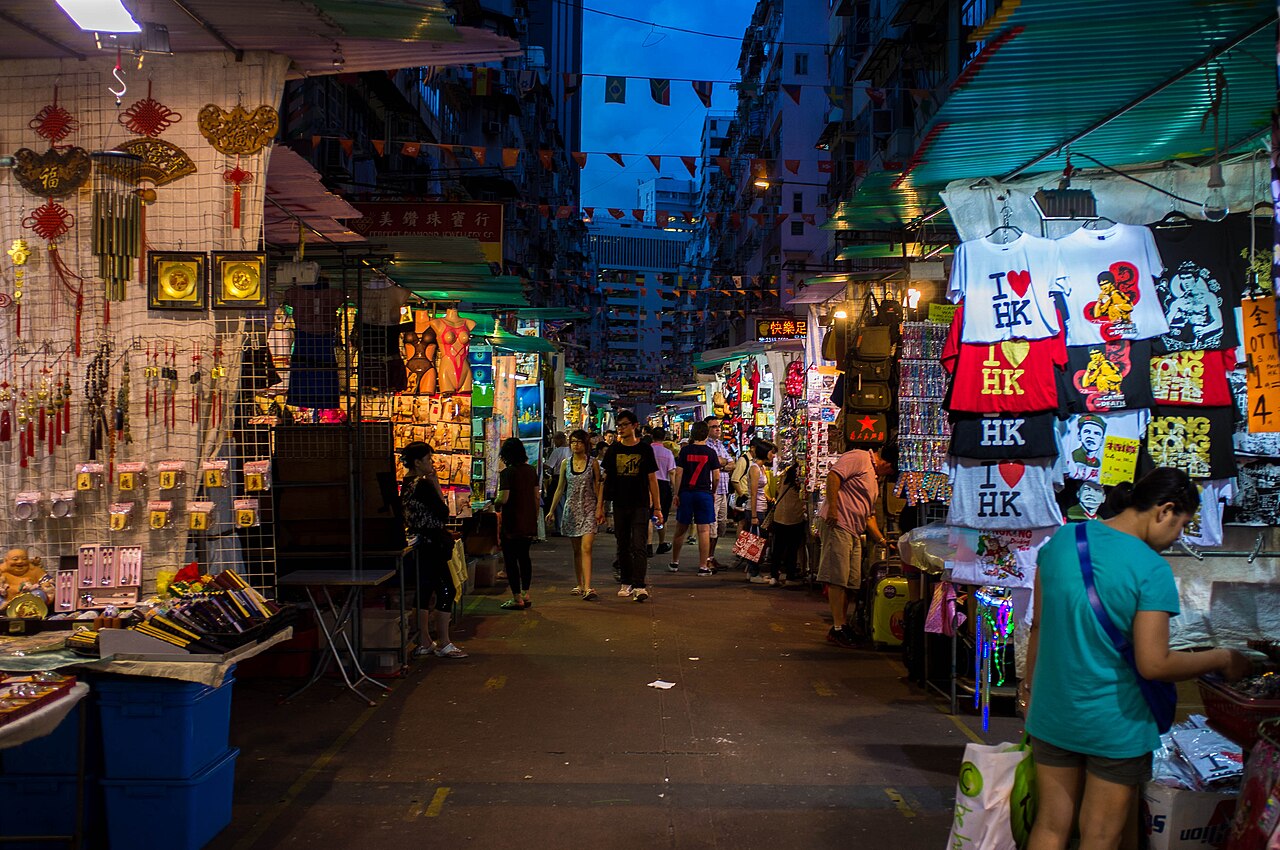
Image: Wikimedia Commons / CC BY-SA 4.0.
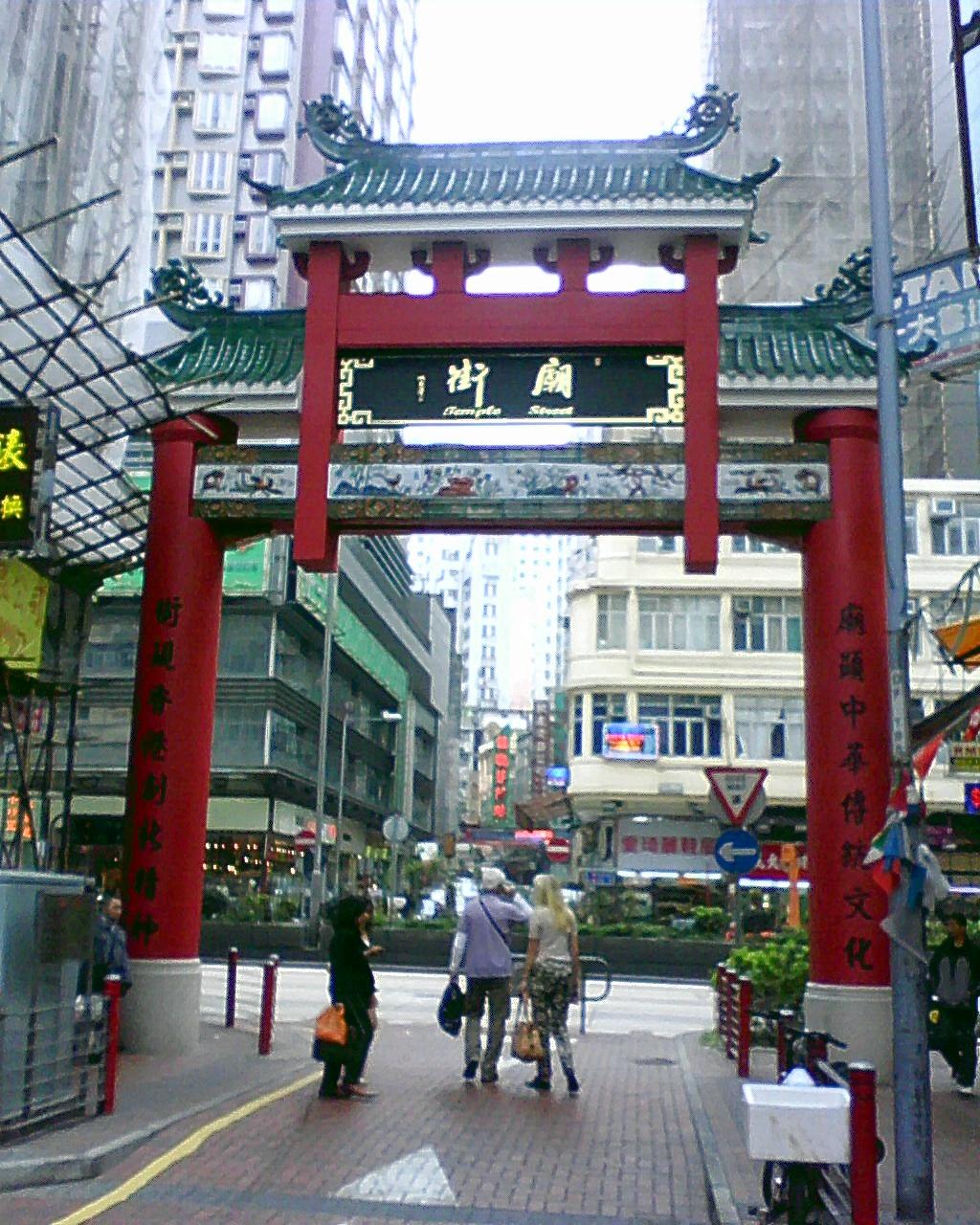
Image: Wikimedia Commons / CC BY-SA 4.0.
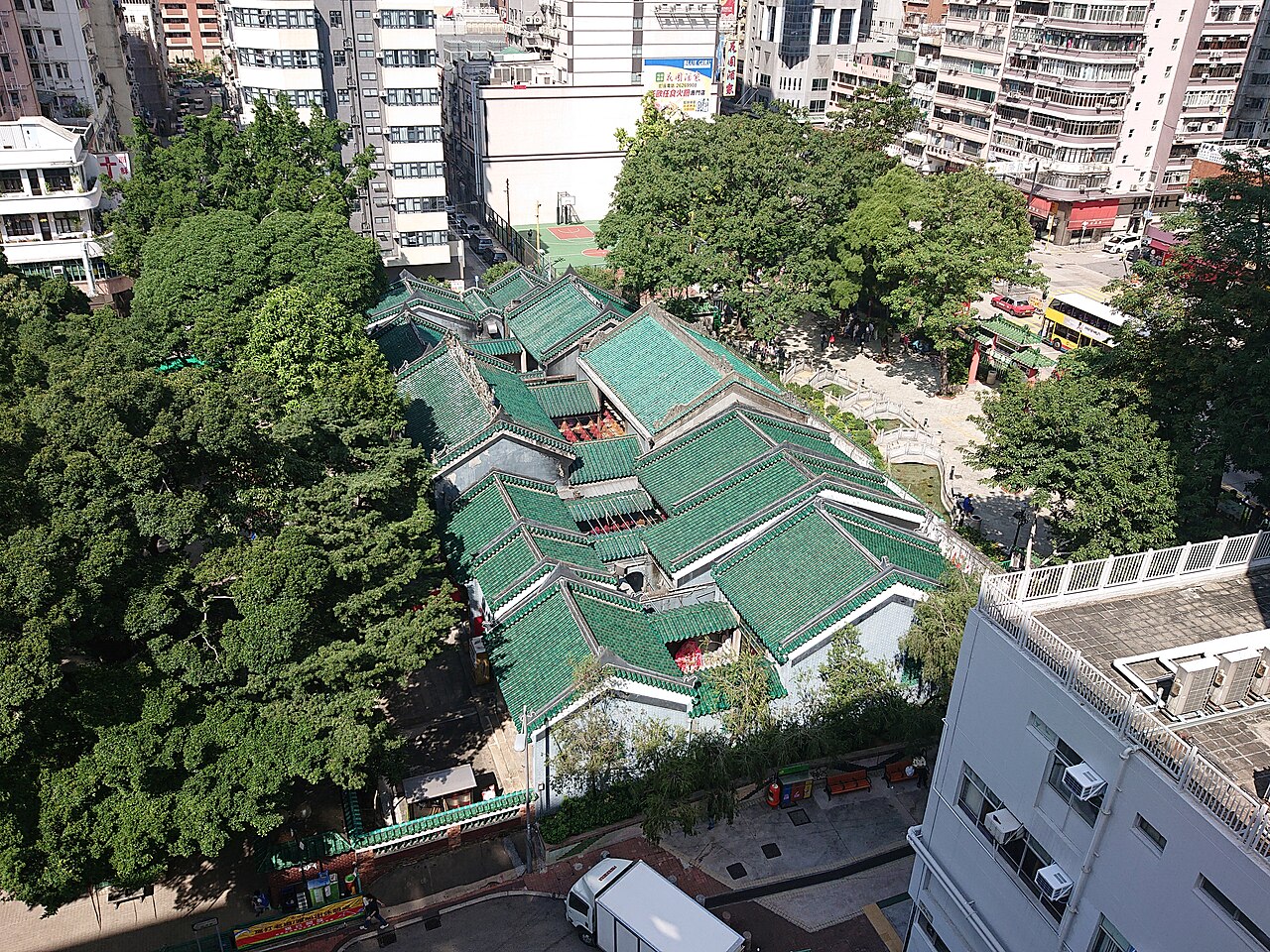
Image: Wikimedia Commons / CC BY-SA 4.0.
Sai Kung (New Territories)
- Locations: the opening scene of King of Comedy — Wan Tin-sau shouting “Try harder! Fight on!” at the sea — and the scenes of extras waiting at the pier were all shot around the Sai Kung waterfront promenade
- Transit: MTR Diamond Hill Station, transfer to bus 92 to Sai Kung terminus, about 35 minutes; from Sai Kung market to the waterfront is a 5-minute walk
- Eating: Seafood Street is a must-pass, but the truer-to-film vibe is a HK$25 bowl of fish-ball noodles by the pier — the kind Wan Tin-sau would actually eat
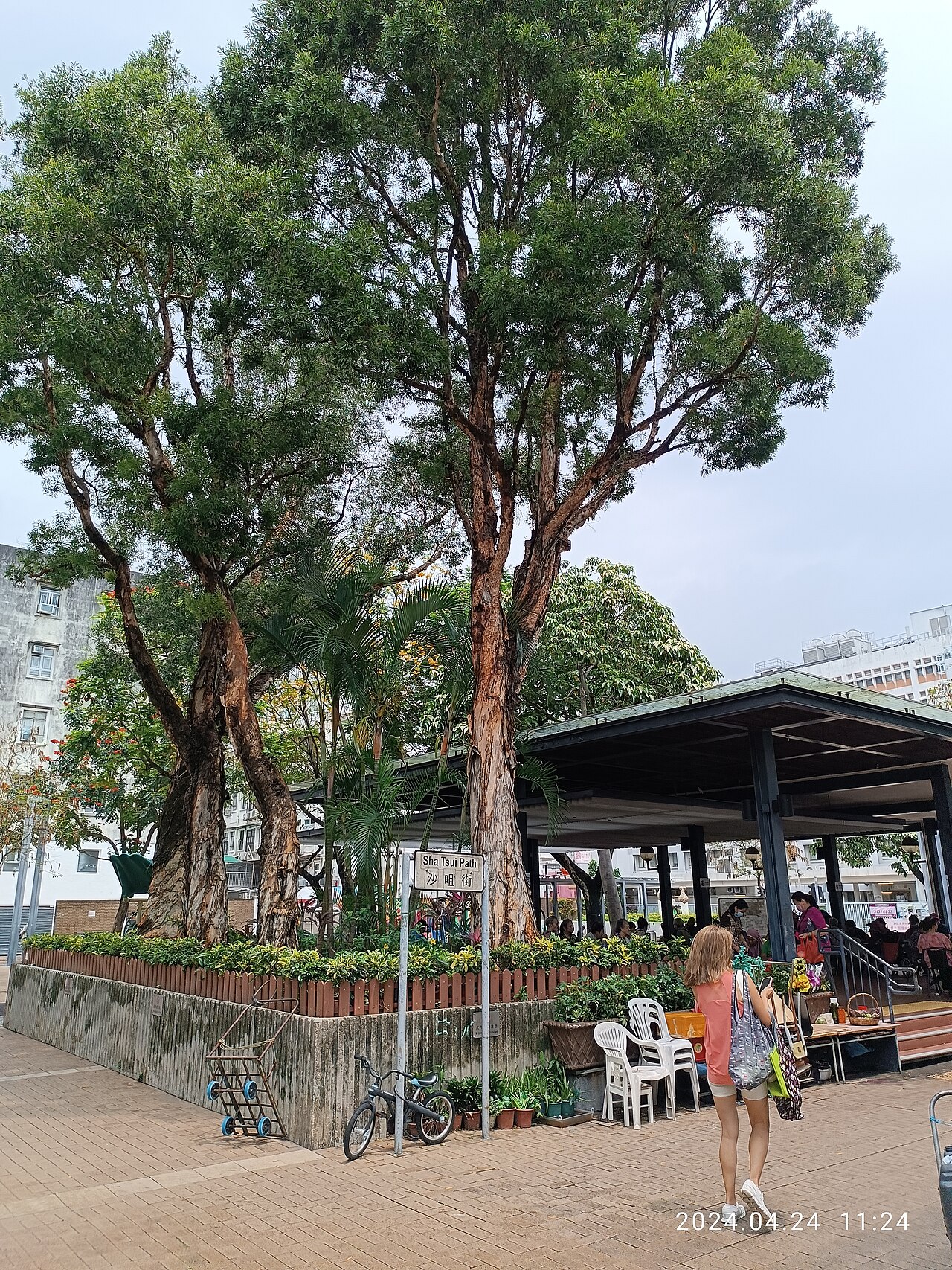
Image: Wikimedia Commons / CC BY-SA 4.0.

Image: Wikimedia Commons / CC BY-SA 4.0.
As the century turned, the grassroots romance of mo lei tau began to give way to another, colder, blacker Hong Kong narrative — undercovers, cops, rooftops, rooftops. Next chapter: the identity split of millennial Hong Kong.
Infernal Affairs — Millennial Hong Kong’s Identity Split
“I’m sorry, I’m a cop.” The moment Anthony Wong says this on the rooftop, he already knows he can’t go back. 2002 Hong Kong was exactly five years after the handover, the embers of the financial crisis hadn’t cooled, SARS was on the way, and Hong Kongers were learning a brand-new grammar: how to keep being yourself in a city that’s no longer yours. Infernal Affairs was born into that air of suspended identity — it’s not just a cops-and-robbers film, it’s a mirror, reflecting an entire generation’s fear of the question “who am I?”
A film that rescued an industry
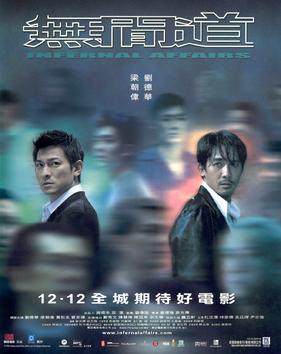
To understand the weight of Infernal Affairs, you have to go back to 2002, the lowest year ever for Hong Kong cinema. Pirated VCDs were everywhere, the Southeast Asian market had shriveled, Hollywood blockbusters crushed the local box office, and the year’s total Hong Kong film revenue hit a historic low. The industry consensus was “HK cinema is dead.” Andrew Lau and Alan Mak took the mirror-image dual-undercover script to Media Asia, slashed the budget to the bone, and almost no one believed in it — the cops-and-robbers genre had been milked dry by the Young and Dangerous series.
But after its release on December 12, 2002, Infernal Affairs pulled in HK$55.05 million in Hong Kong, breaking every record that year, and yanked the industry back from the grave. The cast was the first miracle: Tony Leung Chiu-wai and Andy Lau — Hong Kong cinema’s two most bankable male stars of the 1990s — finally went head-to-head, one playing the undercover cop inside the triads, Chan Wing-yan; the other playing the undercover triad inside the police, Lau Kin-ming. Anthony Wong as Inspector Wong and Eric Tsang as Hon Sam form the other pair: one the only witness who knows Chan is a cop, the other the boss who installed Lau in the police academy. Screenwriter Felix Chong later said in interviews that the entire film’s structure began with the rooftop scene — two undercovers on the same roof, one of them must walk off alive — and the rest of the script was reverse-engineered from that rooftop.
Still: Media Asia / Wikipedia · fair use (non-commercial).
The continuous hell and the postcolonial metaphor
“Infernal” — in Chinese wujian — comes from Buddhist scripture, referring to the lowest of the eight great hells: Avici, the continuous hell, where the sufferers experience “no break in body, no break in lifespan, no break in suffering,” with no rest and no escape. The film opens by quoting the Nirvana Sutra: “In the continuous hell, body has no end, life has no end, and the longest is the great kalpa within the continuous hell.” This is the film’s thesis — both undercovers live in the cracks of identity, with no exit.
Chan Wing-yan has been a triad mole for nine years, with Inspector Wong as the only person in the entire file who knows he’s a cop. Lau Kin-ming rises through the force, and the only person who can expose him is himself. The rooftop confrontation between the two is one of the most iconic head-to-heads in Chinese-language cinema:
- Lau: “Give me a chance.”
- Chan: “How can I give you a chance?”
- Lau: “I never had a choice before. Now I want to be a good man.”
- Chan: “Fine, tell it to the judge — see if he lets you.”
- Lau: “Then you’re asking me to die.”
- Chan: “I’m sorry, I’m a cop.”
This exchange has been quoted line by line by countless people, but its sharpest edge is this: “I want to be a good man” isn’t just a corrupt cop pleading for his life — it’s the line 2002 Hong Kongers were saying to themselves in the mirror. Chan Wing-yan waited nine years for the moment of “becoming a good man again,” which lines up exactly with the collective anxiety about identity at the fifth anniversary of the handover. Hong Kongers under One Country, Two Systems — who are they? When will they stop being undercover?
The film’s success quickly crossed beyond the Chinese-language world. Martin Scorsese remade it in 2006 as The Departed, transplanting the setting to the Boston Irish mob, and took home four awards at the 79th Academy Awards, including Best Picture, Best Director, Best Adapted Screenplay, and Best Editing — Scorsese’s first-ever Best Director Oscar. The original Infernal Affairs swept the 22nd Hong Kong Film Awards, taking home seven including Best Picture, Best Actor (Tony Leung), Best Supporting Actor (Anthony Wong), Best Director, Best Screenplay, and Best Editing.
Lau and Mak rode the momentum and in 2003 released both Infernal Affairs II (a prequel about Hon Sam and the Ngai family feud) and Infernal Affairs III: End Inferno (with interwoven timelines). The trilogy formed the most complex undercover-narrative network in Chinese-language film history. Many fans rank Part II at, or even above, the original — Francis Ng’s Ngai Wing-hau is the last great peak in Hong Kong’s gangster gallery.
Pilgrimage notes: where the rooftop actually is
This is the most commonly mis-tagged location in all of Hong Kong cinema.
- Guangdong Investment Tower (148 Connaught Road Central, near the Sheung Wan side) — this is the actual main shooting location for the rooftop scene. From Sheung Wan MTR Exit A2, walk west along Connaught Road Central for about 5 minutes. The building is still a commercial office tower; the rooftop is not open to the public, so pilgrims can only look up from the street across the way
- North Point Government Offices rooftop — some shots and pickups were done here, near Quarry Bay MTR Station
- IFC One — this is the most common misidentification. Many tourists head up to the top of IFC chasing the “Infernal Affairs rooftop,” but the iconic glass-curtain-wall composition in the film is not IFC
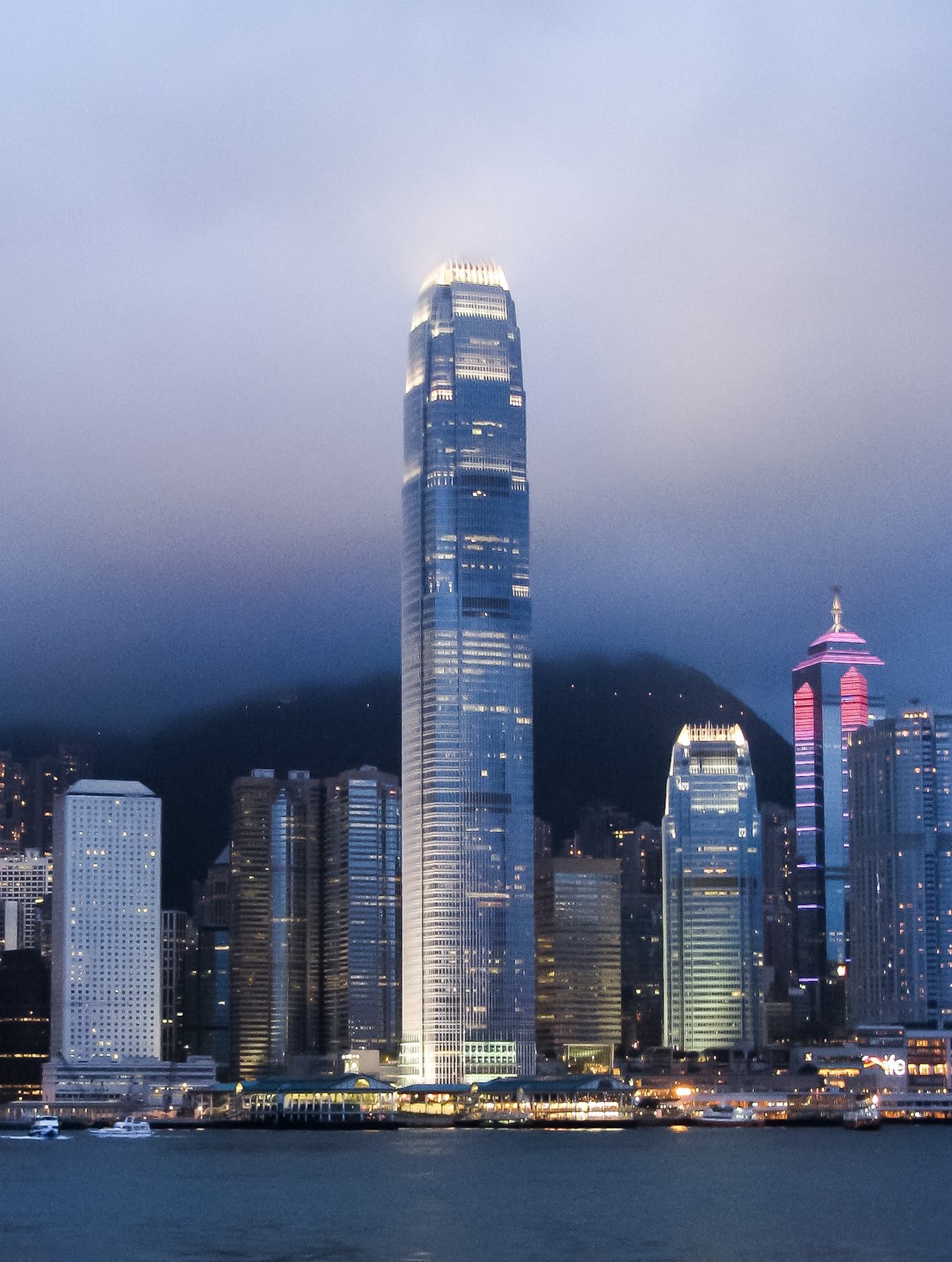
Image: Wikimedia Commons / CC BY-SA 4.0.
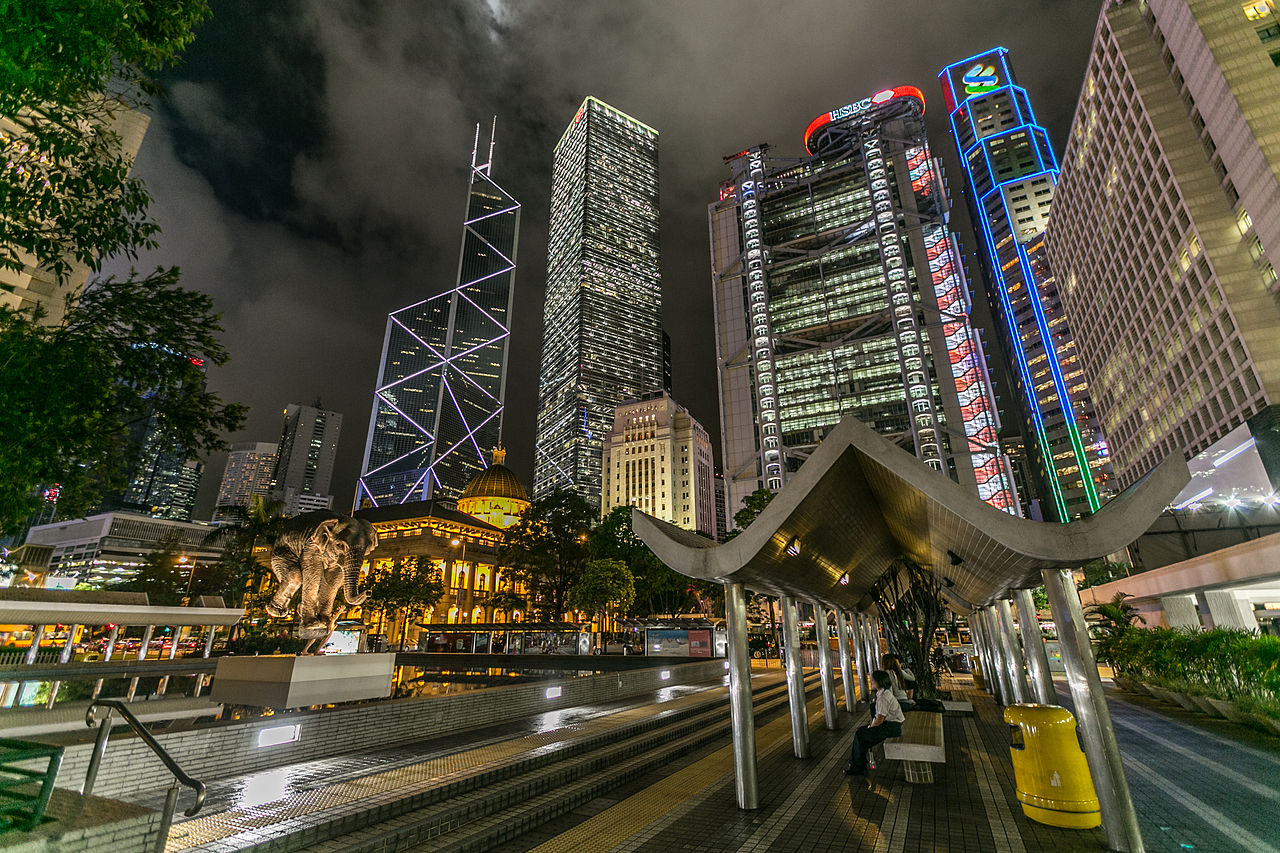
Image: Wikimedia Commons / CC BY-SA 4.0.
On the way, swing by the Monster Building in Quarry Bay — it doesn’t appear in Infernal Affairs itself, but it’s the architectural deity of the same generation of Hong Kong cinema (Transformers: Age of Extinction, Ghost in the Shell were both shot here). The Monster Building is formed by five connected blocks: Yick Cheong, Oceanic, Fok Cheong, Yick Fat, and Montane Mansion, in an E-shaped layout, completed in 1972, with 2,243 units and around 10,000 residents sharing the same atrium. From Taikoo MTR Station Exit B, it’s about a 2-minute walk. Since 2020 the management has installed camera barriers at the atrium entrance and posted notices — this is residential, not a tourist attraction. Keep your voice down, no flash, don’t block the corridors.
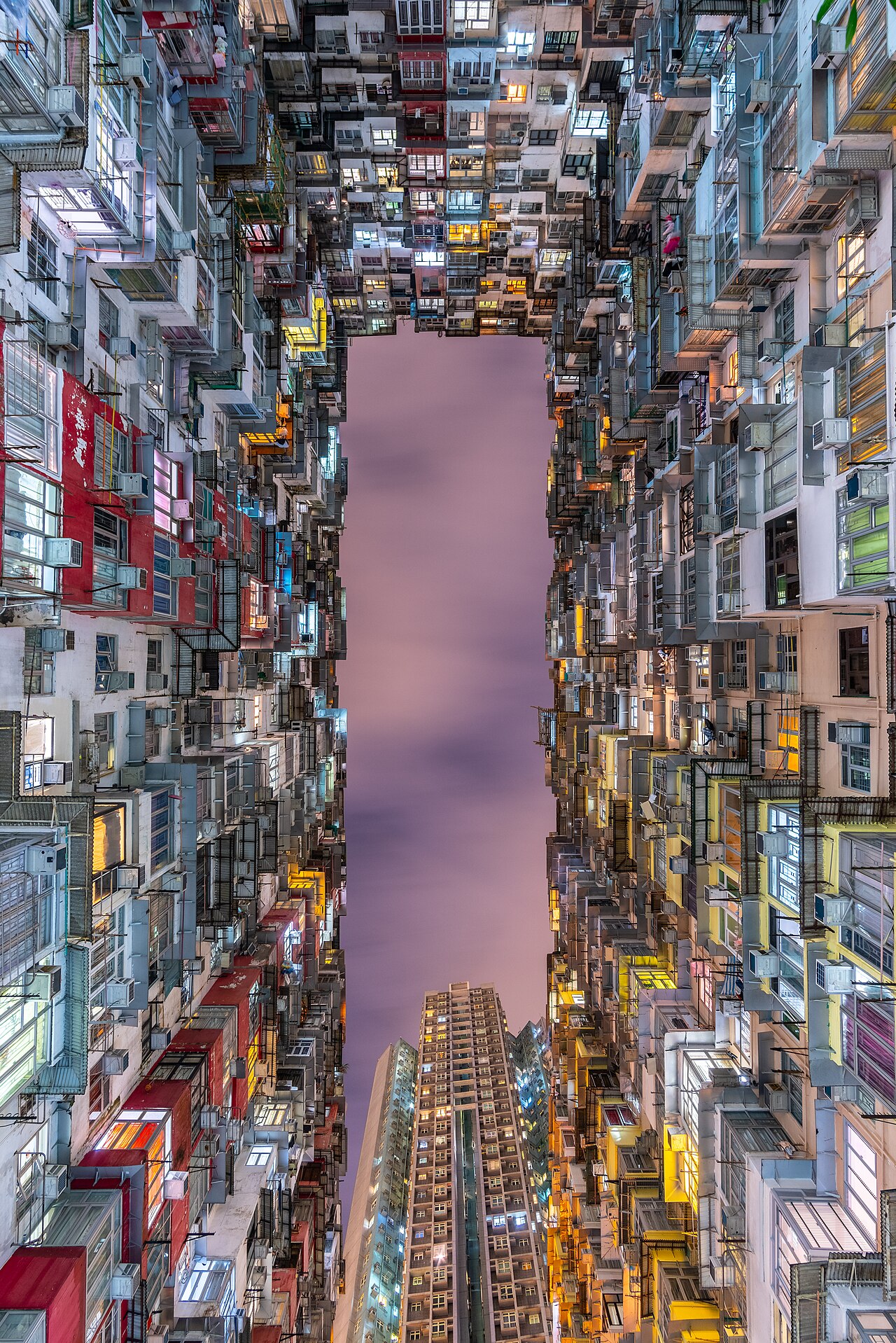
Image: Wikimedia Commons / CC BY-SA 4.0.
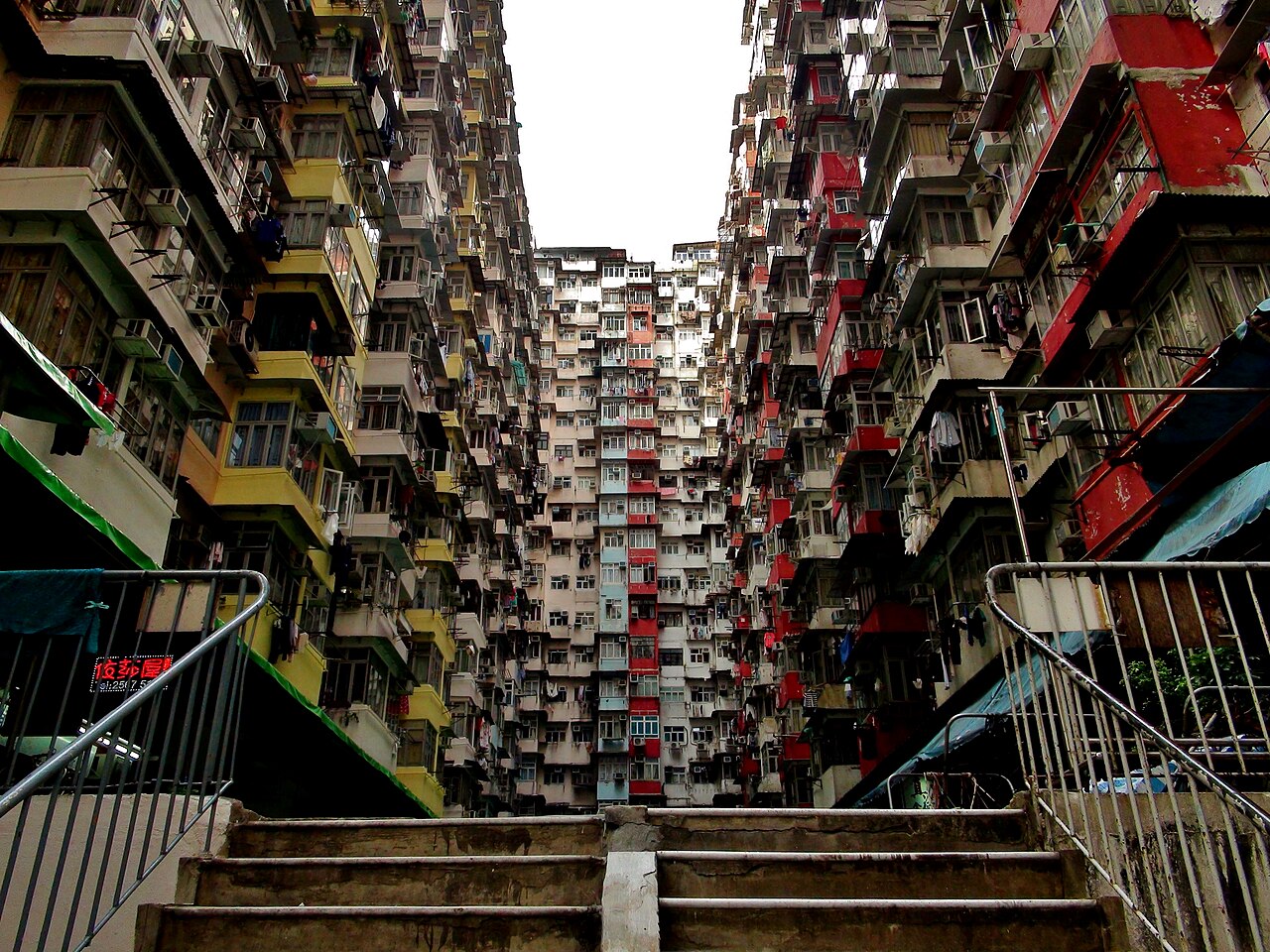
Image: Wikimedia Commons / CC BY-SA 4.0.
Chan Wing-yan dies on a different rooftop in the end, and Lau Kin-ming goes on living with his stolen identity. No one ever clocks out of the continuous hell — but in the next chapter, we’ll find the men still drinking at the dai pai dong of Tsim Sha Tsui East after work: Johnnie To’s Milkyway Image universe, another kind of loneliness in Hong Kong’s nights.
PTU + Election + Sparrow — Johnnie To’s Skeleton of Hong Kong Island
If Wong Kar-wai filmed Hong Kong’s humidity and ambiguity, Johnnie To filmed its geometry. In his lens, fate has a shape — and that shape is often the straight diagonal of Ladder Street in Sheung Wan, the obtuse angle of a Central overpass, the precise number of seconds it takes two groups in a Mong Kok back alley to walk toward the same intersection.
Milkyway Image: the last flag of noir HK cinema
In 1996 Johnnie To founded Milkyway Image with screenwriters Wai Ka-fai and Yau Nai-hoi. At that moment Hong Kong cinema was in its first major slide — capital flight before the handover, rampant piracy, the collapse of the star system — and Milkyway went the opposite way: low budget, high density, ensemble blocking, thoroughly noir. The first film was Wai Ka-fai’s Too Many Ways to Be No. 1 (1997), in which Lau Ching-wan plays the same man’s two diverging fates; then 1998’s The Longest Nite (Tony Leung and Lau Ching-wan strangled by fate in a single night in Macau); and 1999’s Running Out of Time (Andy Lau vs. Lau Ching-wan in a battle of wits, for which Johnnie To won Best Director at the HK Film Awards).
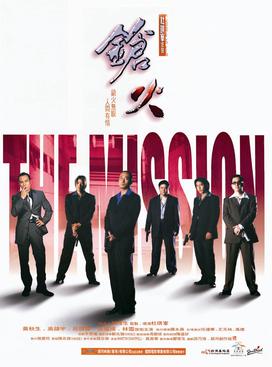
But what really defined the Milkyway aesthetic was 1999’s The Mission. Five bodyguards complete an entire gunfight in a Tsuen Wan mall from almost stationary positions — long lens, fixed focus, figures locked like chess pieces along the frame’s dividing lines. This is Johnnie To’s complete inversion of John Woo’s “violent ballet”: no doves, no slow-mo, only stillness, standoff, and the residual echo of a sudden burst.
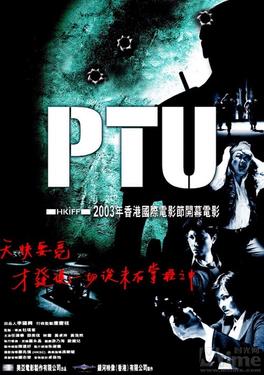
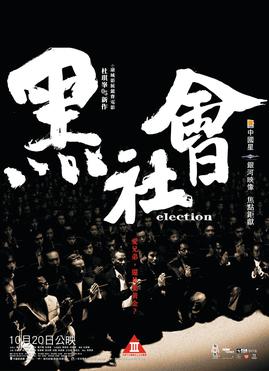
In the 2000s, To brought this language back to the streets. PTU (2003) hands the camera to the least romantic of police units — the Police Tactical Unit; Election / Election 2 (2005-06), the two-parter, is hailed by many critics as the high-water mark of Chinese-language gangster cinema; and Sparrow (2008) is To’s love letter to the streetscape of Hong Kong Island — loose-rhythmed, almost plotless, caressing the overpasses, staircases, and shophouses of Hong Kong Island inch by inch.
Still: Milkyway Image / Wikipedia · fair use (non-commercial).
Still: Milkyway Image / Wikipedia · fair use (non-commercial).
Still: Milkyway Image / Wikipedia · fair use (non-commercial).
The Dragon’s Head Baton, the cleaver, and four pickpockets
PTU’s story is almost laughably small: a Crime Squad officer (played by Lam Suet) loses his service pistol in Mong Kok, and PTU sergeant Ho Man-jin (Simon Yam) leads his team to help find it before dawn. The whole film takes place in a single night, from dusk to sunrise. The most famous moment is outside China Ice Café at 1077A Canton Road, Mong Kok — dim streetlight, empty street, two groups facing off, both motionless — Johnnie To holds a still long-lens shot for tens of seconds to tell you: in Hong Kong cinema, the most violent moment is often the quietest.
Election turns the camera toward the internal vote of the triads. Every two years the elders of “Wo Lin Sing” choose a new chairman — the symbol of power is the Dragon’s Head Baton, passed down through generations. Simon Yam as “Lok” is mild, restrained; Tony Leung Ka-fai as “Big D” is violent and exposed. The Part I finale — Lok smashing Big D to death with a stone by a remote fish pond, then turning back to hold his son’s hand — is one of the coldest cuts in Hong Kong film history. In Part II, Election 2: Triad Election, the chairman becomes “Jimmy” (Louis Koo), and the cleaver brought down on the wooden table is even more chilling than every Dragon’s Head Baton in the first film: the triads want to go clean and run real businesses, but fate (and Beijing) won’t allow it.
Sparrow has a different temperament. “Sparrow” (man jeuk) is Cantonese slang for pickpocket. Simon Yam, Lam Suet, Gordon Lam, and Lo Hoi-pang play four veteran pickpockets wandering Hong Kong Island who meet a woman wanting out (Kelly Lin). The film has almost no conflict; the silent “duel” on a rain-soaked overpass — two teams of pickpockets switching wallets through a forest of umbrellas — is the waltz Johnnie To wrote for Hong Kong.
Pilgrimage points: four coordinates on the Hong Kong Island skeleton
Ladder Street, Sheung Wan: a granite staircase linking Hollywood Road and Bridges Street, cut by the British in the 1840s — a Grade I historic building. Several conversations between Lok and Big D in Election and Gordon Lam’s pickpocket chase in Sparrow were shot here. MTR Sheung Wan Station Exit A2, about 5 minutes on foot. Early morning 7–9 AM is when the light comes in low from the east, and the grain of the stone steps reads best.
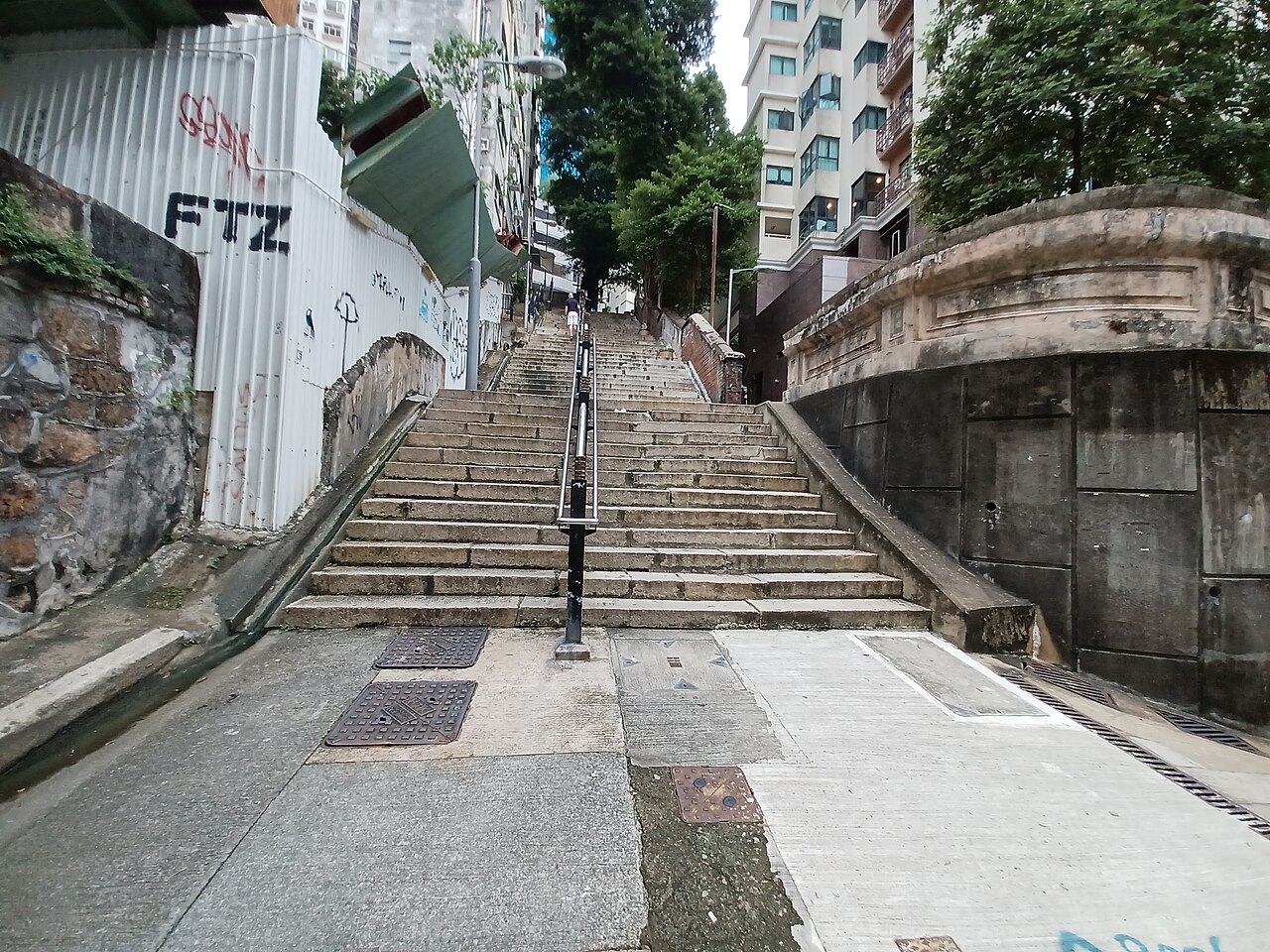
Image: Wikimedia Commons / CC BY-SA 4.0.
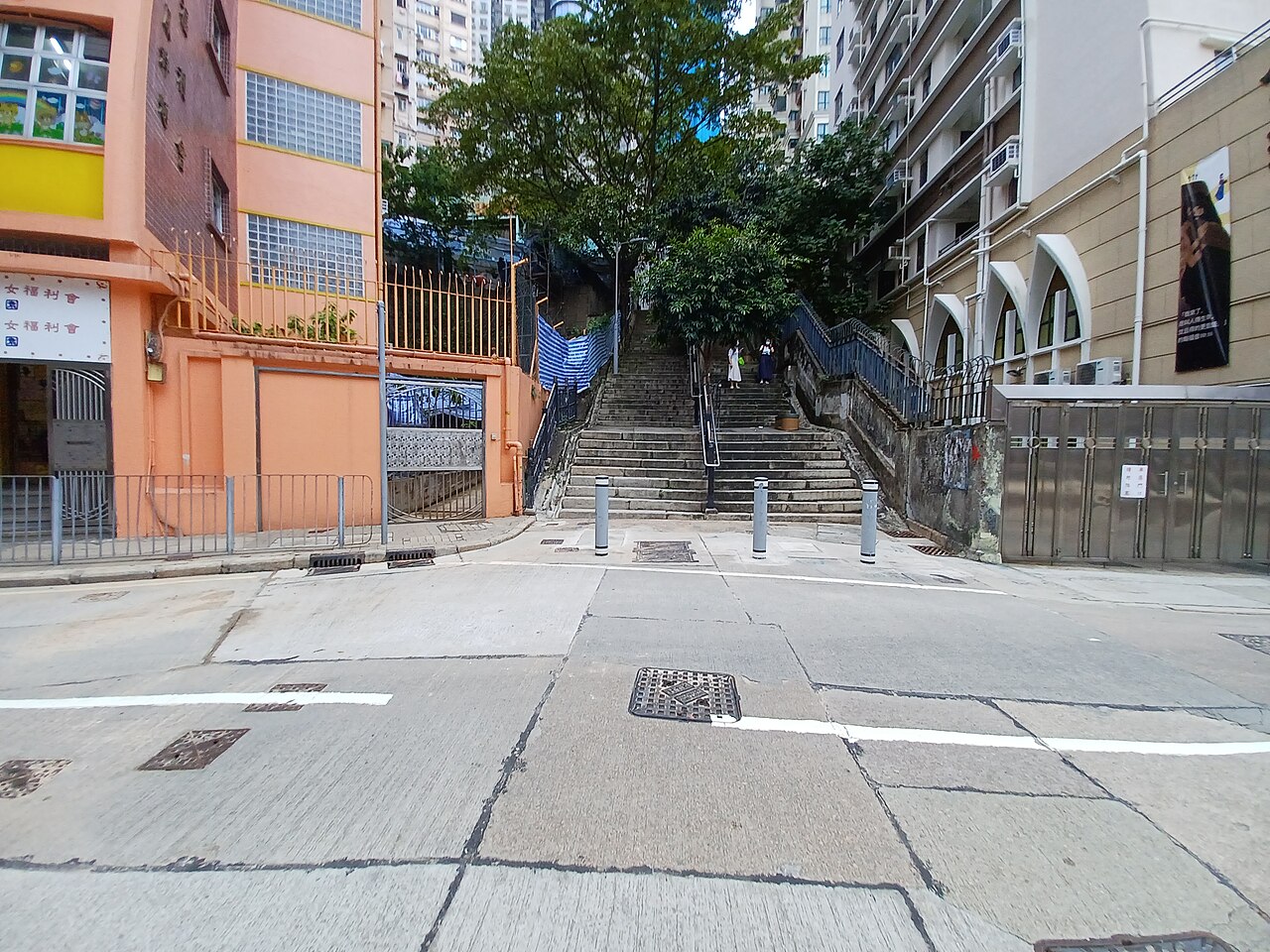
Image: Wikimedia Commons / CC BY-SA 4.0.
Hollywood Road and Upper Lascar Row, Sheung Wan — the antique and shrine streets Johnnie To shoots over and over; the opening teahouse scene of Election is filmed around Hollywood Road.
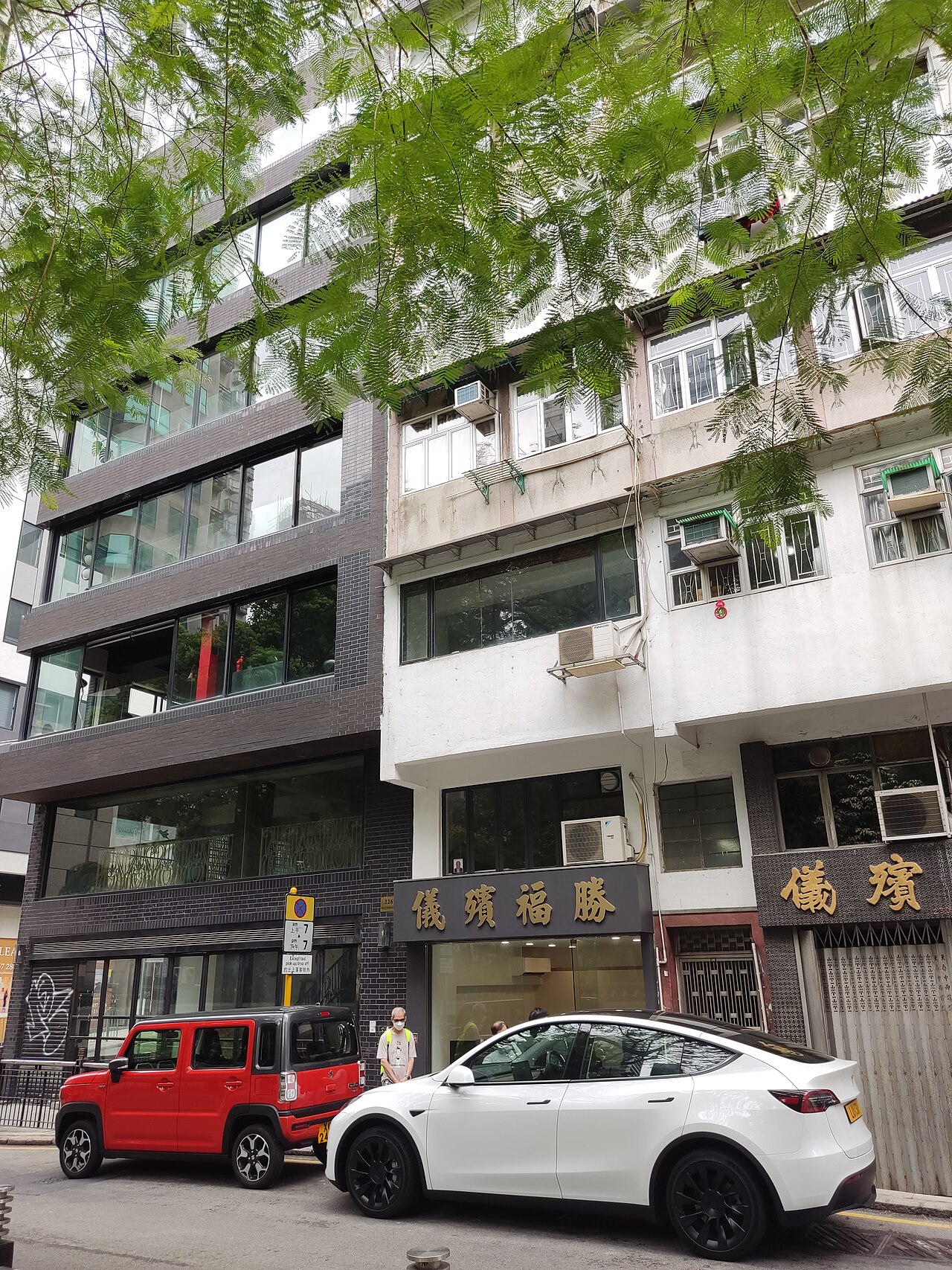
Image: Wikimedia Commons / CC BY-SA 4.0.
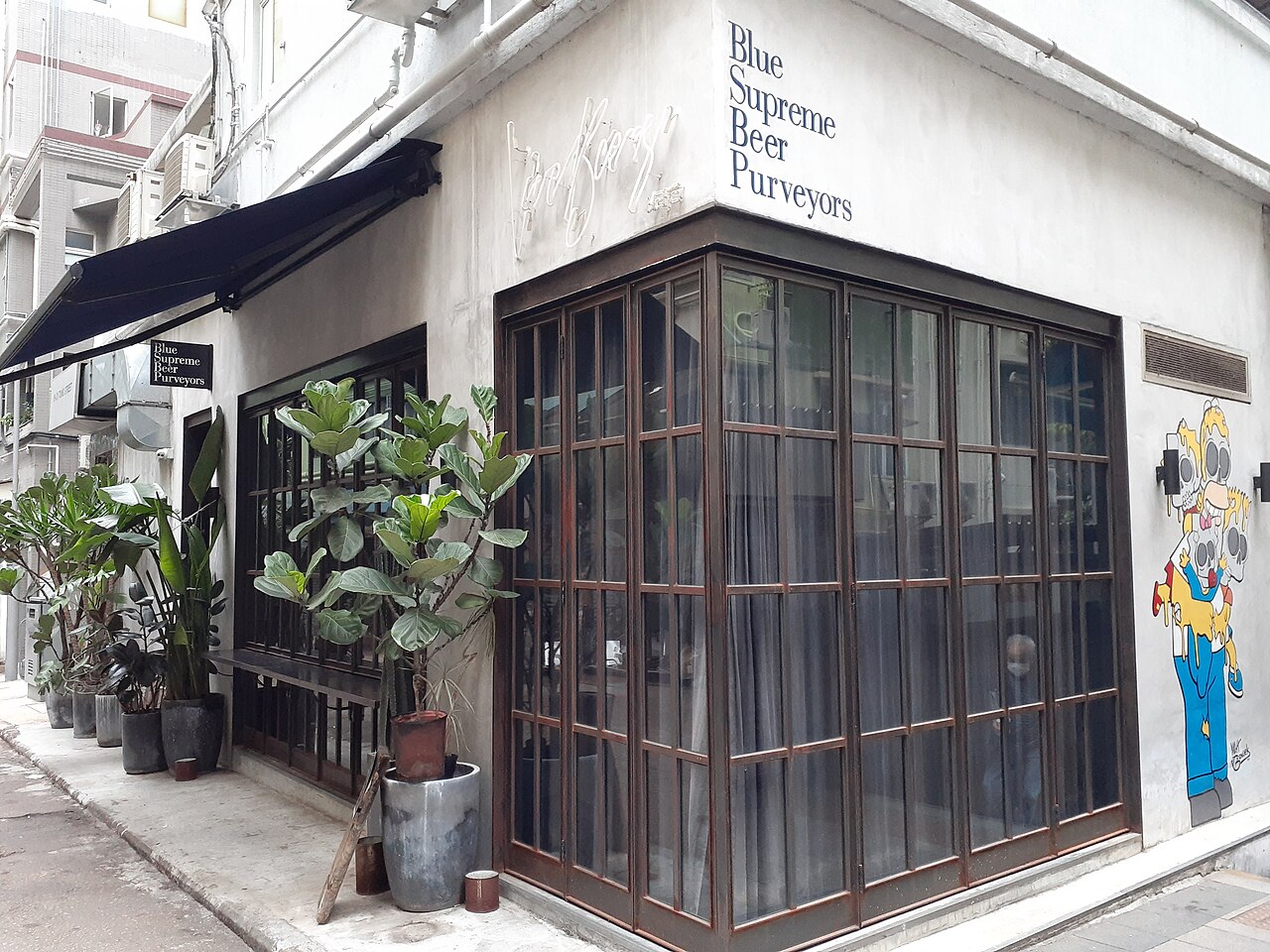
Image: Wikimedia Commons / CC BY-SA 4.0.
Central elevated walkway system: the three-tiered network connecting Queen’s Road Central / Des Voeux Road Central / Connaught Road Central, running from Central Station out to Sheung Wan and Admiralty. This is the main territory of the four pickpockets in Sparrow, including the rain-night umbrella scene. Daytime is mobbed; Sunday morning 6–8 AM is nearly empty, perfect for recreating shots.
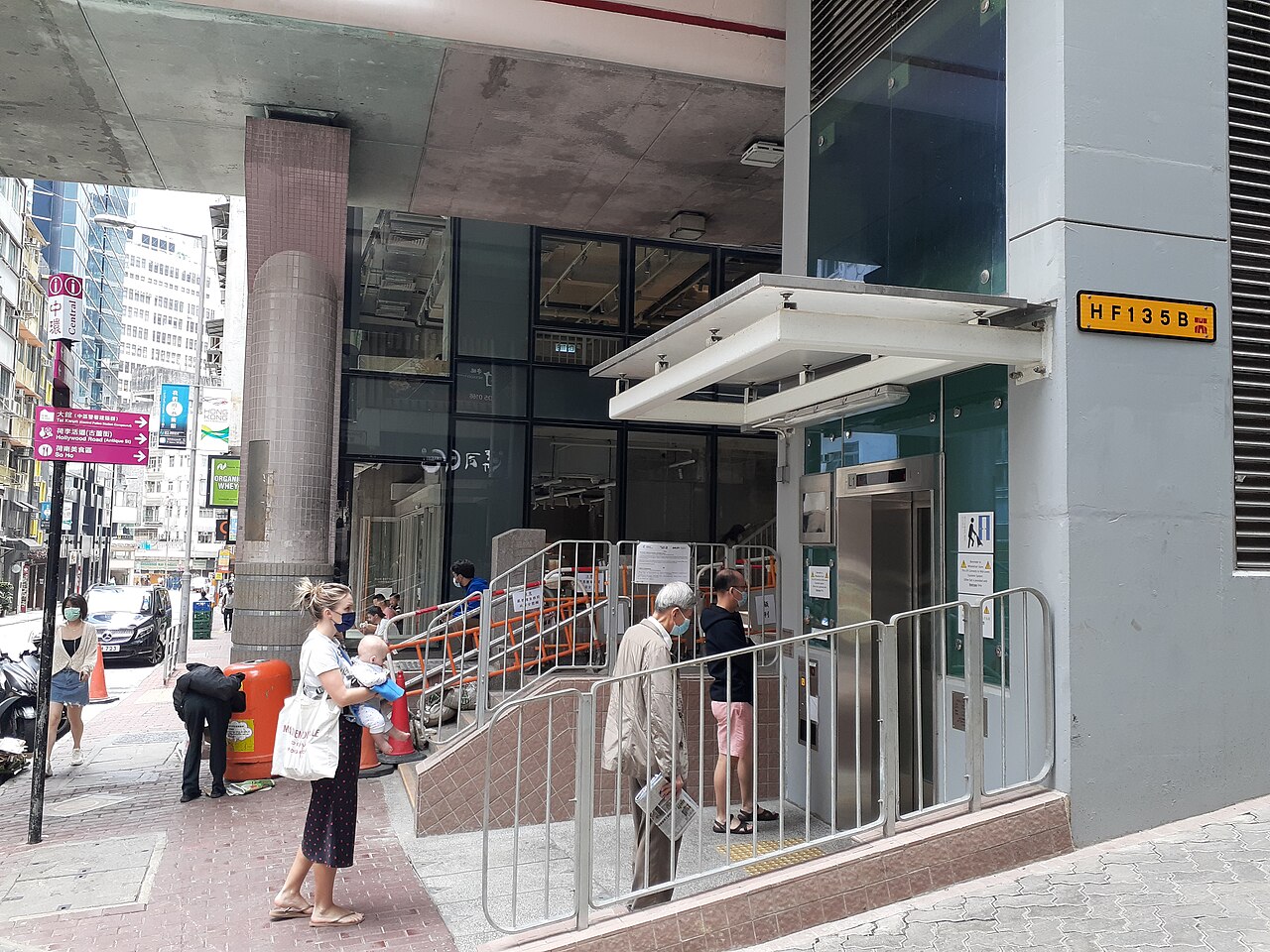
Image: Wikimedia Commons / CC BY-SA 4.0.
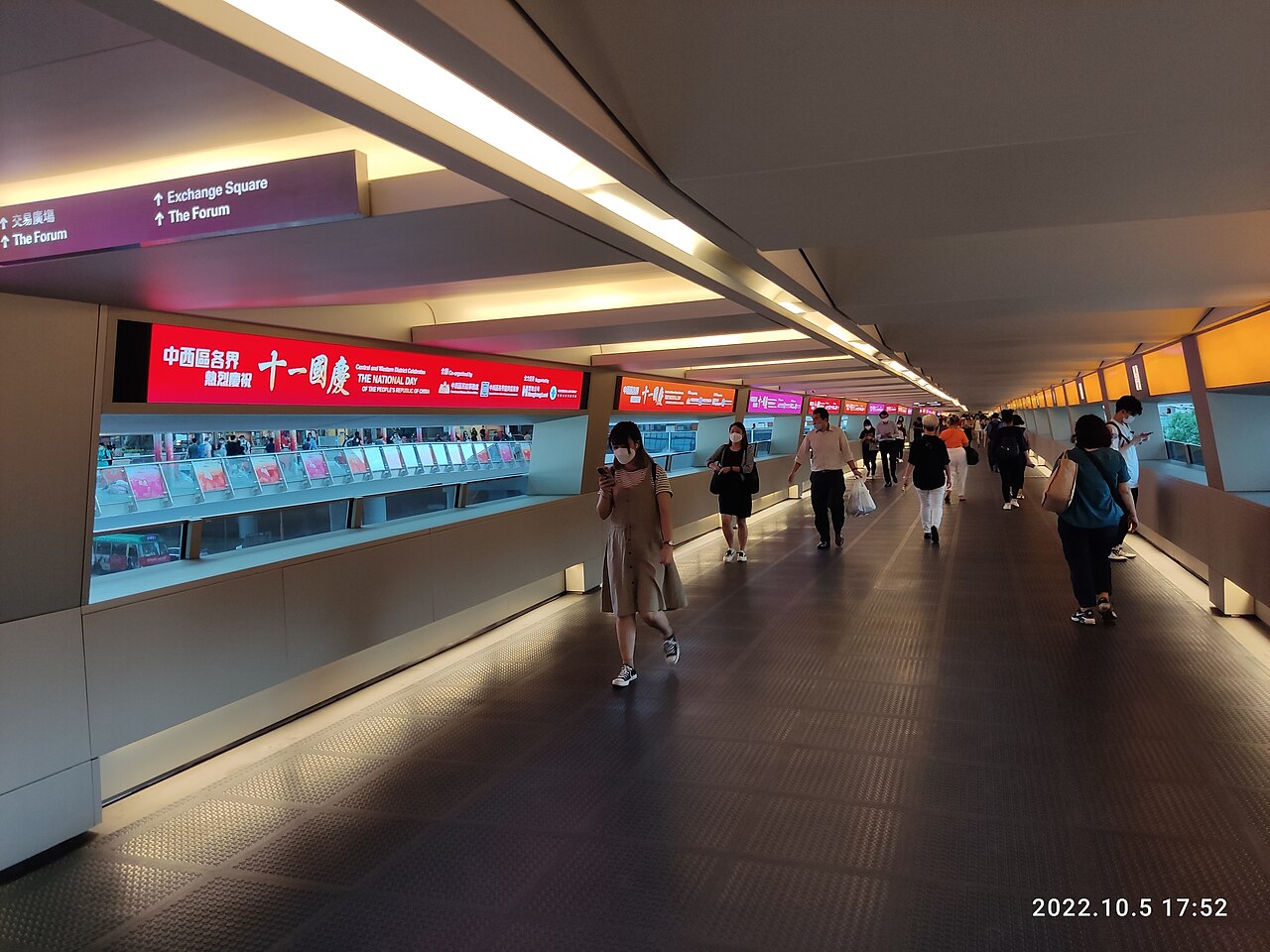
Image: Wikimedia Commons / CC BY-SA 4.0.
Des Voeux Road Central — the tram line; Sparrow uses it several times, with the pickpockets dispersing at the stops.
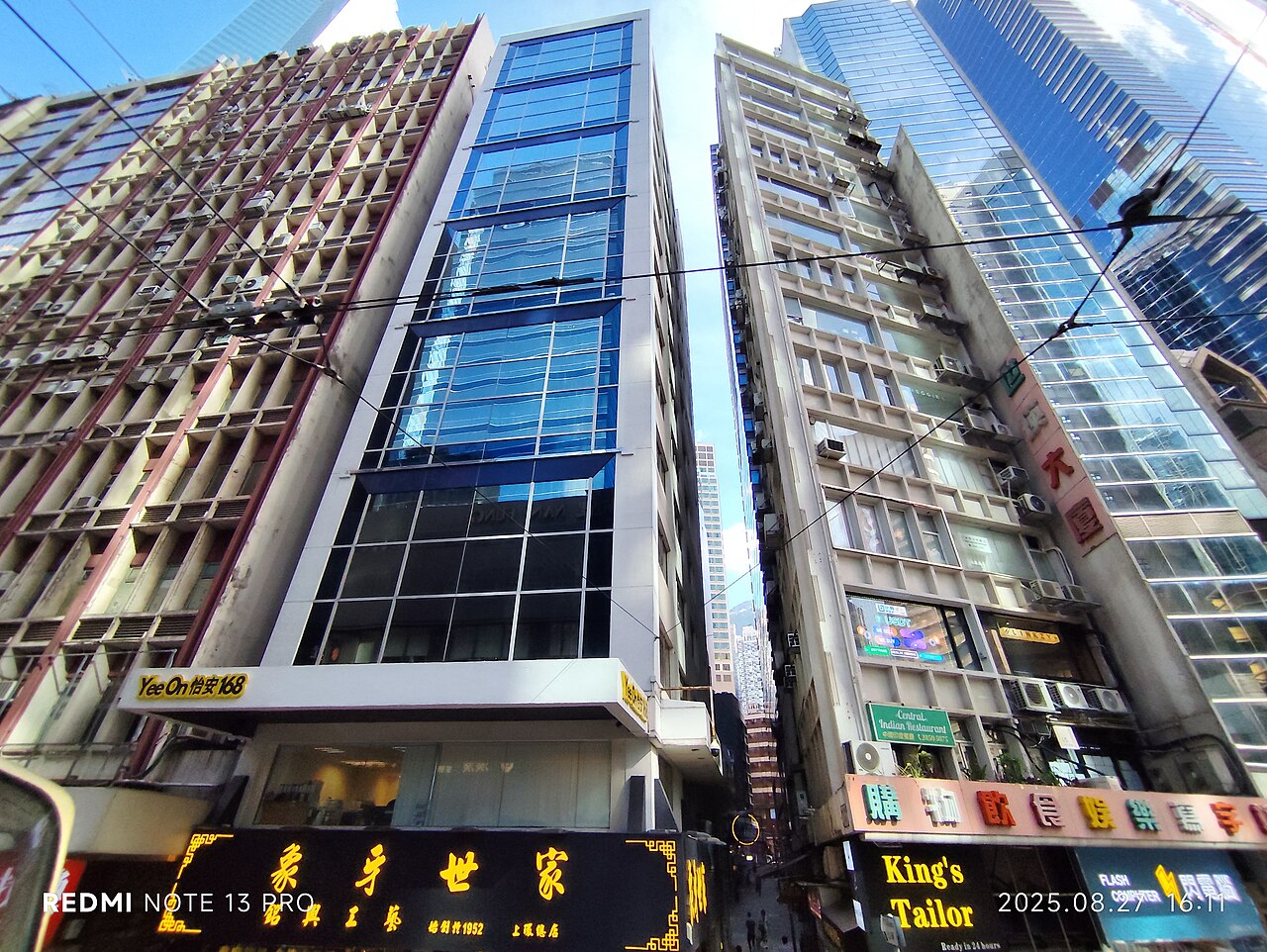
Image: Wikimedia Commons / CC BY-SA 4.0.
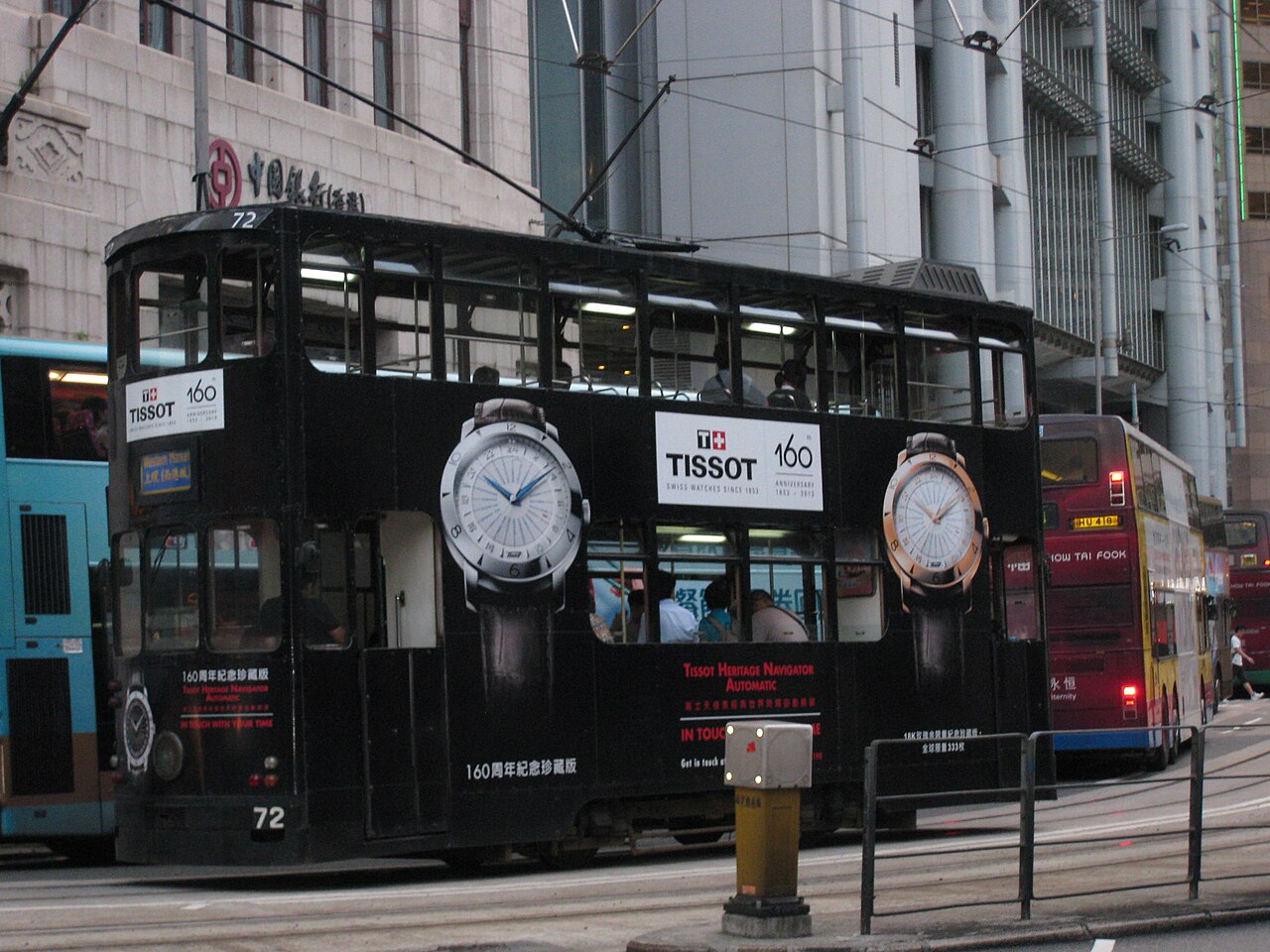
Image: Wikimedia Commons / CC BY-SA 4.0.
That closes Johnnie To’s Hong Kong Island skeleton — and the works section of this piece. Next, we leave the scripts and walk toward specific people: names who have lived their lives as films of their own.
Part II · People — Three Names
The works are the skeleton. Flesh and blood are the people. The next three names — Leslie Cheung, Wong Ka Kui, Chow Yun-fat — each lived a life that didn’t need a script.
Leslie Cheung — Gor Gor and His Many Selves
Hong Kongers call him Gor Gor (“older brother”), not because he’s anyone’s actual elder brother, but because in him Hong Kong found a kind of forever-46-year-old refinement that refused to age.
From son of a tailor to the king who hung up the mic
Leslie Cheung was born in Hong Kong on September 12, 1956, the youngest of ten siblings. His father, Cheung Wood-hoi, was the most famous Western-suit tailor in Central in those years; William Holden, Cary Grant, Marlon Brando were all measured up at his shop when they came to Hong Kong. Born to a tailor’s wealth, Leslie grew up surrounded by the finest cuts and the finest manners, but also with absent parents and the loneliness of being raised by the family helper “Sixth Sister” — something that surfaces again and again in his films.
In 1977 he placed second in the RTV Asia Singing Contest and signed his first contract with a cover of Don McLean’s “American Pie.” Then, record after record, none of them clicked. Until 1983, when in the same year he released “The Wind Continues to Blow” and “Monica” — the former a Cantonese cover of Momoe Yamaguchi’s “Sayonara no Mukōgawa,” the latter an upbeat number by Japanese composer Nobody. One cold, one hot — the two songs pushed the young man dismissed for being “too feminine” into his first peak, starting in 1984.
From December 22, 1989 to January 22, 1990, he held 33 farewell concerts at the Hong Kong Coliseum and announced his retirement from music at 33. For most of the first half of the 1990s, he made only films. Until 1995, when he released Most Beloved (Chong Oi), an album of his own Cantonese-classic covers, which sold 500,000 copies in Korea — a Chinese-language record there that still stands. Late 1996 to early 1997 saw the comeback show that everyone wrote into their autobiographies: the Crossover 97 Concert, 24 nights at the Coliseum. He opened by walking out in red high heels, singing “Monica” first and “The Wind Continues to Blow” second — flipping his two 1983 hits. In 1999 he was awarded the Golden Needle Award, Hong Kong music’s highest honor; in 2010, CNN named him the world’s third most iconic music idol of the past 50 years, behind only Michael Jackson and The Beatles.
Cheng Dieyi on screen, and that legless bird
If music was Gor Gor’s talent, film was his fate. Of his 60-plus works, four or five stand as inescapable coordinates of Chinese cinema.
In Wong Kar-wai’s Days of Being Wild (1990) he plays Yuddy, a drifter forever combing his hair before a mirror. That monologue — “I’ve heard there’s a kind of bird that has no legs. It can only fly and fly, and rest in the wind when it’s tired. This bird lands on the ground only once in its life — and that’s when it dies” — won him Best Actor at that year’s Hong Kong Film Awards.
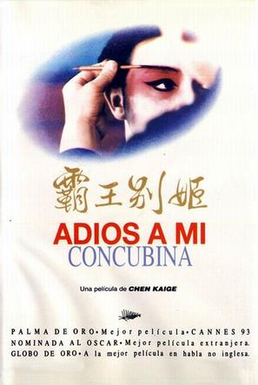
In Chen Kaige’s Farewell My Concubine (1993) he plays Cheng Dieyi, a male dan opera performer who lives his whole life as Consort Yu. The film won Chen Kaige the Palme d’Or at Cannes (the only one ever for a Chinese-language film), was nominated for the Best Foreign Language Film Oscar, and won the César for Best Foreign Film. But Leslie himself didn’t win Best Actor at Cannes — the jury reportedly split over his nationality and the gender of his character. He never spoke about it again.
Still: Jet Tone Films / Wikipedia · fair use (non-commercial).
Still: Tomson Films / Wikipedia · fair use (non-commercial).
Still: Jet Tone Films / Wikipedia · fair use (non-commercial).
Still: Golden Harvest / Wikipedia · fair use (non-commercial).
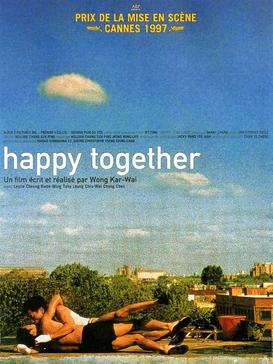
In Wong Kar-wai’s Ashes of Time (1994) he plays Ouyang Feng, a Jin Yong prequel hidden in the desert. In 1997 he and Tony Leung went to Buenos Aires to shoot Happy Together, in which he played Ho Po-wing. Wong Kar-wai won Best Director at Cannes that year — the first time an openly gay romance had headlined a Chinese-language film in the main competition. In Stanley Kwan’s Rouge (1987), he and Anita Mui play the suicide-pact couple, making it the least ghost-movie-like ghost movie of 1980s Hong Kong cinema.
In 1998 he became the first Chinese-language male jury member at the Berlin Film Festival. In 2001 he publicly came out as bisexual in an interview with Time Asia and openly spoke of his relationship with Daffy Tong since 1982 — together 21 years, never apart. In fact, on the final night of “Crossover 97,” he had said from the Coliseum stage to twenty thousand people: “Thank you to the two most important people in my life — my mother, and my beloved Mr. Tong.” That was the first time a top-tier Chinese-language pop star publicly thanked his partner by name from the stage.
At 18:41 on April 1, 2003, he fell from the 24th floor of the Mandarin Oriental in Central. The note left behind contained a single line: “Depression.” Hong Kong was deep in the SARS shadow, and the daily tally of new infections weighed on the city; his death felt like another cloud pressed onto a sky already pressed down. At the funeral, Daffy Tong and his sister Cheung Luk-ping walked at the front; the elegiac couplet read “Mr. Tong’s beloved, Leslie.” That was the first time a major Chinese-language star publicly bore his partner’s name down from the stage of his own funeral.
Three places to go
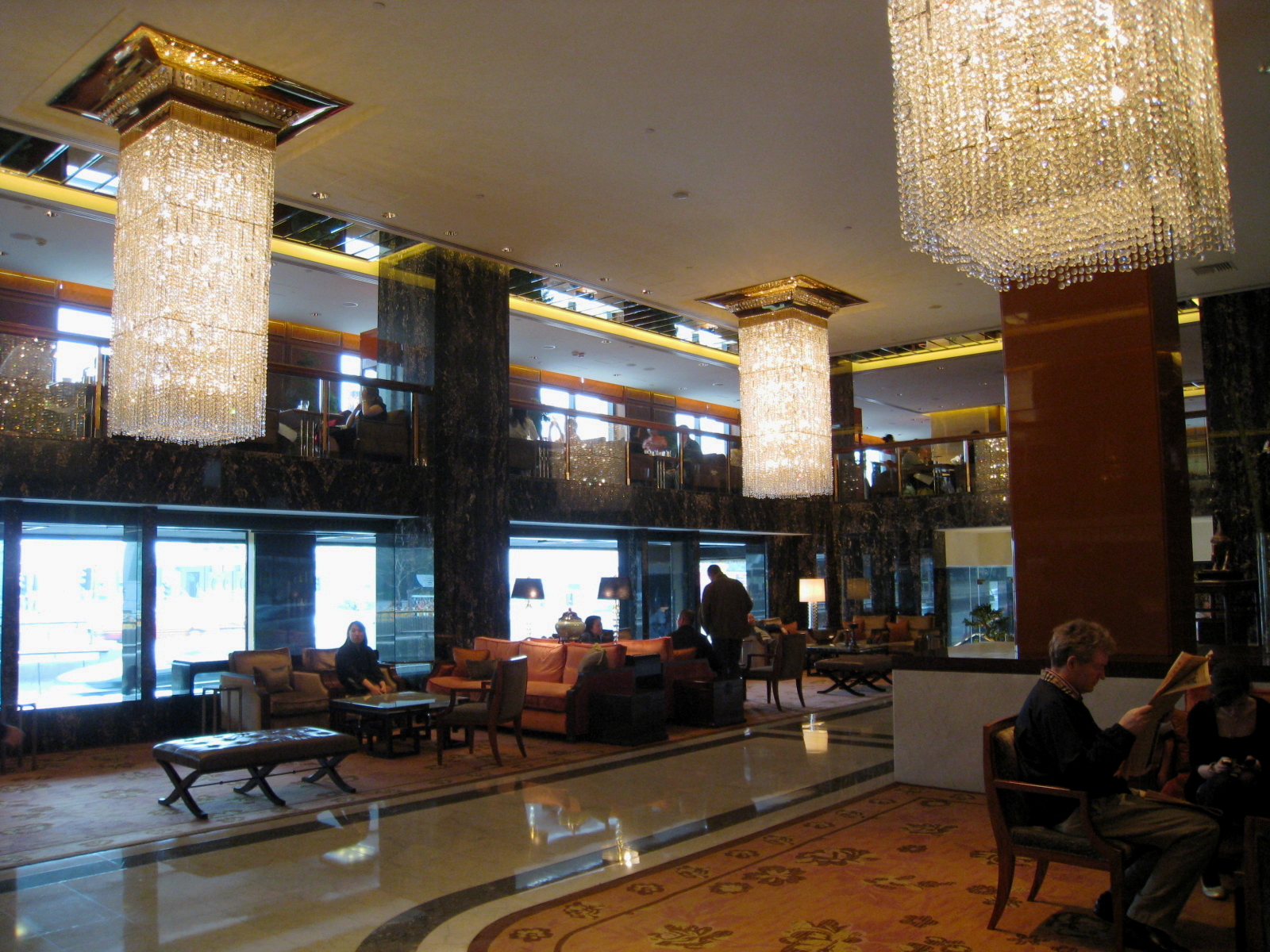
Image: Wikimedia Commons / CC BY-SA 4.0.
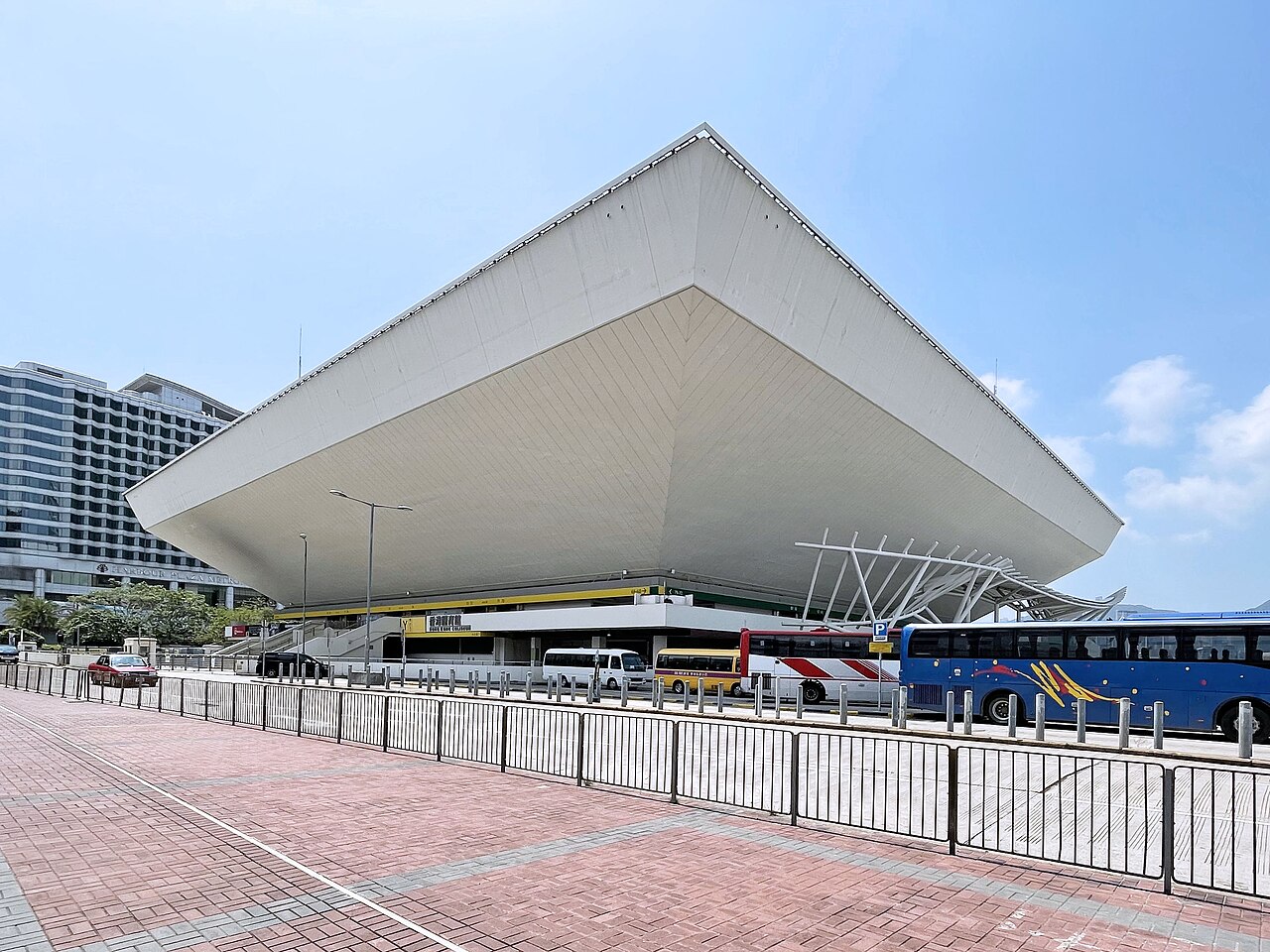
Image: Wikimedia Commons / CC BY-SA 4.0.
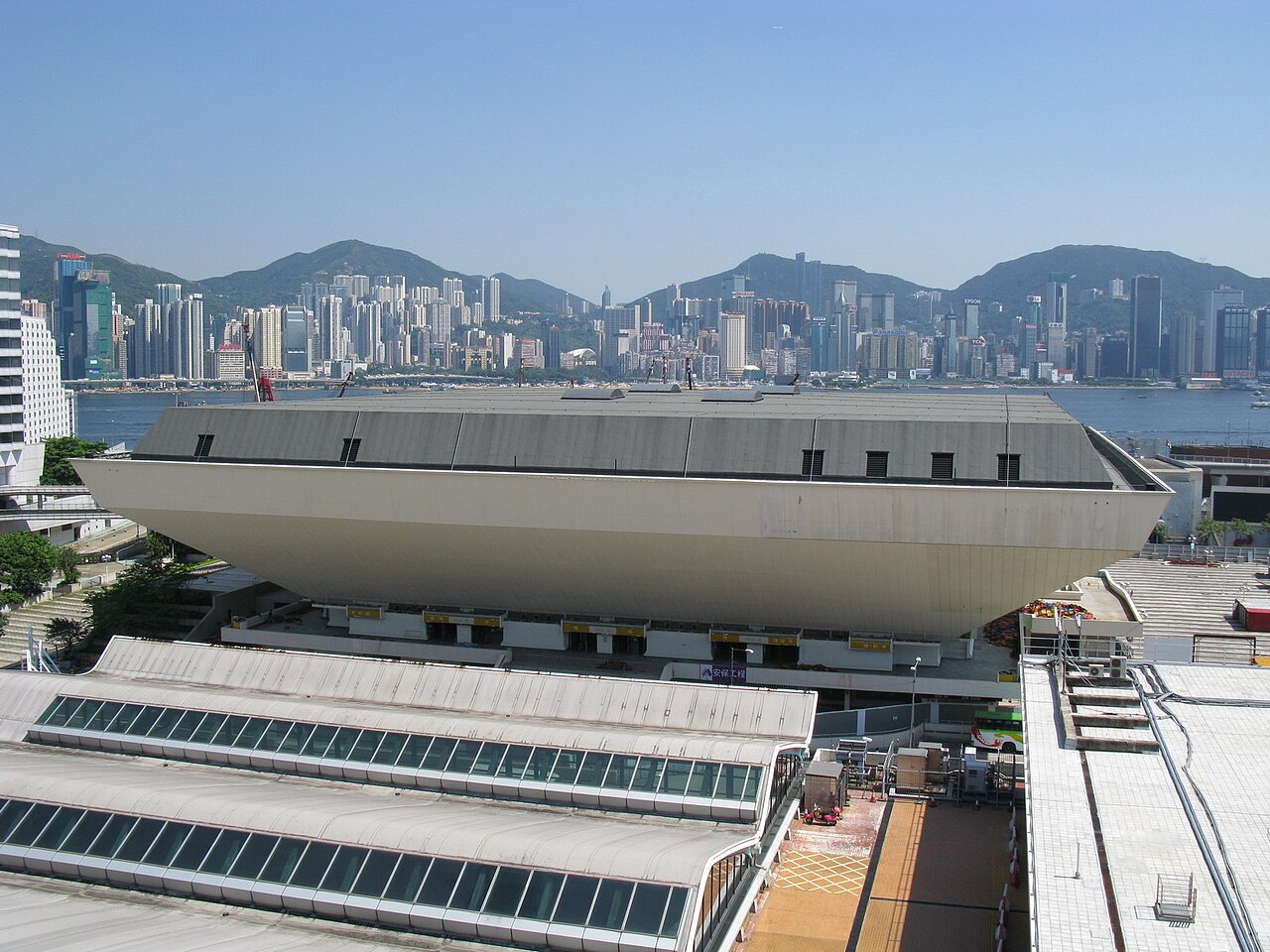
Image: Wikimedia Commons / CC BY-SA 4.0.
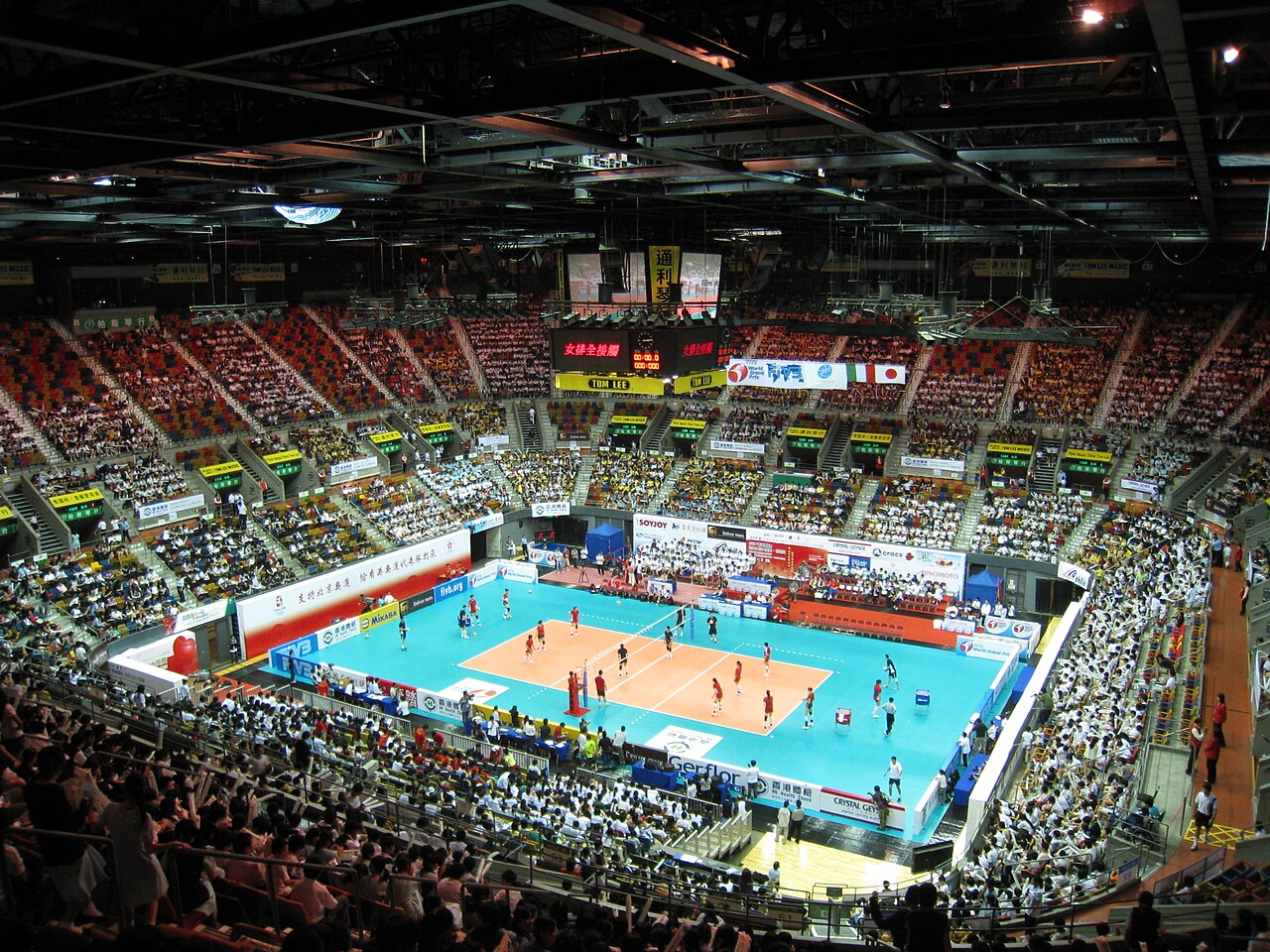
Image: Wikimedia Commons / CC BY-SA 4.0.
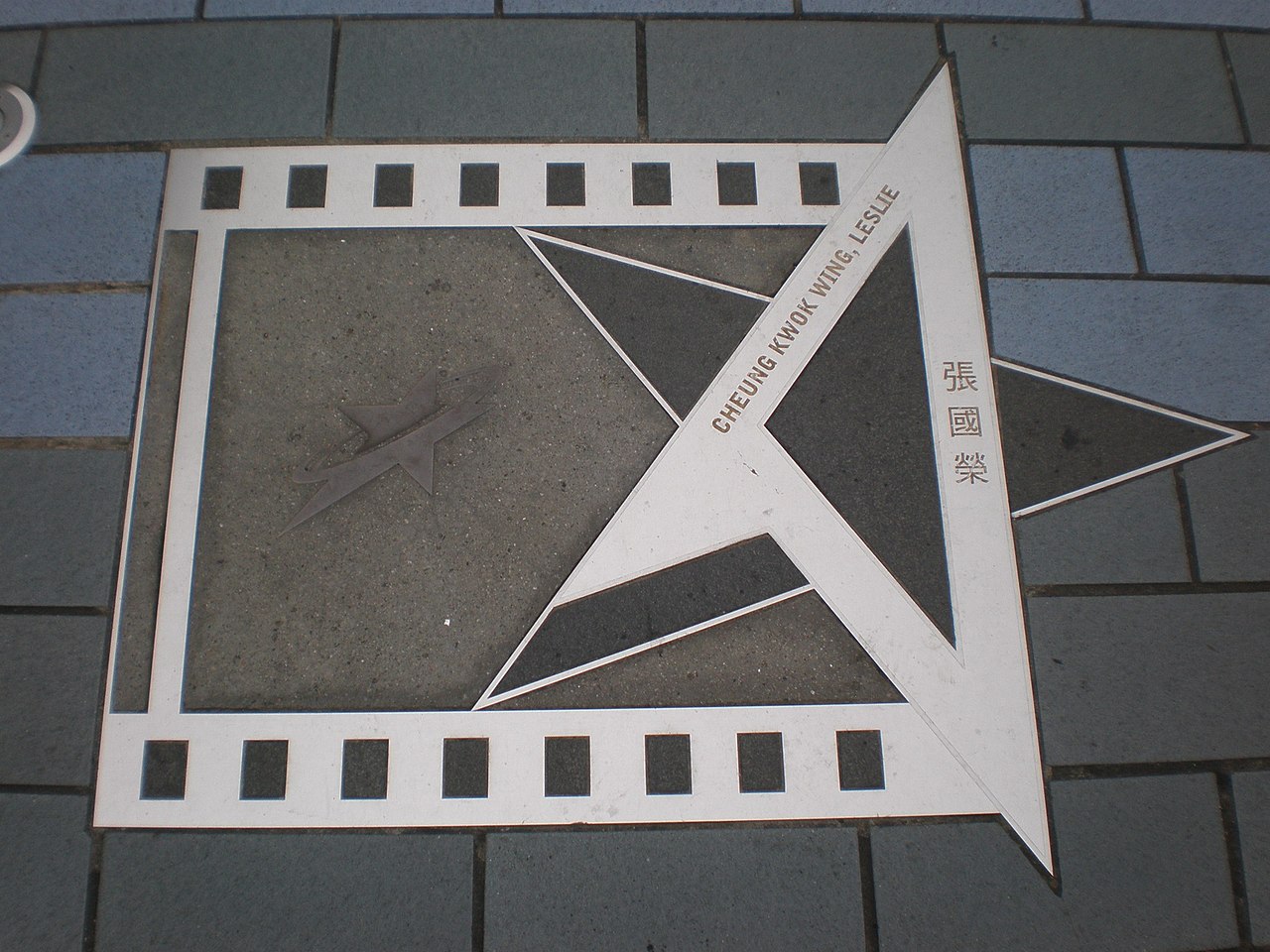
Image: Wikimedia Commons / CC BY-SA 4.0.
- Mandarin Oriental Hotel (5 Connaught Road Central; MTR Central Station Exit F). The 24th floor has been a permanent memorial area, closed to the public, since 2003. Every year on April 1st, hundreds gather on the pedestrian overpass between Conduit Road and Garden Road beside the hotel — flowers, letters, white candles line the railings into the afternoon
- Hong Kong Coliseum (1 Hung Hom Coliseum Road, Kowloon; MTR Hung Hom Station Exit A). The 12,500-seat arena opened in 1983 hosted both the 1989 farewell concerts and the 1996–97 Crossover 97 — on the same stage
- Avenue of Stars, Tsim Sha Tsui (MTR East Tsim Sha Tsui Station Exit J). Leslie Cheung’s handprint was set into the walk when it opened in 2004, with the plaque reading “1956–2003”
After Gor Gor, Hong Kong pop music had one more peak — rock, of a different kind of anger and defiance. Next stop: Beyond and Wong Ka Kui in Prince Edward.
Beyond / Wong Ka Kui — A Decade of Hong Kong Rock
“The toll of the homecoming bell / in his life / brings with it a hint of sigh” — these opening lines of Glorious Years (1990) were written for Nelson Mandela, who had spent 27 years in a South African prison. In a 1980s Hong Kong where Alan Tam, Leslie Cheung, and Anita Mui took turns wearing the crown and love songs floated up and down Tsim Sha Tsui, Beyond was almost the only local band willing to point its pen at apartheid, Third World famine, the Great Wall, and nationalism. They were the lone troop in their era’s Hong Kong pop, a lone troop singing rock in Cantonese and insisting on writing their own words and music.
The band and the decade
Beyond was formed in 1983, starting as a casual project between Wong Ka Kui and a few friends, eventually settling into a four-man lineup: Wong Ka Kui (vocals and lead guitar, almost all the songwriting), Wong Ka Keung (bass, his younger brother), Paul Wong Kwoon-chung (rhythm guitar), and Yip Sai-wing (drums).
- 1983-1986, underground period: playing band competitions and small venues, no mainstream label interest. 1986 they self-released their first vinyl, Goodbye Ideal — rough sleeve, limited sales, but the launching pad everyone now looks back to
- 1988-1990, going commercial: signed to Kinn’s, then Cinepoly. Albums in quick succession — Modern Stage, Secret Police, Beyond IV. Albums The Earth (1988) and Glorious Years (1990) put them on the mainstream map for the first time
- 1991, Assam: Wong Ka Kui traveled to Assam, India with World Vision to visit refugees and returned to write “Amani” (Swahili for “peace”). The same year Beyond held the Live Encounter concerts at the Coliseum
- 1992, going to Japan: After Continuing the Revolution, the band decided to relocate to Tokyo and signed with a Japanese agency
- 1993-06-24: Wong Ka Kui fell from a temporary stage prop during a recording of the Live Show program at Fuji TV in Tokyo. He died on 1993-06-30 at age 31
- The remaining three carried on as Beyond until the band’s official dissolution in 2005
One man, against the grain of his era
Wong Ka Kui was that rare Hong Kong frontman who did words, music, vocals, and guitar all himself. And he wasn’t writing about heartbreak.
- The Earth (1988): “On those green roads / how many wounds have I been through” — about looking back at China after the reform and opening-up
- Glorious Years (1990): about Mandela. “In wind and rain, hold tight to freedom” / “Can we look past the line of skin color?” Mandela was only released in February 1990; the song was written almost in real time
- Amani (1991): Swahili in the chorus, “Amani nakupenda nakupenda wewe” (Peace, I love you), written for the children of African war zones
- The Great Wall (1992): “Surrounding an aging country / surrounding our footsteps” / “The pain has become helpless” — a reflection on the closed-off-ness and nationalism symbolized by the wall
- Boundless Oceans, Vast Skies (1993): Wong Ka Kui wrote it in April 1993 in Japan. “Forgive me — this life, untamed, indulgent, in love with freedom.” Two months later he was gone, and the song became his last
His line “Hong Kong has no music scene, only an entertainment industry” was about as sharp a verdict as he ever pronounced on his own era.
His mother played a very concrete role in his coming up — she’s the one who rented a small second-floor flat at 209 Tung Choi Street, Prince Edward so four boys in their early twenties, with no label interest, could have a place to put their drums, their amps, and write songs. The biographies of Beyond keep returning to this fact — it’s one of the warmer footnotes in Chinese-language rock history.
After Wong Ka Kui’s death, Beyond’s influence into the Mainland only grew. Among Mainland rock listeners, he is named alongside Dou Wei, Zhang Chu, and He Yong — the “Magic Stone Trio” — as the other flag of Chinese rock: a flag flown from Hong Kong, sung in Cantonese, written for Mandela and for African refugees.
Pilgrimage notes
209 Tung Choi Street, Prince Edward (early rehearsal space)
- MTR Prince Edward Station Exit B2, walk along Bute Street to Tung Choi Street, turn right, about 5 minutes
- The building is still there; the interior of the second floor was repurposed long ago. No official marker or plaque
- Tung Choi Street itself preserves a lot of 1980s Mong Kok flavor: Goldfish Market, Sneakers Street, Ladies’ Market all run along this stretch. Best at night
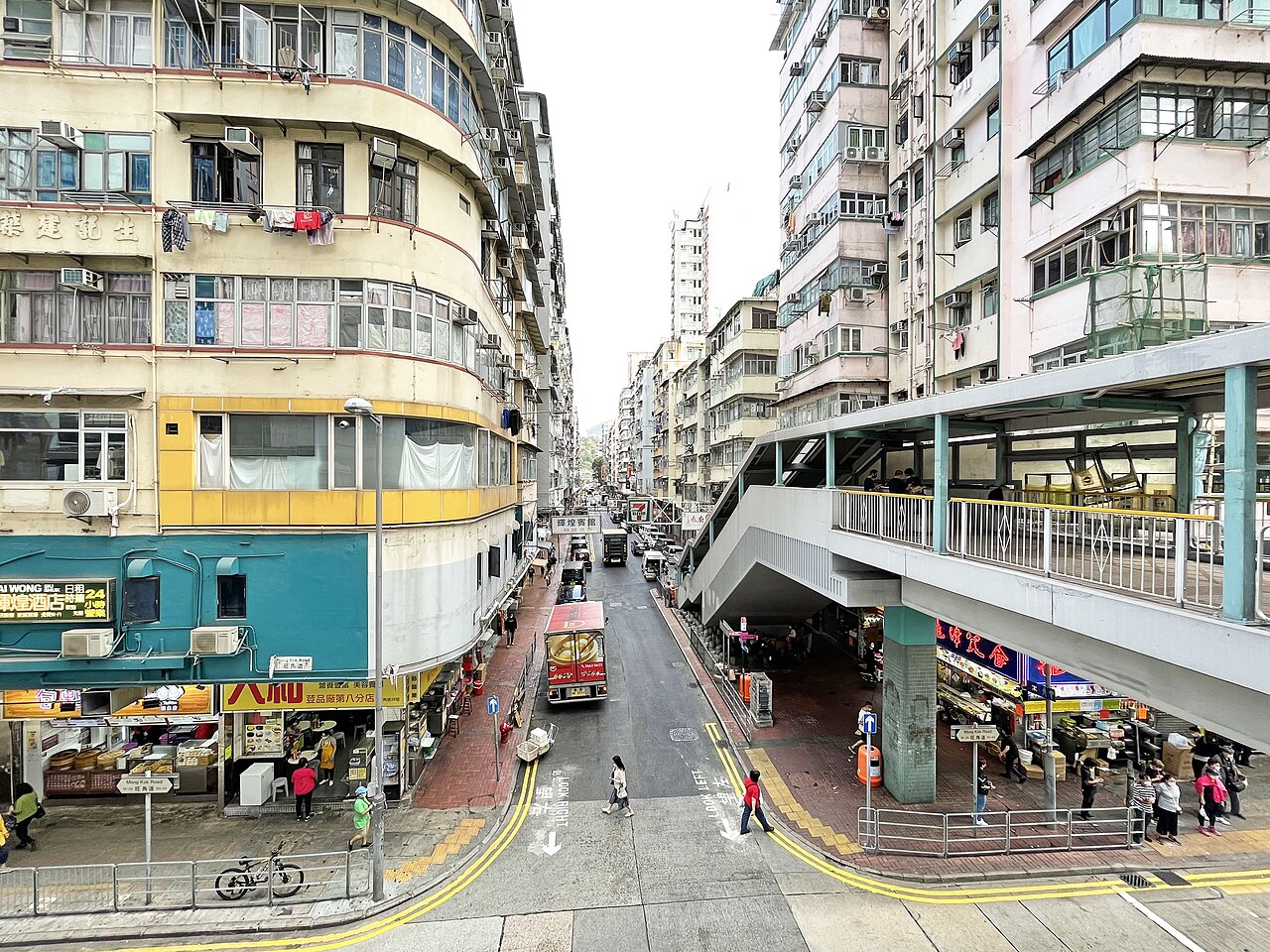
Image: Wikimedia Commons / CC BY-SA 4.0.
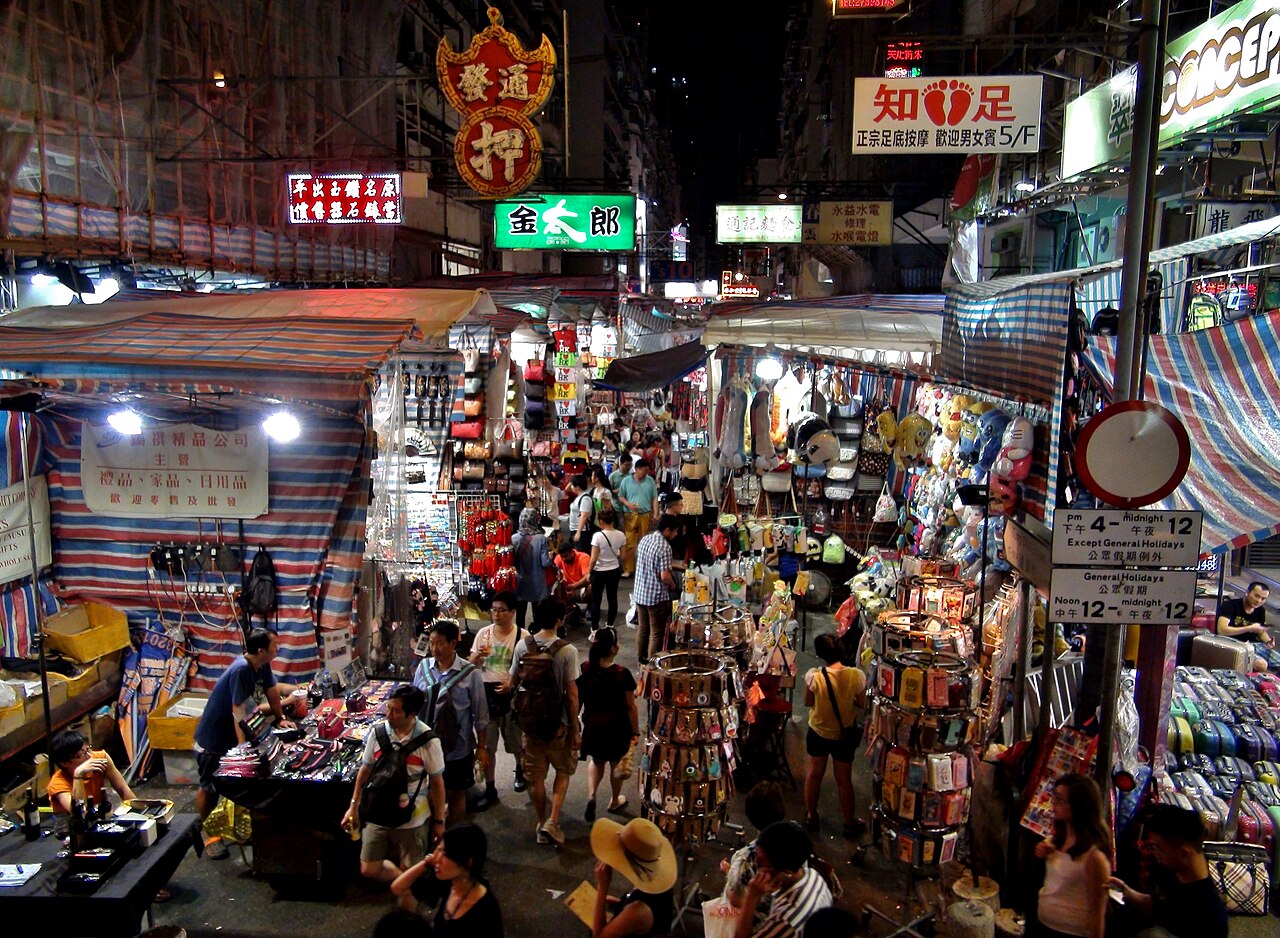
Image: Wikimedia Commons / CC BY-SA 4.0.
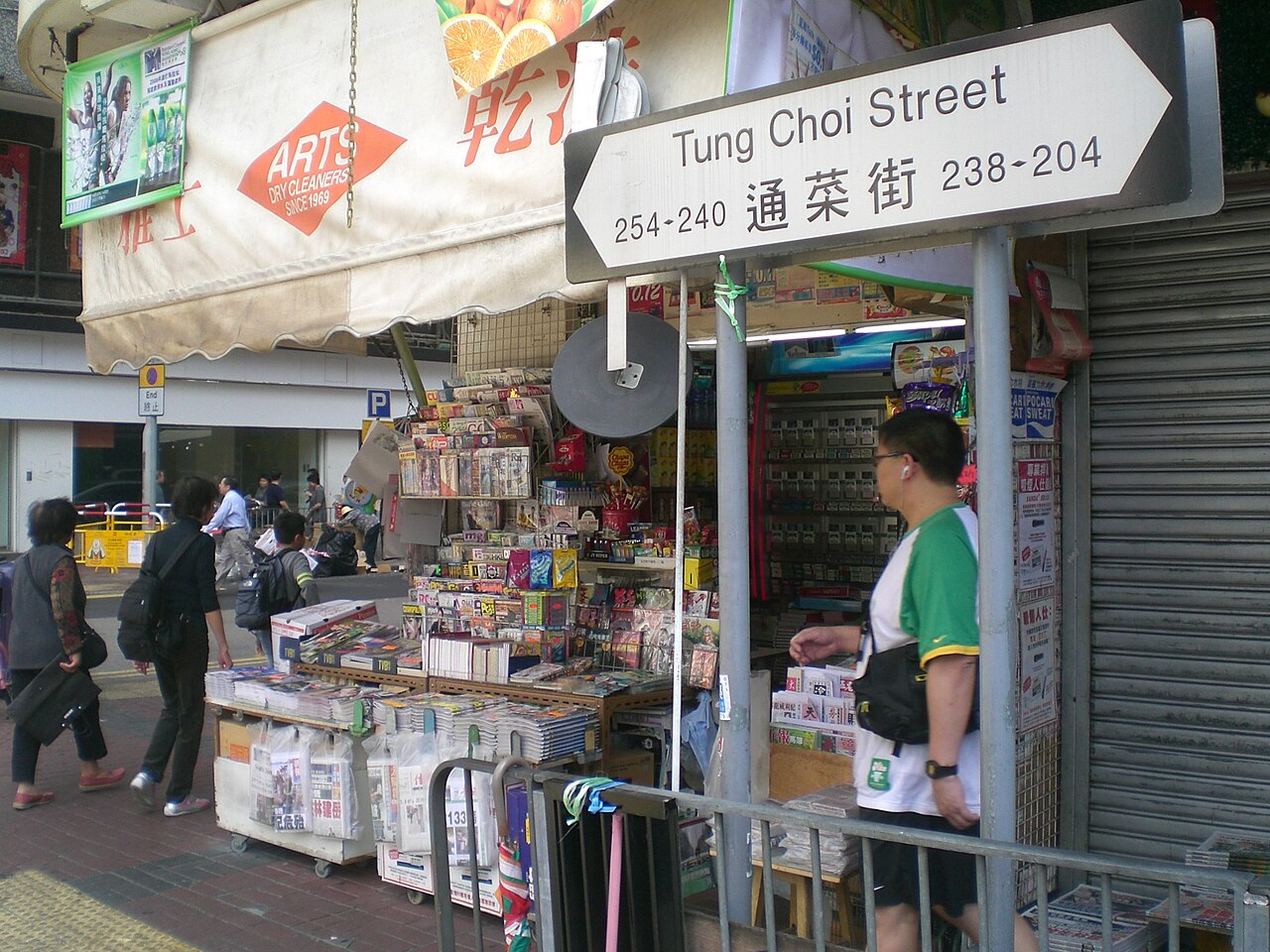
Image: Wikimedia Commons / CC BY-SA 4.0.
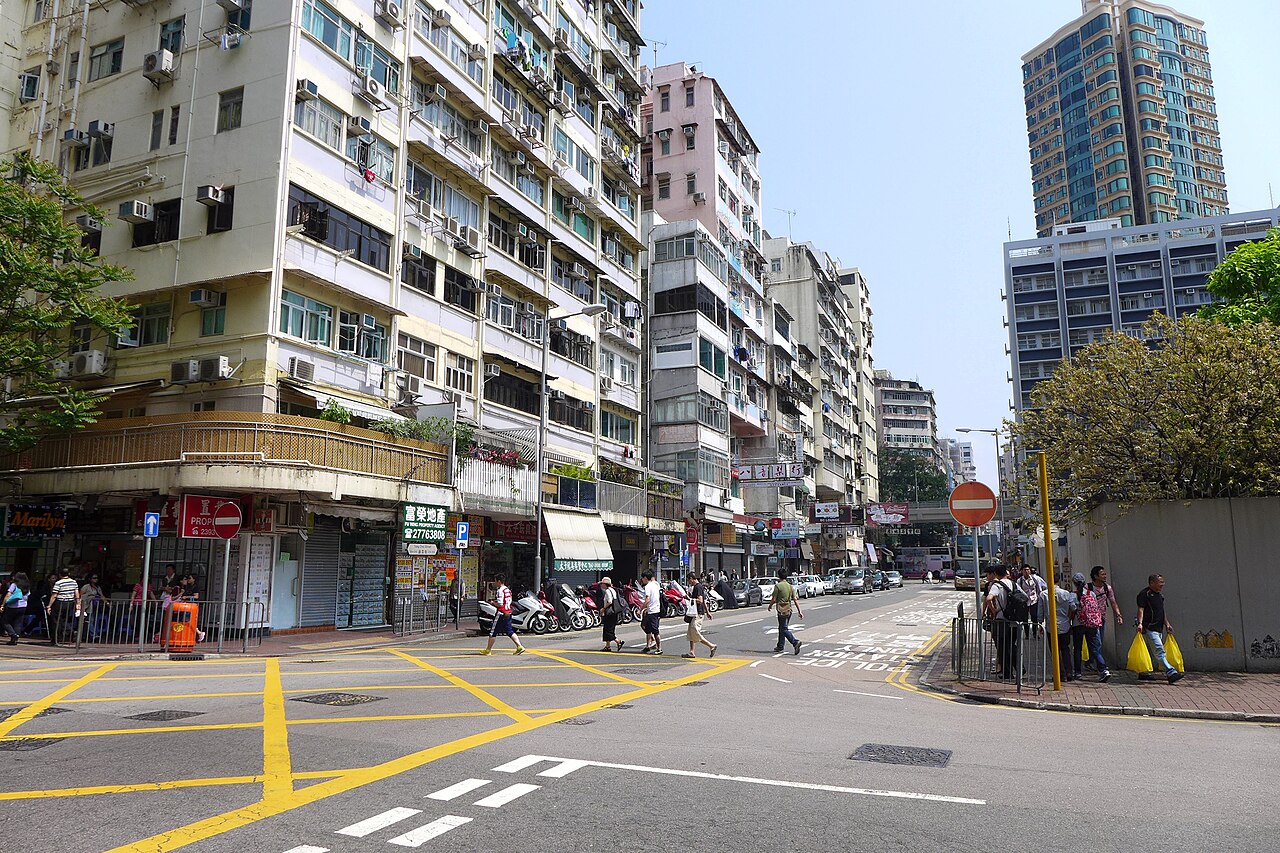
Image: Wikimedia Commons / CC BY-SA 4.0.
The street market and neon of Mong Kok are the real backdrop to Wong Ka Kui’s lyrics:
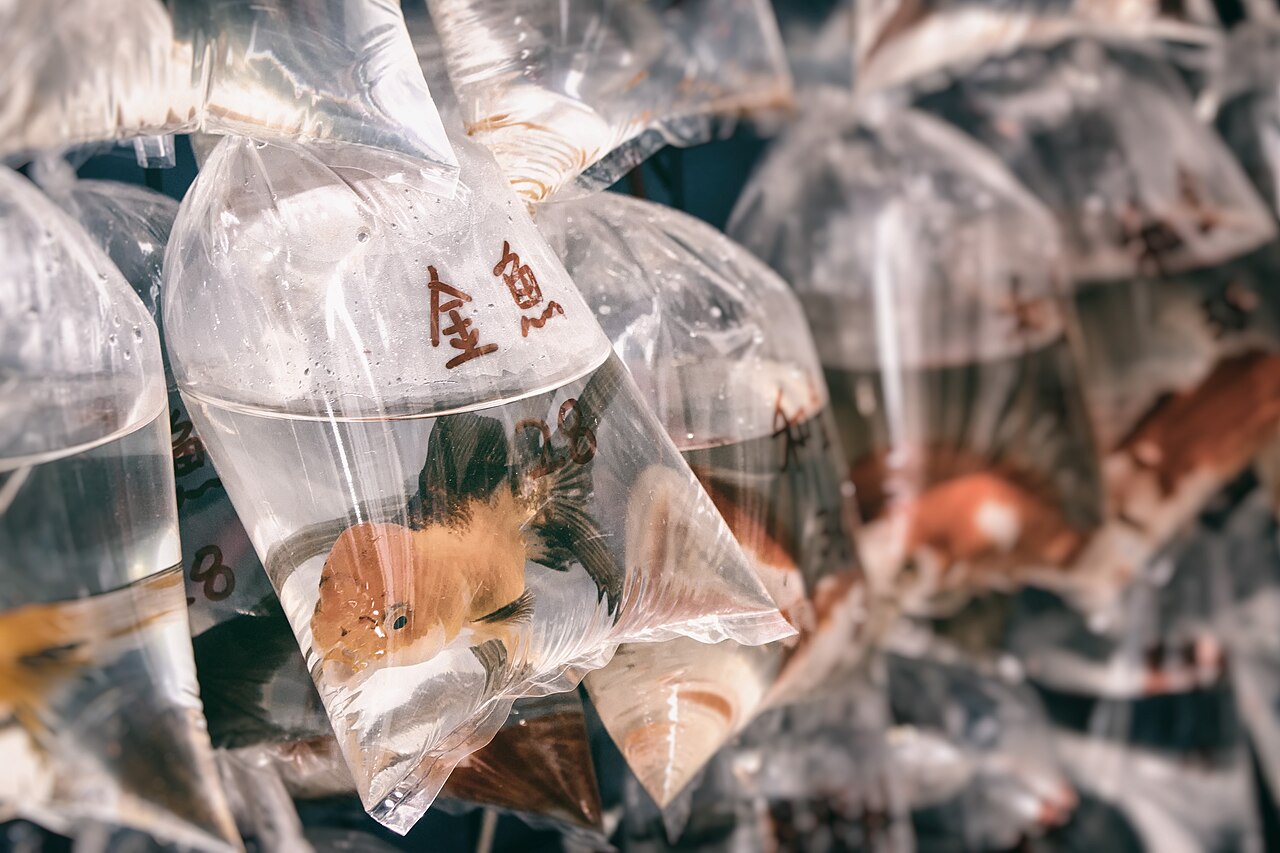
Image: Wikimedia Commons / CC BY-SA 4.0.
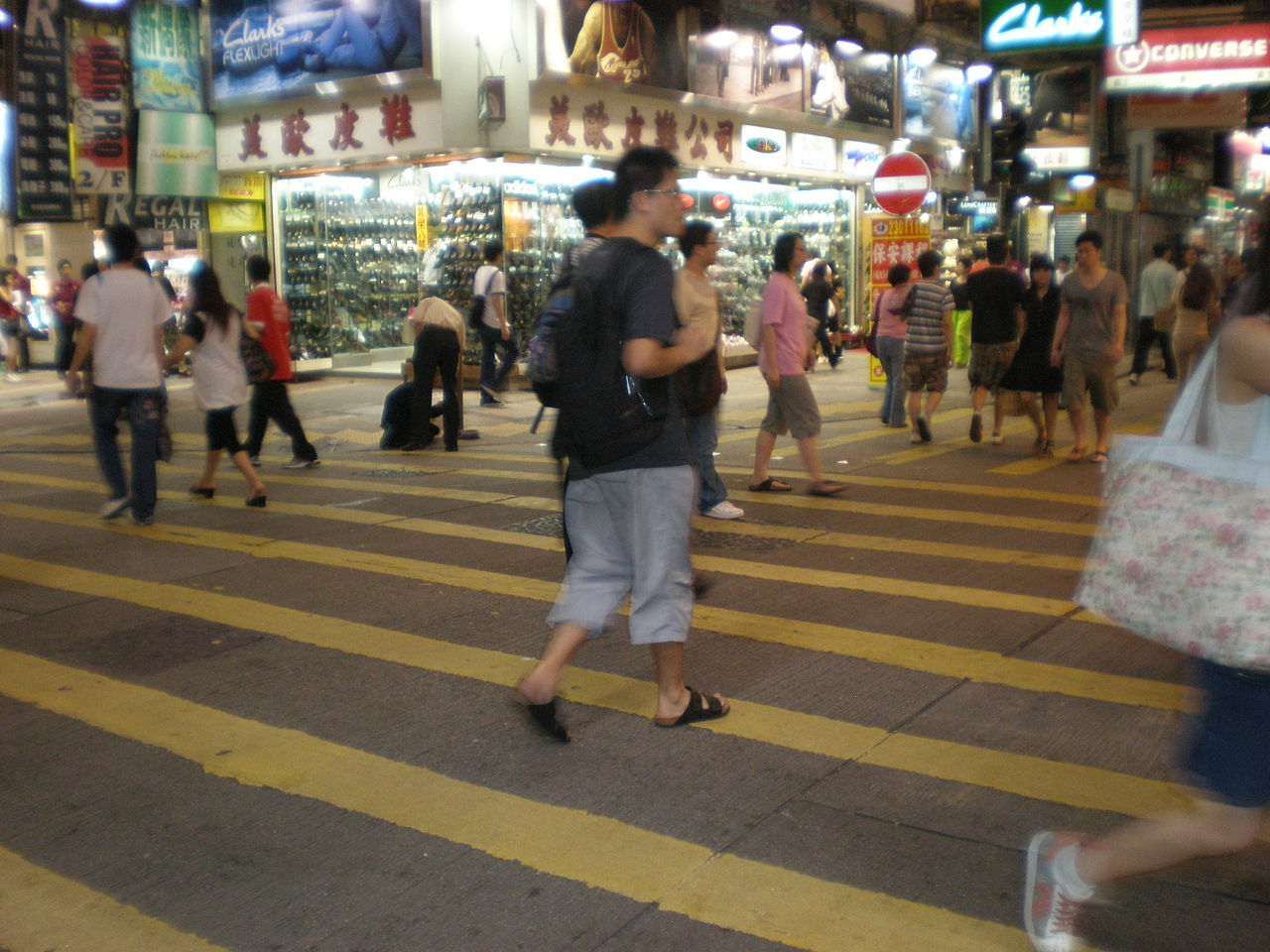
Image: Wikimedia Commons / CC BY-SA 4.0.
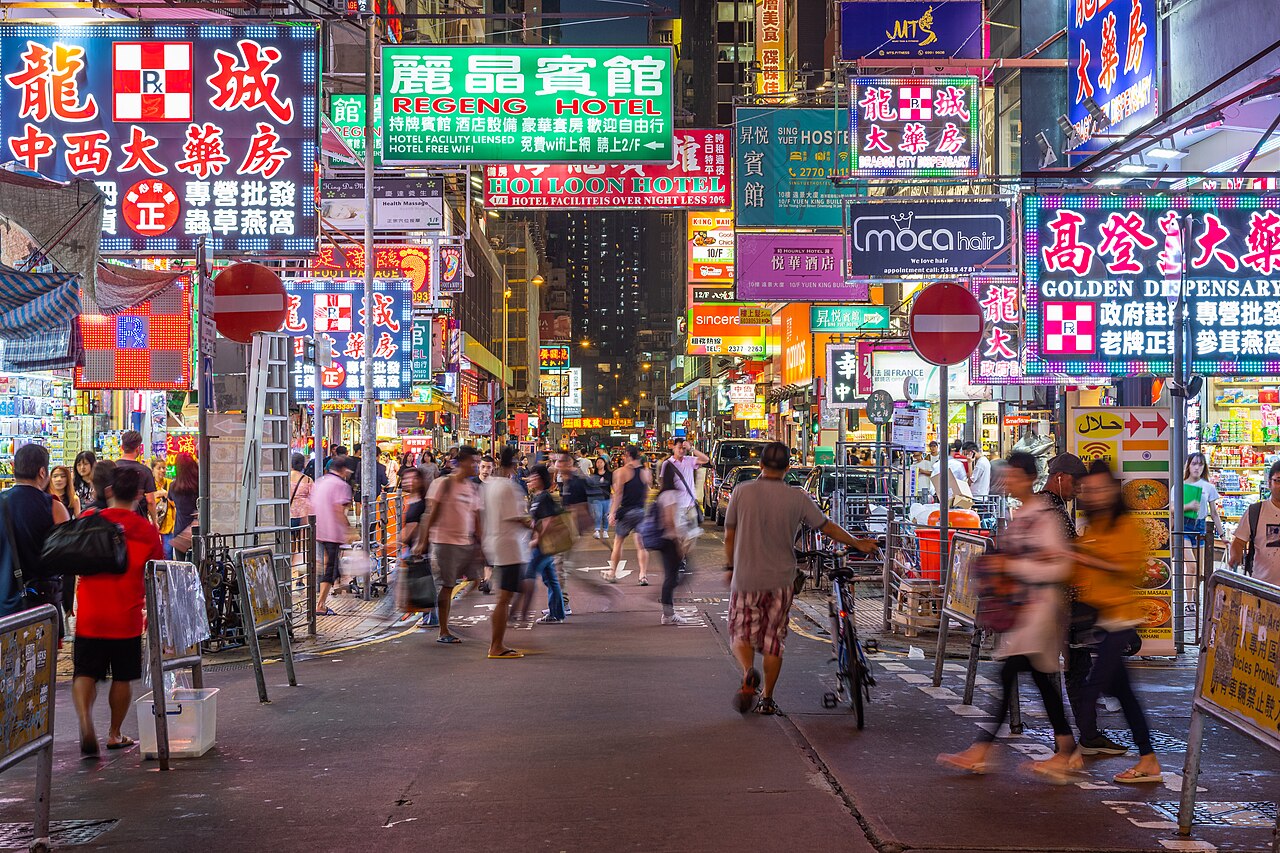
Image: Wikimedia Commons / CC BY-SA 4.0.
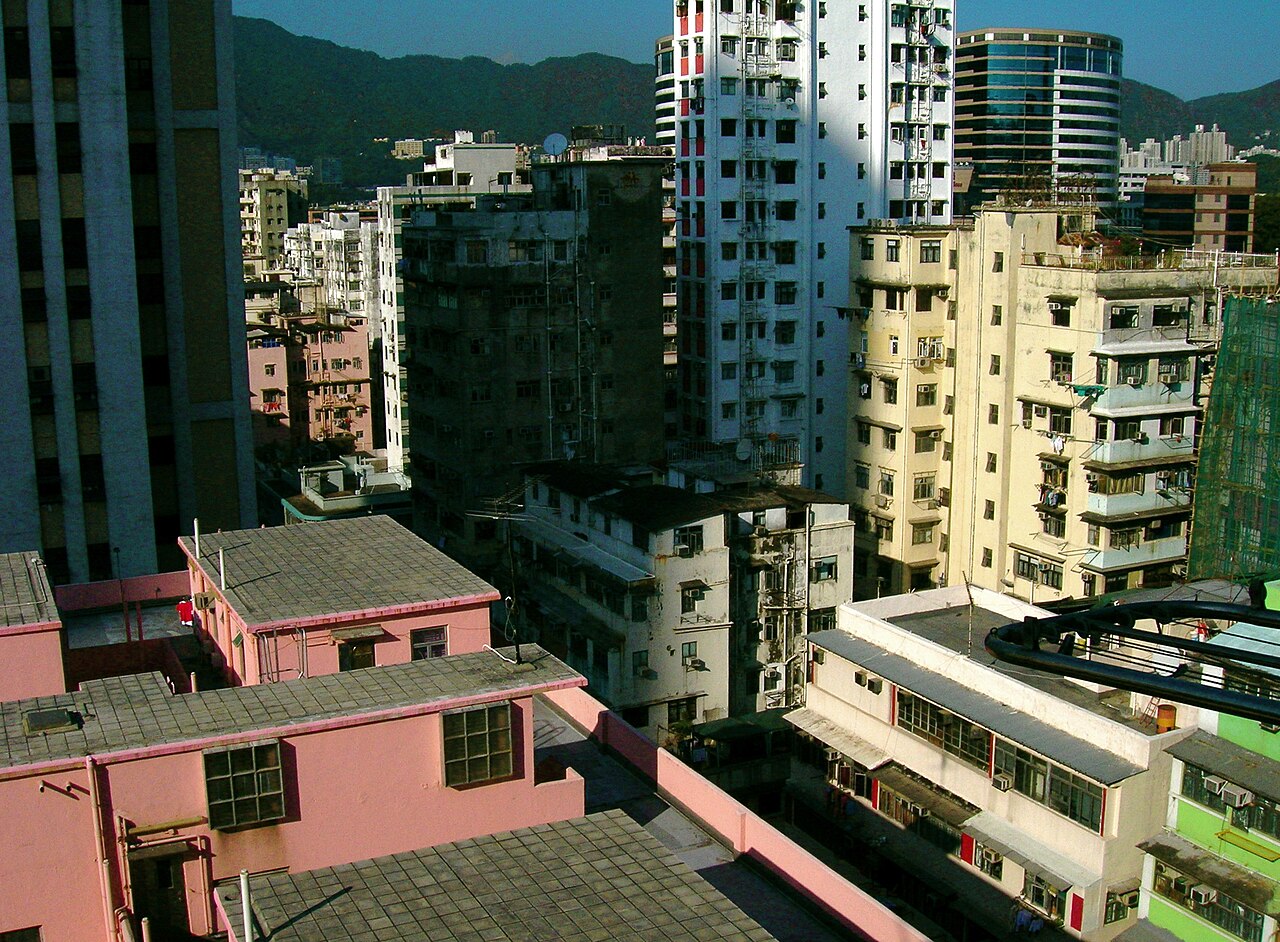
Image: Wikimedia Commons / CC BY-SA 4.0.
Hong Kong Coliseum, Hung Hom
- MTR Hung Hom Station Exit A, across the footbridge. Opened in 1983, this is Hong Kong’s most important indoor concert venue
- Beyond held multiple concerts here; the two most replayed are the 1991 Live Encounter concerts (interwoven with footage from Africa) and the May 1993 “Live & Basic” unplugged shows on the second-floor stage — Wong Ka Kui’s last large-scale Hong Kong performance, just over a month before his fall in Tokyo
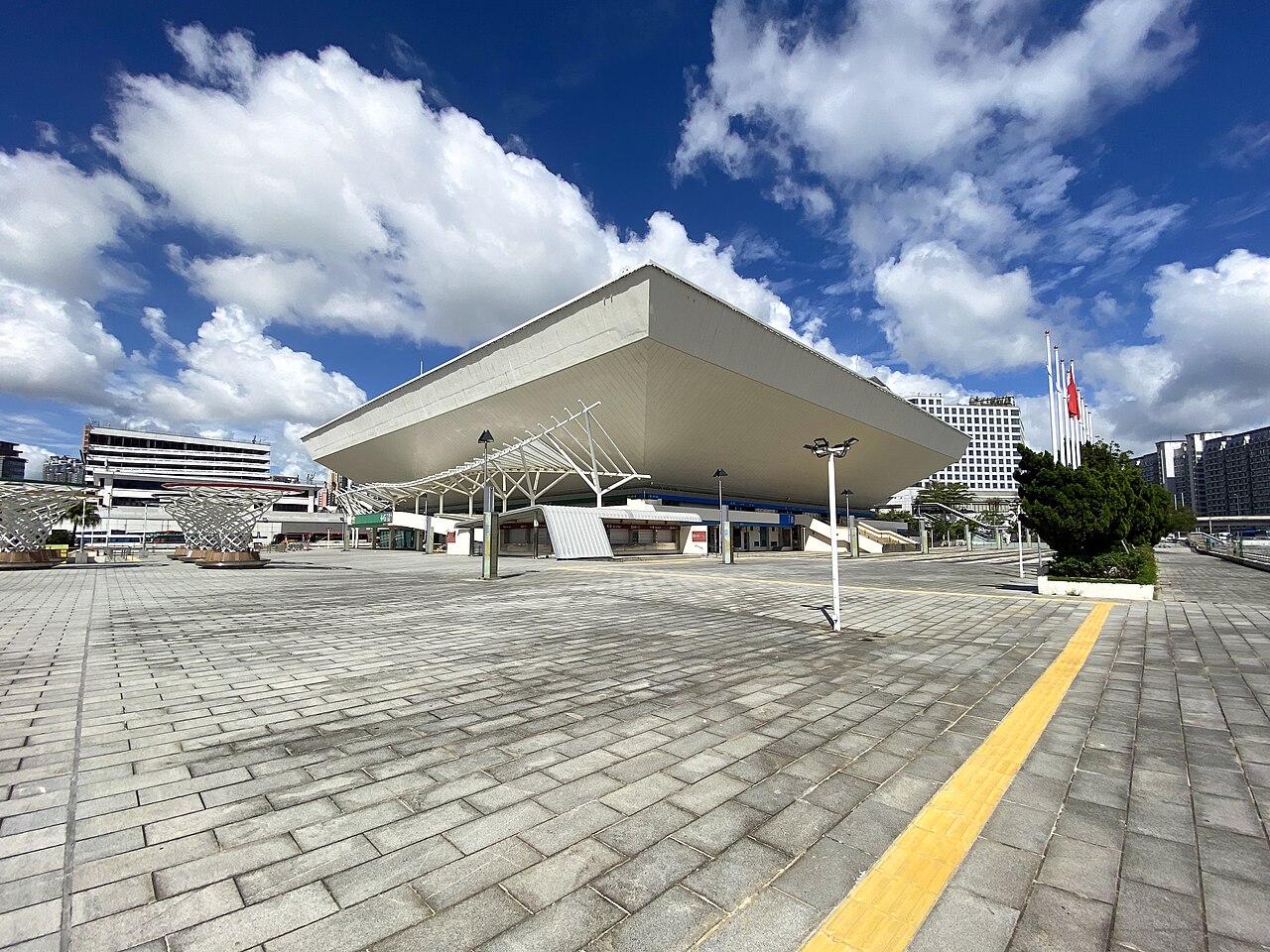
Image: Wikimedia Commons / CC BY-SA 4.0.
Leave that old building on Tung Choi Street behind and head south along Nathan Road. Next, we go looking for another Hong Kong face — toothpick clamped between his teeth, trench coat over his shoulders, walking up from a Tsim Sha Tsui pier. Chow Yun-fat is waiting.
Chow Yun-fat — From Fisherman’s Son to Asia’s Best Actor
If one morning at Tai Po market you see an old man in a faded baseball cap, shorts and slippers, carrying plastic bags of bok choy, don’t doubt your eyes — that might just be Chow Yun-fat. A Best Actor who came up from a fishing village on Lamma Island, won three Hong Kong Film Awards and two Golden Horses, and to this day still takes the double-decker bus to the market for groceries — he’s the most un-legendary legend this city has.
A fishing-village boy and TVB’s third class
On May 18, 1955, Chow Yun-fat was born in Sok Kwu Wan, Lamma Island, Hong Kong. His father was a sailor on ocean-going oil tankers; his mother worked the fields and took in housework on the side. Childhood Chow lived in a wooden shack with no electricity, getting up at four or five in the morning to help his father pull nets, work the fields with his mother, and carry shoulder poles to sell youtiao. “When I was small I didn’t know what poor meant, because everyone was poor,” he later said.
1965, the family moved to Kowloon. As a teenager he worked as an office runner, a postman, a camera salesman, a hotel bellboy — the early-job list he himself put down has at least a dozen entries. In 1973, at eighteen, he saw an ad in the paper for TVB’s third actor-training class and, on a bet with a classmate, applied. His classmates included Ng Man-tat and Simon Yam — all of them later pillars of Hong Kong’s golden TV era.
- 1976: the TV drama The Hotel (129 episodes), as Shiu Wah-shan, his first noticed role
- 1977: A House Is Not a Home, opposite Liza Wang
- 1980: The Bund, as Hui Man-keung — the white scarf, the long coat, the homburg, and Frances Yip’s theme song made him an overnight idol across the entire Chinese-speaking world
But the god of television was the poison of cinema. From 1980 to 1985 he made over twenty films, almost every one a money-loser, and the industry gave him the nickname “box-office poison.”
Mark Gor and three Best Actor awards
The turn came in 1985. John Woo watched his Witness to a Prosecution and saw the Mark Gor he had in mind: down-and-out, proud, fiercely loyal, capable of lighting a cigarette in a firefight. On August 2, 1986, A Better Tomorrow opened. The Hong Kong gross was HK$34.65 million, breaking every record then standing, and overnight Chow Yun-fat went from “box-office poison” to “box-office guarantee.”
What followed was his golden five years:
- 1986 A Better Tomorrow — first Hong Kong Film Awards Best Actor
- 1987 City on Fire (Ringo Lam) — second HKFA; the same year An Autumn’s Tale won him Best Actor at Taiwan’s Golden Horse. Shot in Brooklyn, New York, his “Samp Pan” was so tender that he broke the hearts of every Hong Kong woman who watched it
- 1989 All About Ah-Long (an early Johnnie To film) — third HKFA + second Golden Horse, making him the only three-time HKFA Best Actor in Hong Kong film history
- 1989 The Killer, 1990 God of Gamblers, 1991 Once a Thief — his three collaborations with John Woo and the God of Gamblers series with Wong Jing form the most glittering page of late-’80s/early-’90s Hong Kong cinema
Still: Cinema City / Wikipedia · fair use (non-commercial).
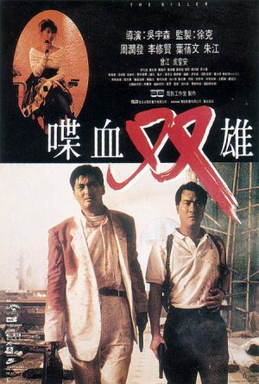
Still: Film Workshop / Wikipedia · fair use (non-commercial).
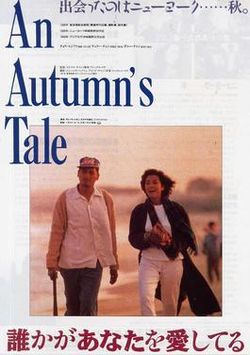
Still: Wikipedia · fair use (non-commercial).
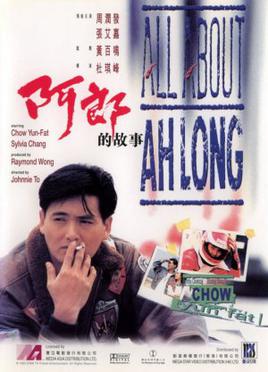
Still: Wikipedia · fair use (non-commercial).
In 1995, at forty, he made the decision that surprised everyone: he was going to Hollywood. He spent three years learning English for it — by his own count, “seven days a week, five hours a day” — sharing a rented house in LA with American roommates and forcing himself to speak only English. In 1999 he co-starred with Jodie Foster in Anna and the King, and in 2000 Ang Lee’s Crouching Tiger, Hidden Dragon put him and Michelle Yeoh on the Oscar stage. Later American films like Bulletproof Monk (2003) didn’t fare well at the box office; after 2010 he largely returned to Asia, making Let the Bullets Fly, Cold War II, Project Gutenberg, and others.
The thing Hong Kongers love most about him is his almost extreme plainness:
- Married to Jasmine Tan since 1986 — almost forty years, no children
- A Nokia phone he used for twenty years, until it broke
- Takes the double-decker bus and MTR out, buys groceries himself at the market, no luxury cars
- In 2018 publicly pledged to donate his entire estate to charity: “The money isn’t mine — I’m just keeping it for a while.”
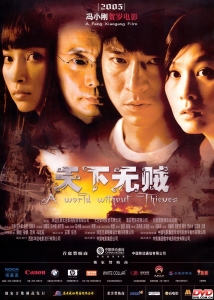
Still: Wikipedia · fair use (non-commercial).
Pilgrimage points: starting at Sok Kwu Wan
Sok Kwu Wan, Lamma Island is reached by direct ferry from Central Pier 4, about a 35-minute ride, about HK$22.50 one-way (adult weekday). Step off the ferry and you’re at the pier. To the left, a row of seafood dai pai dong (Lamma Seafood Restaurant, Rainbow Seafood Restaurant); to the right, the 200-year-old Tin Hau Temple — Fat Gor used to run around here as a kid.
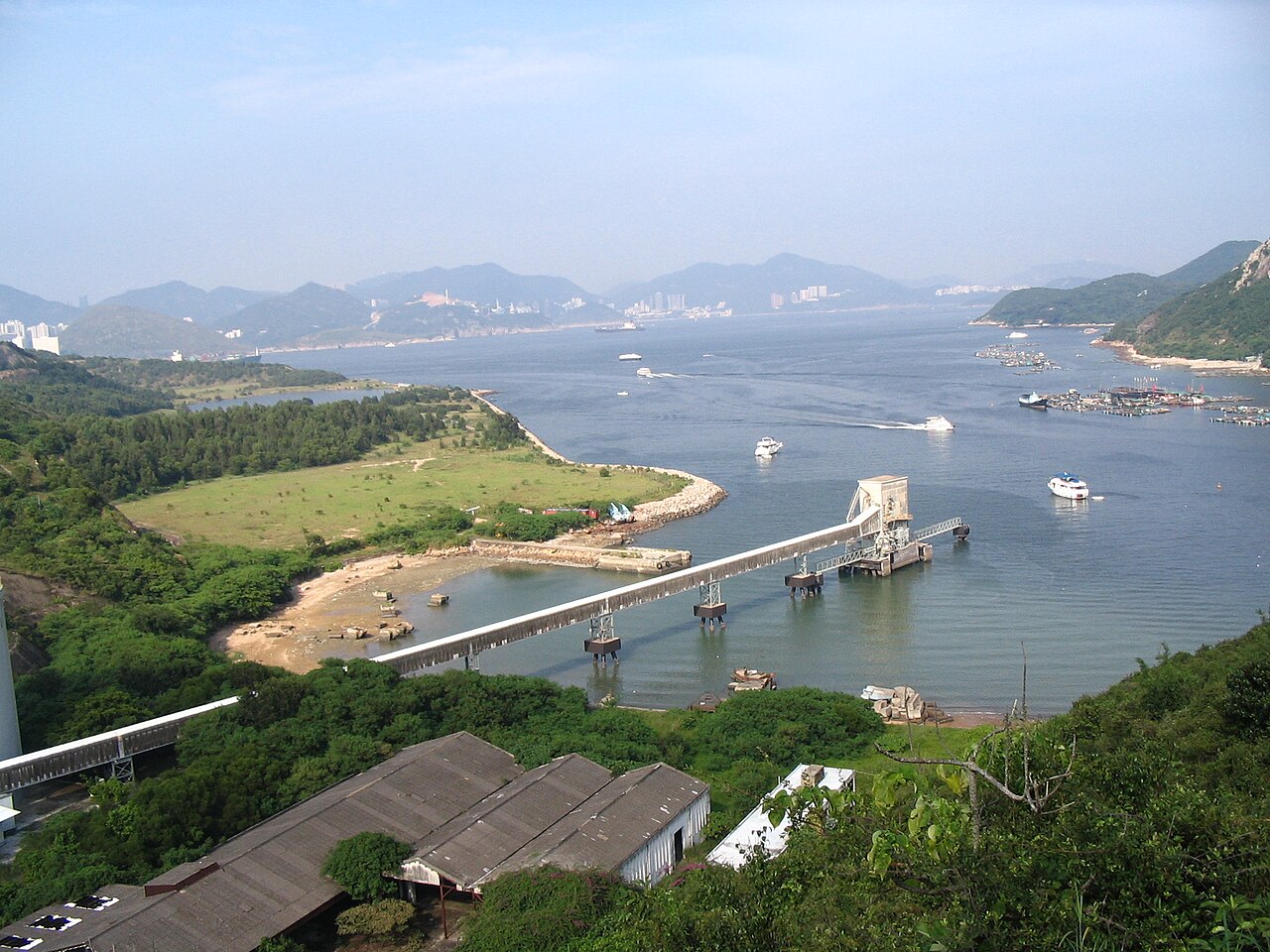
Image: Wikimedia Commons / CC BY-SA 4.0.
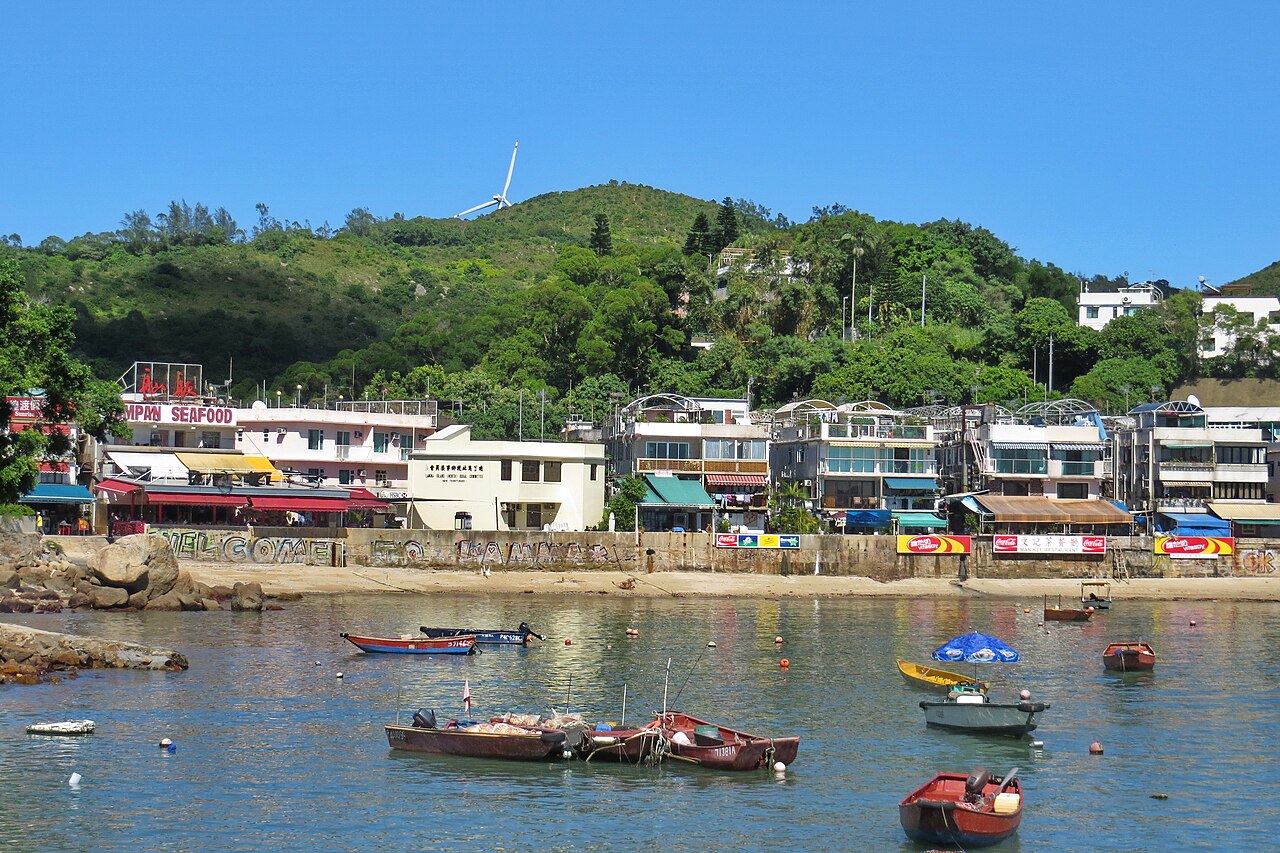
Image: Wikimedia Commons / CC BY-SA 4.0.
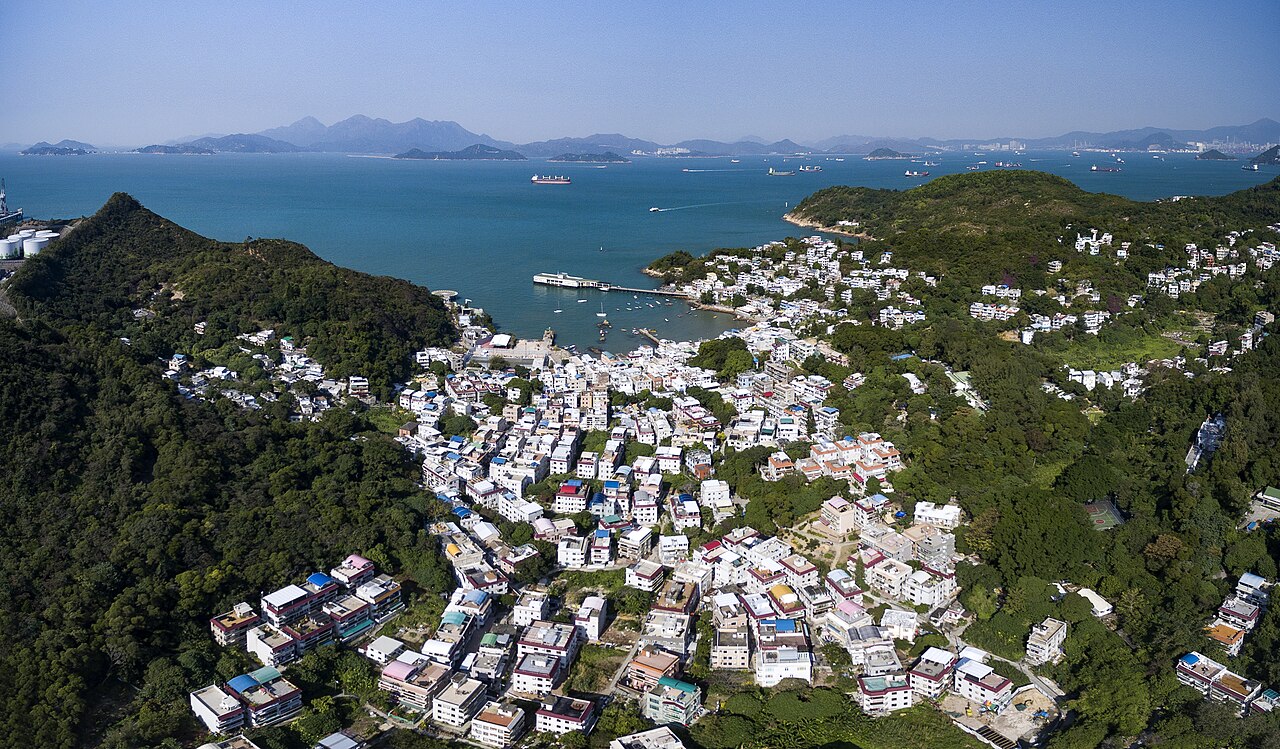
Image: Wikimedia Commons / CC BY-SA 4.0.
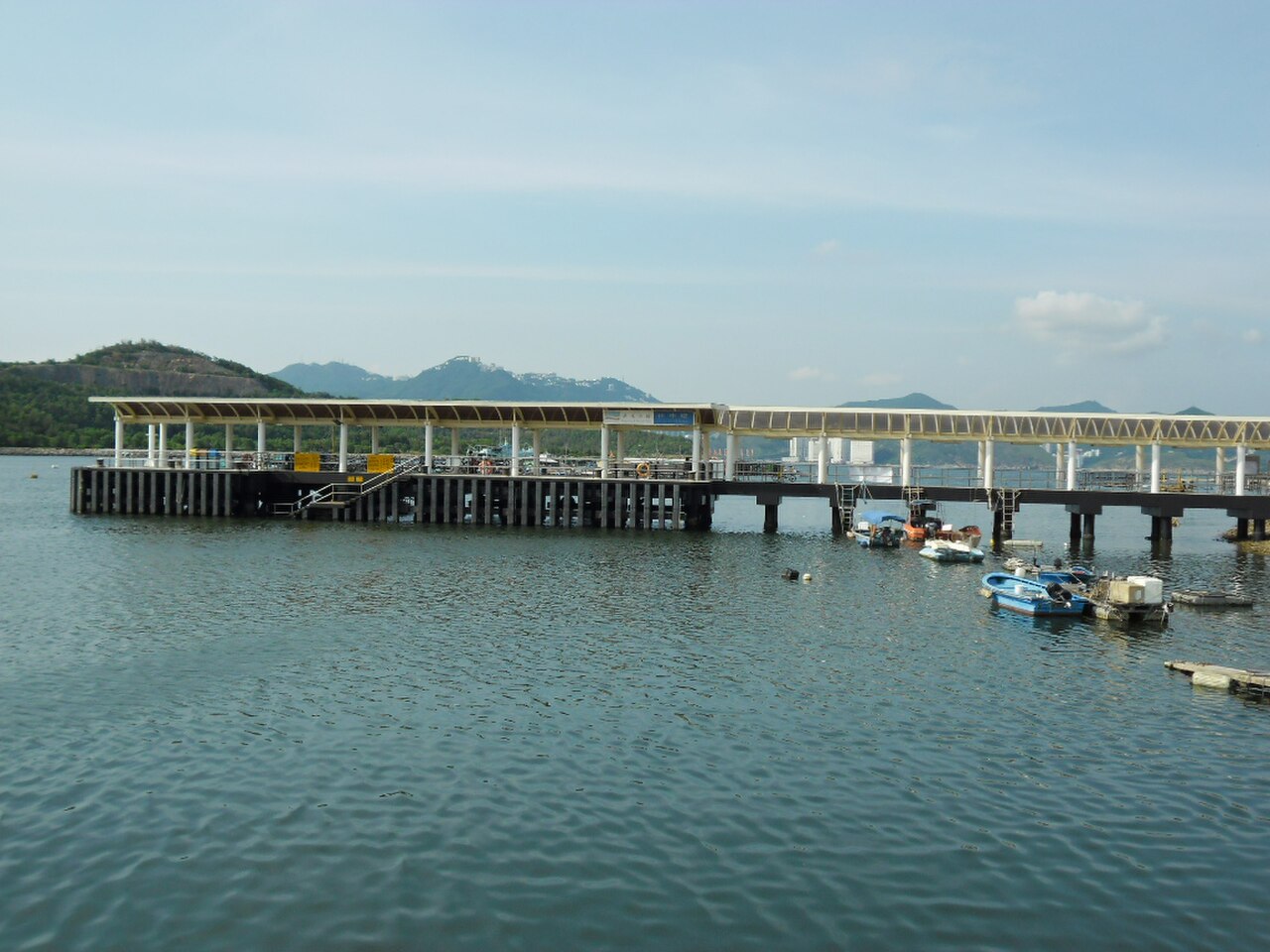
Image: Wikimedia Commons / CC BY-SA 4.0.
The walk really worth doing is the Family Trail: from Sok Kwu Wan pier to Yung Shue Wan pier, about 5 km, 1.5 hours, passing Lo Tik Wan, Hung Shing Yeh Beach (swimmable), several abandoned fishing-village shacks, and the famous windmill. Somewhere along the ridgeline where the South China Sea opens up wide, you’ll suddenly understand why Fat Gor, to this day, still says he’s “just a fisherman’s son.”
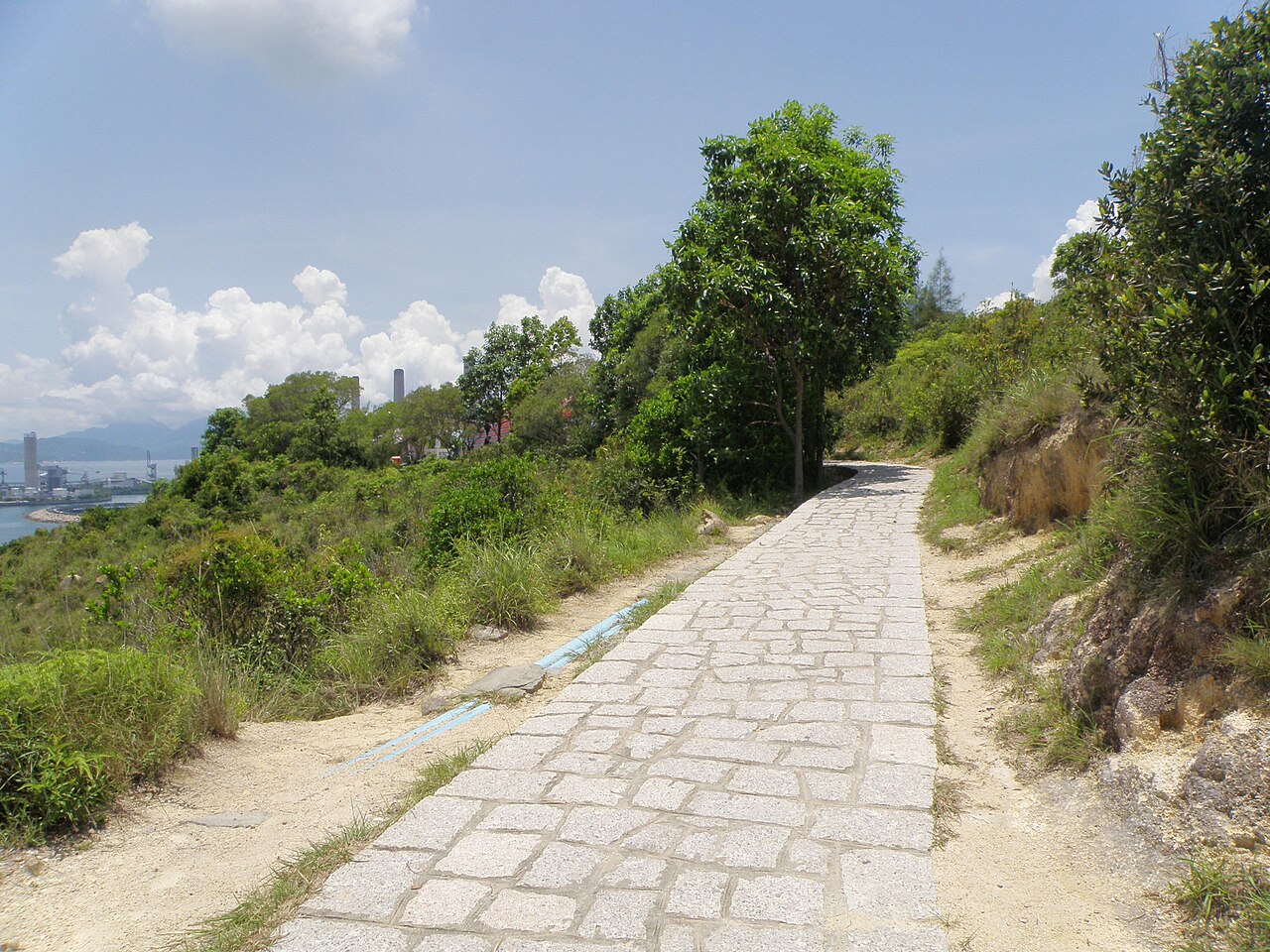
Image: Wikimedia Commons / CC BY-SA 4.0.
As for Ocean Terminal (17 Canton Road, Tsim Sha Tsui), it’s where Mark Gor and Ho Gor look out at the harbor in A Better Tomorrow — best time, dusk 17:30–19:30, to catch the sun setting Victoria Harbour red. And Tai Po Market (Tai Po Complex, 8 Heung Sze Wui Street) or the morning yum-cha spots in Yau Ma Tei are where Fat Gor might actually turn up — but whether you bump into him is luck.
A fisherman’s son who walked out of a fishing village, won every award, made it to Hollywood, and walked back into the market. Next stop, we leave real people behind and meet a pig who lives in Tai Kok Tsui, speaks the same Cantonese, and was raised in the same struggle — McDull.
Part III · Culture — Hong Kong as a Symbol
In the last two chapters, the works recede to the background and the people fade out. What remains is Hong Kong as a symbol — a pig, a building, an island — the last shapes this city has left of itself in its own imagination.
McDull — A Pig’s Parable of Hong Kong
A pig that doesn’t look like a pig, round-headed, droop-eared, always smiling; a city ethic that says “noodles with fishballs but no fishballs” and just smiles and orders again — that’s McDull, the most tender love letter Hong Kong ever wrote itself.
A couple and a pig: from comic strip to animation miracle
McDull and McMug, the little pig brothers, are the creation of writer Brian Tse and illustrator Alice Mak — a married couple. The two began co-publishing children’s books in 1988 and, through the 1990s, ran a comic strip in magazines like Yes! and Little Ming Pao Weekly, gradually building a cross-generational readership from primary-school kids to office workers. Mak’s watercolor style is soft, fuzzy, with the naivety of children’s books; Tse’s writing hides a thoroughly Hong Kong philosophy — resigned but not giving up, self-mocking but not cynical.
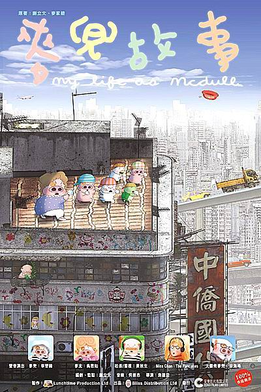
In 2001 the first animated feature, My Life as McDull, was released and earned about HK$15 million. At the tail end of the Infernal Affairs / Shaolin Soccer era, a small-budget local animated film cracking the year’s top earners was a small miracle. More films followed:
- My Life as McDull (2001)
- McDull, Prince de la Bun (2004)
- The Magical McDull (2006)
- McDull, Kung Fu Kindergarten (2009) — earned about RMB 65 million in Mainland China, setting a Chinese-language animation record there
- McDull: The Pork of Music (2012)
The setting, Springfield Flower-Flower Kindergarten, is fictional, but it maps onto the kind of small kindergartens tucked between factory floors and tong lau in Tai Kok Tsui. And Mrs. Mak — a single mother working several jobs to raise her son alone — is a single character who pretty much defines the millions of mothers in 1990s Hong Kong.
Still: Edko Films / Bliss Concepts · fair use (non-commercial).

Still: Edko Films / Wikipedia · fair use (non-commercial).
Fishball coarse noodles, Sorrowful Rice, and a stupid-but-not-dumb pig
If you had to pick one line to represent McDull, it would have to be the “fishball coarse noodles” scene. McDull walks into a cha chaan teng and earnestly orders “Excuse me, fishballs with coarse noodles.” The waiter, expressionless: “Fishball coarse noodles, no fishballs.” McDull thinks for a moment: “Then please, a bowl of fishball lai-fun.” The waiter: “Fishball lai-fun, no fishballs either.” In the end, only lai-fun, only coarse noodles — what you want is never there, and what you settled for as a backup was never there to begin with.
Why did this scene become an aphorism of 1990s–2000s Hong Kong? Because it’s too accurate. Asian financial crisis, SARS, property crash, emigration waves — this generation of Hong Kongers faced life with this exact tender self-mockery: knowing it’s not there, ordering anyway; not getting it, smiling and switching bowls. Same with the Sorrowful Rice in The God of Cookery — fishball lai-fun and Sorrowful Rice are the two ends of the collective taste memory of millennial Hong Kongers: one ornately self-pitying, one plainly resigned.
McDull himself is stupid-but-not-dumb: he tries to climb the bun tower and falls off halfway up; he dreams of weightlifting at the Olympics but eats steamed buns while training; he can’t pass exams or get into a good school, but he remembers his mother’s turkey and that bowl of lai-fun forever without fishballs. This is Brian Tse’s masterstroke — he asks one little pig to carry a whole generation’s mini-epic.
And 2004’s McDull, Prince de la Bun is a hidden punch: McDull’s father, the “Prince of Bun,” has been in exile for years and finally returns — any Hong Kong adult can read this as a political parable about emigration and return around 1997.
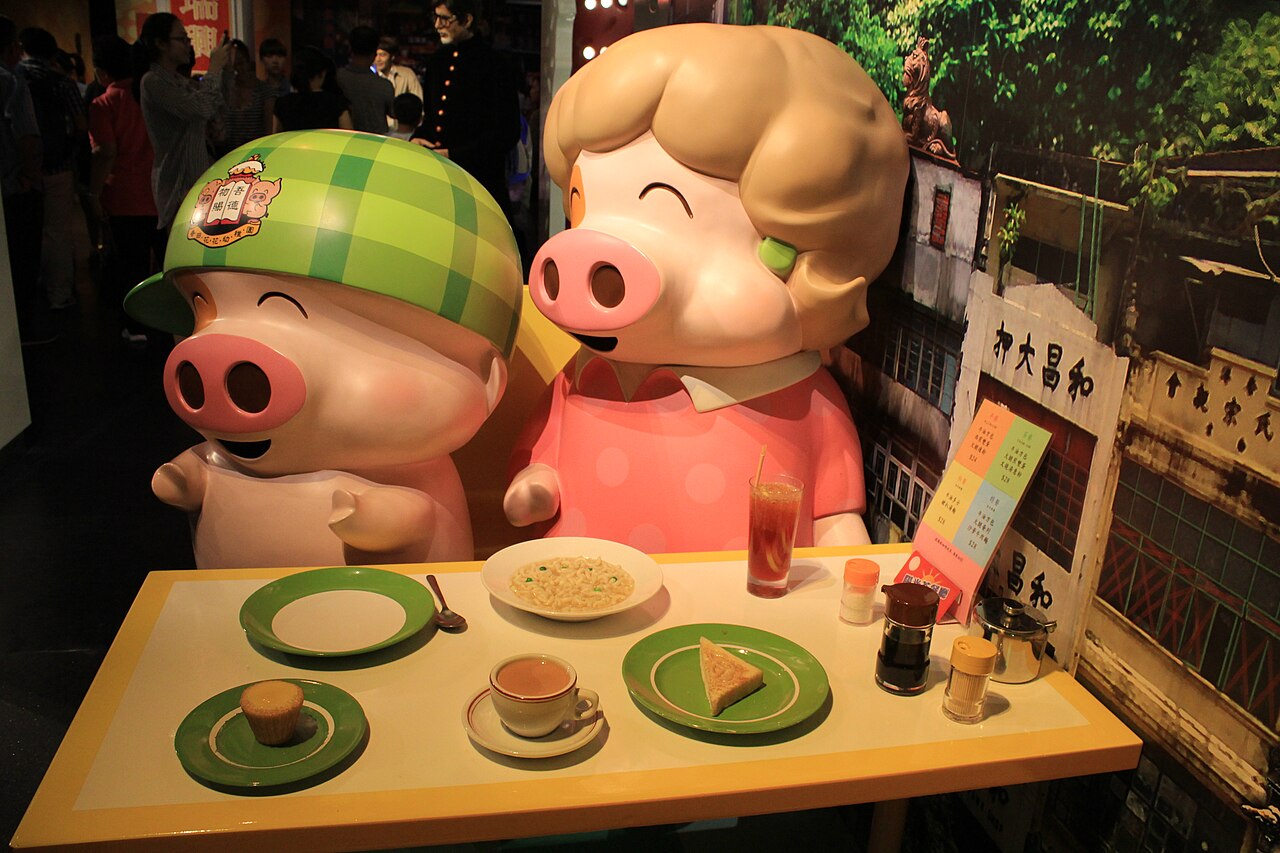
Image: Wikimedia Commons / CC BY-SA 4.0.
Pilgrimage points: Tai Kok Tsui + Cheung Chau (+ a whisper of Kowloon Walled City)
Tai Kok Tsui: MTR Olympic Station or Tai Kok Tsui Station drop you here. The neighborhood was once full of garment workshops and small metal shops; now old buildings and new Olympian City towers are interleaved, and the kind of ground-floor-kindergarten streetscape that inspired Springfield Flower-Flower is vanishing fast. Recommended evening walking blocks: Ivy Street, Larch Street, Lai Chi Kok Road — neon signs, tong lau verandas, market smells — closest to the Hong Kong McDull sees on the way to school.
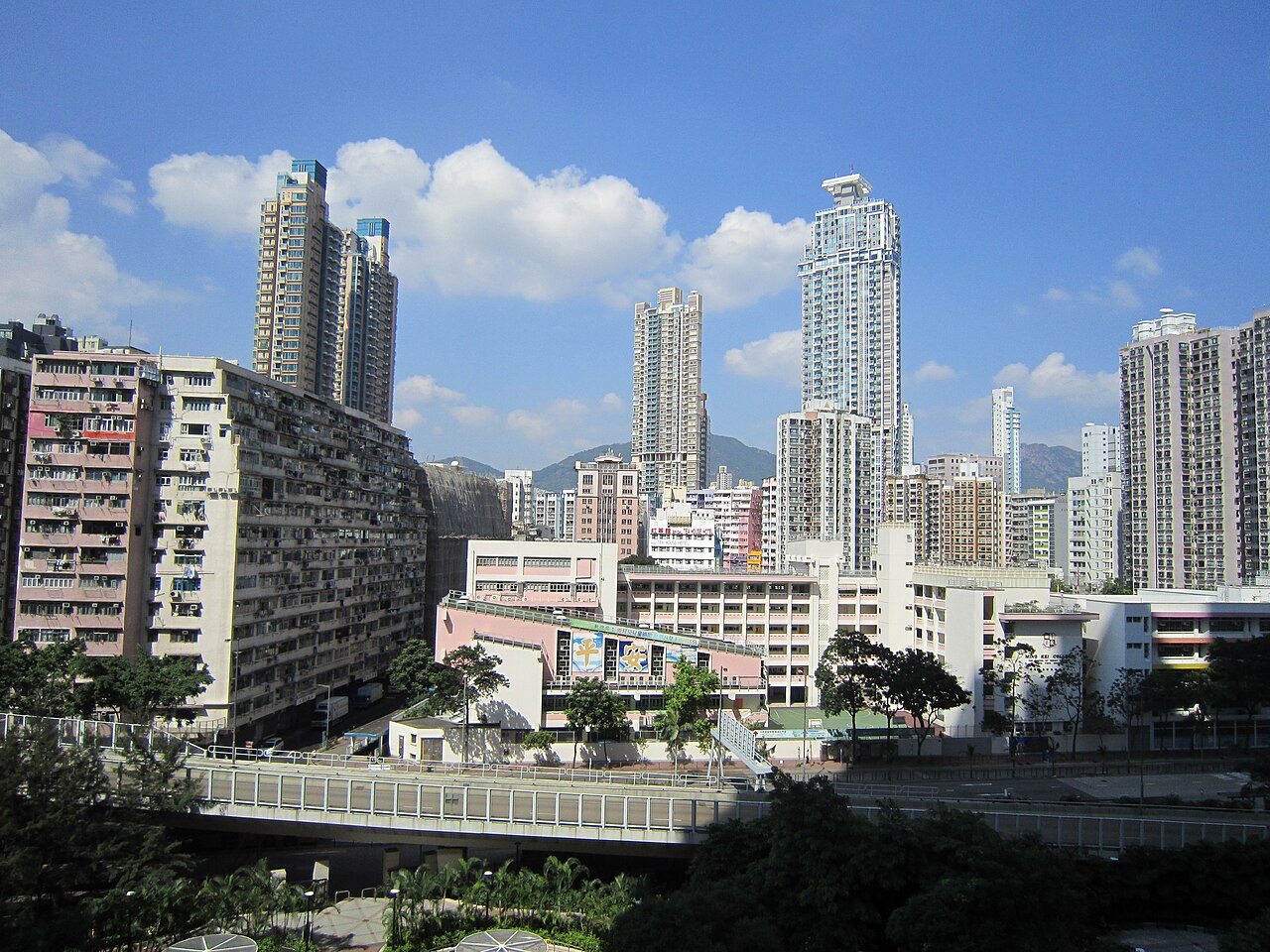
Image: Wikimedia Commons / CC BY-SA 4.0.
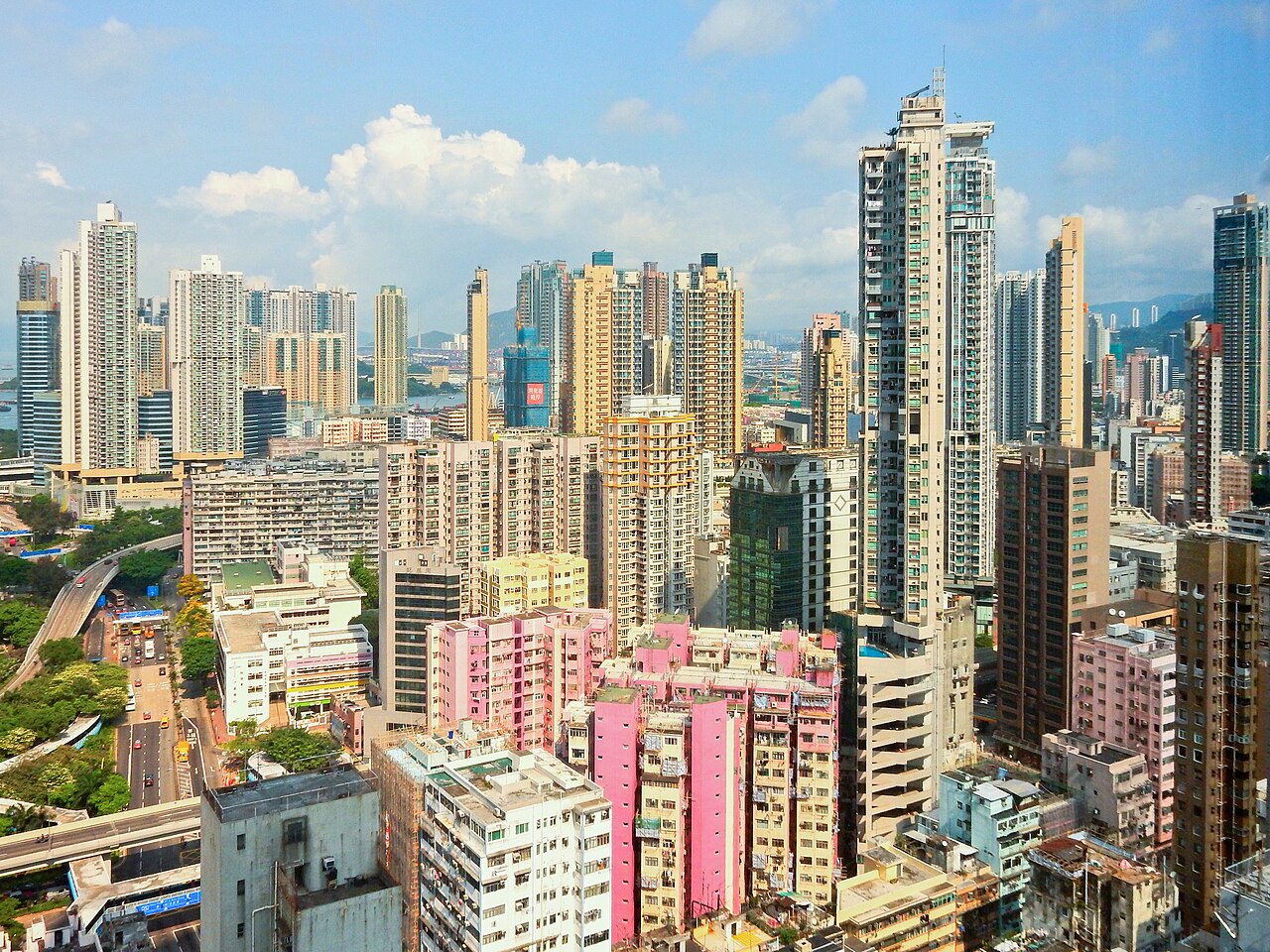
Image: Wikimedia Commons / CC BY-SA 4.0.
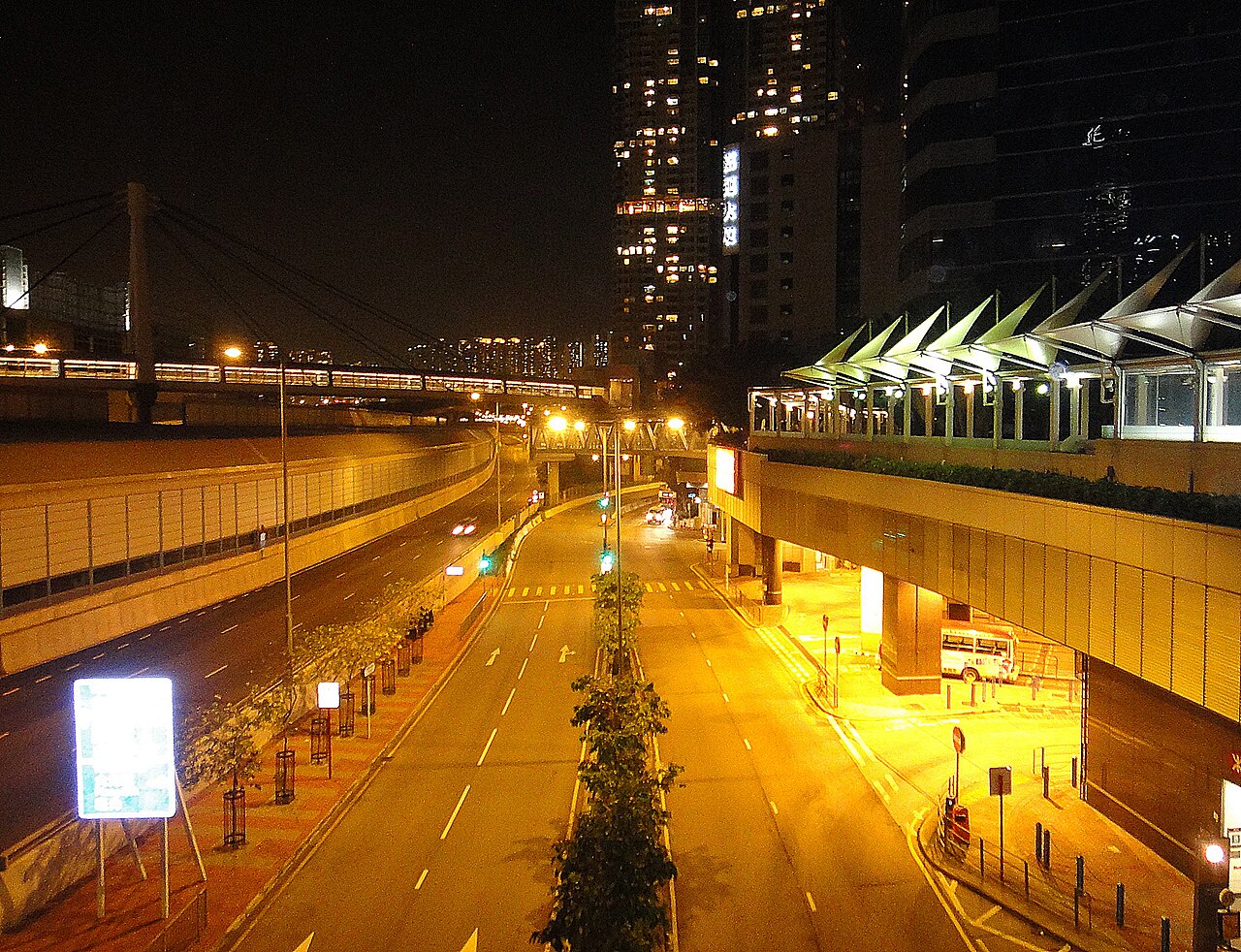
Image: Wikimedia Commons / CC BY-SA 4.0.
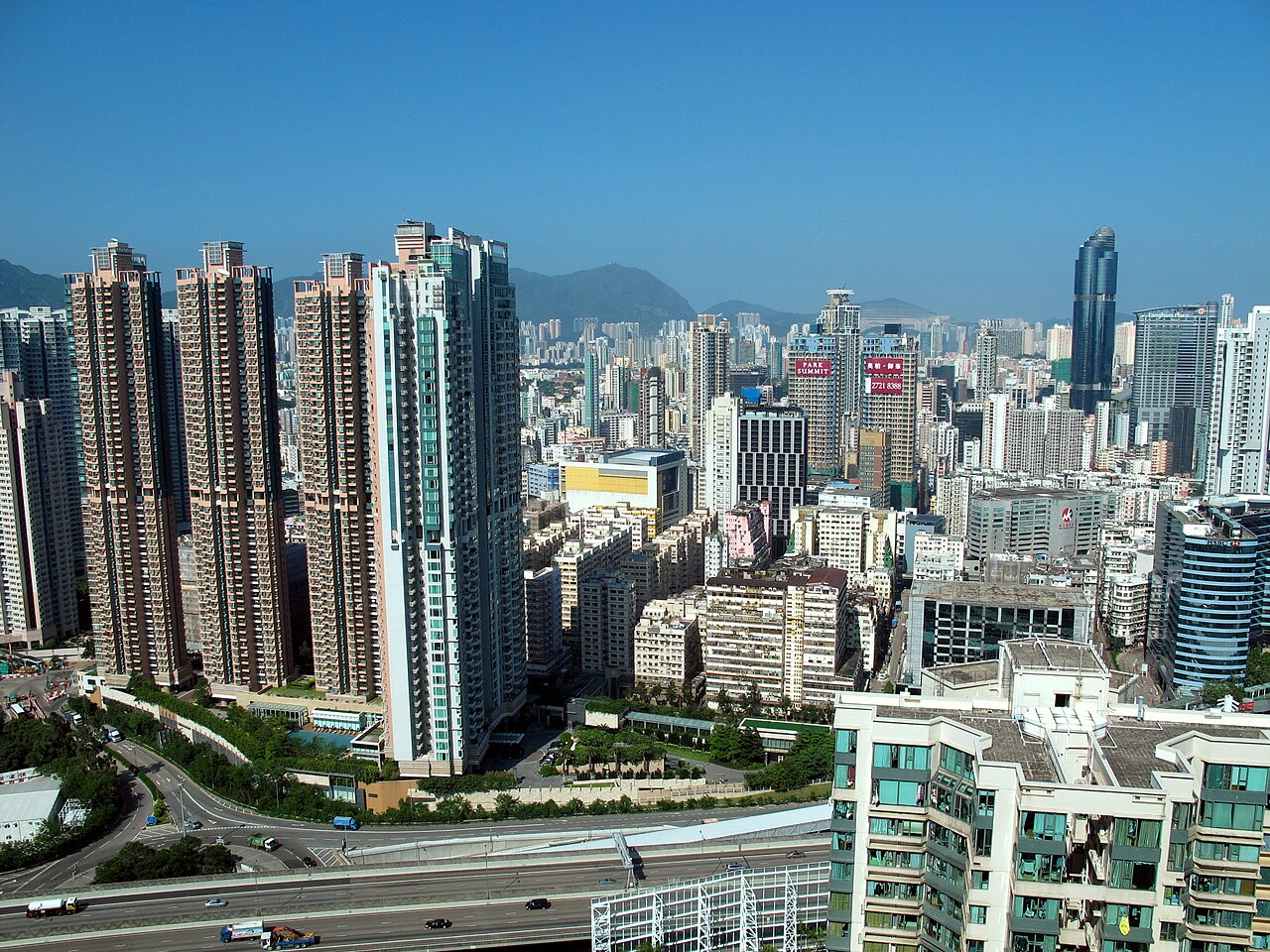
Image: Wikimedia Commons / CC BY-SA 4.0.
McDull’s Hong Kong has another invisible backdrop — Kowloon Walled City (demolished in 1993). That anarchic forest of rebar was the world Stephen Chow grew up beside, and the same gray-tinted atmosphere keeps flickering back in the McDull animations:
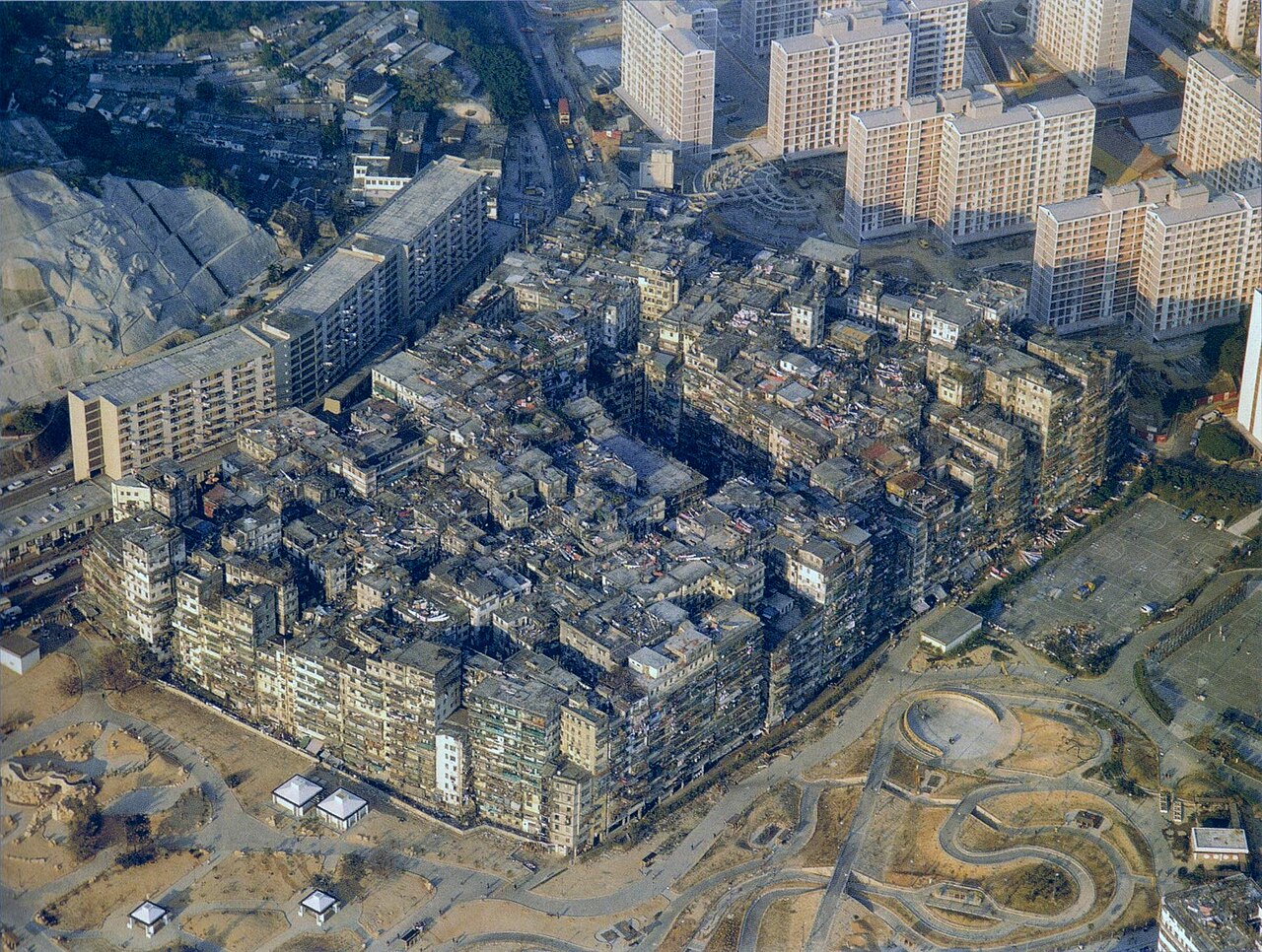
Image: Wikimedia Commons / CC BY-SA 4.0.
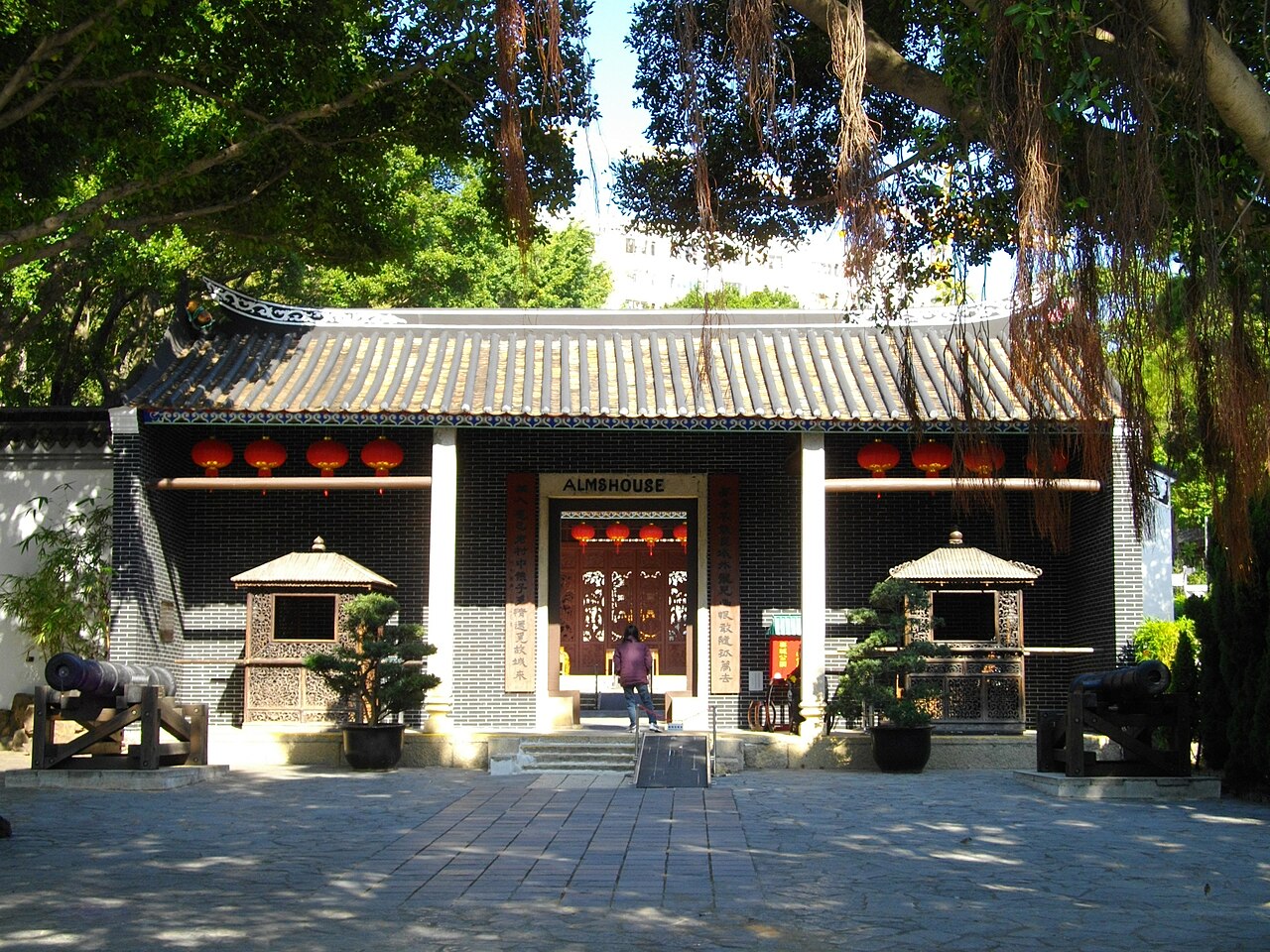
Image: Wikimedia Commons / CC BY-SA 4.0.
Cheung Chau: in McDull, Prince de la Bun, this is where Mrs. Mak takes McDull for summer. From Central Pier 6, ordinary ferries take 50–55 minutes, fast ferries 35 minutes. The Pak Tai Temple, built in 1783, is a Grade II historic building; the Cheung Po Tsai Cave continues a pirate legend; and every April on the lunar calendar the Cheung Chau Bun Festival is the most boisterous of all outer-island festivals — the source of the McDull bun-tower scene. Cheung Chau is the best of the outer islands for a single-day round trip.
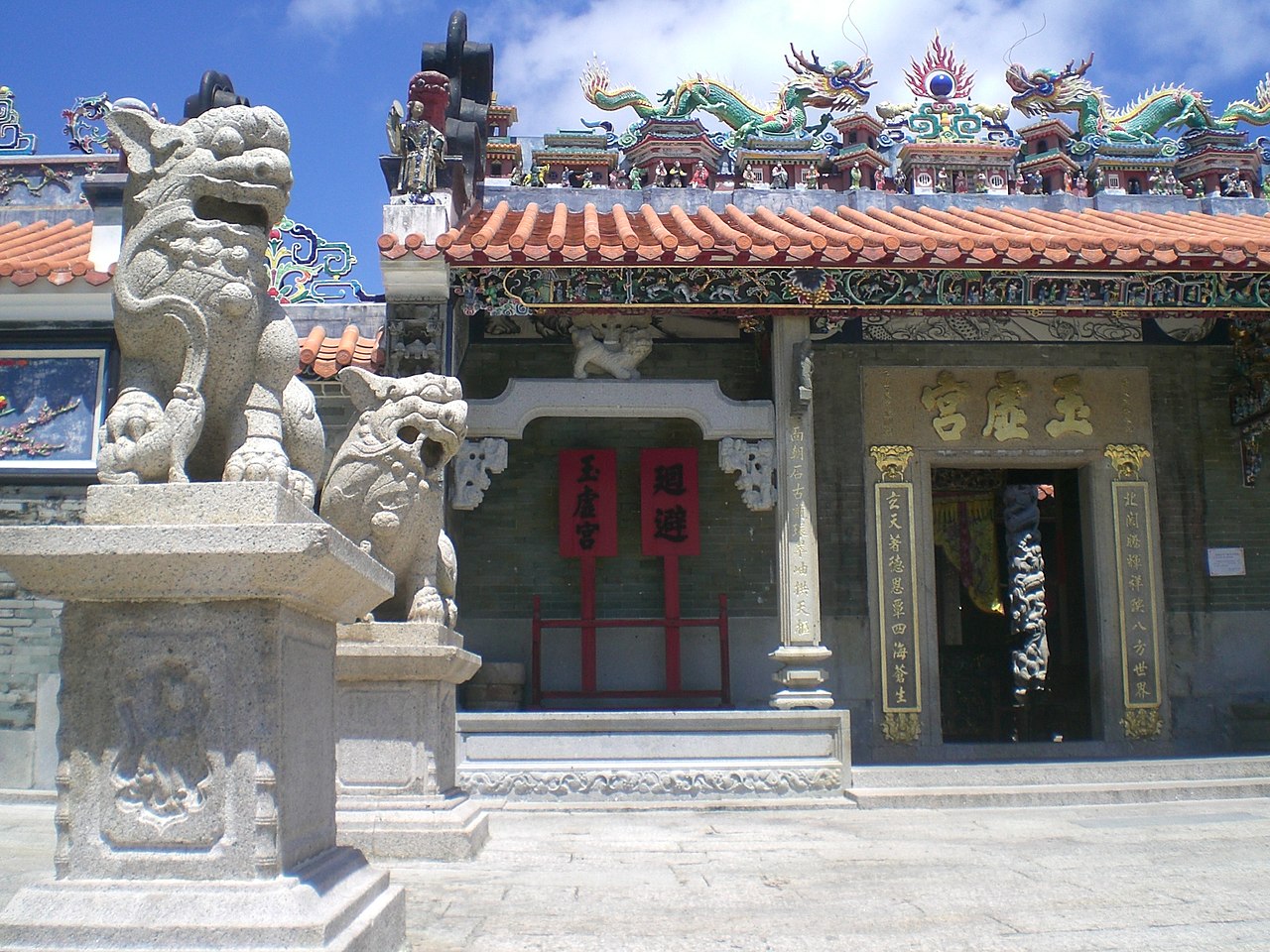
Image: Wikimedia Commons / CC BY-SA 4.0.
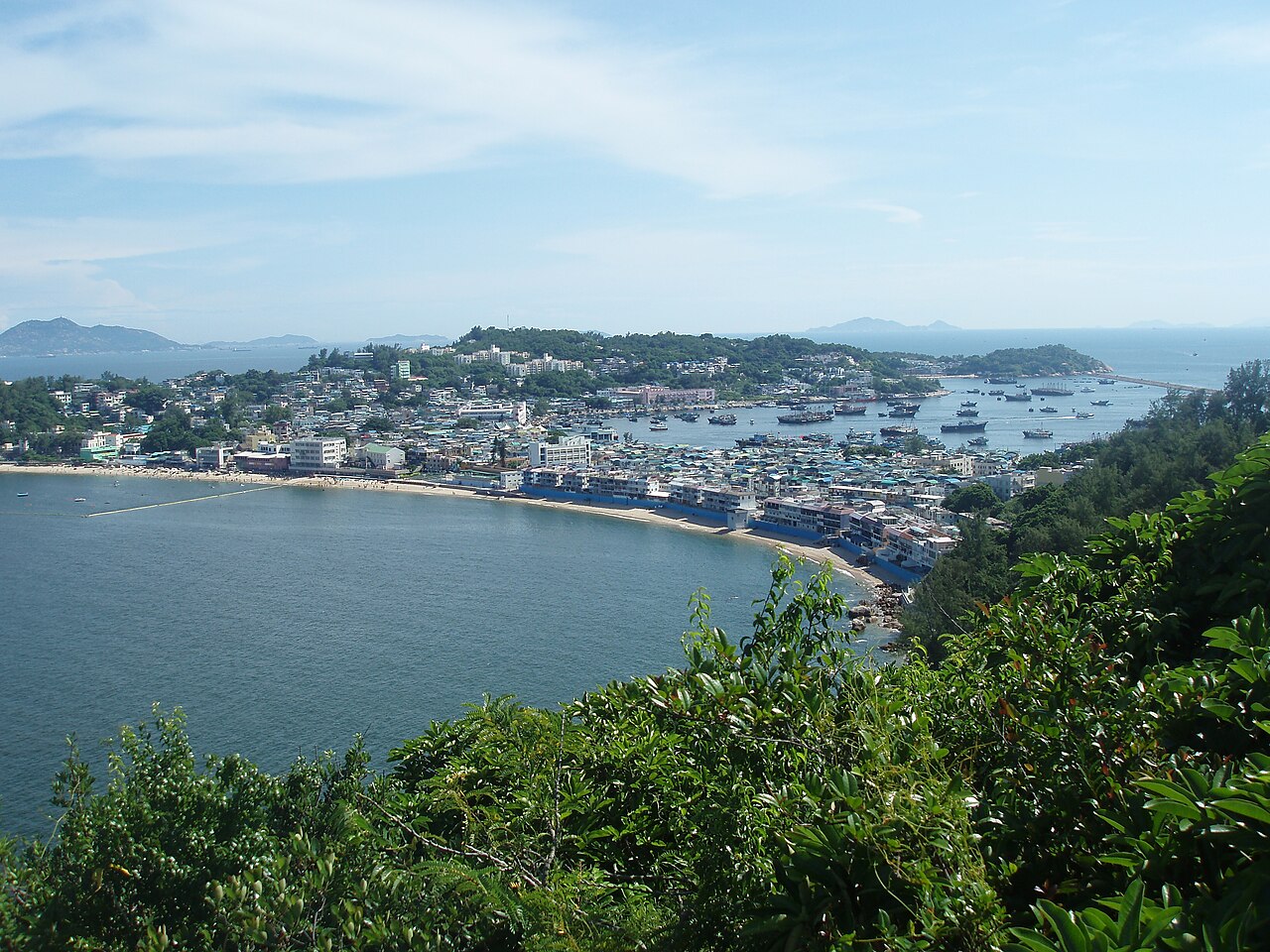
Image: Wikimedia Commons / CC BY-SA 4.0.
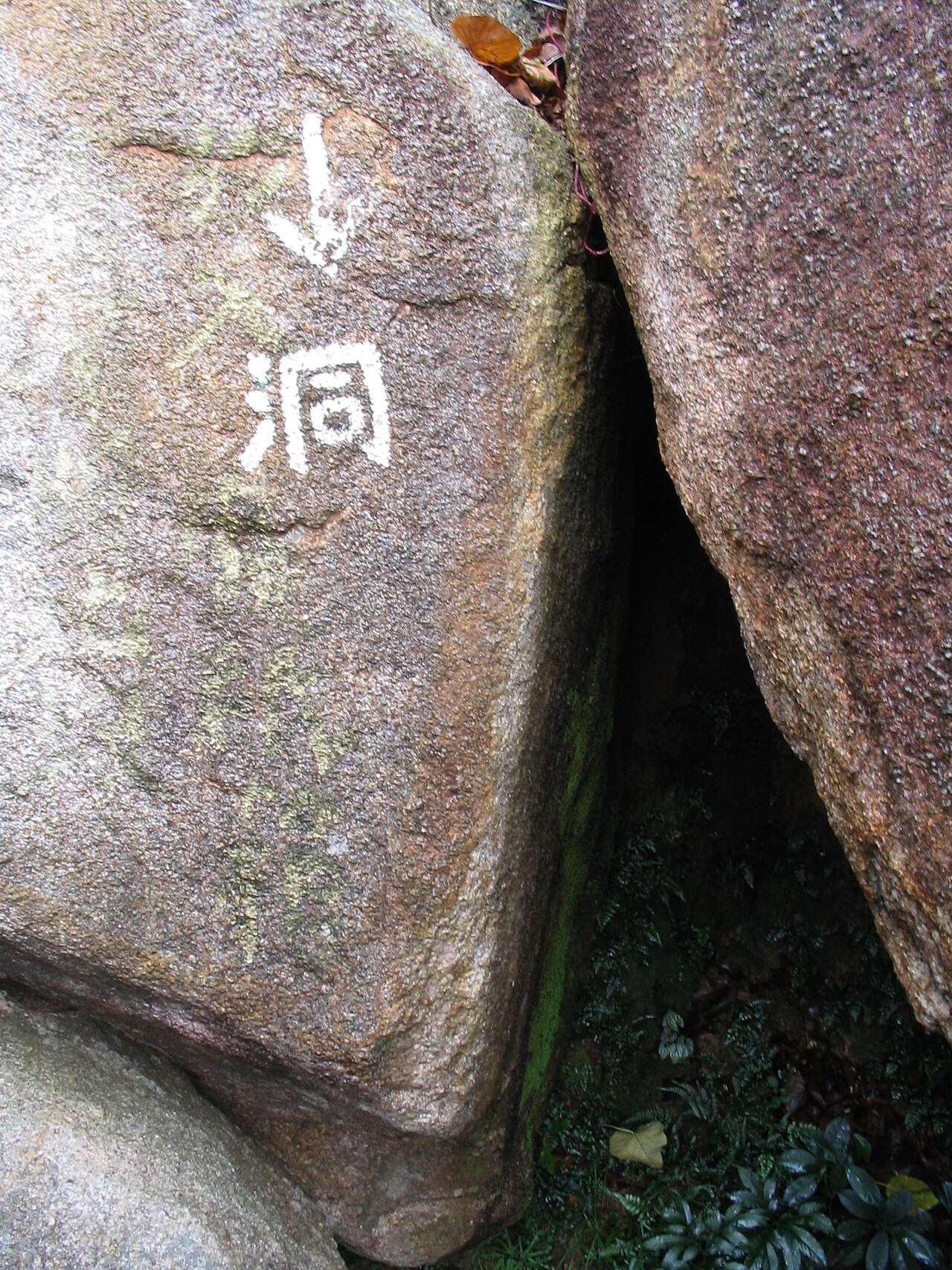
Image: Wikimedia Commons / CC BY-SA 4.0.
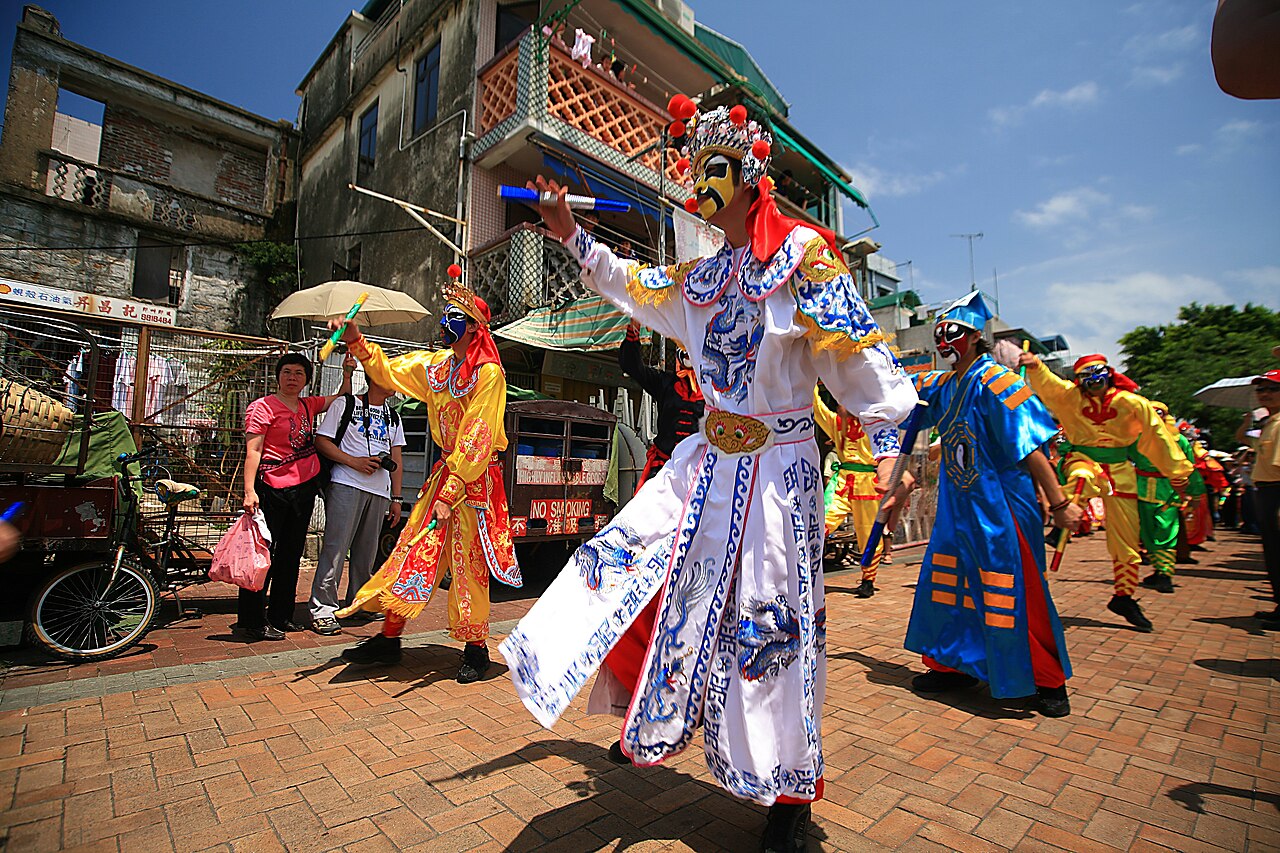
Image: Wikimedia Commons / CC BY-SA 4.0.
When you finish that bowl of forever-fishball-less lai-fun, look up with McDull — and you’ll see, right next door, a building that’s packed so tight it looks like a beast. That’s the next stop: the Monster Building and the outer islands.
The Monster Building and the Outer Islands — Spectacle and Sea Tempo
Hong Kong might be one of the most-looked-at cities in the world. Being looked at is a kind of fate — a city where people live, argue, hang out laundry, while also being someone else’s camera spectacle, Instagram filter, ready-made Hollywood set. This chapter takes you to two extremes: a residential block stuffed with ten thousand people, and a fishing village down to two thousand.
Monster Building, Quarry Bay
From Taikoo MTR Station Exit B, walk two minutes along King’s Road and you’ll run into something so big your neck snaps back automatically. The Monster Building — a nickname from the internet — is the formal cluster of five interconnected residential blocks: Yick Cheong, Oceanic Mansion, Fok Cheong, Yick Fat, Montane Mansion, originally “Pak Ka Sun Tsuen,” designed by architect Ng Yiu-wai, with occupation permits granted by the government in July and August 1972.
The five blocks lock together around a shared E-shaped atrium, with 2,243 residential units and around 10,000 people living inside. Stand in the middle of the courtyard, look up, and you get a near-violent visual repetition — windows, drying poles, AC units, security cages, density piled on density until the sky is reduced to a small patch of gray-blue. That oppressive feeling is exactly why it became a visual icon.
- 2012, French photographer Romain Jacquet-Lagrèze publishes Vertical Horizon, pushing the Monster Building into international view
- 2014 Transformers: Age of Extinction shoots here
- 2017 the live-action Ghost in the Shell also stops by
- Since then, it’s become a must-shoot location for every travel blogger visiting Hong Kong
The cost is that residents are increasingly disturbed. Since 2020, management has put up photography barriers and warning signs in the courtyard, reminding visitors that this is private housing. Please shoot from outside the barrier, don’t ring doorbells, don’t ride residents’ elevators upstairs — this is a place people live, not an attraction.

Image: Wikimedia Commons / CC BY-SA 4.0.
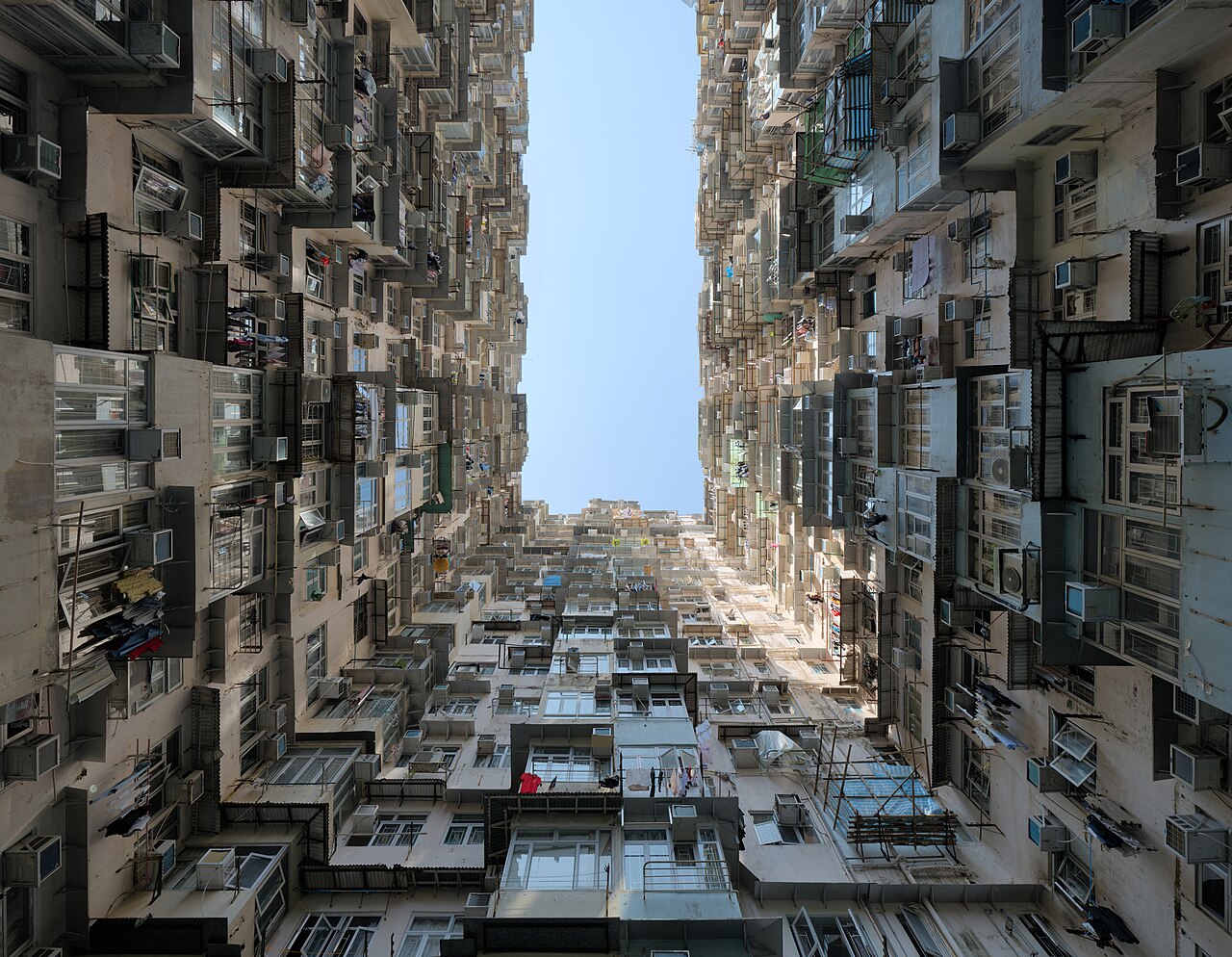
Image: Wikimedia Commons / CC BY-SA 4.0.
Tai O and the outer islands
If Monster Building is the extreme of density, Tai O is its opposite. From Tung Chung Station Exit B, transfer to Bus 11, about 50 minutes to reach this small fishing village on the western tip of Lantau Island, facing the mouth of the Pearl River.
Tai O’s soul is the stilt houses — Hakka fishermen’s homes built directly on wooden piles in the water, one against the next, stretching along the channels. This is a form of dwelling with centuries of history. From the 1900s to the 1950s Tai O was one of Hong Kong’s most important fishing ports, producing shrimp paste and salted fish, with bustling markets. As deep-sea fishing declined and young people moved out, only about 2,000 residents remain today, mostly elderly.
The Hong Kong Tourism Board likes to package Tai O as the “Venice of the East,” but locals never call it that — they just call it Tai O.
Hong Kong film directors discovered the water-vapor light here a long time ago:
- Tsui Hark’s The Magic Crane, The Blade, Green Snake — several waterside scenes were shot here
- Stanley Kwan’s Full Moon in New York — partial scenes
- Chow Yun-fat’s The Adventurers — some sequences
A suggested itinerary for Tai O:
- Arrive 6–8 AM — sea mist hasn’t lifted, stilt houses look like they’re floating in milk
- At the pier, take a HK$25 sampan ride through the channels and out into open water to look for Chinese white dolphins
- At the market, buy a jar of shrimp paste and a bowl of car-jai noodles
- Watch for lineage-shrine deity opera during festivals — one of the last live rural Cantonese opera traditions in Hong Kong
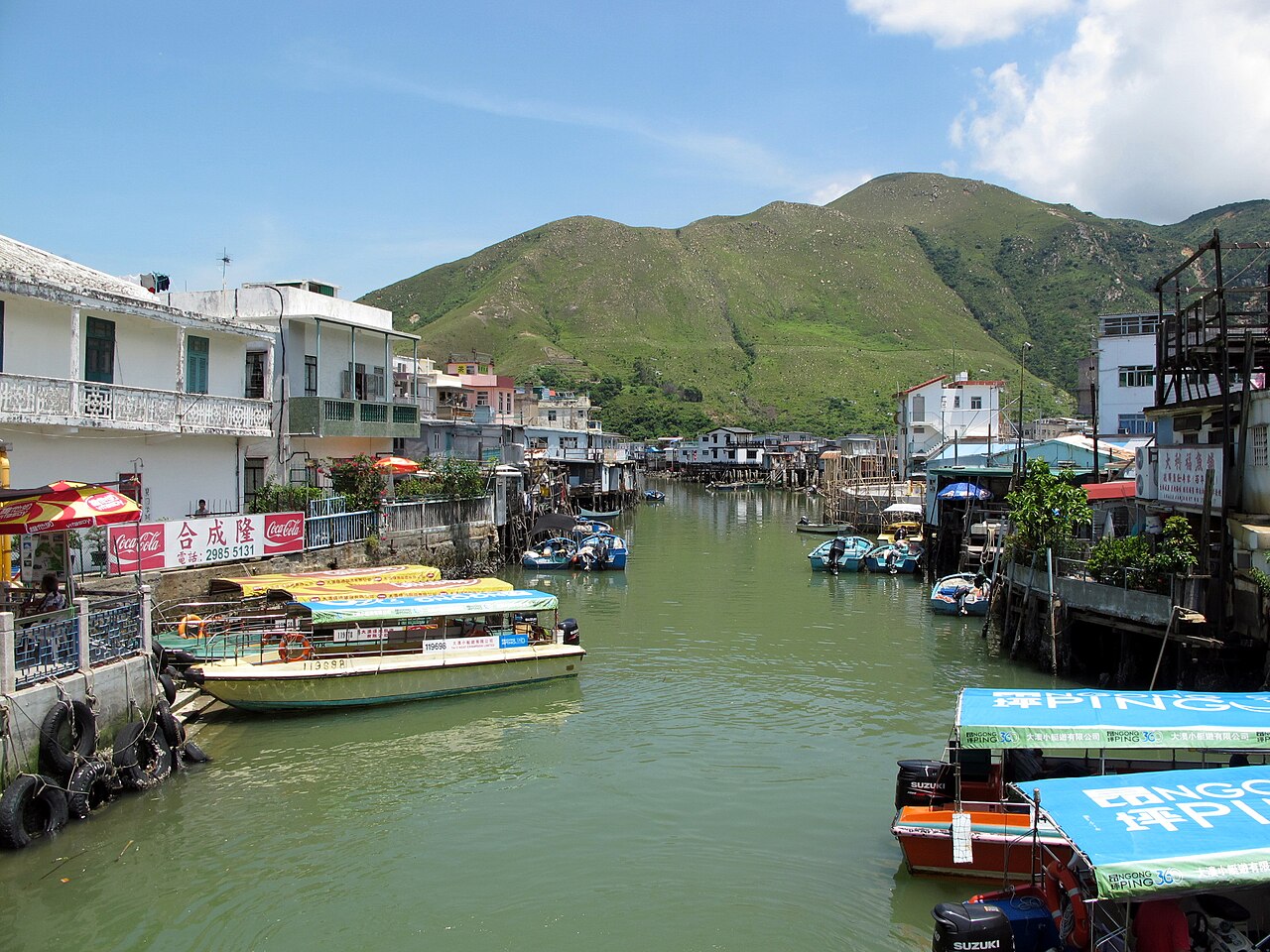
Image: Wikimedia Commons / CC BY-SA 4.0.
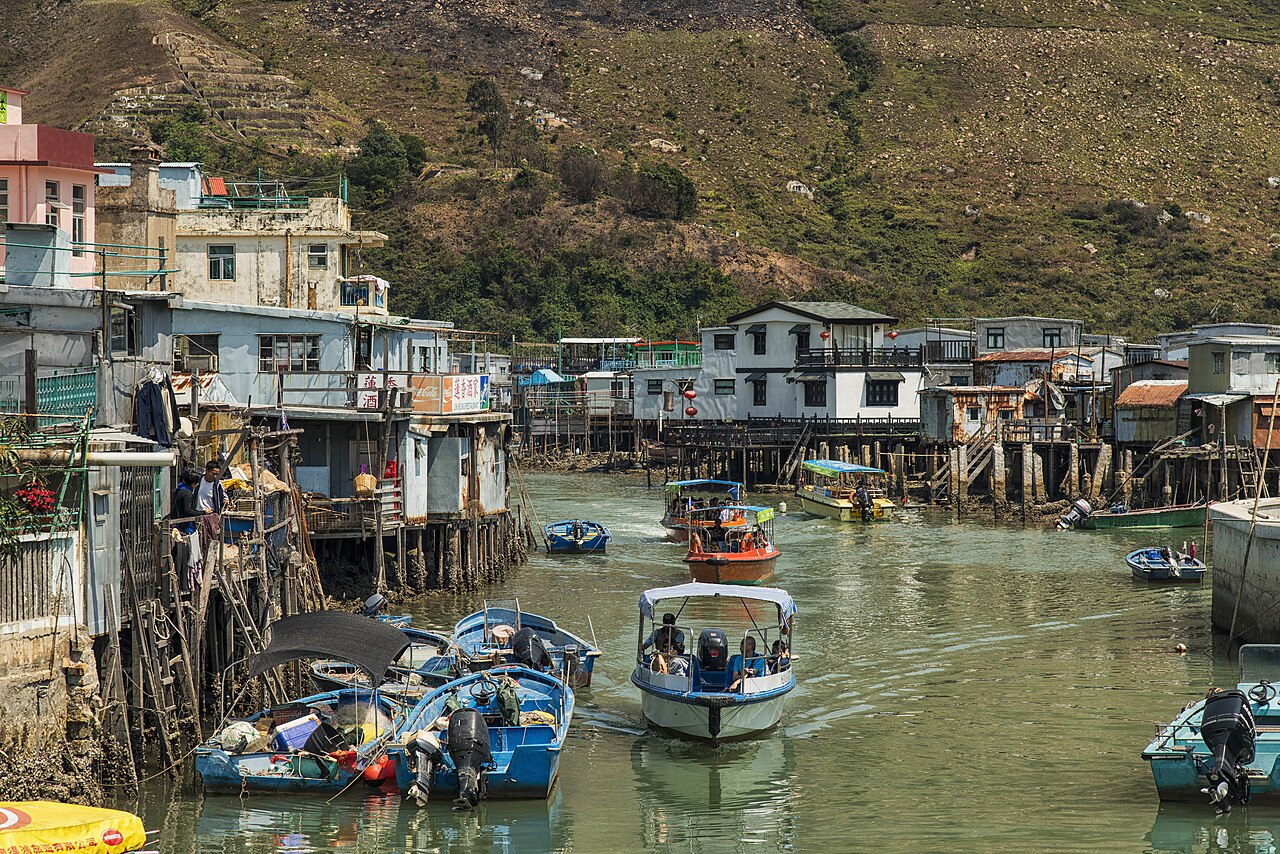
Image: Wikimedia Commons / CC BY-SA 4.0.
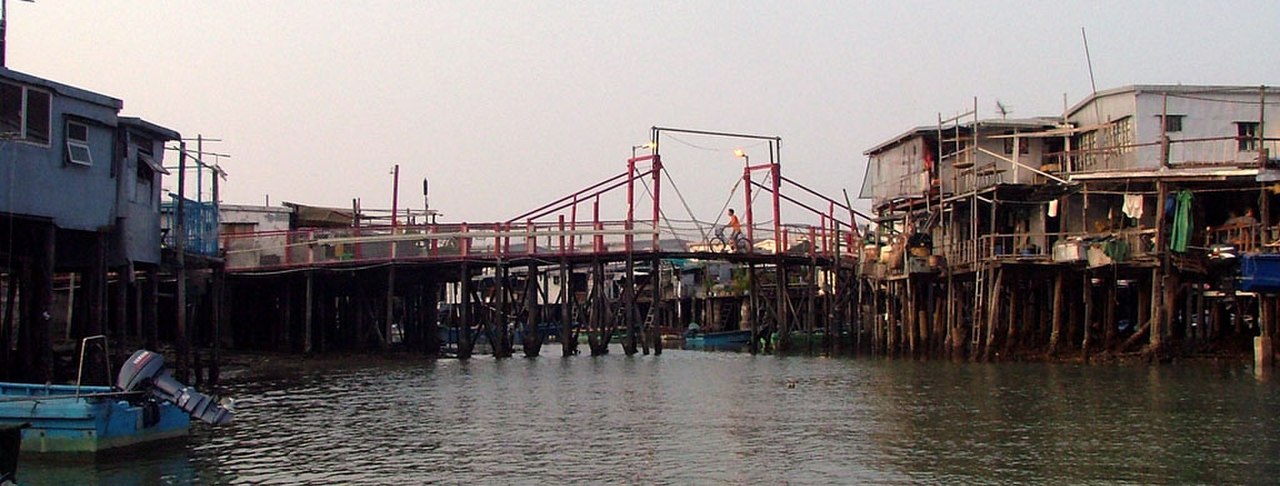
Image: Wikimedia Commons / CC BY-SA 4.0.
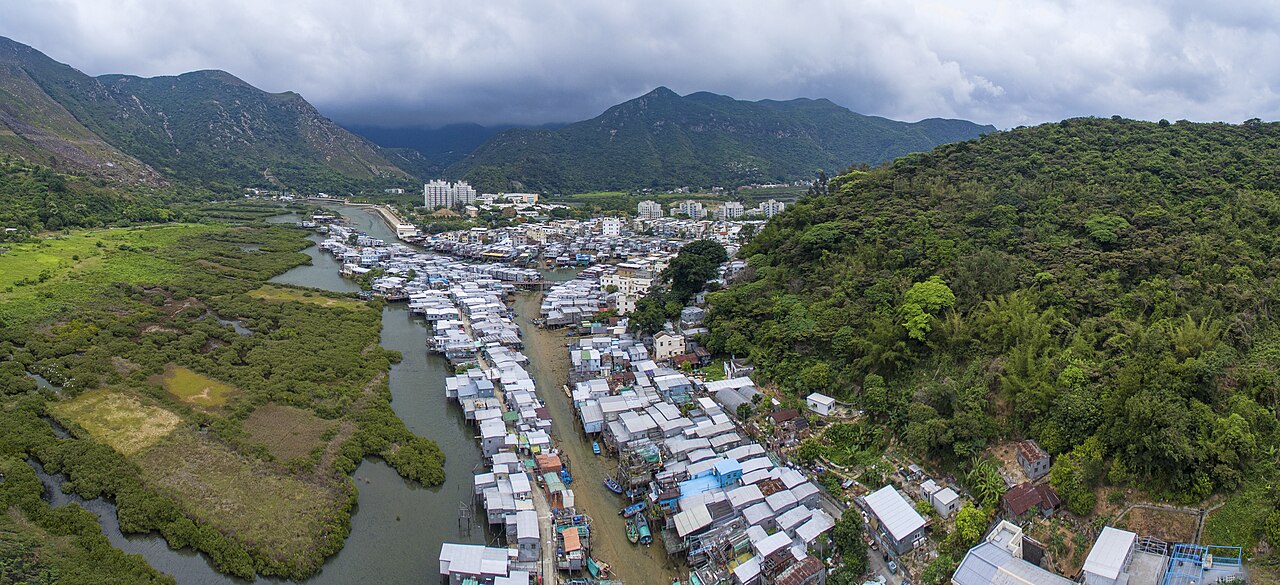
Image: Wikimedia Commons / CC BY-SA 4.0.

Image: Wikimedia Commons / CC BY-SA 4.0.
Two ends of the same looking-logic
Monster Building and Tai O look like two completely different things: one is 1972 modernist vertical housing, the other a centuries-old water-village of wood; one is so dense it suffocates, the other so sparse only the surf remains. But they are actually two ends of the same looking-logic — both have been assigned “iconic” status by outside eyes, both have been repeatedly consumed by film crews, bloggers, and tourists, and the residents have followed the same curve in response: from initial curiosity and openness to today’s vigilance and the installation of barriers.
In the Instagram and Netflix era, Hong Kong is being filtered by a single criterion — be dense enough, or be “primitive” enough, but be photogenic. This is the cost a city of seven million has to bear: you live inside someone else’s postcard.
And as those of us arriving with HK-cinema memories on a pilgrimage, we’re also part of that logic — so please, be quiet about it.
Coda · The Paradox of the Pilgrimage
A pilgrimage has a built-in contradiction. The Hong Kong you came to find is the Hong Kong the movies invented — its tones darker than the real, its neon denser than the real, its rain longer than the real. When you actually step onto the same escalator Faye Wong walked in 1994, it isn’t that poetic: at rush hour someone walks past you eating a pineapple bun, someone is on the phone closing a deal.
But that is the point of the pilgrimage. You don’t come to find the movie; you come to confirm that the movie came from a real place — Wong Kar-wai walked here, Johnnie To walked here, Leslie Cheung had tea here, Wong Ka Kui walked up to that second floor on Tung Choi Street with a guitar on his back, McDull’s imaginary Springfield Flower-Flower sits on some corner of Tai Kok Tsui.
This city has never stopped producing its own mirror image. When you walk these places, you aren’t stepping into a film — you’re opening a hall of mutually reflecting mirrors, and from this moment on, the Hong Kong in the films and the Hong Kong under your feet can never be separated again.
On the day I went home I stood in front of the Mandarin Oriental for a long time. The doorman walked out and asked if I was checking in. I said no, I was just looking. He nodded, didn’t say anything more. Then he turned back into the hotel, and the glass doors reflected the Central streetscape behind me — and in that moment what I saw wasn’t the Central of 2026, it was the Central of 1990, the Central of April 1, 2003, and the Central of 2026 all stacked together on that pane of glass. That’s what this city does. It has never really been in the past.