Descartes · Hume · Nietzsche — Three Demolitions and Rebuildings
The three most important “first demolish, then rebuild” gestures across three hundred years
Reading these three together isn’t because all three appear on philosophy syllabuses. It is because they share the same gesture — first identify a “self-evident,” then carefully take it apart, and then try to build something more stable on top of the debris. The objects of demolition are different, but the relay is clear:
- Descartes (1637–1650) dismantles scholastic authority. Weapon: purposive doubt. What he builds: the method of reason + mind–body dualism + analytic geometry.
- Hume (1739–1751) dismantles the scaffolding Descartes built — Is “I think” stable enough? Does the ontological proof of God survive the razor of impressions? Weapon: the empiricist copy principle. What he builds: temperate skepticism + a naturalism of mind.
- Nietzsche (1883–1888) dismantles the whole language of morality itself — no longer asking “what is good,” but asking “how did this word ‘good’ end up looking the way it does today?” Weapon: genealogy. What he builds: revaluation of values + the overman as a direction.
All three have been misread in the same way: only the half that demolishes is seen, while the half that rebuilds is missed. Descartes gets read as “the cold-blooded mechanist,” Hume as “a nihilist,” Nietzsche as “a proto-fascist” — all three labels mistake “first, demolish” for the destination.
Descartes · Doubt as Method — 1637–1650
In 1637 Descartes wrote the Discourse on Method in French rather than Latin, announcing a new beginning: philosophy would no longer lean on scholastic commentary, but would proceed from an “I” capable of thinking on its own, reviewing every belief in the same order as geometry. This is not so much a knowledge position as a stance — bracket everything doubtful, see what is left that cannot be doubted, then from there, build, step by step, the entire scaffolding of modern knowledge.
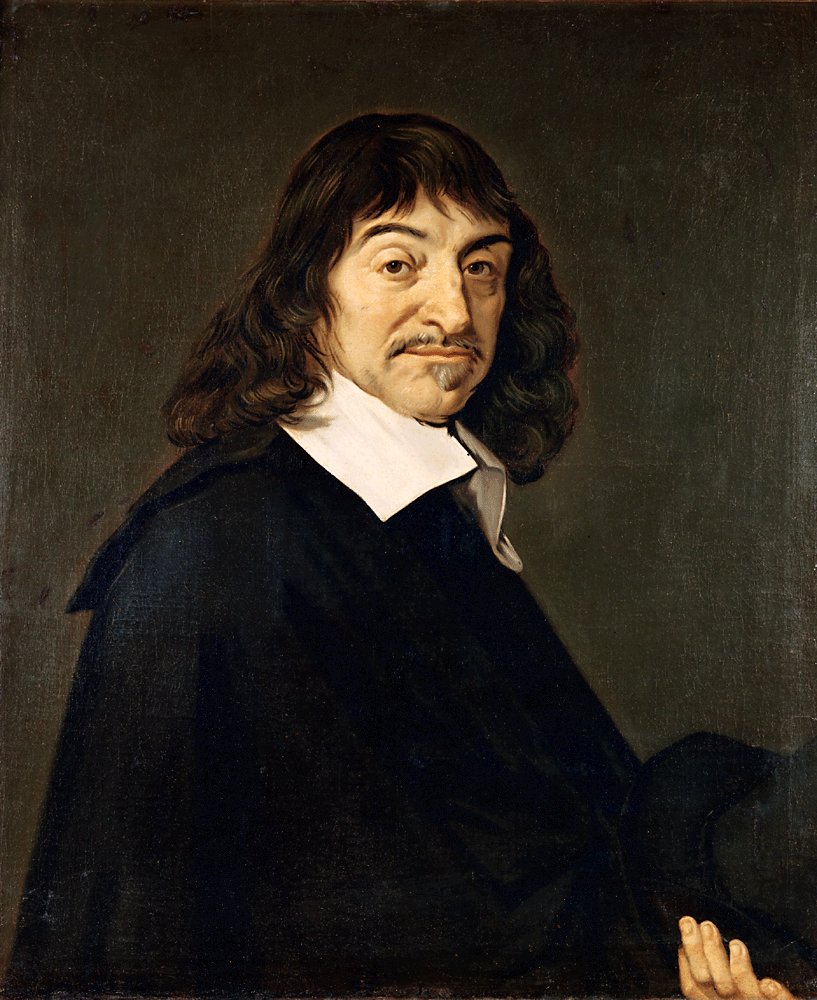
Image: Wikimedia Commons / Public Domain.
The Method of Doubt ≠ Skepticism
This is not a skeptical position but a one-off engineering project. Descartes requires himself to provisionally suspend every belief that has “even the slightest reason to be doubtful” — sensory, memorial, mathematical; even “I am right now awake” goes under the brackets. The goal is to see what is still standing after this carpet-bombing of doubt. Its complement is “certain rebuilding” — once the demolition is over, the structure has to be put back up, or the doubt itself has failed.
Cogito Ergo Sum
The Second Meditation: even if a most powerful “evil demon” deceives me about everything in the world — it still cannot make the “I” who is being deceived not exist, because “being deceived” presupposes an I that is. The Cogito is not a syllogism that infers “exist” from “think”; it is an act that cannot be denied at the moment of its execution.
Mind–Body Dualism
Mind is a “thinking thing” (res cogitans), whose essence is thought, unextended, indivisible. Body is an “extended thing” (res extensa), whose essence is extension, describable by geometry. The radical separation of the two substances opens every subsequent problem in modern philosophy of mind — interactionism, parallelism, epiphenomenalism, contemporary physicalism — all written in the aftershocks of that fissure. That fissure will be re-opened, in the gentlest possible way, by Hume.
Analytic Geometry · A Working Specimen of Mathesis Universalis
The 1637 Geometry translates geometric figures into algebraic equations and algebraic operations into geometric constructions — a plane curve is no longer a traced shape but the solution set of a two-variable equation. Two disciplines that had never communicated are stitched together on a single coordinate sheet. For philosophy this matters more than its technical content: it proves that “universal mathematics” (mathesis universalis) is feasible — any object with clear structure can be reduced to relations and orderings and handled by the same method. The subsequent scientific revolution follows precisely this path.
CASE · Death in Stockholm — Thought Meets Body
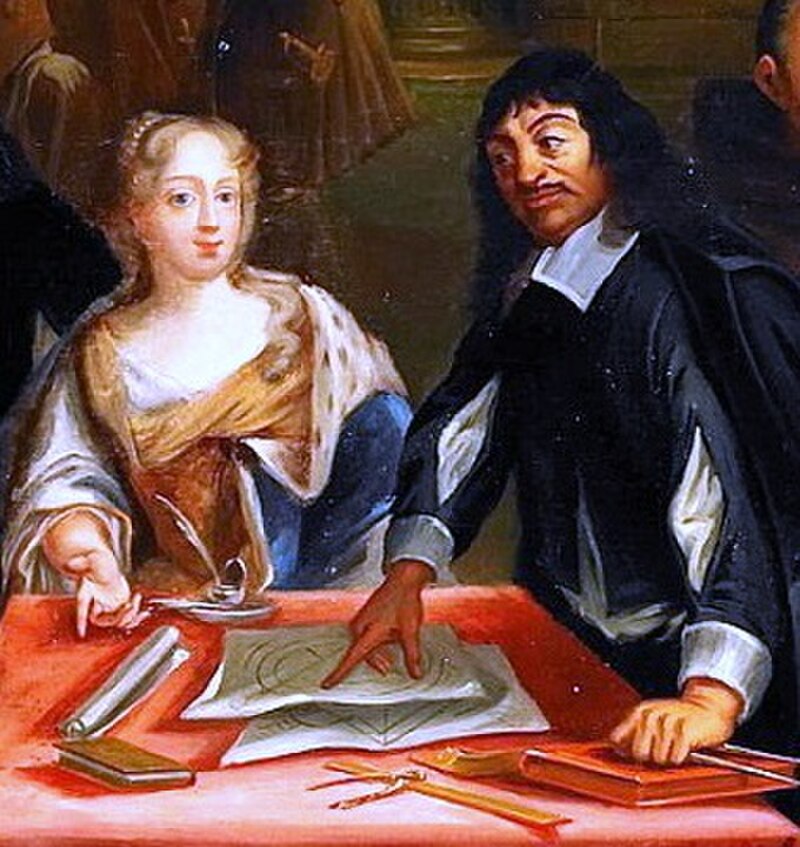
In autumn 1649 Queen Christina of Sweden — a twenty-two-year-old sovereign who had read all of Plato and Seneca — dispatched a warship to bring Descartes to Stockholm. She wanted private philosophy lessons, scheduled three mornings a week at five o’clock in the unheated castle library.
For a man used to sleeping until eleven in the Dutch countryside before turning to thought, this was a physical torture. In late January 1650 he caught pneumonia on the way to court; at four in the morning on February 11 he died in the queen’s palace. A few days before, he said to the French ambassador at his bedside: “Now, my soul, it is time to depart.”
This is the most ironic causal chain in the history of philosophy: the man who most strictly separated mind from body died of body — of northern winter, of rising too early, of inflammation of the lungs. The interactionist problem he tried, his whole life, to dodge, was written out by his own death.
Link to the next section · Descartes’ scaffolding will not survive ninety years of wind.
After the radical separation of mind and body, “body” can be handled with geometry; “mind” is held together by the Cogito and God — the system looks stable in 1641. But by 1739 a twenty-eight-year-old Scot will pick up the razor of impressions and ask: I have no impression of this “God” you speak of, and looking inward I find only a bundle of perceptions where the “I” should be, and “clear and distinct” fails on both cause and induction — what is left?
Hume · Experience as Limit — 1739–1751
In 1739, in the preface to A Treatise of Human Nature, the twenty-eight-year-old David Hume sets himself an ambition: become the “Newton of the mind” — apply the same dispassionate empirical observation to thought itself. He doesn’t start from Descartes’ “I think therefore I am” or “God”; he starts from the more austere fact that the mind contains only impressions and ideas, and everything else has to account for itself.
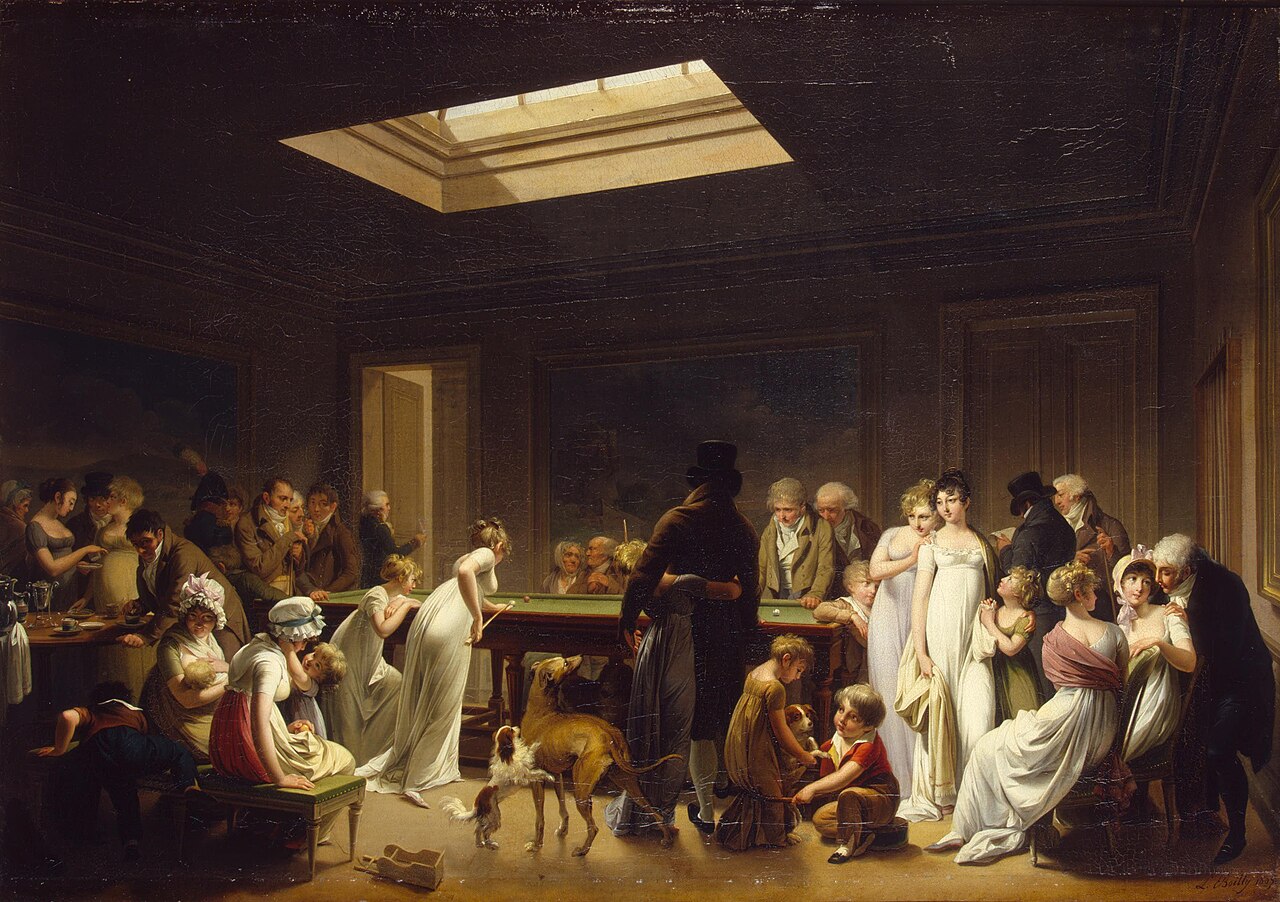
Image: Wikimedia Commons.
Impressions and Ideas + the Copy Principle
Hume partitions all mental contents into two kinds: impressions — direct, vivid, intense feelings: seeing, hearing, pain, love; and ideas — pale copies of impressions: memory, imagination, concept. “All our simple ideas in their first appearance are derived from simple impressions” — this is the founding proposition of Treatise 1.1, which Hume calls “the first principle of my whole philosophy.”
It hands him a fearsome razor: any “concept” without a corresponding impression has to account for its origin — “substance,” “necessary connection,” “soul” first in line. This goes straight for the load-bearing pillars of Descartes’ scaffolding.
Causation Is Habit, Not Necessity
You see one billiard ball strike another; the second one moves. Common sense immediately says, “the first caused the second to move.” Hume asks: what exactly did you see? Two events — first the collision, then the motion. Beyond that, “caused to move,” “necessary connection,” “force” — no sensory impression corresponds to any of them.
So he gives “causation” a definition that is austere to the point of being rude: constant conjunction + mental habit. A lifetime of observing collisions followed by motion makes us, when the next collision occurs, expect the motion almost without thought — not by inference but by reflex. The word “necessity” lives nowhere out in the world; it lives in the head.
Induction Has No Rational Ground
The sun has risen ten thousand times. Can you “prove” from that fact that it will rise tomorrow? The answer Hume gives in §4 of the Enquiry has kept English-language philosophy busy for three centuries: no.
To move from “thus far so” to “thus also will be,” you must first concede a premise — “the future will resemble the past” (the uniformity of nature). But that premise itself can only come from experience, and you are in a circle. Reason is stuck, but life isn’t — “It is custom, not reason, that lets us go on facing the future.”
The “Self” Is a Bundle of Perceptions
Looking inward never catches an independent “I”; only a string of particular perceptions. The self is the unity that appears when these perceptions succeed each other extremely fast — the bundle theory. This goes straight for Descartes’ Cogito — the “thinking substance” that supposedly sits behind every perception, I have never glimpsed.
Is and Ought
From a series of descriptive “is” claims you cannot derive a normative “ought” without smuggling in a new premise. Hume’s guillotine is not meant to abolish morality — it is meant to demand that moral argument disclose its non-descriptive source — usually called sentiment. Nietzsche will pick up this knife 150 years later and cut deeper.
Link to the next section · Hume’s skepticism is gentle but thorough.
Hume is no nihilist. At the end of the Enquiry he writes plainly: extreme skepticism cannot survive once you leave the study — because nature requires that I eat, love, and do business. His skepticism is always mitigated, bounded; its aim is to return philosophy to a human scale, not to abandon judgment. Kant said Hume awoke him “from dogmatic slumber” — but it is also from Kant on that German philosophy launches a counter-attack to win some dignity back for reason. A century and a half later, Nietzsche arrives with a hammer and treats even that counter-attack as a symptom of “slave morality.”
Nietzsche · Genealogy as Revaluation — 1883–1888
Hume tore down “the ultimate metaphysical explanation”; Nietzsche tears down one layer deeper — the neutrality of moral language. He intends to show that morality is not a neutral dictionary handed down from the sky but a text written by historical winners.
Image: Wikimedia Commons.
In 1887, in the preface to On the Genealogy of Morality, Nietzsche writes: “We are unknown to ourselves, we knowers.” He shifts the gaze from “what is good” to “how did this word ‘good’ come to look the way it does.” This is archeology: every morality is an amulet that some kind of human cast for itself in order to survive. The question is not whether to obey it, but what kind of life it serves.
Etymology as Archeology
The evolution of “gut” (good), “schlecht” (bad), and “böse” (evil) in European languages is itself a history of the spirit. “Good” at first meant “noble,” “strong”; “evil” was originally a derivative concept used by aristocrats to designate the powerless. Studying ethics without philology is like doing geology without looking at strata.
Master Morality vs Slave Morality
- Master morality is forged by the strong from their own surplus: its core is “I can, I will, I give.” Its virtues: courage, generosity, pride, saying “yes” to oneself.
- Slave morality is forged by the oppressed from their own incapacity: its core is “He ought not to be like that.” It must first negate the strong in order to define itself as good. Its virtues: humility, meekness, patience, pity, purity — all the words that rename “incapacity” as “virtue.”
Ressentiment
Not ordinary anger — anger can erupt and dissipate. Ressentiment is the suppressed, internalized, creative hatred: it re-evaluates the unreachable target in the spirit first, until revenge becomes “deserved justice.” Ressentiment is the engine of slave morality, and the part it is most apt to hide from itself.
Revaluation of Values ≠ Destruction of Morality
Nietzsche’s program is not “to destroy morality” but to make morality askable: behind every “ought,” which form of life is in play? Who benefits from this “ought,” who is domesticated by it? What emerges after revaluation is not necessarily amorality — it may be a more honest new morality — but first you have to dare to take down the inherited tablets and weigh them.
(Note the shadow of Hume here: he demanded that “ought” disclose a non-descriptive source. Nietzsche takes the knife further. He does not stop at the mild answer “the source is sentiment” — he keeps asking: whose form-of-life sentiment? Why this one?)
Death of God + Eternal Recurrence + Übermensch
Three terms routinely misread:
- Death of God is not the slogan of atheism but a diagnosis: European culture has, in fact, stopped letting God serve as the final guarantor of value, while it has not yet realized this. The remaining choices are two — retreat into the “last man” (the comfortable, numbed bourgeois of small contentments), or shoulder the dreadful freedom of revaluating values.
- Eternal recurrence is a thought experiment: would you live this life — every second, including every shame — infinitely many times over? It is the extreme test of whether one truly affirms life.
- Übermensch is not a sturdier race of humans, but a person who has climbed up out of the well of slave morality and can legislate for himself. The overman is not a destination but a direction; he is the far end of the line, “Man is a bridge, not an end.”
CASE · Crucifixion — the Triumph of Slave Morality
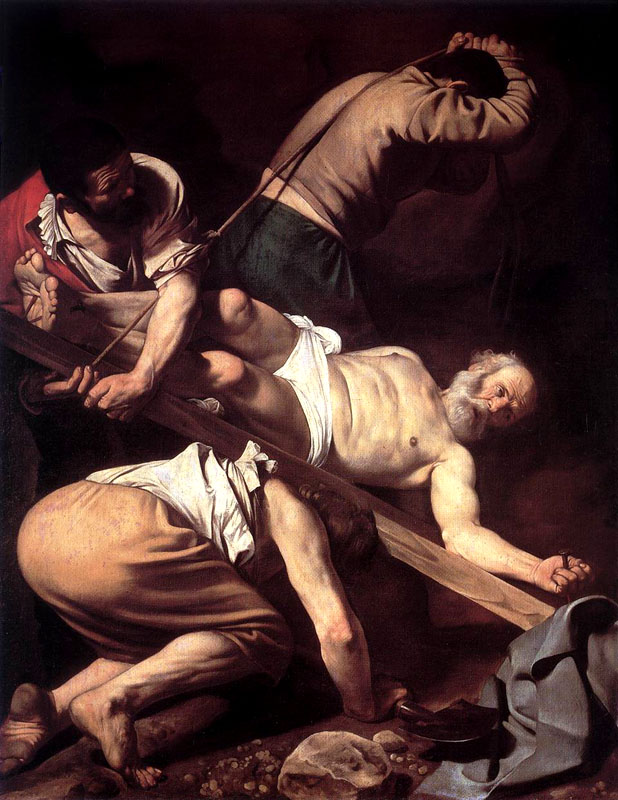
Nietzsche’s most dramatic scene is the “transvaluation” (Umwertung) launched by the oppressed. Unable to resist Rome, the Jews and early Christians renamed every reluctant feature of their condition — weakness, passivity, poverty, patience, suffering — as virtue: “Blessed are the meek, for they shall inherit the earth.”
So arose the deepest semantic event in human history: properties despised by aristocrats become “good,” properties praised by aristocrats (strength, pride, joy, the power of revenge) become “evil.” Crucifixion — the most degrading punishment reserved for slaves and rebels — was inverted into an image of redemption, suffering itself became holy.
Nietzsche is both awed and wary. Awed: it is the most spectacular revenge of the weak on the strong, a spiritual battle two thousand years long. Wary: when suffering, self-abasement, and idle kindness are universalized as the standard of “being human,” the entire civilization begins training a personality type afraid of life itself.
Closing Irony · the text once it leaves the author.
In January 1889 Nietzsche embraced a beaten horse on a street in Turin, broke down weeping, and never wrote another word. He spent his last eleven years entirely without speech, cared for by his sister Elisabeth Förster-Nietzsche — an anti-Semite. She took control of the literary remains, assembled the “will to power” notebooks into the politics she wanted, hosted Hitler enthusiastically in the 1930s, and presented Nietzsche’s walking stick to the Führer. A man who wrote in private notebooks that he was “against every herd instinct, against every nationalism, against every anti-Semitism” was, by his closest kin, rewritten into a spiritual source of fascism. The case proves his own proposition: once a text leaves its author, it becomes spoils written by the victors. Walter Kaufmann’s 1950 English translation/rereading was the watershed that rescued him from the Nazi label.
All Three on One Line — relay of doubt
Place the demolitions on a single line of increasing precision and increasing radius:
- Descartes dismantles the authority of epistemology (scholasticism + faith) and builds back, with “I think” + God + clear and distinct ideas, a rationalist scaffolding.
- Hume dismantles the scaffolding Descartes built — the “I think” becomes a bundle of perceptions, the proof of God fails the impressions razor, “clear and distinct” fails on cause and induction — yet he does not march into nihilism but returns philosophy to a human scale, conceding that the true ground of knowledge is habit, not logic.
- Nietzsche dismantles the whole language of morality — no longer asking “what is good,” but “how did this word ‘good’ come to look the way it does today” — and again does not march into amorality, but demands a more honest new morality that dares to assume a direction.
There is a subterranean line as well — the view of the “self”. Descartes makes the “I” the pivot of the whole system (Cogito); Hume dissolves it into a bundle of perceptions while leaving “narrative coherence” intact as a workaday self; Nietzsche pushes it to the extreme — “Become who you are” — where “who you are” is not some given core, but the string of acts and fates you are willing to affirm, over and over again.
What this three-hundred-year relay leaves us is not a final conclusion but a stance under constant practice: for every “self-evident,” first ask its provenance; for every label passively accepted, first ask who benefits. That stance, outside the philosophy classroom, is the tool anyone who wishes to keep their own head will reach for, again and again.
Reading Order — a tight reading order
If you have limited time, pick one entry-level and one core book per philosopher:
Descartes
- Entry · Discourse on Method (1637) — short, autobiographical, in French rather than Latin. The easiest way into Descartes’ own voice.
- Core · Meditations on First Philosophy (1641) — six meditations, the skeleton of the entire system. Read together with the Objections and Replies (Hobbes, Arnauld, Gassendi and others) at the back of the volume; the dialogical feel is far richer than the meditations alone.
- Late · The Passions of the Soul (1649) — the fruit of his correspondence with Princess Elisabeth, his most candid concession on the dualism problem.
Hume
- Entry · An Enquiry concerning Human Understanding (1748) — a streamlined version; Sections 4–7 distill the core arguments on induction and causation; the safest single Hume book to start with.
- Core · Treatise of Human Nature, Book 1 “Of the Understanding” (1739) — impressions/ideas, causation, induction, the self are all here. Hardest, but the key arguments live here.
- Ethics · An Enquiry concerning the Principles of Morals (1751) — he considered it “incomparably the best, all things considered, of anything I ever wrote.”
Nietzsche
- Entry · On the Genealogy of Morality (1887) — three essays, the clearest structure; the key to the entire ethical critique.
- Core · Beyond Good and Evil (1886) — 296 aphorisms covering religion, free will, women, the future of Europe.
- Late Daggers · Twilight of the Idols, The Antichrist, Ecce Homo (1888) — fastest tempo, most aggressive; to be read but with care, he is moving toward collapse in this year.
Secondary
- Bernard Williams, Descartes: The Project of Pure Enquiry
- Barry Stroud, Hume
- Walter Kaufmann, Nietzsche: Philosopher, Psychologist, Antichrist (1950) — the watershed that rescued Nietzsche from the Nazi label; all subsequent serious Nietzsche studies build on it
- Brian Leiter, Nietzsche on Morality
- Lisa Shapiro (ed.), The Correspondence between Princess Elisabeth and Descartes
References — SEP · Original Sources · Secondary Studies
Descartes
- René Descartes · Stanford Encyclopedia of Philosophy. plato.stanford.edu
- Descartes’ Epistemology · SEP — doubt, cogito, clear and distinct ideas. plato.stanford.edu
- Descartes’ Method · SEP — methodology and the structure of first philosophy. plato.stanford.edu
- Bernard Williams, “Descartes — The Project of Pure Enquiry” (Routledge) — one of the most-cited Descartes studies of the twentieth century. routledge.com
Hume
- David Hume · Stanford Encyclopedia of Philosophy. plato.stanford.edu
- A Treatise of Human Nature · Wikipedia overview. en.wikipedia.org
- davidhume.org — Hume’s primary texts online (Treatise, Enquiry concerning Human Understanding, and others). davidhume.org
Nietzsche
- Friedrich Nietzsche · Stanford Encyclopedia of Philosophy. plato.stanford.edu
- On the Genealogy of Morals (Kaufmann translation) · Penguin Random House. penguinrandomhouse.com
- Walter Kaufmann, “Nietzsche: Philosopher, Psychologist, Antichrist” — the classic English-language introduction to Nietzsche. en.wikipedia.org
- The Birth of Tragedy · Wikipedia overview. en.wikipedia.org
- Apollonian and Dionysian · Wikipedia — the Apollo / Dionysus duality. en.wikipedia.org